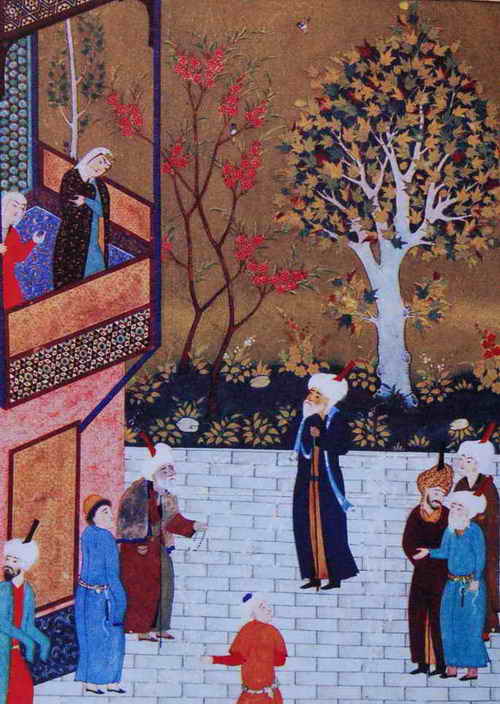
A beautiful recording of Ibn ‘Arabi’s poetry sung in a ḥaḍrah:
Translation:
Poem 1:
Who will show me her of the dyed fingers? Who will show me her of the honeyed tongue?
She is one of the girls with swelling breasts who guard their honour, tender, virgin, and beautiful
Full moons over branches: they fear no waning
In a garden of my body’s country is a dove perched on a bough
Dying of desire, melting with passion, because that which befell me hath befallen her
Mourning for a mate, blaming Time, who shot her unerringly, as he shot me
Parted from a neighbor and far from home! Alas, in my time of severance, for my time of union!
Who will bring me her who is pleased with my torment? I am helpless because of that with which she is pleased.
Poem 2:
When she looks, she gazes with the deep eye of a young gazelle: to her eye belongs the blackness of antimony
Her eyes are adorned with languor and deadly magic, her sides are bound with wonder and incomparable beauty
A slender one, she loves not that which I love, and she does not fulfill her promises with sincerity
She let down her braid like a black serpent, to frighten her followers
By God, I fear not death, my only fear is that I shall die and not see her tomorrow.
Poem 3:
Between ‘Adhriyat and Buṣra, a maid of fourteen rose in my sight like the full moon
She was exalted in majesty above time and transcended it in pride and glory
Every full moon, when it reaches perfection, suffers a waning that it may make a complete month,
Except this one: for she does not move through the zodiac signs, nor double what is single
You are a container holding fragrant perfumes, you are a meadow of spring herbs and flowers
Beauty has reached it utmost limit in you, another like you is outside the realm of possibility.
From R.A. Nicholson’s translation of Tarjuman al-ashwaq
Original:
1 قصيدة
من لي بمخضوبة البنان
من لي بمعسولة اللسان
من كاعبات ذوات خدر
نواعم خرد حسان
بدور تم على غصون
هن من النقص في امان
بروضة من ديار جسمي
حمامة فوق غصن بان
تموت شوقا تذوب عشقا
لما دهاها الذي دهاني
قصيدة 2
ترنو اذا لحظت بمقلة شادن
يعزى لمقتها سواد الاثمد
بالغنج والسحر القتول مكحل
بالتيه والحسن البديع مقلد
هيفاء ما تهوى الذي اهوى ولا
تف للذي وعدت بصدق الموعد
سحيت غديرتها شجاعا اسودا
لتخيف من يقفو بذاك الاسود
والله ما خفت المنون وانما
خوفي اموت فلا اراها في غد
قصيدة 3
طلعت بين اذرعات وبصري
بنت عشر واربع لي بدرا
قد تعالت على الزمان جلالا
وتسامت عليه فخرا وكبرا
كل بدر اذا تناهى كمالا
جاءه نقصه ليكمل شهرا
غير هذي فما لها حركات
في بروج فما تشفع وترا
حقه اودعت عبيرا ونشرا
روضة انبتت ربيعا وزهرا
انتهى الحسن فيك اقصى مداه
ما بوسع الامكان مثلك اخرى
Some of the finest recordings of Ḥaḍrah music I’ve found online are these recordings of a Boutchichi gathering in which they sing a poem by Shaykh ‘abd al-Raḥman Shaghouri :
Translation:
The Saqi approahced us
and presented the cup to us
So we sipped and quenched our thirst
from the cups of Hamza (al-Hashim in the original poem)
He shouted and took lives as spoils of war
how many corpses has he brought back to life!
Far be it from him that he disappoint at all
whosoever comes with sincerity of intention
Empty your heart for the divine disclosure (tajallī)
and clear your eyes to see fully
And empty yourself of otherness, o friend
and annihilate yourself in the exalted Essence
Drink from the cup openly
and don’t see any shame in drinking
Go mad with love’s thirst and cast off all restraint
in the most holy meanings
Strive in your journey through the waystations
and follow the way of the ancients
Don’t pay any attention to what the blamers say
listening to them is a trial
Translation:
O joy of my heart and eyes
O my life after death
after my unification and separation
God returned us to God
Live happy o my heart
and fulfill your desire
This is not by my own effort
but only by the grace of God
Everything that is in life is good
there is nothing in it that does not change
Throw away shifting fantasies
you’ll see all is from God
Then we truly see the Real/Truth
and sincerely find sincerity
We will see neither east nor west
apart from Him while God is our sufficiency
Chorus: O the fortunate of the folk, by God they have succeeded
and they don’t see amongst mankind, other than Him
He draws them near to himself and choses them for himself
and they make their meditation transcendent in His exaltedness
I am not a believer in the mosques, nor do I follow the rites of unbelief. I am not among the pure or polluted. I am neither Moses nor Pharoah.
I am not in the Vedas or in the scriptures; I am neither in drugs nor alcohol. I am not among the drunks, neither in waking nor sleeping.
I am not in joy or sadness, neither pollution nor purity. I am not of water or of earth, nor am I of fire or air.
I am not an Arab nor from Lahore, nor an Indian from Nagaur. I am neither Hindu nor a Turk form Peshawar. Nor do I live in Nadaun.
I have not discovered the secret of religion; nor am I born of Adam and Eve. I have not given myself a name, nor am I found sitting still or moving around.
I know I am the First, I know I am Last, I do not recognize anyone else. None is wiser than I. Bulleh, who is the Lord standing here?
Original:
بلھا کی جاناں میں کون
نہ میں مومن وچ مسیت آں
نہ میں وچ کفر دی ریت آں
نہ میں پاکاں وچ پلیت آں
نہ میں موسٰی، نہ فرعون
بلھا کی جاناں میں کون
نہ میں اندر بید کتاباں
نہ وچ بھنگاں، نہ شراباں
نہ رہنا وچ خراباں
نہ وچ جاگن، نہ سون
بلھا کی جاناں میں کون
نہ وچ شادی نہ غمناکی
نہ میں وچ پلیتی پاکی
نہ میں آبی نہ میں خاکی
نہ میں آتش نہ میں پون
بلھا کی جاناں میں کون
نہ میں عربی، نہ لاہوری
نہ میں ہندی شہر رنگوری
نہ ہندو نہ ترک پشوری
نہ میں رہنا وچ ندون
بلھا کی جاناں میں کون
نہ میں بھیت مذہب دا پایاں
نہ میں آدم حوا جایا
نہ میں اپنا نام دھرایا
نہ وچ بھٹن، نہ وچ بھون
بلھا کی جاناں میں کون
اول آخر آپ نوں جاناں
نہ کوئی دوجا پچھاناں
میتھوں ہور نہ کوئی سیانا
بلھا! او کھڑا ہے کون؟
بلھا کی جاناں میں کون
pseudo-Rumi
What is to be done, O Muslims? for I do not know myself.
I am neither Christian, nor Jew, nor Magian, nor Muslim.
I am not of the East, nor of the West, nor of the land, nor of the sea;
I am not of Nature’s quarry, nor of the heaven circling above.
I am not made of earth, nor of water, nor of wind, nor fire;
nor of the Divine Throne, nor the carpet, nor the cosmos, nor mineral.
I am not from India, nor China, nor Bulgaria, nor Turkestan;
I am not from the kingdom of the two Iraqs, nor from the earth of Khurasan.
Neither of this world, nor the next, I am, nor of Heaven, nor of Hell;
Nor from Adam, nor from Eve, nor from Eden nor Rizwan.
My place is the Placeless, my trace is the Traceless;
‘Tis neither body nor soul, for I myself am the Beloved.
I have cast aside duality, I have seen the two worlds as one;
One I seek, One I know, One I see, One I say.
He is the First, He is the Last, He is the Outward, He is the Inward;
I know no one other than He, none but he who is He
Drunk with Love’s cup, the two worlds have been lost to me;
I have no business save carouse and revelry.
If once in my life I spent a moment without you,
From that time and from that hour I repent of my life.
If once in this retreat I win a moment with you,
I will trample on both worlds, and dance in ecstasy
O Shams of Tabriz, I am so drunk in this world,
That except for drunkenness and revelry, I have no tale to tell.
Original:
چه تدبیر ای مسلمانان که من خود را نمیدانم
نه ترسا و یهودیم نه گبرم نه مسلمانم
نه شرقیم نه غربیم نه بریم نه بحریم
نه ارکان طبیعیم نه از افلاک گردانم
نه از خاکم نه از بادم نه از ابم نه از اتش
نه از عرشم نه از فرشم نه از کونم نه از کانم
نه از دنیی نه از عقبی نه از جنت نه از دوزخ
نه از ادم نه از حوا نه از فردوس رضوانم
مکانم لا مکان باشد نشانم بی نشان باشد
نه تن باشد نه جان باشد که من از جان جانانم
دویی از خود بیرون کردم یکی دیدم دو عالم را
یکی جویم یکی گویم یکی دانم یکی خوانم
ز جام عشق سرمستم دو عالم رفت از دستم
بجز رندی و قلاشی نباشد هیچ سامانم
اگر در عمر خود روزی دمی بی او بر اوردم
از ان وقت و از ان ساعت ز عمر خود پشیمانم
الا ای شمس تبریزی چنان مستم در ین عالم
که جز مستی و قلاشی نباشد هیچ درمانم
Shushtari
After extinction I came out, and I
Eternal now am, though not as I
And who am I, O I, but I?
خرجت في حين بعد الفنا
ومن هنا بقيت بلا أنا
ومن أنا يا أنا إلا أنا
(Abul-l-Hassan ash-Shushtari of Andalusia; trans.by Martin Lings)
‘Sufi Poems: A Mediaeval Anthology’ by Martin Lings
Two gardenias for you;
With them I wish to say:
I love you, I adore you, my love.
Place all your attention on them,
because they are your heart
and mine.
Two gardenias for you
that will have all the warmth
of a kiss.
Of those kisses that I gave you
and that you shall never find
in the warmth of another love.
Beside you they will live
and they will talk to you
as when you are with me.
And you will even believe
that they say to you: “I love you.”
But if one evening,
my love’s gardenias
should happen to die
it’s because they have discovered
that you have betrayed me
because there is another love.
The following verse of the Qur’an has inspired Islamic architecture and literature, illustrating the prominent symbols of the mirror and the perspective shift.
Qur’an 27:44 Pickthall translation:
It was said unto her : Enter the hall. And when she saw it she deemed it a pool and bared her legs. (Solomon) said: Lo! it is a hall, made smooth, of glass. She said: My Lord! Lo! I have wronged myself, and I surrender with Solomon unto Allah, the Lord of the Worlds.
And since she, or Bilqîs, said in answer to the question concerning her throne, which was, “Is thy throne like this? (Quran XXVII, 42), “It seems the same” (XXVII, 42), one can detect her knowledge of the renewal of creation at each instant, for she said, “It seems”. And he showed her the pavillion of crystal, so she supposed it was like a spreading water “and she bared her legs” (Quran XXVII, 44) so the water would not touch her clothing. But it was not a spreading water in reality, just as the visible throne brought into existence before Solomon was not the same throne which she left in Sheba in respect of its form, for it had discarded the first form and assumed another, while the substance, upon which the two thrones imposed successively their forms, was one. So he showed her by that that the state of her throne was like that of the pavillion: as for the throne, because it was deprived of existence, and what the Creator created was similar to that which had vanished; and as for the pavillion, because in its extreme delicacy and limpidity it became similar to clear water, while (in reality) it was different. So he showed her with his actions that she was right in her words, “It seems the same.”
-Ibn ‘Arabi Naqsh al-Fusūs trans. by William Chittick
Original
Solomon’s Pool
When you looked at my polished heart’s shine
you just saw your own reflected in mine
And baring your legs, you hiked up your soul
to wade in my water, so clear and so cold
But I’m too jealous to let you baptize
your body in anything else but my eyes
So you’ll walk on water, just like the Messiah
and dance across skies, like sunset’s smooth fires
You sounded the depths, and to your surprise
found it but a trick to uncover your thighs
The clothes that you bought, all the things that you thought
in my mirror’s undertow, are all swept aside
And so now you walk with my heart underfoot
we’re all alone, lift your head up love and look
Let me lift off that veil, since it’s just you and I
Neither space nor air is the Reality;
Neither earth nor fire is the Reality.
If there’s only the limitless One, all is Shiva.
Which, then is the cloud, and which is the rain?
Original:
गगनं पवनो न हि सत्यमिति
धरणी दहनो न हि सत्यमिति ।
यदि चैकनिरन्तरसर्वशिवं
जलदश्च कथं सलिलं च कथम्
Avadhuta Gita
Chapter 6, Verse 9
Ibn ‘Ajībah
In speaking of the Sufi, they have invoked the similitude of the four elements upon which the physical world is based: air, earth, water, and fire, also known as the four natures, and mentioned by Ibn Sina in the verses
What Hippocrates said of them was sound:
They are fire, water, earth, and wind
All four of these can be found in the nature of the Sufi.
This sublime fragment of a longer qasidah (ode) about a saint who falls madly in love with a beautiful maiden in a black veil (recalling the story of Shaykh San’an ) is sublimely performed in Mauritanian style by Dimi Mint Abba:
Translation:
Tell the beauty in the black veil
What have you done to the pious worshipper?
He was rolling up his sleeves, getting ready for his prayers
when you stopped him at the door of the mosque
God is Greater! God is Greater!
O you who call to God with upraised hands
beseeching and begging for aid
If you seek his intercession tomorrow (on the Day of Judgement)
Tell the beauty in the black veil
For she has stolen from him his religion and certainty
and left him bewildered, without guidance
His prayers and fasts will return to you
Don’t kill him for the sake of the religion of Muhammad
His prayers and fasts will return to you
Don’t kill him, for the sake of Jesus and Ahmad
God, there is no god but God…
Original:
قل للمليحة في الخمار الأسود ماذا فعلت بناسك متعبد
قد كان شمر للصلاة ثيابه حتى وقفت له بباب المسجد
الله أكبر الله أكبر
يا داعيا لله مرفوع اليد متوسلا متضرعا للمنجد
يا طالبا منه الشفاعة في غد قل للمليحة في الخمار الأسود
فسلبت منه دينه ويقينه وتركته في حيرة لا يهتدي
ردي عليه صلاته وصيامه لا تقتليه بحق دين محمد
ردي عليه صلاته وصيامه لا تقتليه بحق عيسى وأحمد
الله لا اله الا الله …..
Who am I to say to you
what I say to you?
I was not a stone polished by water
and became a face
nor was I a cane punctured by the wind
and became a flute…
I am a dice player,
Sometimes I win and sometimes I lose
I am like you
or slightly less…
I was born next to the well
next to the three lonely trees, lonely like the nuns
born without a celebration and without a midwife
I was named by chance
and belonged to a family by chance,
and inherited its features, traits,
and illnesses:
First – an imbalance in the arteries,
and high blood pressure
Second – shyness in addressing the mother,
the father, and the grandmother – the tree
Third – hoping to cure from flu
with a cup of hot chamomile
Fourth – laziness in talking about the gazelle and the lark
Fifth – boredom of winter nights
Sixth – a gross failure in singing …
I played no role in who I became
It was by chance that I became a male …
and by chance that I saw a pale moon
like a lemon, flirting with sleepless girls
I did not strive to find
a mole in the most secret places of my body!
I could have not existed
My father could have not
married my mother by chance
Or I could have been
like my sister who screamed then died
and did not realize that she was born for only one hour
and did not know her mother…
Or: like the eggs of the pigeons
smashed before the chicks saw the lights
It was by chance that I became
a survivor in bus accident
Where my school trip was delayed
because I forgot existence and its conditions
when I was reading a love story the night before,
I impersonated the role of the author,
and the role of the beloved – the victim
so I became the martyr of love in the novel
and the survivor in the road accident
I played no role in kidding with the sea,
but I was a reckless boy,
a fan of hanging around the attractiveness of water
calling me: Come to me!
nor did I play any role in surviving the sea
I was rescued by a human gull
who saw the waves pulling me and paralyzing my hands
I could have not been infected
by the fairies of the ancient hanging poetry
If the house gate was northerly
not overlooking the sea
If the army patrol did not see the village fire
baking the night
Had the fifteen martyrs re-built the barricades,
Had that field not fallen,
I could have become an olive tree
or a geography teacher
or an expert of the kingdom of ants
or a guardian of echo!
Who am I to say to you
what I say to you
at the door of the church
and I am but a throw of a dice
between a predator and a prey
I earned more awareness
not to be happy with my moonlit night
but to witness the massacre
I survived by chance:
I was smaller than a military target
and bigger than a bee wandering among the flowers of the fence
I feared for my siblings and my father
I feared for a time made of glass
I feared for my cat and rabbit
and for a magical moon,
above the high minaret of the mosque
I feared for the grapes of our vines
that suspend like the breasts of our dog …
Fear kept up with me and I continued with it
barefooted, forgetting my little memories
of what I wanted from tomorrow –
there is no time for tomorrow –
I walk / haste / run / go up / go down /
I scream / bark / howl / call / wail /
I go faster / slower / fall down / slow down / dry /
I walk / fly / see / do not see / stumble /
I become yellow / green / blue /
I split / break into tears /
I get thirsty / tired / hungry /
I fall down / get up / run / forget /
I see / do not see / remember / hear / comprehend /
I rave / hallucinate / mumble / scream /
I can not /
I groan / become insane / go astray /
I become less / more / fall down / go up / and drop /
I bleed / and I lose consciousness /
Original:
لاعب النرد
مَنْ أَنا لأقول لكمْ
ما أَقول لكمْ ؟
وأَنا لم أكُنْ حجراً صَقَلَتْهُ المياهُ
فأصبح وجهاً
ولا قَصَباً ثقَبتْهُ الرياحُ
فأصبح ناياً …
أَنا لاعب النَرْدِ ،
أَربح حيناً وأَخسر حيناً
أَنا مثلكمْ
أَو أَقلُّ قليلاً …
وُلدتُ إلى جانب البئرِ
والشجراتِ الثلاثِ الوحيدات كالراهباتْ
وُلدتُ بلا زَفّةٍ وبلا قابلةْ
وسُمِّيتُ باسمي مُصَادَفَةً
وانتميتُ إلى عائلةْ
مصادفَةً ،
ووَرِثْتُ ملامحها والصفاتْ
وأَمراضها :
أَولاً – خَلَلاً في شرايينها
وضغطَ دمٍ مرتفعْ
ثانياً – خجلاً في مخاطبة الأمِّ والأَبِ
والجدَّة – الشجرةْ
ثالثاً – أَملاً في الشفاء من الانفلونزا
بفنجان بابونج ٍ ساخن ٍ
رابعاً – كسلاً في الحديث عن الظبي والقُبَّرة
خامساً – مللاً في ليالي الشتاءْ
سادساً – فشلاً فادحاً في الغناءْ …
ليس لي أَيُّ دورٍ بما كنتُ
كانت مصادفةً أَن أكونْ
ذَكَراً …
ومصادفةً أَن أَرى قمراً
شاحباً مثل ليمونة يَتحرَّشُ بالساهرات
ولم أَجتهد
كي أَجدْ
شامةً في أَشدّ مواضع جسميَ سِرِّيةً !
كان يمكن أن لا أكونْ
كان يمكن أن لا يكون أَبي
قد تزوَّج أُمي مصادفةً
أَو أكونْ
مثل أُختي التي صرخت ثم ماتت
ولم تنتبه
إلى أَنها وُلدت ساعةً واحدةْ
ولم تعرف الوالدة ْ …
أَو : كَبَيْض حَمَامٍ تكسَّرَ
قبل انبلاج فِراخ الحمام من الكِلْسِ /
كانت مصادفة أَن أكون
أنا الحيّ في حادث الباصِ
حيث تأخَّرْتُ عن رحلتي المدرسيّة ْ
لأني نسيتُ الوجود وأَحواله
عندما كنت أَقرأ في الليل قصَّةَ حُبٍّ
تَقمَّصْتُ دور المؤلف فيها
ودورَ الحبيب – الضحيَّة ْ
فكنتُ شهيد الهوى في الروايةِ
والحيَّ في حادث السيرِ /
لا دور لي في المزاح مع البحرِ
لكنني وَلَدٌ طائشٌ
من هُواة التسكّع في جاذبيّة ماءٍ
ينادي : تعال إليّْ !
ولا دور لي في النجاة من البحرِ
أَنْقَذَني نورسٌ آدميٌّ
رأى الموج يصطادني ويشلُّ يديّْ
كان يمكن أَلاَّ أكون مُصاباً
بجنِّ المُعَلَّقة الجاهليّةِ
لو أَن بوَّابة الدار كانت شماليّةً
لا تطلُّ على البحرِ
لو أَن دوريّةَ الجيش لم تر نار القرى
تخبز الليلَ
لو أَن خمسة عشر شهيداً
أَعادوا بناء المتاريسِ
لو أَن ذاك المكان الزراعيَّ لم ينكسرْ
رُبَّما صرتُ زيتونةً
أو مُعَلِّم جغرافيا
أو خبيراً بمملكة النمل
أو حارساً للصدى !
مَنْ أنا لأقول لكم
ما أقول لكم
عند باب الكنيسةْ
ولستُ سوى رمية النرد
ما بين مُفْتَرِس ٍ وفريسةْ
ربحت مزيداً من الصحو
لا لأكون سعيداً بليلتيَ المقمرةْ
بل لكي أَشهد المجزرةْ
نجوتُ مصادفةً : كُنْتُ أَصغرَ من هَدَف عسكريّ
وأكبرَ من نحلة تتنقل بين زهور السياجْ
وخفتُ كثيراً على إخوتي وأَبي
وخفتُ على زَمَن ٍ من زجاجْ
وخفتُ على قطتي وعلى أَرنبي
وعلى قمر ساحر فوق مئذنة المسجد العاليةْ
وخفت على عِنَبِ الداليةْ
يتدلّى كأثداء كلبتنا …
ومشى الخوفُ بي ومشيت بهِ
حافياً ، ناسياً ذكرياتي الصغيرة عما أُريدُ
من الغد – لا وقت للغد –