One of my favorite poems in praise of the Prophet, from Mauritania:
Translation (a bit of liberty taken to approximate the metre of the original poem):
Loving TaHa is delightful…How lovely is that Great Noble!
He’s the treasure of creation, and to all goodness, a doorway
And he’s peace and our protection, and he’s food and our refreshment
He’s a pearl and he’s a treasure, he’s the kernel and quintessence
The land without love of TaHa…is a wasteland so forsaken
And hearts without love of TaHa…are ruins, wrecked and desolated
And in each and every heart is….a portion from TaHa’s passion
He’s the soul’s enchantment, truly…and he is the answered prayer
No beloved can distract you….from him, nor hearts, nor violins
Without that, I don’t care at all…for any blessing or torment
Original:
ُحبُ طه يُستطاب .. حبّذا ذاك الجناب ..
ُفهو ذخرٌ للبرايا .. و هو للخيرات باب ..
ُو هو أمنٌ و أمانٌ .. و طعامٌ و شراب ..
ُو هو درٌ و هو كنزٌ .. و هو لبٌّ و لُباب ..
ُإنَّ أرضاً ليس فيها .. حبُ طهَ ليَباب ..
ُو قلوباً ليس فيها .. حبُ طه لخراب ..
ُفليكنْ في كل قلْبٍ .. من هوىَ طهَ نصاب ..
ُفهو رُقيا النفسِ حقاً .. و الدعاء المستجاب ..
ُلا تُملْكُم عنه ميٌّ .. أو لُبابٌ أو رَباب ..
ُلا تبالُوا بنعيمٍ .. دون ذاكَ أو عقاب ..
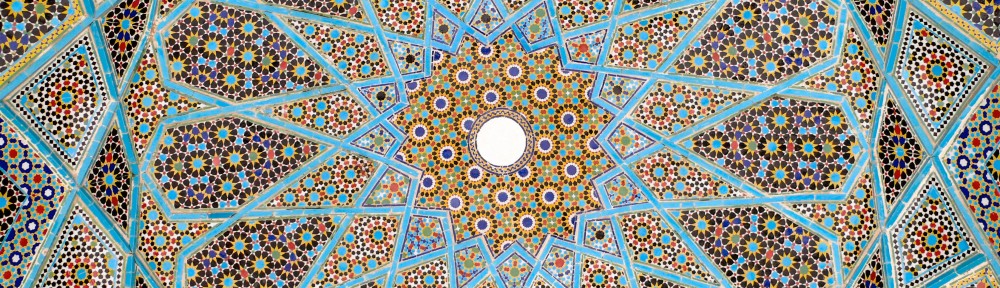
Hafez’s tomb was first constructed in 1452, around sixty years after his death by the Timurid governor of Shiraz, and has been renovated and expanded many times since, often in response to divination performed with his Divan. The tomb is adorned with calligraphic renditions of these ghazals of his, which happen to be among my very favorite:
Translation:
Tell me of your arrival, from this life to you I’ll rise!
I am heaven’s bird and from this world’s snare I will rise
For your friendship, if you should want me as a slave
from the rulership of the whole cosmos I will rise
O Lord, may your cloud of guidance rain down upon me
before, as scattered dust, into the air, I rise
Beside my dust, with wine and song, come and take a seat
drawn by your scent, dancing from my tomb, I will arise
Rise up, o sweet idol, and show your stature’s grace
and from this soul and world, with clapping hands I will rise
though I am old, hold me close all night long in your embrace
then in the morning, young and fresh, from your side I will rise
The day I die, with my last breath, let me see your face
So that like Hafez, from this world and place, I will arise
Original:
مژده وصل تو کو کز سر جان برخیزم
طایر قدسم و از دام جهان برخیزم
به ولای تو که گر بنده خویشم خوانی
از سر خواجگی کون و مکان برخیزم
یا رب از ابر هدایت برسان بارانی
پیشتر زان که چو گردی ز میان برخیزم
بر سر تربت من با می و مطرب بنشین
تا به بویت ز لحد رقص کنان برخیزم
خیز و بالا بنما ای بت شیرین حرکات
کز سر جان و جهان دست فشان برخیزم
گر چه پیرم تو شبی تنگ در آغوشم کش
تا سحرگه ز کنار تو جوان برخیزم
روز مرگم نفسی مهلت دیدار بده
تا چو حافظ ز سر جان و جهان برخیزم
This poem was most likely written as a tribute to Hafez by a later Shi’ite author, but it still adorns his tomb (thanks to N.A. for help with the translation):
Translation:
O heart be the servant of the King of the world and be a king yourself
and always remain under the protection of divine grace
From a foreigner, they won’t buy a thousand for a penny
Let from peak to peak be full of the army of hypocrisy
when Ahmad is my intercessor on the day of resurrection
Say to this blasted body of mine, “be sinful”
The one who is not a friend of ‘Ali is veiled
whether he is the ascetic of his time or a Master of the way
O Ali, I am alive today with your friendship/sanctity
tomorrow I will be a witness to the pure spirit of the Imams
The grave of the eighth Imam, the Sultan of religion, Riḍa,
Kiss it from your soul and be a companion of that court
If your hand cannot reach a flower from that branch
be a plant at the foot of their flower-stem
The man of God who seeks piety
it does’t matter whether his cloak is white or black
Hafez, take the path of servanthood to the king
and then be like the men of the way on the path
Original:
ای دل غلام شاه جهان باش و شاه باش
پـیـوسـتـه در حـمـایـت لطـف اله باش
از خارجـی هزار به یک جو نمی خرند
گو، کوه تا به کـوه منـافق سپـاه بـاش
چون احمدم شـفـیع بود روز رسـتخیز
گو این تن بـلاکش مـن پـرگنـاه بـاش*
آن را که دوستی علی نیست کافر است
گـو زاهـد زمانـه و گو شـیخ راه بـاش**
امـروز زنـده ام بـه ولای تـو یا عـلی
فـردا به روح پـاک امامان گـواه بـاش
قبر امام هشـتم و سـلطان دیـن رضـا
از جان ببوس و بر در آن بارگاه باش
دستت نمی رسد که بچینی گلی زشاخ
بـاری به پـای گلبن ایشـان گیاه بـاش
مرد خـدا شـنـاس که تـقـوی طلب کند
خواهی سپید جامه و خواهی سیاه باش
حـافظ طریـق بـنـدگی شـاه پـیـشـه کن
وانگاه در طریق چـو مـردان راه بـاش
Translation:
The garden of eternity is in the retreat of the dervishes
the very essence of grandeur is the service of the dervishes
The treasury of glory that is sealed by the talisman of wonders
opens at the merciful glance of the dervishes
The castle of paradise for which Rezwan is the doorkeeper
is but a view from the lawn of the dervishes
That which by its radiance turns black hearts to gold
is the alchemy that is the company of the dervishes
That before which the sun lays down its crown of glory
is the greatness that comes from the grandeur of the dervishes
The power/state (dawlat) whose decline need never be feared
without exaggeration, is the power/state of the dervishes
The kings are the qiblah to which we direct our needs
and this is because they are the slaves of the dervishes
That which kings seek to achieve in their prayers
is manifested in the mirror of the countenance of the dervishes
From shore to shore is the army of tyranny,
but from beginningless eternity to eternity without end is the time of the dervishes
O rich man, don’t sell us so much vanity
for your health and wealth are in the hands of the will (himmat) of the dervishes
Korah’s treasure, which still is still sinking from heaven’s severity
is an effect of the wrath of the dervishes
Hafez, if you’re seeking the eternal water of life
its spring is the dust of the retreat of the dervishes
I am the slave of the Asaf of my time
because he has the looks of a nobleman and the character of the dervishes.
Original:
روضه خلد برین خلوت درویشان است
مایه محتشمی خدمت درویشان است
گنج عزلت که طلسمات عجایب دارد
فتح آن در نظر رحمت درویشان است
قصر فردوس که رضوانش به دربانی رفت
منظری از چمن نزهت درویشان است
آن چه زر میشود از پرتو آن قلب سیاه
کیمیاییست که در صحبت درویشان است
آن که پیشش بنهد تاج تکبر خورشید
کبریاییست که در حشمت درویشان است
دولتی را که نباشد غم از آسیب زوال
بی تکلف بشنو دولت درویشان است
خسروان قبله حاجات جهانند ولی
سببش بندگی حضرت درویشان است
روی مقصود که شاهان به دعا میطلبند
مظهرش آینه طلعت درویشان است
از کران تا به کران لشکر ظلم است ولی
از ازل تا به ابد فرصت درویشان است
ای توانگر مفروش این همه نخوت که تو را
سر و زر در کنف همت درویشان است
گنج قارون که فرو میشود از قهر هنوز
خوانده باشی که هم از غیرت درویشان است
حافظ ار آب حیات ازلی میخواهی
منبعش خاک در خلوت درویشان است
من غلام نظر آصف عهدم کو را
صورت خواجگی و سیرت درویشان است
Translation:
The dust of my body is the veil of the face of the beloved of my soul
happy is the moment when from off this face, I cast the veil
Even so, this cage is no good for a sweet singer such as me
I will go to the rose garden of paradise, for I am a bird of that field
It is not clear why I came where I went
my regret and pain is that I have been heedless of my own affair
Oh how I circumambulate in the space of the holy world
but in this flat, compounded abode, I am bound to my body
If the scent of musk issues from my heart’s blood
do not wonder, my friend, for I am the musk gland of Khotan
Do not look at the golden embroidery of my cloak like a candle
for there is burning hidden within this cloak
Come and take Hafez’s existence from him
so that by your being, none will hear from me that I am
One of my favorite English poems of all time is reminiscent of Sufi poetry about Layla, whose name means “night,” and who symbolizes the beloved Divine Essence/Essence of the Self.
Lord Byron
She walks in beauty, like the night
Of cloudless climes and starry skies;
And all that’s best of dark and bright
Meet in her aspect and her eyes;
Thus mellowed to that tender light
Which heaven to gaudy day denies.
One shade the more, one ray the less,
Had half impaired the nameless grace
Which waves in every raven tress,
Or softly lightens o’er her face;
Where thoughts serenely sweet express,
How pure, how dear their dwelling-place.
And on that cheek, and o’er that brow,
So soft, so calm, yet eloquent,
The smiles that win, the tints that glow,
But tell of days in goodness spent,
A mind at peace with all below,
A heart whose love is innocent!
Rumi
Translation:
You look through my two eyes, you are closer to me than myself
Your light shines brighter than the moon
Come into the garden so that the glory of the rose garden is humbled
that it may be more beautiful and blooming than a hundred gardens and rosebeds
so that the cedar will hide its height in shame
that the tongue of the lily will declare you more lily than itself
When you are kind, you are the candle of the soul, soft and pliable as wax
When you are aloof, you are more iron than iron
Do no be wild because you will meet her face to face
her charm will make you as cool and pliant as the earth
Throw away your armor and bare your chest at the moment of battle
there is no better protection nor armor than her.
That’s why in every Sufi retreat, all the openings are are sealed shut
so that from your light the house becomes more illumined
Orignal:
در دو چشم من نشین ای آن که از من منتری
تا قمر را وانمایم کز قمر روشنتری
اندرآ در باغ تا ناموس گلشن بشکند
ز آنک از صد باغ و گلشن خوشتر و گلشنتری
تا که سرو از شرم قدت قد خود پنهان کند
تا زبان اندرکشد سوسن که تو سوسنتری
وقت لطف ای شمع جان مانند مومی نرم و رام
وقت ناز از آهن پولاد تو آهنتری
چون فلک سرکش مباش ای نازنین کز ناز او
نرم گردی چون زمین گر از فلک توسنتری
زان برون انداخت جوشن حمزه وقت کارزار
کز هزاران حصن و جوشن روح را جوشنتری
زان سبب هر خلوتی سوراخ روزن را ببست
کز برای روشنی تو خانه را روشنتری
Ibn al-Farid
Translation:
Every part of me kissed her veil
With every mouth whose touch held every kiss
If she dissolved my body, she would see in every atom
each and every heart filled with each and every love
Original:
ويلثم مني كلّ جزء لثامها
بكلّ فم فى لثمه كلّ قبلة
فلو بسطت جسمي رأت كلّ جوهر
به كلّ قلب فيه كلّ محبة
Translation:
If I sought consolation, who would be there to be my guide
when in love, every leader follows my lead?
In my every limb is every yearning for her
and every longing tugs at my reins
As she bends, I imagine every hip she moves
to be a branch in a sand dune topped by the full moon
Mine is every limb filled with every inner core
wherein, when she glances, is embedded every arrow
And if she dissolved my body she would find every atom
every heart inhabited by every human love
In union with her, a year to me is but an instant,
an hour’s separation like a year.
When we met at nightfall, as the twin straight paths
between her dwelling and my tents brought us together,
We moved away a little from the tribe,
avoiding spies and slanderers with their deceitful talk
I spread my cheek upon the ground for her to walk upon
and she said, “Good news, now you may kiss my veil.”
But this my soul did not permit me, jealously
shielding her from me, for higher is my purpose
We passed the night in hope as my wish decreed
and I saw the world my kingdom and time itself my slave.
Translation modified from Stefan Sperl’s in Stefan Sperl, C. Shackle, Qasida Poetry in Islamic Asia and Africa
Original:
بمنْ أهتَدي في الحبِّ لو رُمْتُ سَلوَةً
وبي يقتَدي ، في الحبِّ ، كلُّ إمامِ
وفي كلِّ عُضوٍ فيَّ كلُّ صبابَةٍ
إليها ، وشَوْقٍ جَاذِبٍ بِزِمَامي
ومِلْنا كذا شيئاً عنِ الحيِّ ، حيثُ لا
رَقيبٌ ، ولا وَاشٍ بِزَوْرِ كَلامِ
فرَشْتُ لها خَدِّي ، وِطاءً ، على الثَّرَى
فقالتْ : لكَ البُشرَى بِلَثمِ لِثامي
فما سَمَحَتْ نَفسي بذلِكَ ، غَيْرَةً
على صَوْنِها مِنِّي لِعزِّ مرامي
وبِتْنا ، كما شاءَ اقتراحي ، على المُنى
أرَى المُلكَ مُلكي والزَّمانَ غُلامي
Shushtari
Translation:
You seek Layla, but she reveals herself within you
You think she’s other, but she’s not other than you
And that’s a madness that is apparent to the cult of lovers
So be careful, for otherness is the essence of being cut off
Don’t you see how her beauty envelops you?
She disappears only when you reject part of yourself
“Come close to me,” you say to she who is your All
And when she loves you, she leads you to yourself
Meeting her is bliss beyond description
and none reach her, save those who see meaning without forms
I was so in love with her that I would have vanished in her love
had she not sworn that I only obey her
I concealed her from people with fantasy
After having revealed her, truly, inside my cloak.
I hid her from myself, with the robe of my worlds,
And from my envy, out of the severity of my jealousy
O Dazzling beauty! Should the light of your face
Touch the eyes of a blind man, he would see every atom
She is adorned with each and every charm and grace of beauty
And wherever she appears, she is desired by those who love.
As the wind stirs up, so does my pain get stirred up
I want to forget you, believe me
But there is always more wind
I want to forget you
but there is always more wind
Rumi
Translation:
Love is the One who masters all things;
I am mastered totally by Love.
By my passion of love for Love
I have ground sweet as sugar.
O furious Wind, I am only a straw before you;
How could I know where I will be blown next?
Whoever claims to have made a pact with Destiny
Reveals himself a liar and a fool;
What is any of us but a straw in a storm?
How could anyone make a pact with a hurricane?
God is working everywhere his massive Resurrection;
How can we pretend to act on our own?
In the hand of Love I am like a cat in a sack;
Sometimes Love hoists me into the air,
Sometimes Love flings me into the air,
Love swings me round and round His head;
I have no peace, in this world or any other.
The lovers of God have fallen in a furious river;
They have surrendered themselves to Love’s commands.
Like mill wheels they turn, day and night, day and night,
Constantly turning and turning, and crying out.
Two of my favorite poems of Hafez; legend is that scholars decided to settle a debate over whether or not Hafez should receive a proper Muslim burial by performing divination with his poetry, the last couplet of the second poem emerged and Hafez was given a proper burial and his shrine has remained a site of pilgrimage ever since.
Translation:
It’s the fatwa of the Magian Pir and an ancient saying:
Wine is forbidden where the beloved is not the sommelier
I want to tear this cloak of hypocrisy
for unsuitable company is a painful torment for the spirit
Hoping for a sip of wine from the beloved’s lip
For years I have remained firm at the tavern door
Perhaps he has forgotten my old service
Morning breeze, remind him of our ancient pact
If you pass over my grave after a hundred years
My rotten bones will rise from the dust, dancing
The heart-ravisher took my heart with a hundred promises first
Apparently, his kind nature will not forget its pact
Tell the rosebud not to be sad about its knotted state
For it will find help from the breaths of the dawn wind and breeze
O heart, think about finding your remedy at another door
For the lover’s pain cannot be cured by the doctor’s medicines
Get the jewel of ma’rifat that you can take with you
The wealth of gold and silver belongs to others
This snare is hard, without the grace of God
Adam cannot prevail over the accursed Satan
Hafez, if you have no gold or silver, so what? Give thanks!
What better wealth than subtlety of speech and soundness of nature?
(translation modified from Reza Saberi’s Divan of Hafez, 426-7)
Original:
فتوی پیر مغان دارم و قولیست قدیم
که حرام است می آن جا که نه یار است ندیم
چاک خواهم زدن این دلق ریایی چه کنم
روح را صحبت ناجنس عذابیست الیم
تا مگر جرعه فشاند لب جانان بر من
سالها شد که منم بر در میخانه مقیم
مگرش خدمت دیرین من از یاد برفت
ای نسیم سحری یاد دهش عهد قدیم
بعد صد سال اگر بر سر خاکم گذری
سر برآرد ز گلم رقص کنان عظم رمیم
دلبر از ما به صد امید ستد اول دل
ظاهرا عهد فرامش نکند خلق کریم
غنچه گو تنگ دل از کار فروبسته مباش
کز دم صبح مدد یابی و انفاس نسیم
فکر بهبود خود ای دل ز دری دیگر کن
درد عاشق نشود به به مداوای حکیم
گوهر معرفت آموز که با خود ببری
که نصیب دگران است نصاب زر و سیم
دام سخت است مگر یار شود لطف خدا
ور نه آدم نبرد صرفه ز شیطان رجیم
حافظ ار سیم و زرت نیست چه شد شاکر باش
چه به از دولت لطف سخن و طبع سلیم
Translation:
Now that the breeze of paradise blows from the garden
it’s just me and the joyful wine and a houri-natured beloved
Why should the beggar not brag of the sultanate today when
his pavilion is the shade of the cloud and his banquet is the field’s horizon?
The meadow tells the tale of the month of spring
He is not wise, who trades cash for credit of paradise
Do not seek loyalty from the enemy, there will be no light
If the monastery’s candle is lit by the synagogue’s lamp
Mend your soul with wine, for this ruinous world intends
to make bricks from our dust
Do not blame me, a drunk, for the blackness of my record
Who knows what fate has written on his head?
Do not keep your feet away from Hafez’s funeral
for, though immersed in sin, he’s on his way to paradise
translation modified from Reza Saberi’s Divan of Hafez)
The bird that sings the song of pain is love
The courier who knows the tongue of the Unseen is love
The existence that calls you to nonexistence is love
And that which redeems you from you is love
Original:
مرغی که نوای درد راند عشق است
پيکی که زبان غيب داند عشق است
هستی که به نيستيت خواند عشق است
وآنچ از تو ترا باز رهاند عشق است
Translation by Reza Saberi
Rumi
What then is love? The Ocean of Nonexistence.
It is there that the foot of the intellect is broken
Rumi, Mathnawi, ed. Nicholson, III: 4724.
Ibn ‘Arabi
Many mistakes may occur in love. The first of them is that people imagine that the object of love is an existent thing… In fact, love’s object remains forever nonexistent, but most lovers are not aware of this, unless they should be knowers of the realities. (II 337.17)
A collection of verses from West African poets on the theme…
The first is said to have been improvised extemporaneously by Abū Isḥāq Ibrāhīm ibn Ya’qūb al-Kānemī (from Kanem in contemporary Northeastern Nigeria) upon his visit to the Almohad Sultan Abū Yūsuf Ya’qūb al-Manṣūr (d. 1199) in Marrakech. The Nigerian poet composed and recited these verse on the spot upon entering the Sultan’s presence:
He removed his veil, but out of awe, my eyes still saw him through a veil
His favour drew me near, but out of awe, found myself distant in this nearness.
Original:
ازال حجابه عنّي وعيني تراه من المهابت في حجابي
وقرّبني تفضّله ولاكن بعدت مهابتاً عند إقترابي
See this post for more on this theme and its symbolism…
The second is from a contemporary Tijānī scholar from Mauritania:
I was annihilated in love for him and I subsisted until
I was annihilated from that annihilation and from subsistence as well.
-Muhammad Ould Shaykh ‘Abd Allah
Original:
فنيت بحبه و بقيت حتى فنيت عن الفناء وعن البقاء
-لمحمد ولد شيخ عبدالله
As is this last set of verses:
I love the the sun when it appears, since it reminds me of the appearance of matchless love
And no star is seen when she comes forth, either from above or from below
And so, O Maya, you have appeared in the eye of my heart, and everything other than you has disappeared
So I see you in whatever is not you, and I don’t see other than you whenever I see you
—Shaykh Manna Abba “Shaykhānī” wuld Muḥammad al-Ṭulbā, (modified from the translation by Muṣṭafā Okon-Briggs)
Original:
أحبّ الشّمس تطهر اذ تحاكي ظهور الحبّ من غير اشتراك