Posts Tagged ‘digitization’

A Bridge to the Past: The Writings of William Brewster

Thursday, January 29th, 2015

William Brewster was a self-educated ornithologist who lived in Cambridge, Massachusetts. From the mid-1800s until his death in 1919, he amassed a tremendous specimen collection and became one of the foremost experts on birds in the northeastern United States. In 1906, the Nuttall Ornithological Club published The Birds of the Cambridge Region of Massachusetts, Brewster’s exhaustive work on the avian fauna of his own backyard. While the book is a valuable historical resource, it is Brewster’s journals and diaries—spanning over 50 years of his life—that contain the goldmine of his recorded observations. Last year, the Ernst Mayr Library made these journals and diaries available on BHL.

Photo of William Brewster in The Auk, Volume 37, 1920

Photo of William Brewster in The Auk, Volume 37, 1920

Increasingly, researchers and conservationists rely on collections of data points to understand species’ habits, population decline, and migration patterns. One such collection is eBird, a website created by the Cornell Lab of Ornithology and the National Audubon Society. eBird harnesses the contributions of bird-watchers around the world to create interactive maps that display individual observations as data points. These data points are integrated into systems such as the Global Biodiversity Information Facility (GBIF), where they paint a rich picture of global environmental health that transcends individual, component snapshots of information.

Since eBird launched in 2002, it has captured millions of bird observations. Prior to the World Wide Web, however—and especially prior to the advent of bird-watching as a common recreational activity around 1900—the record is more spotty. This makes the existing historical data, such as William Brewster’s carefully recorded observations, all the more valuable.
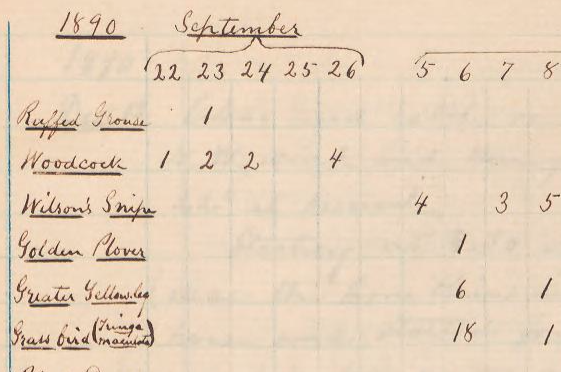
A bird list from Brewster’s 1890 journal

A bird list from Brewster’s 1890 journal

Brewster saw the effects of urbanization and development on the Cambridge of his boyhood; more than the changed landscape, he lamented the loss of birds. In Birds of the Cambridge Region, he wrote of the Mt. Auburn area:

Knolls and ridges have been levelled, swamps and meadows drained or filled, and woods, groves, thickets and orchards swept away, to make place for settlements of houses…Most of the native birds have disappeared…So complete has been the transformation, that it is only by appealing to the imagination…that one can hope to reconstruct even the more prominent features of the landscape as it was twenty or thirty years ago.

In addition to the effects of development, Brewster witnessed the explosion of non-native House (English) Sparrows, the effects of 0ver-hunting, and the cost of human attitudes and ignorance. Brewster listed the Great Horned Owl as an “occasional or accidental” visitor to Cambridge and the Cooper’s Hawk as “expunged or doubtful”; at the time, people believed that these birds were a serious threat to domestic fowl, and they killed them at every opportunity. Wild Turkeys were totally extirpated from the region during Brewster’s lifetime.

Map of Fresh Pond, c.1866, from The Birds of the Cambridge Region of Massachusetts; image provided by Charles Sullivan, Cambridge Historical Commission

Map of Fresh Pond, c.1866, from The Birds of the Cambridge Region of Massachusetts; image provided by Charles Sullivan, Cambridge Historical Commission

Fresh Pond, one of Brewster’s favorite birding spots, is a case study in the harmful effects of human engineering. Before Fresh Pond was made a public park in 1884, hunters decimated the migratory duck populations that had once been abundant. The establishment of the park allowed the ducks to return, but at the cost of marsh birds: the vegetation at the water’s edge was cut down for a perimeter path, and some of the pond’s coves were filled in. With their habitat gone, several Rail species that Brewster commonly encountered around the pond disappeared. According to eBird, they’ve rarely been seen since. Even as the duck population rebounded, the city charged policemen with shooting their guns to scare them off, afraid that they would pollute the municipal water supply.

House Sparrows may be here to stay, but not all the damage has been permanent. Cambridge is working to restore Fresh Pond as a sanctuary for local wildlife. Cooper’s Hawks are now spotted regularly in the city. And Great Horned Owls and Wild Turkeys reside in Mt. Auburn Cemetery, where Brewster is buried. As we continue to make progress, the historical information provided by Brewster and others serves as a guide to conservation, filling in critical gaps in the stories of hundreds of bird species.
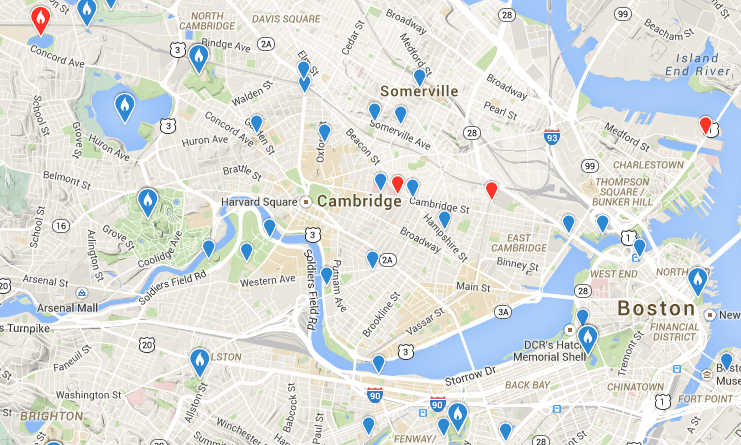
eBird Cooper’s Hawk sightings in the Cambridge region for 2014

eBird Cooper’s Hawk sightings in the Cambridge region for 2014

Making Brewster’s writings available on BHL is an important step, but the work doesn’t end there. In order for his journals and diaries to be truly useful, they need to be converted to searchable text files. Ordinarily, a computer would do this using Optical Character Recognition (OCR), but because the technology has trouble reading cursive handwriting, transcriptions must be typed out one page at a time. Thanks to a grant from the Institute for Museum and Library Services (IMLS), volunteers and project partners at the Ernst Mayr Library are doing just that. Read about BHL’s involvement in the Purposeful Gaming grant, and if you want to help, try your hand at transcribing Brewster’s diaries and journals. By making these writings accessible, we can reach into the past to find information that will help us plot a course for the future.
Transcribing the Field Notes of William Brewster

Friday, May 30th, 2014

William Brewster (1851-1919) was a renowned American amateur ornithologist, first president of the Massachusetts Audubon Society, and a president of the American Ornithologists’ Union. He was an avid collector of birds and their nests and eggs, and collected over forty thousand specimens from 1861 until his death in 1919. His collection, bequeathed to the Museum of Comparative Zoology at Harvard University, is considered one of the finest private collections of North American birds ever assembled. Though Brewster collected throughout North America, his collection is especially comprehensive in its coverage of the birds of New England. Brewster thoroughly documented his collecting trips. His journals and diaries are a gold mine of scientific observations and a delightful account of years spent exploring the woods, fields, lakes, and rivers of New England.

The Ernst Mary Library of the Museum of Comparative Zoology is in the process of digitizing its collection of Brewster’s field notes and observations, and making these available worldwide via the Biodiversity Heritage Library (BHL). As part of a project led by the Missouri Botanical Garden, and funded by the Institute of Museum and Library Services, we have begun efforts to transcribe Brewster’s voluminous field notes with the ultimate goal of making the full text of his observations searchable and available for any number of uses. As an initial trial project, we have placed ten digitized volumes of field notes on two crowdsourcing websites, and we invite anyone interested to help us accomplish our goal of transcribing at least 2000 pages of Brewster’s journals. The crowdsourcing websites chosen for this project are the Biodiversity Volunteer Portal (BVP), a collaboration between the Australian Museum and the Atlas of Living Australia; and a BHL installation of FromThePage, a transcription tool developed by Ben Brumfield.

Please feel free to visit one or both of these transcription sites, create an account, and enjoy Brewster’s idyllic writing style while helping to unlock his valuable observations for the benefit of all. We also invite you to browse Brewster’s diaries and journals on the BHL portal.

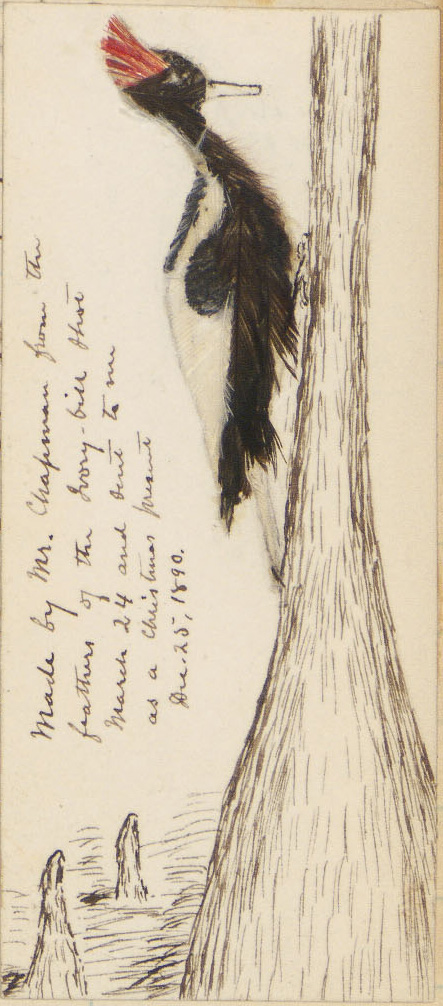
Ivory-billed woodpecker from 1890 journal

Ivory-billed woodpecker from 1890 journal

Field Notes and Cockroaches

Tuesday, November 6th, 2012

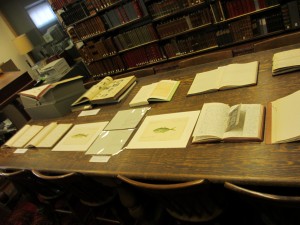
Field Notes from the Ernst Mayr Library collection.

Last week there were a couple of events in the Ernst Mayr Library. On Thursday we were visited by about a dozen attendees from the “Take Note” conference held at the Radcliffe Institute for Advanced Study. This conference brought together scholars from a variety of disciplines to explore the role of note-taking in different disciplines. The conference also launched a virtual exhibition entitled “An Exploration of Note-Taking in Harvard University Collections“. There was also discussion and review of emerging digital annotation tools.

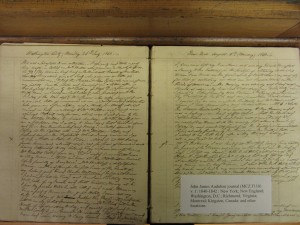
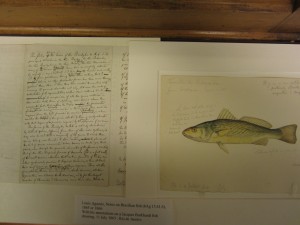
The students and scholars who visited the Ernst Mayr Library were treated to a lecture and note-taking session organized by Michael Canfield. Additionally they viewed biologists’ field notes from the 19th and early 20th century. The display included one of John James Audubon’s notebooks–mostly text, field notes from Louis Agassiz coupled with illustrations by his travelling artist, Jacques Burkhardt, a psychiatrist’s bird watching lists,sketches and notes along with field notes and analytic compilations from William Brewster, Curator at the MCZ from 1885 to 1902. Connie Rinaldo gave a brief presentation about the Biodiversity Heritage Library partner IMLS grant Connecting Content: A Collaboration to Link Field Notes to Specimens and Published Literature to which the Ernst Mayr Library is contributing digitzed versions of Brewster’s field notes, diaries, photographs and correspondence along with MCZ specimen images from Brewster’s collection of birds from Cambridge, MA.

Pages from Audubon’s field notes (1840-1842)

Agassiz’s notes on Brazilian Fish, 1865 or 1866 along with Burkhardt illustration.

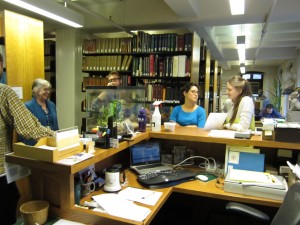
So what about the cockroaches? The library pets, hissing cockroaches, have new and more spacious digs so we thought it was a great time to show them off along with some books from the amazing collections of the Ernst Mayr Library. Since the field notes were already on display, we added some books with cockroach images and announced a Friday afternoon “flash” exhibit complete with snacks. We know some folks were unable to attend and were disappointed, so feel free to ask for a tour, either private or for your lab. Check with Connie Rinaldo, Dana Fisher or Mary Sears.

Checking out the Hissing Cockroaches.

Global Biodiversity Heritage Library

Tuesday, June 26th, 2012

The third global Biodiversity Heritage Library meeting took place in Berlin, Germany on June 7-8, 2012, hosted by Henning Scholz at  the Museum fur Naturkunde. We covered many important issues during these two days. Representatives attended from the BHL (represented by several institutions in the US and UK), BHLEurope (represented by several institutions in the UK, Germany, France, Belgium, Czech Republic and Austria), BHLEgypt (represented by Noha Adley from the Bibliotheca Alexandrina), BHL Australia (represented by Elicia Wallis from the Museum of Victoria) and BHL SciELO (represented by Abel Packer and Fabio Batalha from SciELO in Brazil). Chinese colleagues were unable to attend.
Each global group reported on the state of the BHL in their region. By-laws and a governance structure were approved. Officers were elected for the Executive Committee: Elicia Wallis, Museum Victoria, Australia, Chair; Henning Scholz, Museum fur Naturkunde, Berlin, Vice-Chair; and Nancy Gwinn, Smithsonian Libraries (and BHL Executive Chair), Secretary. Noha Adley from the Bibliotheca Alexandrina was appointed as the global BHL Technical Director. We also discussed how to synchronize BHL data, avoid duplication, address global copyright issues and ensure metadata quality across the regions.
Each region has put its own stamp on their version of the BHL.
The global BHL currently has nodes in Europe, Egypt, China, Brazil, US/UK, and Australia. Following the global BHL meeting, a several members of the Smithsonian, MOBOT, and Field Museum teams continued on to meet African colleagues in South Africa to establish BHL Africa. Chris Freeland, BHL Technical Director was unable to attend the BHL Europe, Global BHL and BHL Africa meetings due to a bike accident.  He never rests, however, and made an amazing video statement to encourage a BHL Africa


The Biodiversity Heritage Library marches on!

Welcome to Archivist Fougy Henry!

Thursday, May 10th, 2012

We would like to welcome Fougy Henry, our new Library Assistant and Archivist! Fougy will be working on the BHL, and also on Alexander Agassiz’s collection of glass plate negatives, dating to the 1890s. Included are plates of expeditions by the Albatross and others to places such as Australia, Brazil, Easter Island, Newport, RI (one of Alexander’s private homes), and more. There are about 1000 plates; some are labeled with who is in the picture or location but some are not labeled in any way. Fougy’s job will be to organize, arrange, research, describe, assign metadata and do conservation work as needed in consultation with Weismann Preservation Center. Once the negatives have been digitized, we will begin the task of linking the slides to publications and specimens in the MCZ collection. Fougy will also be enhancing metadata and quality for our contributions to the Biodiversity Heritage Library.

A native of Boston, Fougy received a degree from the Harvard Graduate School of Education in 1997 in Human Development and Psychology. They worked as a mental health counselor and also in clinical research in nutrition, obesity, and diabetes for several years in Philadelphia and in Boston. They have also worked as a personal chef, pastry chef, and caterer. Switching careers, they attended Simmons Graduate School of Library and Information Science and graduated in August 2011 with a concentration in Archives Management. They believe that the field of librarianship combines many of her organizational and analytical skills. They are a Cambridge resident, a practicing vegan and when they’re not in a library or archive, they’re either taking a long walk with her two children and husband, dancing to Kompa, Zouk or Soca music, or doing natural hair care for her friends. They enjoy creating healthy, wholesome, and flavorful dishes with organic foods!