Posts Tagged ‘field notes’

Notes from William Brewster: Signs of Spring

Friday, March 18th, 2016

Here in the Greater Boston area we’ve had a week or so of beautiful spring weather. Robins are out foraging over soft ground, Red-winged Blackbirds flash their wings in wetland areas, and Song Sparrows are singing again. While we’re still likely to have more cold snaps and snow, we’re definitely feeling the season shift.

For ornithologist William Brewster, a productive day’s work often looked like a long ramble outside with a notebook and a gun, or later on, a notebook and a pair of binoculars. His daily journal entries often run many pages long as he notes the places he visited and every natural detail that stood out to him.

On March 25, 1891, Brewster spent the day riding and walking from Lexington to Belmont with a friend, and noted many of the signs of spring that we’re seeing this week.
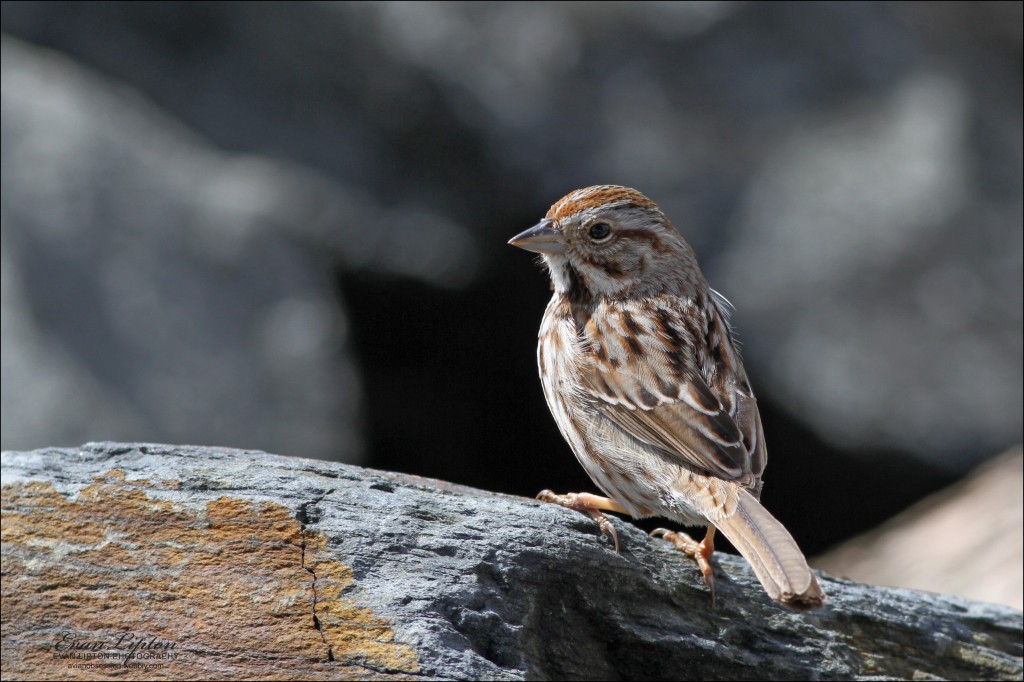
Song Sparrow, photographed in Sagamore, Mass. Photos courtesy of Evan Lipton. © Evan Lipton 2013.
Song Sparrow, photographed in Sagamore, Mass.

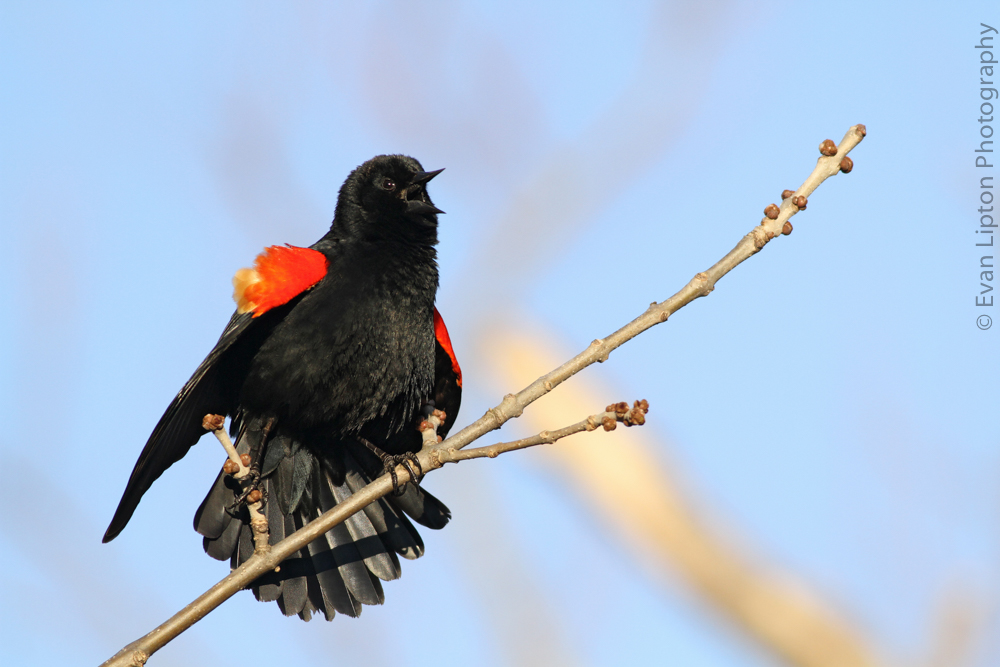
Red-winged Blackbird, photographed in Milton, Mass. Photos courtesy of Evan Lipton. © Evan Lipton 2015.

Red-winged Blackbird, singing and displaying, photographed in Milton, Mass. Photos courtesy of Evan Lipton. © Evan Lipton 2013 and 2015.

(This journal entry has been abridged and broken into shorter paragraphs for readability.)

March 25, 1891

Started at 8.20 this morning with F. Bolles and drove to the Bryant farm in Lexington. The past six days have been cloudy and dismal with snow, sleet, and rain falling much of the time, but this morning the sun rose clear and there was a light breeze from the N. W. which by 9 a.m. had increased to a typical March wind, roaring through the leafless woods, ruffling the most sheltered forest roads and beating the tall, withered meadow grass savagely to and fro.

The greater part of the day, however, was just warm enough to be delightful, especially in openings in the woods and on sheltered hillsides. The air was bracing but at no time raw and there was a smell of earth mould and wet leaves. In short Spring was in the air.

The roads were dry and hard in most places and the grass tinged with green on sunny exposures while about spring holes it was vivid green. There is little snow or ice left except under evergreens in the woods and on the north side of high banks. The ground is still very wet and sodden and there is hard frost under the leaves everywhere in the woods.

We heard a Bluebird or two before reaching Waverly and two Song Sparrows, one opposite the Adams place being an exceptionally fine singer. As the horse was walking slowly up the steep pitch past the lower mill pond there was a sudden whirring of wings behind us on the right and a bevy of twelve Quail hurtled over our heads like a shower of cannon balls. They crossed the ravine just below the house and disappeared over the knolls beyond flying very fast and nearly 100 feet above the earth when above the bed of Beaver Brook. What disturbed them I do not know; certainly not our carriage for they rose among the pines at least 100 yds. from the road.

The willows were wonderfully beautiful as we entered their eastern end, the sunlight bringing out their old gold tints and lying lovingly on the long, straight reach of road that led away across the great, half flooded meadow. There were hosts of Song Sparrows here. Indeed we must have heard nearly a dozen and others were continually flitting across the road or rustling through the dry grass on its borders. Two Rusty Blackbirds rose from the flooded meadow and alighted in the top of a maple uttering their tinkling medley.

In the woods at the western end six or eight Crows were sitting in pairs in the tops of the tall oaks. A Red-wing, the only one seen during the day, was singing in the top of a hickory under which we drove without disturbing him. We drove past the Bryant farm to the Theodore Parker place and then returned. Just before searching the Bryant farm we started a musk rat from the road where, on the edge of a pond of rain water, he was sitting in the sun. He floundered and skipped over and through the shallow water in haste and finally disappeared in a half submerged stone wall.

Our drive home was a fitting close to the long, restful, delightful day. As we entered the Willows the sun was setting and its level beams threw a strong light on the tops of the trees, the road itself being in shadow.

A great flock of Crows (Bolles counted forty five) straggled off in a long, swarming line northward apparently starting on a migrating flight but perhaps on the way to a roost.

A musk rat kept abreast of us for a little way clearing deep furrow in the smooth surface of the ditch on the right of the road and finally humping his back and diving so smoothly as to leave scarcely a ring on the spot where he disappeared. Near the Payson place more Crows, a small flock, starting on a flight but heading first west and then nearly south-west.

The wind blew cold and strong and the light was fading fast when we reached home at about six o’clock.

You can read the full journal entry here on the Biodiversity Heritage Library website.

If you’re not familiar with the New England spring singers noted in Brewster’s journal entry, check out the videos below.

-Elizabeth Meyer

A Bridge to the Past: The Writings of William Brewster

Thursday, January 29th, 2015

William Brewster was a self-educated ornithologist who lived in Cambridge, Massachusetts. From the mid-1800s until his death in 1919, he amassed a tremendous specimen collection and became one of the foremost experts on birds in the northeastern United States. In 1906, the Nuttall Ornithological Club published The Birds of the Cambridge Region of Massachusetts, Brewster’s exhaustive work on the avian fauna of his own backyard. While the book is a valuable historical resource, it is Brewster’s journals and diaries—spanning over 50 years of his life—that contain the goldmine of his recorded observations. Last year, the Ernst Mayr Library made these journals and diaries available on BHL.

Photo of William Brewster in The Auk, Volume 37, 1920

Photo of William Brewster in The Auk, Volume 37, 1920

Increasingly, researchers and conservationists rely on collections of data points to understand species’ habits, population decline, and migration patterns. One such collection is eBird, a website created by the Cornell Lab of Ornithology and the National Audubon Society. eBird harnesses the contributions of bird-watchers around the world to create interactive maps that display individual observations as data points. These data points are integrated into systems such as the Global Biodiversity Information Facility (GBIF), where they paint a rich picture of global environmental health that transcends individual, component snapshots of information.

Since eBird launched in 2002, it has captured millions of bird observations. Prior to the World Wide Web, however—and especially prior to the advent of bird-watching as a common recreational activity around 1900—the record is more spotty. This makes the existing historical data, such as William Brewster’s carefully recorded observations, all the more valuable.

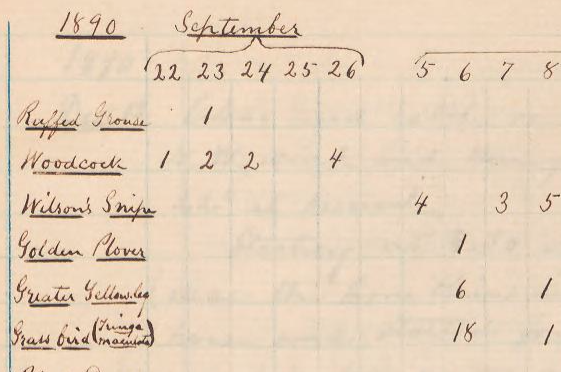
A bird list from Brewster’s 1890 journal

A bird list from Brewster’s 1890 journal

Brewster saw the effects of urbanization and development on the Cambridge of his boyhood; more than the changed landscape, he lamented the loss of birds. In Birds of the Cambridge Region, he wrote of the Mt. Auburn area:

Knolls and ridges have been levelled, swamps and meadows drained or filled, and woods, groves, thickets and orchards swept away, to make place for settlements of houses…Most of the native birds have disappeared…So complete has been the transformation, that it is only by appealing to the imagination…that one can hope to reconstruct even the more prominent features of the landscape as it was twenty or thirty years ago.

In addition to the effects of development, Brewster witnessed the explosion of non-native House (English) Sparrows, the effects of 0ver-hunting, and the cost of human attitudes and ignorance. Brewster listed the Great Horned Owl as an “occasional or accidental” visitor to Cambridge and the Cooper’s Hawk as “expunged or doubtful”; at the time, people believed that these birds were a serious threat to domestic fowl, and they killed them at every opportunity. Wild Turkeys were totally extirpated from the region during Brewster’s lifetime.

Map of Fresh Pond, c.1866, from The Birds of the Cambridge Region of Massachusetts; image provided by Charles Sullivan, Cambridge Historical Commission

Map of Fresh Pond, c.1866, from The Birds of the Cambridge Region of Massachusetts; image provided by Charles Sullivan, Cambridge Historical Commission

Fresh Pond, one of Brewster’s favorite birding spots, is a case study in the harmful effects of human engineering. Before Fresh Pond was made a public park in 1884, hunters decimated the migratory duck populations that had once been abundant. The establishment of the park allowed the ducks to return, but at the cost of marsh birds: the vegetation at the water’s edge was cut down for a perimeter path, and some of the pond’s coves were filled in. With their habitat gone, several Rail species that Brewster commonly encountered around the pond disappeared. According to eBird, they’ve rarely been seen since. Even as the duck population rebounded, the city charged policemen with shooting their guns to scare them off, afraid that they would pollute the municipal water supply.

House Sparrows may be here to stay, but not all the damage has been permanent. Cambridge is working to restore Fresh Pond as a sanctuary for local wildlife. Cooper’s Hawks are now spotted regularly in the city. And Great Horned Owls and Wild Turkeys reside in Mt. Auburn Cemetery, where Brewster is buried. As we continue to make progress, the historical information provided by Brewster and others serves as a guide to conservation, filling in critical gaps in the stories of hundreds of bird species.

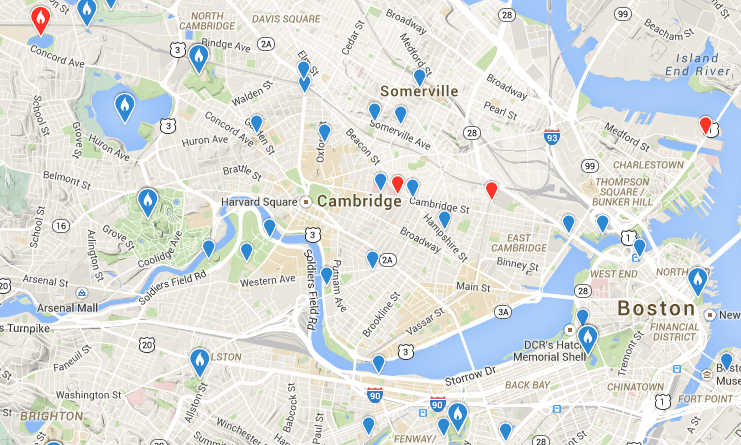
eBird Cooper’s Hawk sightings in the Cambridge region for 2014

eBird Cooper’s Hawk sightings in the Cambridge region for 2014

Making Brewster’s writings available on BHL is an important step, but the work doesn’t end there. In order for his journals and diaries to be truly useful, they need to be converted to searchable text files. Ordinarily, a computer would do this using Optical Character Recognition (OCR), but because the technology has trouble reading cursive handwriting, transcriptions must be typed out one page at a time. Thanks to a grant from the Institute for Museum and Library Services (IMLS), volunteers and project partners at the Ernst Mayr Library are doing just that. Read about BHL’s involvement in the Purposeful Gaming grant, and if you want to help, try your hand at transcribing Brewster’s diaries and journals. By making these writings accessible, we can reach into the past to find information that will help us plot a course for the future.

Transcribing the Field Notes of William Brewster

Friday, May 30th, 2014

William Brewster (1851-1919) was a renowned American amateur ornithologist, first president of the Massachusetts Audubon Society, and a president of the American Ornithologists’ Union. He was an avid collector of birds and their nests and eggs, and collected over forty thousand specimens from 1861 until his death in 1919. His collection, bequeathed to the Museum of Comparative Zoology at Harvard University, is considered one of the finest private collections of North American birds ever assembled. Though Brewster collected throughout North America, his collection is especially comprehensive in its coverage of the birds of New England. Brewster thoroughly documented his collecting trips. His journals and diaries are a gold mine of scientific observations and a delightful account of years spent exploring the woods, fields, lakes, and rivers of New England.

The Ernst Mary Library of the Museum of Comparative Zoology is in the process of digitizing its collection of Brewster’s field notes and observations, and making these available worldwide via the Biodiversity Heritage Library (BHL). As part of a project led by the Missouri Botanical Garden, and funded by the Institute of Museum and Library Services, we have begun efforts to transcribe Brewster’s voluminous field notes with the ultimate goal of making the full text of his observations searchable and available for any number of uses. As an initial trial project, we have placed ten digitized volumes of field notes on two crowdsourcing websites, and we invite anyone interested to help us accomplish our goal of transcribing at least 2000 pages of Brewster’s journals. The crowdsourcing websites chosen for this project are the Biodiversity Volunteer Portal (BVP), a collaboration between the Australian Museum and the Atlas of Living Australia; and a BHL installation of FromThePage, a transcription tool developed by Ben Brumfield.

Please feel free to visit one or both of these transcription sites, create an account, and enjoy Brewster’s idyllic writing style while helping to unlock his valuable observations for the benefit of all. We also invite you to browse Brewster’s diaries and journals on the BHL portal.

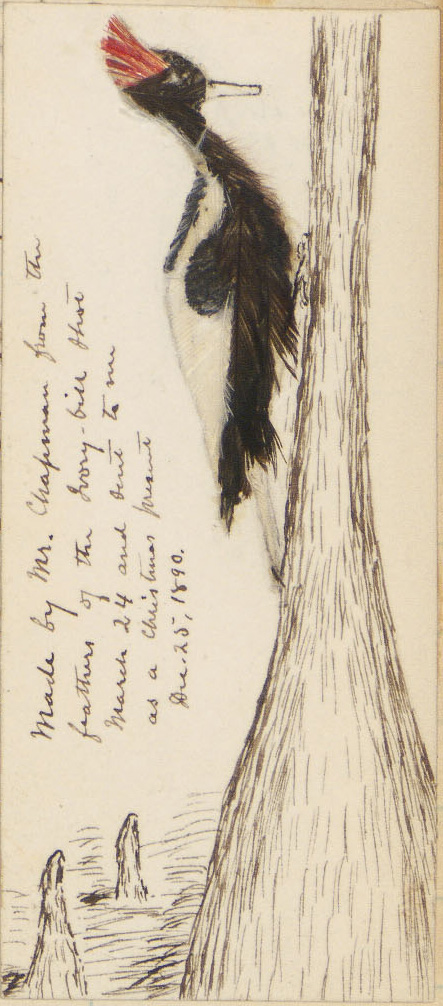
Ivory-billed woodpecker from 1890 journal

Ivory-billed woodpecker from 1890 journal