Posts Tagged ‘ornithology’

Notes from William Brewster: Signs of Spring

Friday, March 18th, 2016

Here in the Greater Boston area we’ve had a week or so of beautiful spring weather. Robins are out foraging over soft ground, Red-winged Blackbirds flash their wings in wetland areas, and Song Sparrows are singing again. While we’re still likely to have more cold snaps and snow, we’re definitely feeling the season shift.

For ornithologist William Brewster, a productive day’s work often looked like a long ramble outside with a notebook and a gun, or later on, a notebook and a pair of binoculars. His daily journal entries often run many pages long as he notes the places he visited and every natural detail that stood out to him.

On March 25, 1891, Brewster spent the day riding and walking from Lexington to Belmont with a friend, and noted many of the signs of spring that we’re seeing this week.
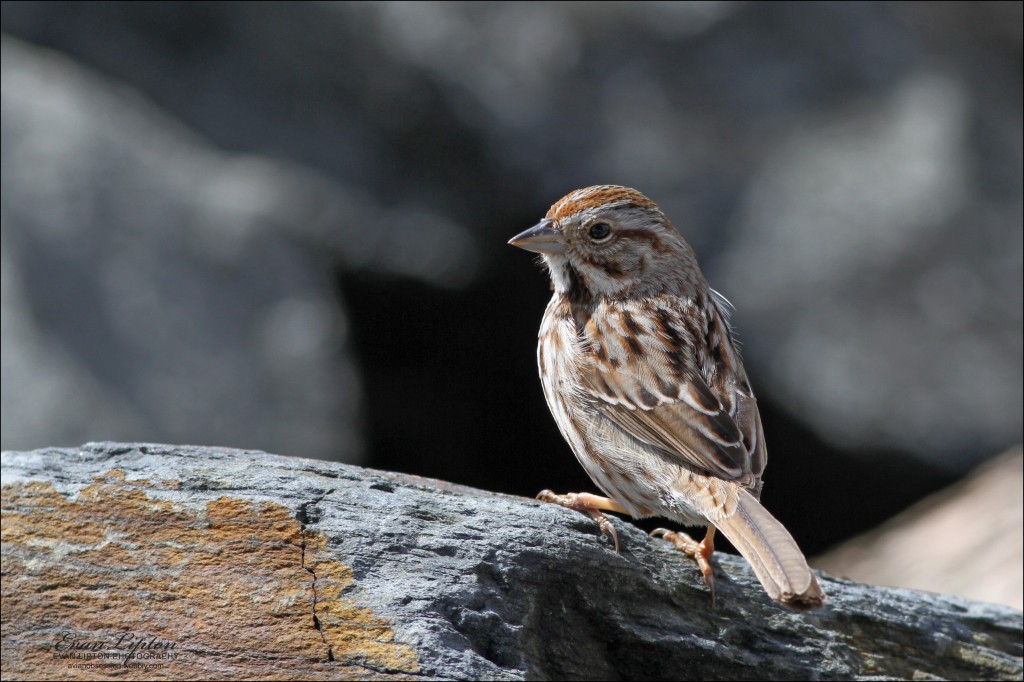
Song Sparrow, photographed in Sagamore, Mass. Photos courtesy of Evan Lipton. © Evan Lipton 2013.
Song Sparrow, photographed in Sagamore, Mass.

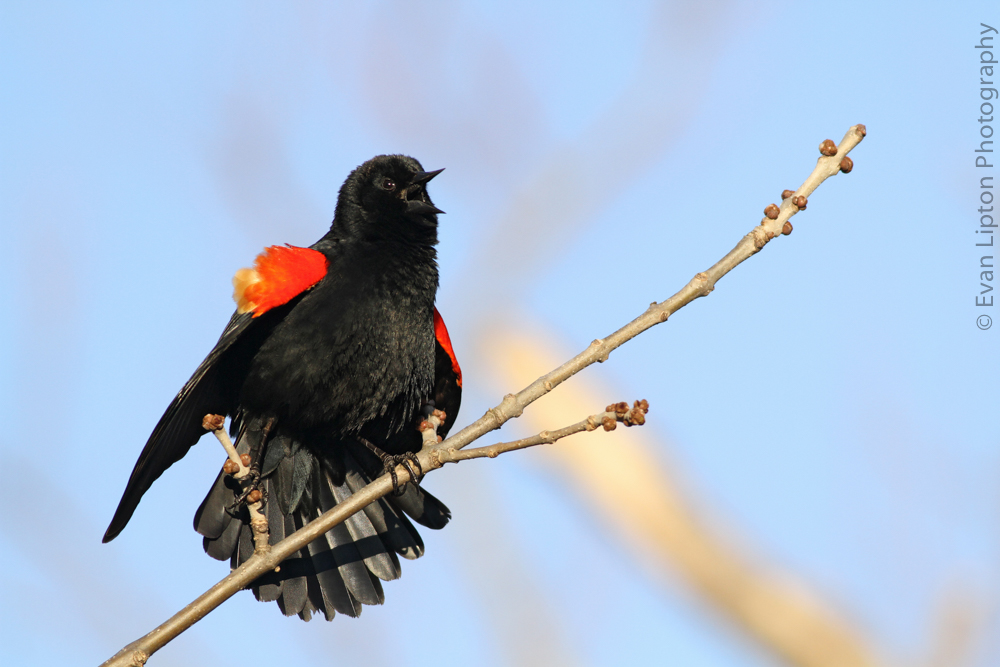
Red-winged Blackbird, photographed in Milton, Mass. Photos courtesy of Evan Lipton. © Evan Lipton 2015.

Red-winged Blackbird, singing and displaying, photographed in Milton, Mass. Photos courtesy of Evan Lipton. © Evan Lipton 2013 and 2015.

(This journal entry has been abridged and broken into shorter paragraphs for readability.)

March 25, 1891

Started at 8.20 this morning with F. Bolles and drove to the Bryant farm in Lexington. The past six days have been cloudy and dismal with snow, sleet, and rain falling much of the time, but this morning the sun rose clear and there was a light breeze from the N. W. which by 9 a.m. had increased to a typical March wind, roaring through the leafless woods, ruffling the most sheltered forest roads and beating the tall, withered meadow grass savagely to and fro.

The greater part of the day, however, was just warm enough to be delightful, especially in openings in the woods and on sheltered hillsides. The air was bracing but at no time raw and there was a smell of earth mould and wet leaves. In short Spring was in the air.

The roads were dry and hard in most places and the grass tinged with green on sunny exposures while about spring holes it was vivid green. There is little snow or ice left except under evergreens in the woods and on the north side of high banks. The ground is still very wet and sodden and there is hard frost under the leaves everywhere in the woods.

We heard a Bluebird or two before reaching Waverly and two Song Sparrows, one opposite the Adams place being an exceptionally fine singer. As the horse was walking slowly up the steep pitch past the lower mill pond there was a sudden whirring of wings behind us on the right and a bevy of twelve Quail hurtled over our heads like a shower of cannon balls. They crossed the ravine just below the house and disappeared over the knolls beyond flying very fast and nearly 100 feet above the earth when above the bed of Beaver Brook. What disturbed them I do not know; certainly not our carriage for they rose among the pines at least 100 yds. from the road.

The willows were wonderfully beautiful as we entered their eastern end, the sunlight bringing out their old gold tints and lying lovingly on the long, straight reach of road that led away across the great, half flooded meadow. There were hosts of Song Sparrows here. Indeed we must have heard nearly a dozen and others were continually flitting across the road or rustling through the dry grass on its borders. Two Rusty Blackbirds rose from the flooded meadow and alighted in the top of a maple uttering their tinkling medley.

In the woods at the western end six or eight Crows were sitting in pairs in the tops of the tall oaks. A Red-wing, the only one seen during the day, was singing in the top of a hickory under which we drove without disturbing him. We drove past the Bryant farm to the Theodore Parker place and then returned. Just before searching the Bryant farm we started a musk rat from the road where, on the edge of a pond of rain water, he was sitting in the sun. He floundered and skipped over and through the shallow water in haste and finally disappeared in a half submerged stone wall.

Our drive home was a fitting close to the long, restful, delightful day. As we entered the Willows the sun was setting and its level beams threw a strong light on the tops of the trees, the road itself being in shadow.

A great flock of Crows (Bolles counted forty five) straggled off in a long, swarming line northward apparently starting on a migrating flight but perhaps on the way to a roost.

A musk rat kept abreast of us for a little way clearing deep furrow in the smooth surface of the ditch on the right of the road and finally humping his back and diving so smoothly as to leave scarcely a ring on the spot where he disappeared. Near the Payson place more Crows, a small flock, starting on a flight but heading first west and then nearly south-west.

The wind blew cold and strong and the light was fading fast when we reached home at about six o’clock.

You can read the full journal entry here on the Biodiversity Heritage Library website.

If you’re not familiar with the New England spring singers noted in Brewster’s journal entry, check out the videos below.

-Elizabeth Meyer
Notes from William Brewster: Winter Irruption

Tuesday, March 8th, 2016

For a few days in January of 1893, Cambridge was abuzz with an unfamiliar sight: a sudden ‘irruption’ of red and gold birds that drew lots of attention.

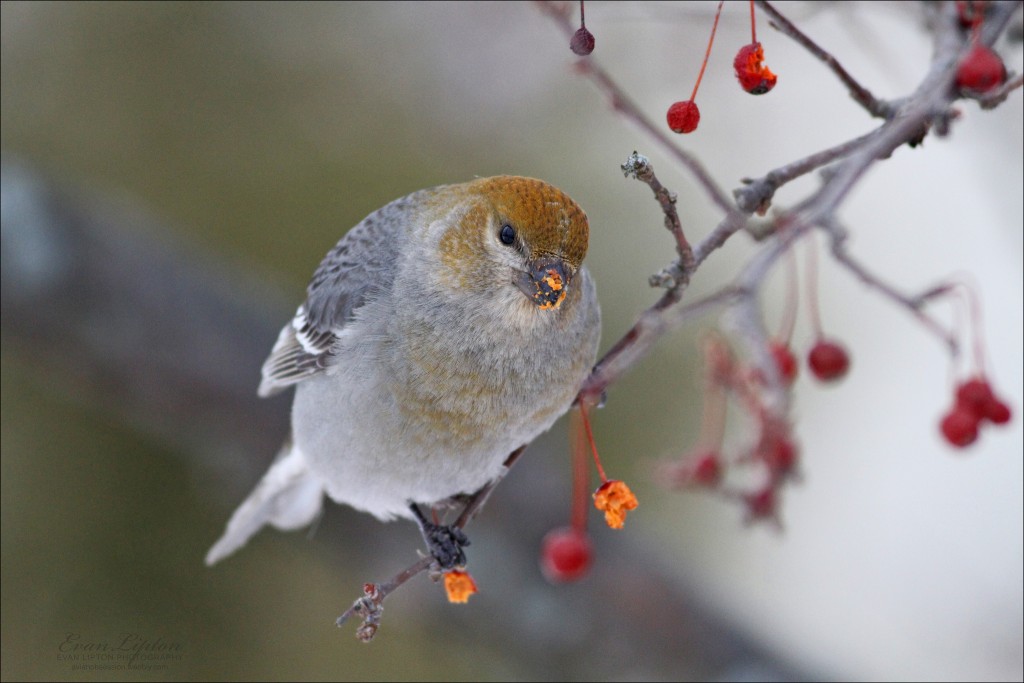
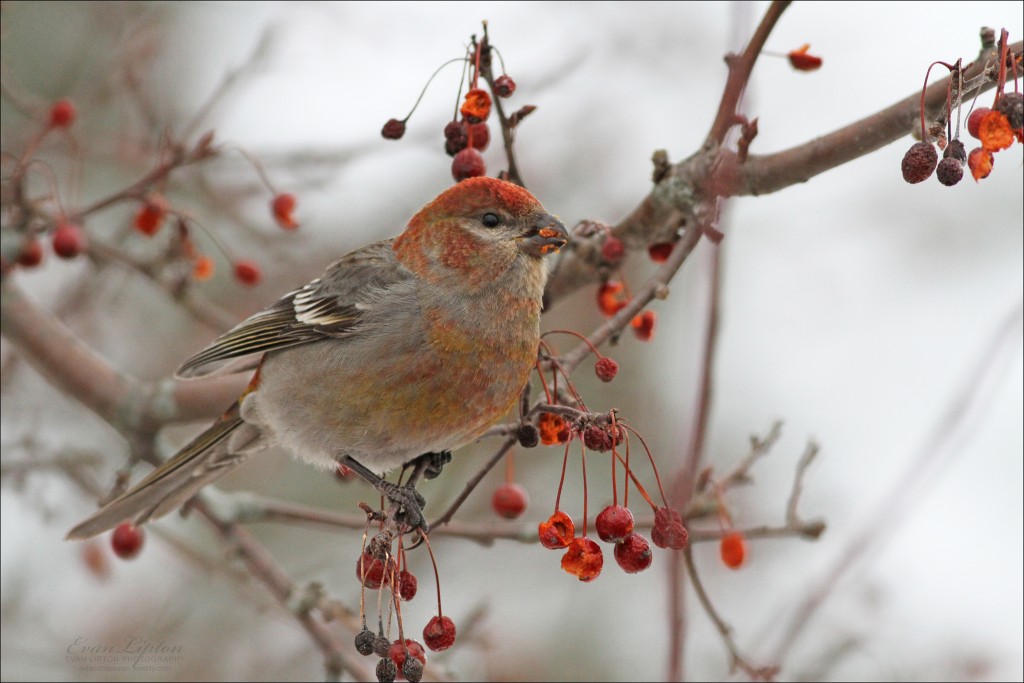
William Brewster recognized them as Pine Grosbeaks. They’re beautiful birds: the males a have a soft red head and breast that fades to light gray underneath, and dark wings with two white stripes or ‘wing bars’. In females and juveniles, the red head is replaced with a gold color. Large finches, they have stubby, thick, seed-cracking in beaks, similar in shape to a Northern Cardinal’s. In the winter, large foraging flocks of Pine Grosbeaks often strip entire trees of their fruits, crushing through pulp and seeds and moving on when the food source has been exhausted.

8480723386_dc2aabb2ca_k

8479623001_472271c794_k

Male (above) and female Pine Grosbeaks, photographed in Newburyport, Mass. Photos courtesy of Evan Lipton. © Evan Lipton 2013.

(These journal entries have been abridged and broken into shorter paragraphs for readability.)

Cambridge, January 10, 1893.

There were a good many Pine Grosbeaks scattered along the line of ashtrees on the ridge to my left and as I approached Mt. Auburn Street their numbers increased until upon reaching Mr. Hayes’s place I found the trees literally alive with them.

Soon after I stopped to look at them they began flying from every direction into a large white ash which stands near the foot of the avenue. This tree was loaded with fruit and with snow clinging to the fruit clusters and to every twig. In a few minutes it supported also more than a hundred Grosbeaks which distributed themselves quite evenly over every part from drooping lower to the upright upper branches and began shelling out and swallowing the seeds. The rejected wings floated down in showers and soon began to give the surface of the snow beneath a light brownish tinge. The snow clinging to the twigs and branches was also quickly dislodged by the movements, of the active, heavy birds and for the first few minutes it was continually flashing out in puffs like steam from a dozen different points at once. The finer particles, sifting slowly down, filled the still air and enveloped the entire tree in a gauzy veil or mist tinted, where the sun-beams pierced it, with rose, salmon and orange, elsewhere of a soft, dead white and of incredible delicacy and beauty, truly a fitting drapery for this winter picture- the hardy Grosbeaks at their morning meal.

They worked in silence when undisturbed and so very busily that at the end of an hour they had actually eaten or shaken off nearly half the entire crop of seeds. Some men employed in a marble cutter’s shop near the tree were neglecting their tasks to watch and discuss them. One of these men told me that a few Grosbeaks were seen in the tree late yesterday afternoon.

Cambridge, January 11, 1893

This was the great Grosbeak day; the city was simply flooded with them. Whenever or wherever I stepped out of doors I saw flocks of varying sizes flying overhead and the sound of their piping was always in my ears. Just after breakfast I took a walk up Brattle Street and found an immense flock feeding in an ash heavily laden with fruit in Mr. Piper’s place on the corner of Fayerweather Street. I counted 149 birds in this tree and there were fully half as many more in another ash in front of Mr. Richardson’s house on the opposite side of Brattle Street to Miller’s hearing Grosbeaks continually & seeing several flocks of from 30 to 50 birds each. They were in Hubbard Park the whole day and I saw a few on my own place but more visited the old cedar tree.

I had sent word to Faxon of this condition of things and at half-past three he arrived and we went together to the Piper place where we found the birds even more numerous than had been in the morning. They had stripped both ash trees and were operating on the fallen fruit.

Over the space covered by the spread of the branches of the Piper ash they were crowded together so closely as almost to conceal the snow[.] We divided into halves and made a rough count Faxon getting 108 and I 115 birds. We missed some and there were others in the trees and on the roofs of the neighboring houses. 250 would be a low estimate for the total number assembled here at this time.

They attracted much attention from the passers by and people in sleighs & on foot were continually stopping to look at them. One man asked if they were “harbingers of spring”, a question which gave us some grim amusement insomuch as we were suffering from the bitter cold and unable to stand still for more than a minute or two at a time.

As we were returning, about sunset, Grosbeaks were continually passing overhead coming from the direction of the Botanic Gardens and flying towards the West. I afterwards learned from Mr. Fernald that over 300 Grosbeaks spent the entire day in the Gardens and from Mr. Hoffman that there were about 70 in the College yard during the afternoon. These figures indicate that there total number in the city to-day must have exceeded 1000[.]

I visited the Hayes place this morning and again with Faxon in the afternoon but saw only a few stray Grosbeaks there. The men at work in the marble yard told me that the birds finished the fruit of the big ash before sunset yesterday. They spent most of the afternoon eating the fallen buds.

Cambridge, January 12 1893

Although Grosbeaks have continued very numerous through the day in the vicinity of my place their numbers have decreased very considerably as compared with yesterday – quite one half I should say. They have evidently exhausted the food supply hereabouts and are departing in search of fresh fields.

Brewster’s notes were the basis for an article published by the American Ornitholigsts’ Union in the ornithological journal ‘The Auk’. You can read Brewster’s article, ‘A Remarkable Flight of Pine Grosbeaks (Pinicola enucleator)’ at the Biodiversity Heritage Library website.

-Elizabeth Meyer

Notes from William Brewster: A Day on a Boston Harbor Garbage Scow

Monday, February 29th, 2016

On a bitter January morning in 1893, amateur ornithologist William Brewster took an excursion out past the Boston Harbor Islands, intending to take notes on marine birds and to collect a few if any caught his interest.

What better way to find Gulls and other seabirds than to hop onto a maritime garbage truck? The day’s bird notes are detailed and definitely an intriguing read for birders, but it’s his description of the city’s garbage disposal that make this entry particularly memorable.

(The passage is abridged and broken into shorter paragraphs for readability.)

January 19, 1893. Boston Harbor.

Met E. A. [Edward A. Bangs] & Outram Bangs by appointment at Fort Hill Wharf, Boston, at 10.30 A.M. Half an hour later we started down the Harbor (Dr. Sidney Holditch accompanying us) in a large scow loaded with city garbage consisting chief of decayed fruit, vegetables[,] scraps of meat etc. from the market and such from private houses, besides a great quantity of coal ashes and a miscellaneous assortment of waste paper, paper boxes battered tin cans etc. -in all some four hundred cart loads gathered during the preceeding twenty-four hours by the city scavengers.

This scow alternates with another of similar build in making daily trips, in tow of a tug, to the dumping grounds well outside the outer islands.

Despite the ice which, in cakes of varying size and thickness, covered the water for the first half of the way, we made such good progress that by 1 P.M. we reached the Graves and got rid of our redolent cargo.

This was accomplished quickly & easily by two men for the scow is so constructed that by the aid of a simple piece of mechanism the hull can be split in two longitudinally allowing a broad stream of water to flow directly through the hold from stem to stern and sweep everything out. The halves are hinged together of course & are prevented from sinking by capacious air chambers.

The tug steams steadily ahead during the operation so that the contents of the scow are not deposited in one spot but trail out behind forming a broad belt on the water for a distance of several hundred yards the ashes sinking quickly of course but much of the vegetable matter and all the paper floating, at least for a short time.

The great quantity of garbage thus spread out over the water usually attracts immense numbers of Gulls. Indeed we had been assured by several passengers who had made the trip that most of the birds in the harbor followed the scow to the dumping ground where others joined them from the open ocean until the assembled birds numbered thousands. The scow men confirmed this and added that the birds, having never been molested, ordinarily behave in the most fearless manner flapping past within a yard or two of the boat and were attempting to snatch choice morsels from her deck load.

It was to see all this and perhaps shoot a few specimens if anything rare was found among the birds that we undertook this expedition but we were utterly disappointed for the Gulls showed scarce any interest in the movements of the scow to-day.”  

Disappointingly, he did not see many birds he’d been hoping to encounter: no Guillemots, Auks, Puffins, Loons or Grebes, which he’d seen on a similar Boston Harbor trip in 1879.

He did note a large mixed flock of Herring Gulls and Black-backed Gulls (Great or Lesser), as well as a Kittiwake, large groups of Goldeneye Ducks and Red-breasted Mergansers, a ‘Gooseander’ (Common Merganser), a Black Duck, a ‘Velvet Scoter’ (today, the common name of a Eurasian species; it may have been one of our three New England species, a White-winged, Black, or Surf Scoter), and at least 25 seals, which he thought might be Harbor Seals

You can peruse his full journal entry here on the Biodiversity Heritage Library website.

-Elizabeth Meyer