Archive for October, 2014

Alexander Agassiz’s Expedition and Other Images Collection: An Archivist’s Process

Friday, October 24th, 2014

By Fougy Henry, EdM, MSLIS

Archivist and Library Assistant

Ernst Mayr Library, Museum of Comparative Zoology

Harvard University

Processing the Alexander Agassiz’s Expedition and Other Images Collection (1897-1950 (bulk)), which contains 734 gelatin dry plate glass negatives, 268 film negatives and 13 photographic prints requires several key skills: strong attention to detail, the ability to do research, knowledge of descriptive metadata, and most of all a steady hand.

I started this project in April 2012 with little experience in processing glass plate negatives. Before delving into the hands-on technical component of processing, I conducted a bit of research. I asked myself, what is this collection’s provenance?

Using my local resources I gained information from Robert Young, the Ernst Mayr Library’s Special Collections Librarian and records left behind from previous librarians. I learned that the images document the expeditions and work of Alexander Agassiz (1835-1910), a pioneer in oceanographic research, zoological investigation, and mining engineering. Agassiz was best known as a naturalist and for his expeditions, deep-sea investigations, and studies of coral reefs and islands. He devoted four decades to expanding and developing the Harvard University Museum of Comparative Zoology, where he served as curator and director from 1873 to 1910.  Included in the collection are many unpublished images from expeditions of the Albatross, Challenger, Croydon, and Yaralla to locations such as Easter Island, Fiji, and Australia, as well as glimpses of Agassiz’s Newport, Rhode Island laboratory and home; also photographs taken by later MCZ director Thomas Barbour and a number of zoological specimen images. The collection, stored in a cabinet in the library’s Room K for decades, was initially processed in the 1970s, when group numbers were assigned and attempts at identification were made.

In order to get myself organized to process this collection I took following steps:

IMG_1

Survey the collection 

I began in-depth evaluation of the collection with the sizing and counting of the glass plates. The survey step was necessary to improve control of the images and to order supplies to rehouse them. Maggie Hale from Harvard Library Imaging Services provided a batch-loader spreadsheet and draft work plan template to document the descriptive metadata.  Ms. Hale and Brenda Bernier from the Weissman Preservation Center examined the collection and provided technical advice.

Documentation of Descriptive Information

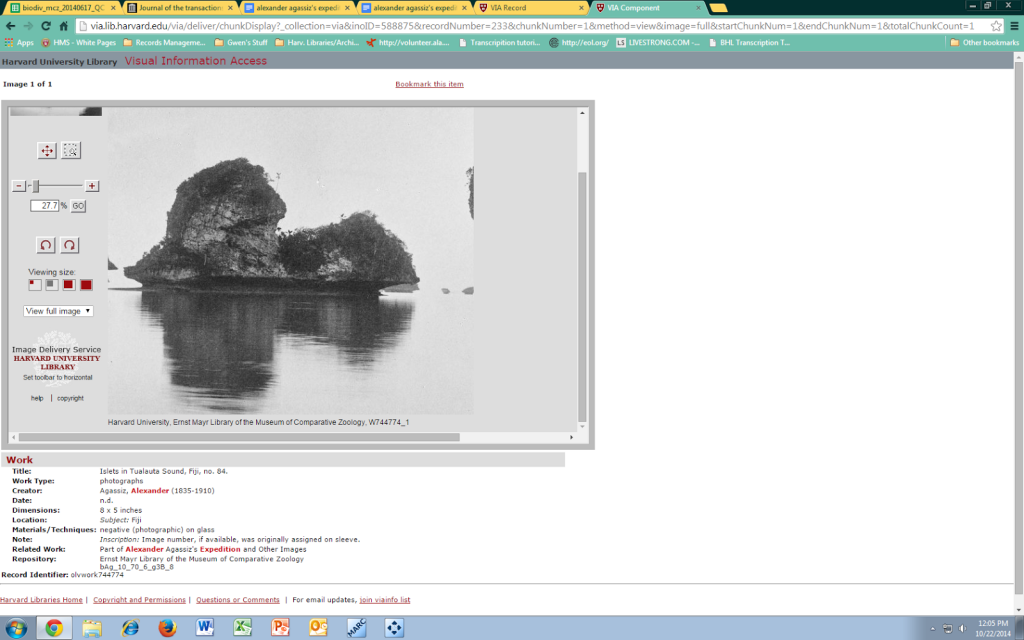
Starting in June 2012, I literally took items from each wooden drawer (see image above), reorganized them by the group numbers and subject areas that were developed by librarians in the 1970’s, measured and documented the length and width of each item, transcribed descriptive information on the original sleeve, and noted the condition and type of each item (broken, chipped, or torn; glass, film or paper photograph) in the batch-loader Google Doc spreadsheet template. After completing the documentation, I grouped the sizes within a group number together. For example for group g3B all the glass plates were put together, and the same method was followed for the film and print photographs. In the screenshot below you will see the digitized glass plate with the descriptive fields listed underneath. The descriptive metadata was gleaned from the batch-loader spreadsheet.
IMG_2

Cataloging:

Call numbers and Hollis record (Hollis #014208913) for the collection were developed by Robert Young. Between September and November 2013 I matriculated in the Library Juice Academy course, Describing Photographs for the Online Catalogue, which increased my skills in providing rich descriptive metadata.

Cleaning:

The collection was in remarkable good condition except for a few broken glass plates. The conservation steps taken were to remove dust, and debris. To clean the glass plates, while wearing nylon gloves I held the glass plate with one hand and wiped down the ink-free side with ethanol alcohol soaked cotton cloth. Once dry, I placed the glass plates in acid-free enclosures and boxed them in preparation for digitization at Harvard Library Imaging Services. For films and prints I gently removed dust with either a blower or cotton cloth.

Shipping and Rehousing for Permanent Storage:

Items were grouped – glass plates, followed by film and prints – and placed in temporary record center boxes designed for transport with Volara and bubble wrap for inside padding. They were then brought from the Ernst Mayr Library’s Special Collection to the Harvard Library Imaging Services at Widner Library by Robert Young and his wife Eriko in their car.  After the items were digitized and returned to the Ernst Mayr Library, I rehoused them in permanent storage boxes.

Digitization:

Digitization of the collection was completed in August 2014, and the descriptive information from the spreadsheet, linked to the images, is now in the Harvard University Library’s Visual Information Access catalog (VIA), and can be accessed here.

List of materials used:

  1. Record center boxes for temporary storage and transport.
  2. Suspension boxes for permanent storage
  3. ethanol alcohol
  4. cotton pads
  5. acid-free sleeves
  6. magnifying glass
William McMichael Woodworth with woman on deck, Samoa. 1897, Photograph from glass-plate negative

William McMichael Woodworth with woman on deck, Samoa. 1897, Photograph from glass-plate negative

Personal Reflections:
My greatest fear while working with this collection was that I would break a glass plate negative. Luckily for me and the collection, this never happened! What did break was my initial assumption that I wouldn’t be able to personally connect with a scientific exploration collection.  Although I held each item up to a light and reviewed them with a magnifying glass in order to better describe them, some details became more apparent once digitized. The digitized collection revealed indigenous and local peoples of Fiji, Samoa, Peru, Samba River Valley, Panama, Cuba and Jamaica.

As an Archivist, my academic training and professional experiences provided me with the ability to arrange and describe collections, and yet they also position me to create more intersections between the collections with their corresponding peoples, cultures, places and times.  Two years ago when I took on the project, I did not think of the subject areas of Cultural anthropology, Native aesthetics, Colonization, Sociology or Ecology as research uses in addition to scientific exploration, and zoological specimens.  I think of the descendants of the indigenous people in these images and their possibility to have more access to their elders that are long gone. I’m glad I was able to personally connect to a rich part of history.
Alexander Agassiz’s Expedition and Other Images Collection is now accessible!

Thursday, October 23rd, 2014

fiji

Background

The collection, which primarily documents the expeditions and work of Alexander Agassiz, a pioneer in oceanographic research and zoological investigation and curator and director of the Museum of Comparative Zoology (1873-1910), consists of 734 gelatin dry plate glass negatives, 268 film negatives, and 13 photographic prints from the late 1890s through the mid-twentieth century.  The photographs were taken on the Albatross, Challenger, Croydon, and Yaralla expeditions to locations such as Easter Island, Fiji, and Australia, as well as at Agassiz’s Newport, Rhode Island, laboratory and home and at other sites.  The collection also includes images taken by Thomas Barbour (who was a student of Alexander Agassiz two decades before becoming MCZ director himself) in South America, Indonesia, Jamaica, Cuba and Florida, as well as those (chiefly zoological specimens) photographed at or for the MCZ.

The images, which were digitized at Harvard Library Imaging Services, supplement related images of the three Albatross expeditions to the Pacific (1891, 1899-1900, and 1904-1905) and the Hassler Expedition to South America (1871-1872), accessible through the HUL Open Collections Program’s Expeditions & Discoveries web page.

Access

The collection’s 1,015 digital images are in the Harvard University Library’s Visual Information Access catalog (VIA) and can be accessed here.

Robert Young, Special Collections Librarian

Fougy Henry, EdM, MSLIS Archivist and Library Assistant

New book list, October 22, 2014

Thursday, October 23rd, 2014

Les amphibiens et les reptiles du Languedoc-Roussillon et régions limitrophes: atlas biogéographique.
[By] Philippe Geniez et Marc Cheylan. [Mèze]: Biotope; [Paris]: Muséum national d’histoire naturelle, 2012. HOLLIS# 014151386
QL658.F7 G45 2012

Les animaux et écosystèmes de l’Holocene disparus de Madagascar.
[By] Steven M. Goodman & William L. Jungers; illustrations de Velizar Simeonovski. Antananarivo, Madagascar: Association Vahatra, 2013. HOLLIS# 014173585
QE720.2.M28 G66 2013

Atlas des amphibiens et reptiles de France.
Jean Lescure & Jean-Christophe de Massary, coordinateurs; ouvrage collectif de la Société herpétologique de France. Mèze: Biotope; Paris: Muséum national d’histoire naturelle, 2012. HOLLIS# 014151420
QL658.F7 S63 2012

The birds of London.
By Andrew Self. London; New York: Bloomsbury Publishing Plc, 2014. HOLLIS# 014173590
QL690.G7 S45 2014

The breeding birds of the London area: the distribution and changing status of London’s breeding birds in the closing years of the 20th century.
Editor, Jan Hewlett; survey co-ordinator, K.F. Betton; maps, M.J. Earp; editorial advisory group, P.F.S. Cornelius … [et al.]. London: London Natural History Society, 2002. HOLLIS# 014173595
QL690.G7 B74 2002

Catalogue of the Masao Oita insect collection, the University Museum, the University of Tokyo.
By Masaya Yago [and 7 others]. Tōkyō-to Bunkyō-ku: Tōkyō Daigaku Sōgō Kenkyū Hakubutsukan, 2014. HOLLIS# 014212639
QL556.J3 T65 2014

Daichi no megumi to sono miryoku: dai 29-kai tokubetsu kikakuten = Presentation of geoheritage: 29th special exhibition.
Toyohashi-shi Shizenshi Hakubutsukan; [henshū, Satō Chisako]. [Toyohashi]: Toyohashi-shi Shizenshi Hakubutsukan, 2014. HOLLIS# 014152386
QE304.D34 2014

The Evolutionary Feedback between Genetic Conflict and Genome Architecture.
By Adrian Young. Thesis, Ph.D. Harvard University, 2014. HOLLIS# 014101158
QH447.Y68 2014

Handbook of the mammals of the world. Volume 4: sea mammals.
Chief editors, Don E. Wilson, Russell A. Mittermeier; associate editors, Sue Ruff, Albert Martínez-Vilalta; authors, Paolo Cavallini … [et al.]. Barcelona: Lynx, c2009-. HOLLIS# 012111668
Ref. QL701.2.H25 2009 v. 4

Kamele sind anders – Trampeltiere in MitteleuropaSozialverhalten – Haltungsproblematik – Reiten und Therapie.
By Gabriele Heidicke mit einem Beitr. von Pamela Holzlöhner1. Aufl. Hohenwarsleben Westarp-Wiss. 2011. HOLLIS# 014173655
QL737.C433 H44 2011

A message from Martha: the extinction of the passenger pigeon and its relevance today.
By Mark Avery. London; New York: Bloomsbury, 2014. HOLLIS# 014203698
QL696.CC63 A87 2014

Modern phylogenetic comparative methods and their application in evolutionary biology: concepts and practice.
László Zsolt Garamszegi, editor. Heidelberg; New York: Springer, [2014]. HOLLIS# 014208961
QH367.5.M63 2014

Narwhal tusk discoveries.
By Martin T. Nweeia. [place of publication not identified]: [publisher not identified], [2014]. HOLLIS# 014208706
QL737.C433 N84 2014

The passenger pigeon.
By Errol Fuller. Princeton, New Jersey: Princeton University Press, [2014]. HOLLIS# 014203704
QL696.C63 F85 2014

Die Säugetiere Schleswig-Holsteins.
[By] Peter Borkenhagen; herausgegeben von der Faunistisch-Ökologischen Arbeitsgemeinschaft Schleswig-Holstein. Husum: Husum Druck- und Verlagsgesellschaft, 2011. HOLLIS# 014174575
QL728.G3 B67 2011

A taxonomic study on the family formicidae from Hubei Province (Insecta.Hymenoptera: Formicidae).
By Wang Rei. Wuhan: Zhongguo di zhi da xue chu ban she, 2009. HOLLIS# 014202558
QL568.F7 W36 2009

Türkiye kuşları cep kitabı = The pocket book for birds of Türkiye.
Prof. Dr. İlhami Kiziroğlu. 2. baskı. Ankara: Geoturka, 2009. HOLLIS# 013734005
QL691.T9 K59 2009

The walking whales: from land to water in eight million years.
By J.G.M. Thewissen; with illustrations by Jacqueline Dillard. Berkeley: University of California Press, [2015]. HOLLIS# 014135019
QE882.C5 T484 2015

New book list, October 8, 2014

Thursday, October 9th, 2014

Aggression in humans and other primates: biology, psychology, sociology.
Edited by Hans-Henning Kortüm & Jürgen Heinze. Berlin; Boston: De Gruyter, [2013]. HOLLIS# 014173649
BF575.A3 A5237 2013

Amphibian conservation: global evidence for the effects of interventions.
By Rebecca K. Smith and William J. Sutherland. Exeter: Pelagic Publishing, [2014]. HOLLIS# 014173581
QL644.7.S65 2014

Bee time: lessons from the hive.
By Mark L. Winston. Cambridge, Massachusetts: Harvard University Press, 2014. HOLLIS# 014020511
SF523.3.W547 2014

Between land and sea: the Atlantic Coast and the transformation of New England.
By Christopher L. Pastore. Cambridge, Massachusetts: Harvard University Press, 2014. HOLLIS# 014020516
GB459.4.P37 2014

Biota rossiĭskikh vod ͡IAponskogo mor͡ia (Biota of the Russian waters of the Sea of Japan). Volumes 1-9.
Glavnyĭ redaktor serii, V.L. Kasʹ͡ianov. Vladivostok: Dalʹnauka, 2004-. HOLLIS# 013416629
QH95.24.B56 2004

Cerambycidae sul-americanos (Coleoptera): taxonomia: subfamília Cerambycinae. Vol. 5: Cerambycini-Subtribo Sphallotrichina subtrib. nov., Callidiopini Lacordaire, 1869, Graciliini Mulsant, 1839, Neocorini trib. nov. Vol. 13: Subfamília Lamiinae, Hemilophini Thomson, 1868, parte I. Suplemento 3.
Ubirajara R. Martins, organizador. São Paulo: Sociedade Brasileira de Entomologia, 1997-. HOLLIS# 012107944
QL596.C4C47 1997 v. 5, 13 (pt. 1)

Catalogue of the living bivalvia of the continental coast of the Sea of Japan (East Sea) = Katalog sovremennykh dvustvorchatykh molli͡uskov kontinentalʹnogo poberezhʹi͡a I͡Aponskogo mori͡a.
By K.A. Lutaenko and R.G. Noseworthy. Vladivostok: Dalʹnauka, 2012. HOLLIS# 014202897
QL430.6.L88 2012

Crabs and shrimps of the Pacific Coast: a guide to shallow-water decapods from southeastern Alaska to the Mexican border.
By Gregory C. Jensen, Ph.D. 2nd edition. Bremerton (3808 Sundown Dr.), Washington: MolaMarine, ©2014. HOLLIS# 014203678
QL444.M33 J46 2014

Deepwater megabenthos of south-western Australia.
Edited by F.R. McEnnulty. Perth, W.A.: Western Australian Museum, 2011. HOLLIS# 014203554
QH95.55.A8D34 2011

Diversity, prevalence, and host specificity of avian Plasmodium and Haemoproteus in a Western Amazon assemblage.
By Maria Svensson-Coelho, John G. Blake, Bette A. Loiselle, Amanda S. Penrose, Patricia G. Parker, and Robert E. Ricklefs. Washington, D.C.: American Ornithologists’ Union, 2013. HOLLIS# 014174436
QL696.P2 S84 2013

Dolphin confidential: confessions of a field biologist.
By Maddalena Bearzi. Chicago; London: The University of Chicago Press, 2012, ©2012. HOLLIS# 013165175
QL737.C432 B43 2012 [e-book]

Ecogeographic patterns of morphological variation in Elepaios (Chasiempis Spp): Bergmann’s, Allen’s, and Gloger’s rules in a microcosm.
By Eric A. Vanderwerf. Washington, D.C.: American Ornithologists’ Union, c2012. HOLLIS# 014174410
QL696.P255 V36 2012

Evolutionary dynamics of mammalian karyotypes.
Editors, Roscoe Stanyon, Alexander Graphodatsky. Basel; New York: Karger, 2012. HOLLIS# 014173617
QH390.E983 2012

An evolutionary perspective on germ cell specification genes in insects.
A dissertation presented by Benjamin Ewen-Campen. Thesis, Ph.D., Harvard University, 2014. HOLLIS# 014101226
QH607.E83 2014

Frogs: genetic diversity, neural development, and ecological implications.
Henry Lambert, editor. New York: Nova Publishers, [2014]. HOLLIS# 014122144
QL668.E2 F7747 2014

The influence of anthropogenic noise on birds and bird studies.
Edited by Clinton D. Francis and Jessica L. Blickley. Washington, D.C. : American Ornithologists’ Union, 2012. HOLLIS# 014174421
QL698.95.F73 2012

Linking bacterial symbiont physiology to the ecology of hydrothermal vent symbioses.
By Roxane Beinart. Thesis, Ph.D., Harvard University, 2014. HOLLIS# 013966038
QH548.B34 2013

Microbiology of the avian egg.
Edited by R.G. Board and R. Fuller. 1st ed. London; New York: Chapman & Hall, 1994. HOLLIS# 013599679
QR116.M53 1994

Mosquito eradication: the story of killing “Campto”.
Editors, Brian H. Kay and Richard C. Russell. Collingwood, VIC: CSIRO Publishing, [2013]. HOLLIS# 014173623
RC116.M66 2013

A natural history of Australian bats: working the night shift.
By Greg Richards and Les Hall; principal photographer, Steve Parish. Collingwood, Vic.: CSIRO Pub., ©2012. HOLLIS# 014173628
QL737.C5R478 2012eb [e-book]

Ninth International workshop on Agglutinated Foraminifera, Zaragoza, Spain, September 3-7, 2012: Abstract volume.
Edited by L. Alegret, S. Ortiz and M. A. Kaminski. London: The Grzybowski Foundation, 2012. HOLLIS# 014199577
QE772.I57 2012

North American amphibians: distribution and diversity.
By David M. Green, Linda A. Weir, Gary S. Casper, and Michael J. Lannoo. Berkeley: University of California Press, [2014]. HOLLIS# 014019981
QL651.G74 2014

A photographic guide to some common birds of Aravallis.
By Shriyans Bhandari. Rajasthan: Rajasthan Tourism Development Corporation Ltd., [2013]. HOLLIS# 014169384
QL691.I4 B53 2013

Planting for wildlife: a practical guide to restoring native forests.

Nicola Munro and David Lindenmayer. Collingwood, Vic.: CSIRO Publishing, 2011. HOLLIS# 014173633
SD409.M86 2011eb [e-book]

Predictors of juvenile survival in birds.
By Terri J. Maness and David J. Anderson. Washington, D.C.: American Ornithologists’ Union, 2013. HOLLIS# 014174443
QL698.2.M25 2013

Regenerat͡sii͡a u goloturiĭ. [Regeneration in holothurians].
[By] I. I͡U. Dolmatov, V.S. Mashanov. Vladivostok: Dalʹnauka, 2007. HOLLIS# 014202898
QL384.H7D65 2007

Report of the seventh session of the sub-committee on aquaculture: St Petersburg, Russian Federation, 7-11 October 2013.
Rome: Food and Agriculture Organization of the United Nations, [2014]. HOLLIS# 014202550
SH3.F66 2013

A sparrowhawk’s lament: how British breeding birds of prey are faring.
By David Cobham; with illustrations by Bruce Pearson. Princeton, New Jersey; Woodstock, Oxfordshire, United Kingdom: Princeton University Press, [2014]. HOLLIS# 014173635
QL696.F3 C63 2014

Vyrashchivanie lichinok donnykh morskikh bespozvonochnykh v laboratornykh uslovii͡akh :prakticheskie rekomendat͡sii. [Rearing of benthic marine invertebrates under laboratory conditions :practical recommendations].
[By] S.D. Kashenko. Vladivostok: Dalʹnauka, 2010. HOLLIS# 014196398
QL362.8.K37 2010