Archive for December, 2012

New books list, December 19, 2012

Thursday, December 20th, 2012

All-Ireland Mammal Symposium 2009.
Fidelma Butler and Conor Kelleher (editors). [Belfast] : Irish Naturalists’ Journal, [2012]. HOLLIS# 013481576
QL728.I7 A45 2009

The Crustacea : revised and updated from the Traité de Zoologie. Volume 3.
Edited by J. Forest and J.C. von Vaupel Klein ; advisory editor, F.R. Schram. Leiden ; Boston : Brill, 2004- . HOLLIS# 009471158
QL435.C77 2004 v. 3

Dolphin-human interaction program : policies, problems and alternatives.
By Kristin L. Stewart, Lori Marino. Ann Arbor, MI : Animals and Society Institute, [2009], ©2009. HOLLIS# 013514584
QL737.C432 S73 2009

Forest biodiversity in North, Central and South America, and the Caribbean : research and monitoring.
Edited by F. Dallmeier and J.A. Comiskey. Paris : UNESCO ; New York : Parthenon Pub. Group, 1998. HOLLIS# 013462773
QH77.N56 F67 1998

A glorious enterprise : the Academy of Natural Sciences of Philadelphia and the making of American science.
By Robert McCracken Peck and Patricia Tyson Stroud ; photographs by Rosamond Purcell. 1st ed. Philadelphia : University of Pennsylvania Press, c2012. HOLLIS# 013151336
QH70.U62 P557 2012

Halocyprid ostracods of the Arabian Sea region.
By Inna Drapun, Sharon L. Smith. Muscat, Oman : Sultan Qaboos University, Academic Publication Board, 2011. HOLLIS# 013495980
QL444.O83 D73 2011

Une nouvelle classification du genre Carabus L., 1758 : liste Blumenthal 2011-2012.
Par Thierry Deuve, Muséum national d’histoire naturelle, Paris. Andrésy : Association Magellanes, 2012. HOLLIS# 013471027
QL596.C2 D48 2012

Restoration and reclamation of boreal ecosystems : attaining sustainable development.
[Edited by] Dale H. Vitt and Jagtar S. Bhatti. Cambridge ; New York : Cambridge University Press, 2012. HOLLIS# 013400384
QH541.5.T3 V55 2012

To fashion a fauna for British India.
By John Mathew. Thesis (Ph.D., Dept. of the History of Science). Cambridge, Mass.: Harvard University, 2011. HOLLIS# 013471034
QL309.M37 2011

Transition from low-value fish to compound feeds in marine cage farming in Asia.
By Mohammad R. Hasan. Rome : Food and Agriculture Organization of the United Nations, 2012. HOLLIS# 013512455
SH295.H27 2012

World aquaculture 2010.
Aquaculture Service, Fisheries and Aquaculture Resources Use and Conservation Division, Fisheries and Aquaculture Department. Rome : Food and Agriculture Organization of the United Nations, 2011. HOLLIS# 013512972
SH135.W77 2011

Happy Holidays from the Library Pets

Thursday, December 20th, 2012

(To the tune of Jungle Bells, sort of )

Hissing roach! Hissing roach! We’re the very best;
Hissing roaches are so good, we’re not like all the rest.
Hissing as we go, we are very nice
Unlike all those other ones, we do not infest.

Oh! Cockroaches! Cockroaches!
We are very sweet.
We are very lovely pets
And we are very neat.

Best wishes from the Cockroaches (the Library Pets, NOT pests)

Exhibits in NWB

Thursday, December 20th, 2012

Visit http://blogs.law.harvard.edu/nwblibrarylab/ to keep up with what’s happening in the new exhibit cases in the lobby of the Northwest Building. Suggestions are always welcome …

Lepidoptera Love: Nabokov’s Untold Story

Saturday, December 8th, 2012

“I have hunted butterflies in various climes and disguises: as a pretty boy in knickerbockers and sailor cap; as a lanky cosmopolitan expatriate in flannel bags and beret; as a fat hatless old man in shorts.”

Although Vladimir Nabokov is remembered as one of America’s most venerated novelists, his first and most beloved pastime was not the writing of books but, the chasing of butterflies. Nabokov loved butterflies long before Humbert Humbert fell so tragically in love with his adolescent nymphet and long after American parents had stopped naming their children “Lolita.” 


Nabokov’s Childhood Inspiration
In celebration of Nabokov’s lifelong love for this branch of entomology we are spotlighting a book that BHL partner MBLWHOI has digitized for your viewing enjoyment:

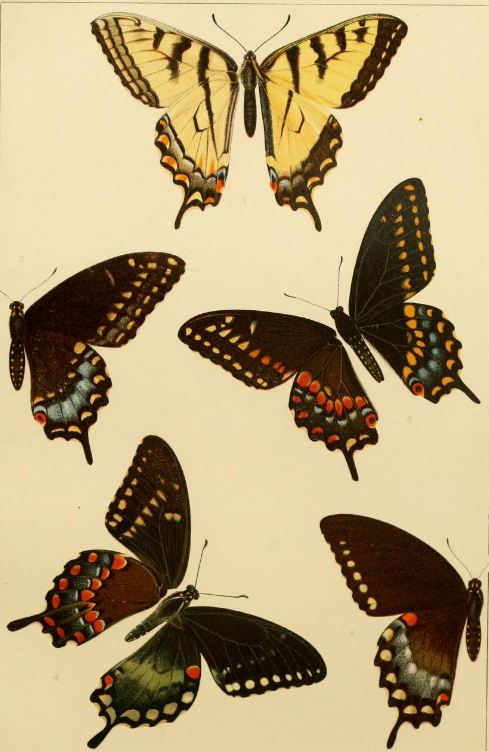
The butterflies of the eastern United States and Canada : with special reference to New England  by Samuel Hubbard Scudder.

From VN’s personal collection

The three volume set of this work indisputably shaped Nabokov’s first perceptions of the hidden world of taxonomy; a world concerned with type specimens, small red tags, and the tiniest of minutia. It has been confirmed that the Nabokov family library in Vyra, Russia held a copy of this book. Perhaps, it is the very same one that Nabokov is enjoying featured in the picture above. Although, Nabokov appears to exhibit the politeness and propriety as expected from a young aristocratic boy, one can only imagine a young Vladimir privately perusing this book’s pages and beautiful color lithographs with gluttonous delight.

A little known fact is that Nabokov deeply admired author Samuel Hubbard Scudder, author of this work. Nabokov emigrated to the United States in 1940 and within a year moved to Cambridge, Massachusetts where he would volunteer to organize the then disheveled collections of butterfly specimens held in the Museum of Comparative Zoology’s Entomology Department. This is the collection that was started by Samuel Scudder and A.S. Packard in 1859. In fact, many of the specimens held in the collection were personally contributed by Scudder himself. It was not by a twist of fate that Nabokov ended up in Cambridge; his admiration for Scudder had paved the way.

From the Book of the Week
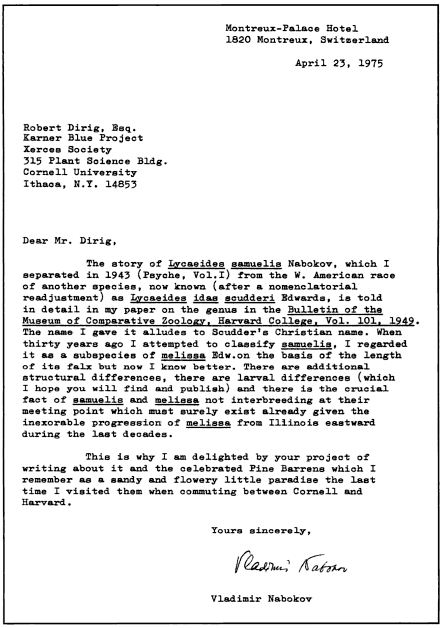
In tribute to Scudder, upon discovering a misclassified species of  butterfly that bore the wrong label in the Museum of Comparative Zoology’s collection, he renamed the sub-species of melissa after him: Lycaeides mellisa samuelis, commonly known as the Karner Blue.
It truly was a rare man to be held in high esteem by Nabokov who has been noted by his biographers to be a markedly irreverent man who saw little wrong with calling Ezra Pound a total fake, criticizing Audubon’s technique in regards to his illustrations of butterflies, or perhaps most shocking: disparaging Darwin’s Theory of Evolution. To the average person,  such criticism is considered blasphemy. Nevertheless, we all know Nabokov was far from average and behind each criticism he had as always had diligently and ever so painstakingly collected evidence to support his statements.


Nabokov’s Lepidoptera Career and Contributions
While working at MCZ, Nabokov’s passion for lepidoptera was quickly noted. He was eventually appointed to a paid position as the de-facto Curator of Lepidoptera for the museum and served this post from 1942-1948. It would be during this time that he would produce his most important contributions to the field. His top three accomplishments were:


The Karner Blue, its own species?
1) The separation of the Karner Blue aka Lycaeides melissa samuelis from the Lycaeides idas group. As noted earlier, there was a butterfly that had been misclassified in the MCZ collections. This particular butterfly had previously not been observed and described by taxonomists. After doing extensive work in genitalia comparison for the butterfly, Nabokov renamed the specimen in honor of Scudder by giving the specimen his first name samuelis. Some have even suggested that this sub-species might be a full-fledged biological species in its own right but, further inquiry still needs to be done. Any takers? You can read his 1943 article in the open-source journal Psyche where he separates out the Karner Blue from the idas.


2) Providing a compelling hypothesis about the Polyommatus blues evolutionary and migratory paths in his 1945 Psyche paper Notes on Neotropical Plebejinae. He conjectured that they came from a common ancestor that lived about 10 million years ago in Asia and they migrated by way of the Bering Strait and moved slowly all the way down to Chile. While most full-time lepidopterists had disregarded Nabokov’s findings as those of a dilettante, a recent paper has vindicated Nabokov’s theory (using gene-sequencing technology to map evolutionary relationships) showing that he was correct about the migratory patterns of the Blues. Of last year’s discovery, Naomi Pierce current Curator of Lepidoptera at the MCZ and co-author of the vindicating paper said she “was blown away…because he made these five predictions about what our time traveler would see, and he was spot-on correct about all of them.” Read the full story which appeared in the NY Times last year.
Migratory patterns of the Blues from N.Pierce’s et. al. article


3)  A complete revision of the North American members of the genus Lycaeides. After dissecting 350 specimens, Nabokov came up with three groups: Lycaeides argyrognomon (renamed idas in 1954), Lycaeides scudderi and Lycaeides melissa. Of the paper he wrote and published in the Bulletin of the Museum of Comparative Zoology (available for free on the BHL) Nabokov said, “This work took me several years and undermined my health for quite a while. Before I never wore glasses. This is my favorite work. I think I really did well there.” Later, a review from Alexander Klots author of Field Guide to the Butterflies of North America glowingly said “the recent work of Nabokov has entirely rearranged the classification of this genus.”  Nabokov couldn’t have been more pleased saying, “That’s real fame. That means more than anything a literary critic might say.”


Nabokov’s fanciful illustrations
Nabokov’s Legacy?

So are we to remember this man foremost as a Novelist or a Lepidoperist? Surely, his books would have been nothing without his butterflies. The pages of Nabokov’s fictional work flutter with 570 mentions of butterflies and entomologists have now named over 20 species of butterfly after characters from his novels. Ironically, it was Nabokov’s literary importance and notoriety that drew disdain from the very community that he so desired to be apart of. Most full time lepidopterists considered Nabokov a boyish aficionado with a reputation for excessive”splitting.” Moreover, they felt he had not earned but garnered the title “most famous lepidopterist in the world,” simply because of his literary status. Since many of Nabokov’s contributions to the sciences have been vindicated we think it only right to remember him as much a lepidopterist as a literary giant. The notion that the twain can meet is perhaps embodied in a quote from his novel Pale Fire: “Does there not exist a high ridge where the mountainside of ‘scientific’ knowledge joins the opposite slope of ‘artistic’ imagination?”

Yes, and it is on this Ridge where one will find Nabokov. At last Nabakov has been wholeheartedly accepted by the very community that once disregarded him. We know he would be pleased if he were alive today. Is it not comforting to know that a man of such incredible fame considered the life of the taxonomist, who busies himself with the classification and description of all of Earth’s wonderful creatures, the most rewarding of all. He knew the work to be done was endless, the pay less than fabulous, and the fame? Are you kidding? The thought is laughable. The work of the taxonomist is oft overlooked and its characters considered by society as dusty anachronisms who do monotonous “detail-oriented things.” Yet the work that is done is not done for the attention or glamor that it brings, but rather the inner satisfaction that comes from knowing that you are making a contribution that is vitally important to the existence and persistence of life.

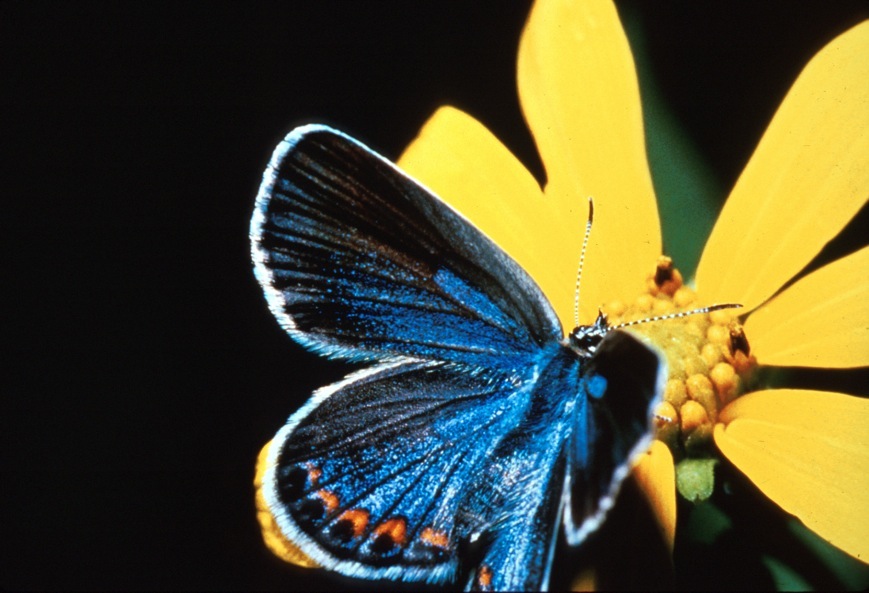
Photocredit: US Fish and Wildlife Service, Ann Swengel


Today, the Karner Blues are poster-children of the conservation movement due in-part because of Nabokov’s work on them. In the early 60’s and 70’s Nabokov was still able to catch them on road-trips from Cornell to Boston. However in 1992, the Karner blue butterflies were federally listed as endangered. The dramatic decline in their population is due to habitat loss and modification resulting from human activities.


Jacqueline Ford, Biodiversity Heritage Librarian
This is a guest post that was originally featured on the BHL Blog on 12/07/2012. Click here to view the original posting.

New Books List, December 5, 2012

Wednesday, December 5th, 2012

Alhajas para soberanos : los animales reales en el siglo XVIII : de las leoneras a las mascotas de cámara.
By Carlos Gómez-Centurión Jiménez. Valladolid :J unta de Castilla y León, Consejería de Cultura y Turismo, 2011. HOLLIS# 013402794
DP192.5.G64 2011

Beyond reductionism : a passion for interdisciplinarity.
Edited by Katharine N. Farrell, Tommaso Luzzati and Sybille van den Hove. Milton Park, Abingdon, Oxon ; New York : Routledge, 2013. HOLLIS# 013393438
QH541.15.E25 B49 2013

Callianassoidea of the world (Decapoda, Thalassinidea).
By Katsushi Sakai. Leiden ; Boston : Brill, c2005. HOLLIS# 013402860
QL444.M33 S35 2005

Chameleons of Africa : an atlas : including the chameleons of Europe, the Middle East and Asia.
By Colin R. Tilbury. Frankfurt am Main : Edition Chimaira ; Lanesboro, MN : Zoo Book Sales, Serpent’s Tale [U.S. distributor], 2010. HOLLIS# 013402883
QL666.L23 T55 2010

Conservation biology : a primer for South Asia.
Kamaljit S. Bawa, Richard B. Primack, Meera Anna Oommen.3rd ed. Hyderabad, India : Universities Press (India), 2011. HOLLIS# 013402819
QH77.S6 B39 2011

Conservation, ecology, and management of catfish : the second international symposium.
Edited by Paul H. Michaletz and Vincent H. Travnichek. Bethesda, Md. : American Fisheries Society, 2011. HOLLIS# 013397336
SH351.C4 I58 2010

Environmental flows : saving rivers in the third millennium.
By Angela Helen Arthington. Berkeley : University of California Press, c2012. HOLLIS# 013397401
QH541.5.S7 A78 2012

Feline behaviour and welfare.
By Andrew F. Fraser. Wallingford, Oxfordshire, UK ; Cambride, MA : CABI, c2012. HOLLIS# 013397461
QL737.C23 F744 2012

Field guide to the birds of Macaronesia : Azores, Madeira, Canary Islands, Cape Verde.
By Eduardo Garcia-del-Rey. 1st ed. Barcelona : Lynx, [2011]. HOLLIS# 013397464
QL694.5.M26 G37 2011

Fish karyotypes : a check list.
By Ryoichi Arai. Tokyo : Springer, c2011. HOLLIS# 013397466
QL638.99.A72 2011

Guide to the butterflies of the Palearctic Region. Nypmhalidae, part V, subfamily Nymphalinae.
Editor : G. C. Bozano. Milano : Onmes Artes ; 1999- . HOLLIS# 009115949
QL546.G84 1999 v. 3, pt. 5

The macaque connection : cooperation and conflict between humans and macaques.
Sindhu Radhakrishna, Michael A. Huffman, Anindya Sinha, editors. New York : Springer,[2012], c2013. HOLLIS# 013397529
QL737.P93 M23 2012

Marine interstitial poecilostomatoida and cyclopoida (copepoda) of Australia.
By Tomislav Karanovic. Leiden ; Boston : Brill, 2008. HOLLIS# 013402854
QL444.C73 K37 2008

The mortal sea : fishing the Atlantic in the Age of Sail.
By W. Jeffrey Bolster. Cambridge, Mass. : Belknap Press of Harvard University Press, c2012. HOLLIS# 013190747
SH213.5.B65 2012

The naturalized animals of Britain and Ireland.
By Christopher Lever. [Rev. ed.] London : New Holland, 2009. HOLLIS# 013402881
QL255.L56 2009

Planet without apes.
By Craig B. Stanford. Cambridge, Mass. : Belknap Press of Harvard University Press, 2012. HOLLIS# 013190804
QL737.P96 S733 2012

The science of entomology.
By William S. Romoser, John G. Stoffolano, Jr. 4th ed. Boston, Mass. : WCB McGraw-Hill, c1998. HOLLIS# 007716094
QL463.R65 1998

2nd atlas of the breeding birds of Maryland and the District of Columbia.
Edited by Walter G. Ellison ; foreword by Chandler S. Robbins. Baltimore : Johns Hopkins University Press, 2010. HOLLIS# 013379395
QL684.M3 S43 2010

Snails on rocky sea shores.
By John Crothers. Exeter [U.K.] : Pelagic Publishing, c2012. HOLLIS# 013400392
QL430.4.C76 2012

Studies on eumalacostraca : a homage to Masatsune Takeda.
By Hironori Komatsu, Junji Okuno and Kouki Fukuoka (editors). Leiden ; Boston : Brill, c2012. HOLLIS# 013400422
QL444.M3 S88 2012

Studies on Malacostraca : Lipke Bijdeley Holthuis memorial volume.
By Charles H.J.M. Fransen, Sammy De Grave, and Peter K.L. Ng (editors). Leiden ; Boston : Brill ; Biggleswade : Extenza Turpin [distributor], c2010. HOLLIS# 013402846
QL444.M3 S78 2010

Urban bird ecology and conservation.
By Christopher A. Lepczyk and Paige S. Warren, editors. Berkeley : University of California Press, c2012. HOLLIS# 013500749
QL698.95.U73 2012

New book list, Nov. 21, 2012

Monday, December 3rd, 2012

Adaptation and evolution in marine environments: the impacts of global change on biodiversity.
Guido di Prisco, Cinzia Verde, editors. Heidelberg, New York: Springer, c2012- . HOLLIS# 013227823
QH84.1.A33 2012 v. 2

African ecology: benchmarks and historical perspectives.
By Clive A. Spinage. Berlin; New York: Springer, c2012. HOLLIS# 013395309
QH194.S65 2012

Atlas of biodiversity risk.
Edited by Josef Settele … [et al.]. Sofia, Bulgaria: Pensoft Publishers, 2010. HOLLIS# 013395313
Ref. G1046.D1 A7 2010

Axioidea of the world and a reconsideration of the Callianassoidea (Decapoda, Thalassinidea, Callianassida).
By Katsushi Sakai. Leiden; Boston : Brill, c2011. HOLLIS# 013402849
QL444.M33 S25 2011

Bats in captivity. Volume 3: Diet and feeding – environment and housing; v. 4: Legislation and public education.
Edited by Susan M. Barnard. 1st ed. Washington, DC: Logos Press, c2009- HOLLIS# 012691575
SF408.6.B38 B385 2009 v. 3-4

Biodiversity monitoring in Australia.
Editors: David Lindenmayer and Philip Gibbons. Collingwood, Vic.: CSIRO Publishing, c2012. HOLLIS# 013395322
QH77.A8 B53 2012

The biology of squat lobsters.
Editors, Gary C.B. Poore, Shane T. Ahyong, Joanne Taylor. Boca Raton, FL: CRC Press ; Collingwood, VIC : CSIRO Pub., c2011. HOLLIS# 013395326
QL444.M33 B56 2011

Biotic evolution and environmental change in Southeast Asia.
Edited by David J. Gower … [et al.]. Cambridge ; New York : Cambridge University Press, 2012. HOLLIS# 013395331
QH193.S6 B46 2012

The boreal owl: ecology, behaviour and conservation of a forest-dwelling predator.
By Erkki Korpimäki and Harri Hakkarainen. Cambridge, UK : Cambridge University Press, 2012, ©2012. HOLLIS# 013395333
QL696.S83 K67 2012

Bryophyte ecology and climate change.
[Edited by] Zoltán Tuba, Nancy G. Slack, and Lloyd R. Stark. Cambridge; New York: Cambridge University Press, 2011. HOLLIS# 013395341
QK533.B717 2011

Building babies: primate development in proximate and ultimate perspective.
Kathryn B. H. Clancy, Katie Hinde, Julienne N. Rutherford, editors. New York: Springer, c2013. HOLLIS# 013395345
QL737.P9 B85 2013

Capturing the essence: techniques for bird artists.
By William T. Cooper. New Haven: Yale University Press, c2011. HOLLIS# 013396782
NC782.C66 2011

Catfishes: the complete guide to the successful care and breeding of more than 100 catfish species.
By Lee Finley. Neptune City, NJ: T.F.H., c2009. HOLLIS# 013409142
SF458.C38 F56 2009

Coding and redundancy: man-made and animal-evolved signals.
By Jack P. Hailman. Cambridge, Mass.: Harvard University Press, c2008. HOLLIS# 011432591
QA268.H34 2008

Design and analysis of long-term ecological monitoring studies.
Edited by Robert A. Gitzen … [et al.]. Cambridge; New York: Cambridge University Press, 2012. HOLLIS# 013397353
QH541.15.M64 D46 2012

Ecological and environmental physiology of fishes.
By F. Brian Eddy and Richard D. Handy. 1st ed. Oxford: Oxford University Press, 2012. HOLLIS# 013397369
QL639.8.E365 2012

Ecology of faunal communities on the Andaman and Nicobar Islands.
By K. Venkataraman, C. Raghunathan, C. Sivaperuman, editors. Berlin; New York: Springer, c2012. HOLLIS# 013397379
QH183.E27 2012

(Endo)symbiotic methanogenic archaea.
Johannes H.P. Hackstein, editor. Heidelberg: Springer, c2010. HOLLIS# 013464502
QR92.M46 E53 2010

Eurasian Steppes. Ecological problems and livelihoods in a changing world.
Marinus J.A. Werger, Marja A. van Staalduinen, editors. Dordrecht; New York : Springer, c2012. HOLLIS# 013397410
QH541.5.P7 E97 2012

Evidence-based conservation: lessons from the lower Mekong.
Edited by Terry C.H. Sunderland, Jeffrey Sayer and Minh-Ha Hoang. Milton Park, Abingdon, Oxon; New York, NY : Routledge, 2013. HOLLIS# 013397416
QH77.M57 E95 2013

The evolution of parental care.
Edited by Nick J. Royle, Per T. Smiseth and Mathias Kölliker. 1st ed. Oxford: Oxford University Press, 2012. HOLLIS# 013397455
QL762.E96 2012

Evolutionary systems biology.
Orkun S. Soyer, editor. New York: Springer, c2012. HOLLIS# 013397457
QH324.2.E967 2012

Exhibit labels: an interpretive approach.
By Beverly Serrell. Walnut Creek, CA: Alta Mira Press, c1996. HOLLIS# 008825115
AM157.S46 1996

A field guide to the Southeast coast & Gulf of Mexico: coastal habitats, seabirds, marine mammals, fish, & other wildlife.
By Noble S. Proctor, Patrick J. Lynch; illustrated by Patrick J. Lynch. New Haven [Conn.]: Yale University Press, c2011. HOLLIS# 013402810
QL157.S68 P76 2011

Fossils.
By Cyril Walker & David J. Ward; photographs by Colin Keates. 2nd American ed. New York: DK, c2002. HOLLIS# 013402885
QE711.3.W35 2002

Genetic sex differentiation in fish.
By T.J. Pandian. Boca Raton, FL: Science Publishers, 2012. HOLLIS# 013397473
QL638.99.P466 2012

Guia dos sphingidae da Serra dos Órgãos, sudeste do Brasil = A guide to the hawkmoths of the Serra Dos Orgaos, south-eastern Brazil.
By Alan Martin, Alexandre Soares and Jorge Bizarro. Northam: REGUA, 2011. HOLLIS# 013402805
QL561.S7 M27 2011

Host manipulation by parasites.
Edited by David P. Hughes, Jacques Brodeur, Frédéric Thomas. Oxford : Oxford University Press, 2012. HOLLIS# 013397502
QL757.H67 2012

Hymenoptera and conservation.
By T. R. New. Hoboken, NJ: Wiley, 2012. HOLLIS# 013397513
QL563.N49 2012

Insect outbreaks revisited.
Edited by Pedro Barbosa, Deborah K. Letourneau, Anurag A. Agrawal. Chichester, West Sussex; Hoboken, NJ: John Wiley, 2012. HOLLIS# 013397520
QL496.15.I57 2012

Marine biodiversity and ecosystem functioning: frameworks, methodologies, and integration.
Edited by Martin Solan, Rebecca J. Aspden, and David M. Paterson. 1st ed. Oxford : Oxford University Press, 2012. HOLLIS# 013397541
QH91.8.B6 M27 2012

Natural history of Delmarva: dragonflies and damselflies: essays of a lifelong observer.
By Hal White ; with photographs by the author and Jim White. Dragonflies and damselflies [Newark, Del.] : University of Delaware Press in collaboration with the Delaware Nature Society, c2011. HOLLIS# 013397548
QL520.2.D35 W45 2011

The new natural history, volumes 1-6.
[Edited] by Richard Lydekker ; and [contributions by] R. Bowdler Sharpe … [et al.]. New York: Merrill and Baker, [189-]. HOLLIS# 013464563
QL45.L92 1890z v. 1-6 [gift of Peter Cook]

New frontiers in crustacean biology: proceedings of the TCS Summer Meeting, Tokyo, 20-24 September 2009.
By Akira Asakura (editor in chief). Leiden; Boston: Brill, c2011. HOLLIS# 013402842
QL435.A1 C78 2009

Oceanography and marine biology: an introduction to marine science.
By David W. Townsend. Sunderland, Mass.: Sinauer Associates, c2012. HOLLIS# 013402815
QH91.T69 2012

Origin(s) of design in nature: a fresh, interdisciplinary look at how design emerges in complex systems, especially life.
Edited by Liz Swan, Richard Gordon, and Joseph Seckbach. Dordrecht; New York: Springer, c2012. HOLLIS# 013396772
QH360.5.O75 2012

Post-embryonic development of the Copepoda.
By Frank D. Ferrari and Hans-Uwe Dahms. Leiden; Boston: Brill, 2007. HOLLIS# 013402857
QL444.C7 F47 2007

Primates : classification, evolution, and behavior.
Everett F. Hughes and Madison E. Hill, editors. New York, N.Y.: Nova Science Publisher’s, Inc., c2012. HOLLIS# 013397571
QL737.P9 P6773 2012

Queensland’s threatened animals.
Edited by Lee K Curtis … [et al.]. Collingwood, Vic.: CSIRO Pub., c2012. HOLLIS# 013398126
QL84.7.A1 Q44 2012

A rapid biological assessment of the Kwamalasamutu region, Southwestern Suriname.
Edited by Brian J. O’Shea, Leeanne E. Alonso, Trond H. Larsen. Arlington, VA: Conservation International, c2011. HOLLIS# 013400358
QH125.6.R37 2011

Report of the FAO/CITES Workshop to Review the Application and Effectiveness of International Regulatory Measures for the Conservation and Sustainable Use of Elasmobranchs: Genazzano (Rome), Italy, 19-23 July 2010.
FAO/CITES Workshop to Review the Application and Effectiveness of International Regulatory Measures for the Conservation and Sustainable Use of Elasmobranchs. Rome: Food and Agriculture Organization of the United Nations, 2012. HOLLIS# 013462641
SH351.S6 F36 2010

Rodents: habitat, pathology, and environmental impact.
Alfeo Triunveri and Desi Scalise, editors. Hauppauge, N.Y.: Nova Science, 2012. HOLLIS# 013398108
QL737.R6 R628 2012

Die Seescheiden von Helgoland: Biologie und Bestimmung der Ascidien.
By Wolfgang Groepler. 1. Aufl. Hohenwarsleben: Westarp Wissenschaften, 2012. HOLLIS# 013462615
QL613.G76 2012

Simulation of ecological and environmental models.
By Miguel F. Acevedo. Boca Raton, FL: CRC Press, c2013. HOLLIS# 013400387
QH541.15.M3 A24 2013

Snails: biology, ecology, and conservation.
Emil M. Hämäläinen and Sofia Järvinen, editors. Hauppauge, N.Y.: Nova Science Publisher’s, c2012. HOLLIS# 013398111
QL430.4.S566 2012

Species on the edge of survival.
Gland, Switzerland: IUCN ; Glasgow : HarperCollins, 2011. HOLLIS# 013400397
QL82.S64 2011

Squirrels of the world.
By Richard W. Thorington, Jr. … [et al.]. Baltimore: Johns Hopkins University Press, c2012. HOLLIS# 013400402
QL737.R68 S68 2012

Systematic list of fossil decapod crustacean species.
By Carrie E. Schweitzer … [et al.]. Leiden; Boston: Brill, 2010. HOLLIS# 013402852
QE817.D3 S97 2010

Vida en evolución: la historia natural vista desde Sudamérica.
[By] Sebastian Apesteguía, Roberto Ares. 1. ed. Buenos Aires : Vázquez Mazzini Editores, 2010. HOLLIS# 013402784
QH366.2.A64 2010

Wetland environments: a global perspective.
By James Sandusky Aber, Firooza Pavri, Susan Ward Aber. Chichester, West Sussex ; Hoboken, NJ : Wiley-Blackwell, 2012. HOLLIS# 013400430
QH87.3.A24 2012

The wildlife techniques manual. Volumes 1 & 2.
Edited by Nova J. Silvy. 7th ed. Baltimore, Md. : Johns Hopkins University Press, 2012. HOLLIS# 013400431
SK355.R47 2012 v. 1-2