… have ended. Mr. and Mrs. Finch successfully raised three healthy strapping, noisy little Finches, and have departed from their little house on a ledge outside one of the Library’s windows. The Finches were assiduous and devoted parents and we hope they will return later to raise another family. After all, there are lots more windows available …. Meantime, we miss the noisy little guys.
Archive for May, 2012
The Finch Family Chronicles…
Friday, May 25th, 2012New book list, May 16, 2012
Thursday, May 17th, 2012Here’s a list of our newly-acquired titles now on display in the Library:
Aquaculture and behavior.
Edited by Felicity Huntingford, Malcolm Jobling, Sunil Kadri. Chichester, West Sussex ; Ames, Iowa : Wiley-Blackwell, 2012. HOLLIS#: 013156802.
QL639.3.A68 2012
Aquaculture development. 6, Use of wild fishery resources for capture-based aquaculture.
Rome : Food and Agriculture Organization of the United Nations, 2011. HOLLIS#: 13107529.
SH328.A696 2011
Aquatic ecosystems.
Sheila A. Browne, editor. New York : Nova Science Publisher’s, c2012. HOLLIS#: 013156809.
QH541.5.W3 A6788 2012
Bats : biology, behavior, and conservation.
By Jakob L. Zupan and Sara L. Mlakar, editors. New York : Nova Science Publishers, c2011. HOLLIS#: 013108310.
QL737.C5 B3726 2011
The biology of freshwater wetlands.
By Arnold G. van der Valk. 2nd ed. Oxford ; New York : Oxford University Press, 2012. HOLLIS#: 013156837.
QH87.3.V35 2012
Comparative anatomy and phylogeny of primate muscles and human evolution.
By Rui Diogo, Bernard Wood. Boca Raton, FL : CRC Press, c2012. HOLLIS#: 013156839.
QL737.P9 D56 2012
The Crustacea : revised and updated from the Traité de Zoologie. Volume 9, part B.
Edited by J. Forest and J.C. von Vaupel Klein ; advisory editor, F.R. Schram. Leiden ; Boston : Brill, 2004- HOLLIS#: 009471158.
QL435.C77 2004 v. 9, pt. B
Deserts : fauna, flora, and environment.
Editors, Chandrakasan Sivaperuman, Eduardo G. Grunwaldt, Juan Carlos Guevara. Hauppauge, N.Y. : Nova Science Publishers, c2012. HOLLIS#: 013156810.
QH88.D465 2012
Ecological and environmental physiology of insects.
By Jon F. Harrison, H. Arthur Woods, Stephen P. Roberts. Oxford : Oxford University Press, 2012. HOLLIS#: 013156845.
QL496.4.H37 2012
Ecological speciation.
By Patrik Nosil. Oxford ; New York : Oxford University Press, 2012. HOLLIS#: 013156851.
QH380.N675 2012
Elephants : ecology, behavior and conservation.
By Maya Aranovich and Olivier Dufresne, editors. New York : Nova Science, c2012. HOLLIS#: 013156812.
QL737.P98 E444 2012
Fire in Mediterranean ecosystems : ecology, evolution and management.
By Jon E. Keeley… [et al.]. Cambridge, UK ; New York : Cambridge University Press, 2012. HOLLIS#: 013156874.
QH545.F5 F5747 2012
Fossil arachnids.
By Jason A. Dunlop & David Penney. Manchester : Siri Scientific Press, 2011. HOLLIS#: 013149803.
QE825.D85 2011
Frogs : biology, ecology, and uses.
James L. Murray, editor. New York : Nova Science, c2012. HOLLIS#: 013156814.
QL668.5.F76 2012
Gastropods : diversity, habitat, and genetics.
Andrea M. Bianchi and Jamie N. Fields, editors. Hauppauge, N.Y. : Nova Science, 2012. HOLLIS#: 013156818.
QL430.4.G27 2012
Genome organization and function in the cell nucleus.
Edited by Karsten Rippe. Weinheim : Wiley-VCH, c2012. HOLLIS: 013156875.
QH447.G464 2012
Global perspectives on the biology and life history of the white shark.
Edited by Michael L. Domeier. Boca Raton, FL : CRC Press, c2012. HOLLIS#: 013156879.
QL638.95.L3 G56 2012
Herpetological osteopathology : annotated bibliography of amphibians and reptiles.
By Bruce M. Rothschild, Hans-Peter Schultze, Rodrigo Pelligrini. New York ; London : Springer, 2012. HOLLIS#: 013142492.
QL669.8.R68 2012
Hic sunt leones : esploratori, geografi e viaggiatori tra ottocento e novecento : dal Friuli alla conoscenza dei paesi extraeuropei.
A cura di Paola Visentini. Udine, Italy : Edizioni del Museo Friulano di Storia Naturale, 2011. HOLLIS#: 013109277.
Q115.H43 2011
Honeybee neurobiology and behavior : a tribute to Randolf Menzel.
C. Giovanni Galizia, Dorothea Eisenhardt, Martin Giurfa, editors. Dordrecht ; New York : Springer, c2012. HOLLIS#: 013156880.
QL568.A6 H657 2012
In the light of evolution. Volume 5: cooperation and conflict.
John C. Avise and Francisco J. Ayala, editors. Washington, D.C. : National Academies Press, c2007- HOLLIS#: 011964899
QH359.I55 2007 v. 5
An introduction to ecological genomics.
By Nico M. van Straalen and Dick Roelofs. 2nd ed. Oxford ; New York : Oxford University Press, 2012. HOLLIS#: 013156885.
QR74.S78 2012
Life at extremes : environments, organisms, and strategies for survival.
Edited by Elanor M. Bell. Wallingford, Oxfordshire, UK ; Cambridge, MA : CABI, c2012. HOLLIS#: 013156886.
QH543.L53 2012
Long-term field studies of primates.
Peter M. Kappeler, David P. Watts, editors. Heidelberg : Springer, c2012. HOLLIS#: 013156889.
QL737.P9 L66 2012
Molecular panbiogeography of the tropics.
By Michael Heads. Berkeley : University of California Press, c2012. HOLLIS#: 013156893.
QH84.5.H43 2012
A monograph on the Diphyllidea (Platyhelminthes, Cestoda) : tapeworms of elasmobranchs. Part II.
By Gaines Albert Tyler II. Lincoln, Neb. : University of Nebraska State Museum, 2006. HOLLIS#: 013175173.
QL391.P7 T95 2006
A monograph on the Lecanicephalidea (Platyhelminthes, Cestoda) : tapeworms of Elasmobranchs. Part I.
By Kirsten Jensen. Lincoln, Neb. : University of Nebraska State Museum, 2005. HOLLIS#: 013175172.
QL391.P7 J45 2005
A monograph on the Phyllobothriidae (Platyhelminthes, Cestoda) : tapeworms of elasmobranchs. Part III.
By Timothy R. Ruhnke. Lincoln, Neb. : University of Nebraska State Museum, 2011. HOLLIS#: 013175175.
QL391.P7 R84 2011
Moult and ageing of European passerines.
By Lukas Jenni, Raffael Winkler ; photographs by Thomas Degen. London : Christopher Helm, 2011. HOLLIS#: 013156896.
QL696.P2 J443 2011
Mud crab aquaculture : a practical manual.
By Colin Shelley and Alessandro Lovatelli. Rome : Food and Agriculture Organization of the United Nations, 2011. HOLLIS#: 013168971.
SH380.47.S39 S44 2011
The narrative of the Beagle voyage, 1831-1836 (4 volumes).
Edited by Katharine Anderson. London : Pickering & Chatto, 2012. HOLLIS#: 013156900.
F2936.F58 2012 v. 1-4
The Oxford handbook of comparative cognition.
Edited by Thomas R. Zentall and Edward A. Wasserman. Oxford ; New York : Oxford University Press, c2012. HOLLIS#: 013156905.
QL785.C535 2012
Primate sexuality : comparative studies of the prosimians, monkeys, apes and human beings.
By Alan F. Dixson. 2nd ed. Oxford [England] ; New York : Oxford University Press, 2012. HOLLIS#: 013156910.
QL737.P9 D59 2012
Quantifying functional biodiversity.
By Laura Pla, Fernando Casanoves, Julio Di Rienzo. Dordrecht ; New York : Springer, c2012. HOLLIS#: 013156912.
QH75.P53 2012
Recent freshwater ostracods of the world : Crustacea, Ostracoda, Podocopida.
By Ivana Karanovic. Berlin ; New York : Springer, c2012. HOLLIS#: 013156914.
QL444.O86 K37 2012
Stereotaxic and chemoarchitectural atlas of the brain of the common marmoset (Callithrix jacchus).
By Craig D. Hardman, Ken W.S. Ashwell. Boca Raton, FL : CRC Press, c2012. HOLLIS#: 013156919.
QL737.P925 H37 2012 (with CD-ROM)
Temperature-dependent biology and physiology of reduviids.
By K. Sahayaraj and S. Sujatha. New York : Nova Science Publishers, c2012. HOLLIS#: 013156821.
QL523.R4 S25 2012
Turtles : anatomy, ecology, and conservation.
Melanie J. Cosgrove and Sophie A. Roe, editors. New York : Nova Science Publishers, c2012. HOLLIS#: 013156826.
QL666.C5 T862 2012
Wildlife behavior and conservation.
By Richard H. Yahner. New York : Springer, 2012. HOLLIS#: 013156922.
QL751.Y34 2012
2012 OEB Graduates
Tuesday, May 15th, 2012Congratulations to OEB graduates for 2012: Geoffrey Dilly (Girgius Lab), Kristina Fontanez (Cavenaugh Lab), Kerry Geiler (Hartl Lab), Juan Pablo Giraldo Gomez(Holbrook Lab), Collin Johnson (Woollacott Lab), Donald Luke Mahler (Losos Lab), Joshua Puzey (Kramer Lab), Prashant Sharma (Giribet Lab) and Jesse Weber (Hoekstra Lab).
Welcome to Archivist Fougy Henry!
Thursday, May 10th, 2012We would like to welcome Fougy Henry, our new Library Assistant and Archivist! Fougy will be working on the BHL, and also on Alexander Agassiz’s collection of glass plate negatives, dating to the 1890s. Included are plates of expeditions by the Albatross and others to places such as Australia, Brazil, Easter Island, Newport, RI (one of Alexander’s private homes), and more. There are about 1000 plates; some are labeled with who is in the picture or location but some are not labeled in any way. Fougy’s job will be to organize, arrange, research, describe, assign metadata and do conservation work as needed in consultation with Weismann Preservation Center. Once the negatives have been digitized, we will begin the task of linking the slides to publications and specimens in the MCZ collection. Fougy will also be enhancing metadata and quality for our contributions to the Biodiversity Heritage Library.
A native of Boston, Fougy received a degree from the Harvard Graduate School of Education in 1997 in Human Development and Psychology. They worked as a mental health counselor and also in clinical research in nutrition, obesity, and diabetes for several years in Philadelphia and in Boston. They have also worked as a personal chef, pastry chef, and caterer. Switching careers, they attended Simmons Graduate School of Library and Information Science and graduated in August 2011 with a concentration in Archives Management. They believe that the field of librarianship combines many of her organizational and analytical skills. They are a Cambridge resident, a practicing vegan and when they’re not in a library or archive, they’re either taking a long walk with her two children and husband, dancing to Kompa, Zouk or Soca music, or doing natural hair care for her friends. They enjoy creating healthy, wholesome, and flavorful dishes with organic foods!
EOL reaches “one million species pages”
Wednesday, May 9th, 2012Encyclopedia of Life reaches historic “one million species pages” milestone
Free online biodiversity encyclopedia meets key metric with addition of content from Smithsonian Institution
Washington, DC – May 9, 2012 – The Encyclopedia of Life (EOL; eol.org) has surged past one million pages of content with the addition of hundreds of thousands of new images and specimen data from the Smithsonian Institution’s National Museum of Natural History (NMNH). Launched in 2007 with the support of leading scientific organizations around the world, the Encyclopedia of Life provides global access to knowledge about life on Earth by building a web page for each of the 1.9 million recognized species.
The new content from NMNH recently added to EOL includes type specimen information from the botany, entomology, vertebrate zoology and invertebrate zoology departments. In taxonomy, type specimens are the first found material from which new species are scientifically defined and given names. These specimens are vital resources for scientists who study the classification of organisms and to all studies of comparative biology.
“The Encyclopedia of Life is a consortium of partners who generate and integrate biodiversity information worldwide. To achieve our ambitious goals, we have to continuously increase the number of species pages and the amount of trusted information in each of them,” said Dr. Erick Mata, EOL Executive Director. “Thanks to the hard work of our international collaborators, we hit the one million page mark with plenty of momentum for the next five years.”
The new images now available on EOL include specimen photos of bones and skins, mounted specimens, x-rays, and photos from collecting expeditions. Some highlights include image galleries for pressed plants, mollusk shells and other marine invertebrates, insects, fish and herpetology.
Reaching the milestone of one million pages of rich content underscores how far the EOL initiative has come since its inception five years ago. When EOL first launched, it offered only 30,000 species pages from fewer than a dozen content partners. Today, EOL has more than 200 collaborators around the world, a global member community, and active contributors who share their time, creativity and knowledge through EOL.
“This isn’t just a big milestone for us — it’s also an important one for all of our users, supporters and partners who have helped build the global EOL network,” said Dr. Cynthia Parr, Director of EOL’s Species Pages Group. “We are well on our way towards building a resource that will have maximum impact on the understanding and conservation of biological diversity.”
The Encyclopedia of Life (EOL) operates as an ongoing collaboration of individuals and organizations who share the vision to provide global access to knowledge about life on Earth. EOL is supported by founding sponsors the John D. and Catherine T. MacArthur Foundation and the Alfred P. Sloan Foundation. Additional support comes from EOL member institutions and donations from around the world. Some of the organizations involved include:
Atlas of Living Australia
Biodiversity Heritage Library
Chinese Academy of Sciences
La Comisión Nacional para el Conocimiento y Uso de la Biodiversidad (CONABIO)
Field Museum of Natural History
Harvard University
El Instituto Nacional de Biodiversidad (INBio)
Marine Biological Laboratory
Missouri Botanical Garden
NCB Naturalis – the Netherlands Centre for Biodiversity
New Library of Alexandria
Smithsonian Institution
South African National Biodiversity Institution (SANBI)
My Life as a BHL Staffer: Chris Carden
Tuesday, May 8th, 2012I am the Metadata Librarian for the Biodiversity Heritage Library digitization project at the Ernst Mayr Library. Check out my recent post on the BHL Blog where I present an example of one of my daily activities: augmenting the resource metadata and searchability of materials both in Harvard’s HOLLIS and on the BHL Portal: http://blog.biodiversitylibrary.org/2012/05/my-life-as-bhl-staffer-chris-carden.html.

Library Pets
Tuesday, May 8th, 2012Countway has Cooper the Therapy Dog … the Ernst Mayr Library has a flourishing group of Gromphadorhina portentosa. More familiarly known as the Madagascar hissing cockroach, these animals, which can grow up to 4 inches long, are quite unlike their pesky cousins, the ones that invade our homes and, though harmless, usually disgust us. After all, most people don’t enjoy going into their kitchens at night and opening a cabinet only to have multiple roaches skitter into corners, across counters, and even up one’s arm. Note the newly molted roach in the pictures.
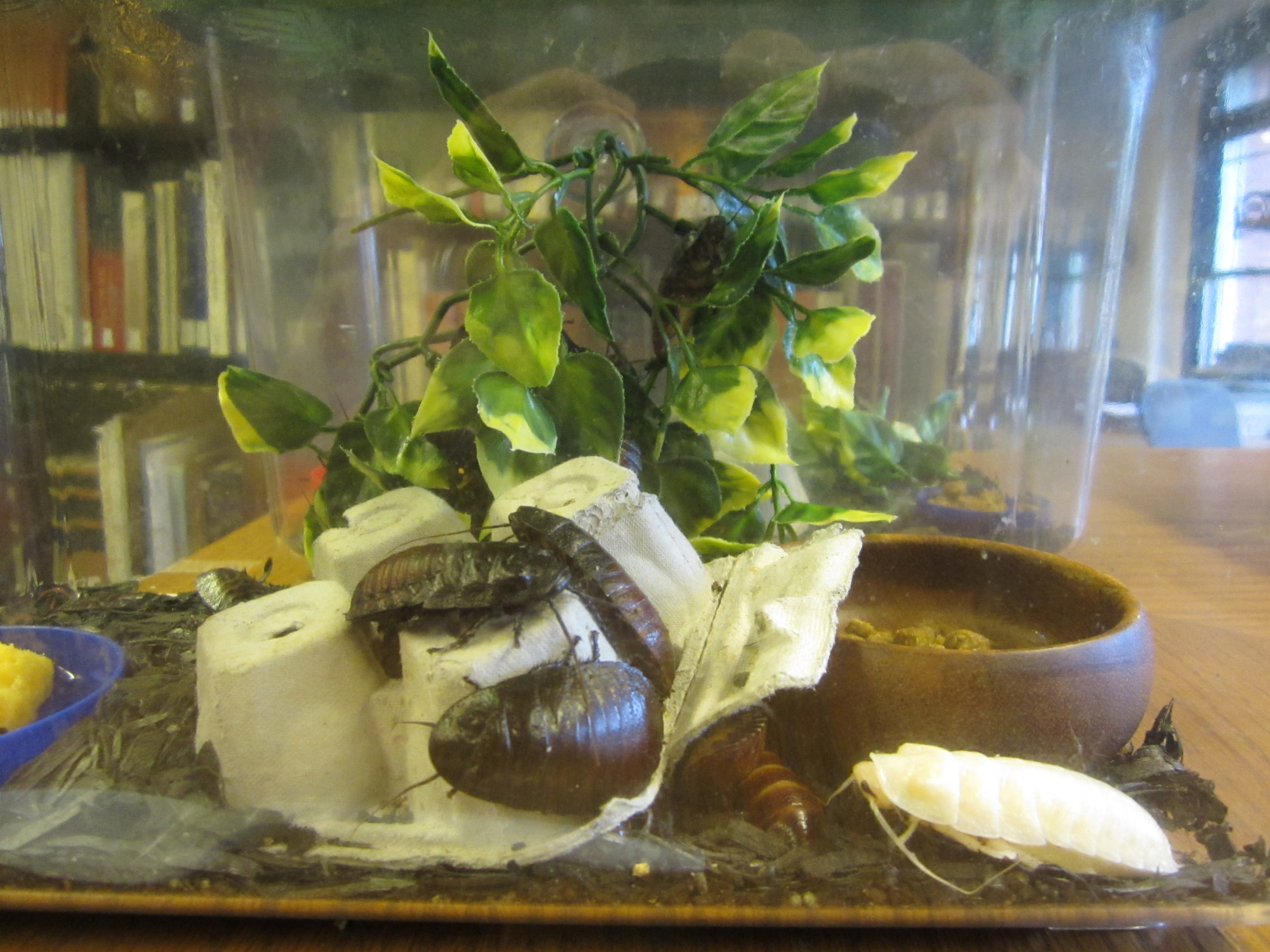
G. portentosa, on the other hand, move slowly and can’t survive on book glue and soap scum as their unpopular cousins can. They earn their common name by making a startling hissing sound when disturbed or upset. Males will hiss at each other, wave antennae, thump their abdomens, and even push each other around. (Adult males have humps on their thoraxes that distinguish them from females and are can be used in encounters with rivals.) And unlike female pest roaches, which simply drop their little egg-filled capsules in any crack or corner, G. portentosa females retain their egg capsules inside their bodies until the young hatch.
The library currently has three groups, one consisting of all adult males, another of females and young. Recently, we put a few males and females together for a cockroach orgy. They were first separated in an attempt to control the population, but the babies keep coming; since males don’t develop their characteristic humps until they are close to adulthood, we think that the adolescent males are taking advantage of lack of competition from their elders to have their way with the females. In the past few weeks, however, there have been no new babies, hence a chosen few were selected to carry on the colony. Stay tuned!
Need some relaxation but can’t get an appointment with Cooper the Therapy Dog? Come to the Ernst Mayr Library, borrow a cockroach container, put it on one of the comfortable desks in the Library, and watch the action (there won’t be much) while you read or study. Offerings of bits of banana or other soft fruits are gratefully accepted, and will probably be rewarded by a view of gourmet dining cockroach-style.
