Field Notes from the Ernst Mayr Library collection.
Last week there were a couple of events in the Ernst Mayr Library. On Thursday we were visited by about a dozen attendees from the “Take Note” conference held at the Radcliffe Institute for Advanced Study. This conference brought together scholars from a variety of disciplines to explore the role of note-taking in different disciplines. The conference also launched a virtual exhibition entitled “An Exploration of Note-Taking in Harvard University Collections“. There was also discussion and review of emerging digital annotation tools.
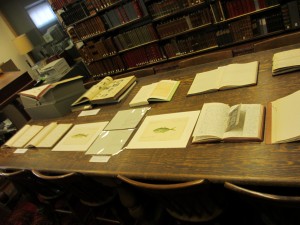
The students and scholars who visited the Ernst Mayr Library were treated to a lecture and note-taking session organized by Michael Canfield. Additionally they viewed biologists’ field notes from the 19th and early 20th century. The display included one of John James Audubon’s notebooks–mostly text, field notes from Louis Agassiz coupled with illustrations by his travelling artist, Jacques Burkhardt, a psychiatrist’s bird watching lists,sketches and notes along with field notes and analytic compilations from William Brewster, Curator at the MCZ from 1885 to 1902. Connie Rinaldo gave a brief presentation about the Biodiversity Heritage Library partner IMLS grant Connecting Content: A Collaboration to Link Field Notes to Specimens and Published Literature to which the Ernst Mayr Library is contributing digitzed versions of Brewster’s field notes, diaries, photographs and correspondence along with MCZ specimen images from Brewster’s collection of birds from Cambridge, MA.
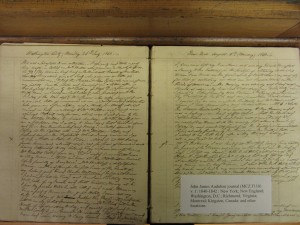
Pages from Audubon’s field notes (1840-1842)
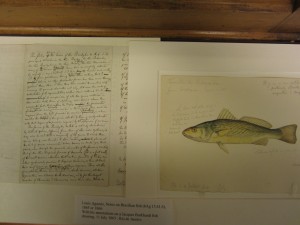
Agassiz’s notes on Brazilian Fish, 1865 or 1866 along with Burkhardt illustration.
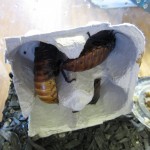
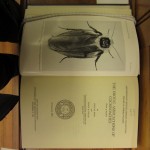
So what about the cockroaches? The library pets, hissing cockroaches, have new and more spacious digs so we thought it was a great time to show them off along with some books from the amazing collections of the Ernst Mayr Library. Since the field notes were already on display, we added some books with cockroach images and announced a Friday afternoon “flash” exhibit complete with snacks. We know some folks were unable to attend and were disappointed, so feel free to ask for a tour, either private or for your lab. Check with Connie Rinaldo, Dana Fisher or Mary Sears.
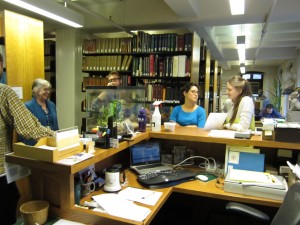
Checking out the Hissing Cockroaches.