Posts Tagged ‘bhlib’

Librarian Travels: Global Biodiversity Heritage Library Meeting in Australia, part 1.

Friday, February 21st, 2014

I recently returned from a trip to the global Biodiversity Heritage Library Meeting in Australia.  The kick-off was “BHL Day” on 31 January 2014  in the Melbourne Museum, Melbourne, Australia.

Ely Wallis, Chair of gBHL organized the meeting and we had a spectacular time.   BHL Day  began with a traditional welcome from the indigenous people of Australia by Caroline Martin, Bunjilaka Manager of the museum.

As we stood in a circle, Caroline Martin (with our host Ely Wallis on left) led a traditional welcome.

Presentations from members of the gBHL nodes attending followed the welcome.  Reports were provided by BHL Classic Chair, Nancy Gwinn, BHL Australia’s Ely Wallis, BHL China’s JinzhongCui and Fenghong Liu, BHL Europe’s Jiri Frank, BHLSciELO’s Abel Packer and Fabiana Montanari Lapido and BHL Africa’s Anne-Lise Fourie.

BHLAfrica report, Anne-Lise Fourie


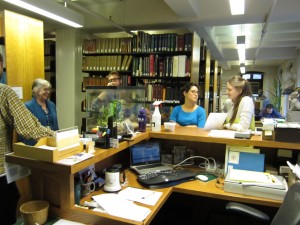
Staff from BHL Egypt were unable to attend.  It was illuminating to hear what the global BHL nodes are doing.  The afternoon session posed several provocative questions related to recent literature, reprint collections and archival collections leading to a fruitful discussion of new directions as well as boundaries for BHL.  Joining BHL representatives were staff and volunteers from the Melbourne Museum, Australia’s national science agency (CSIRO) and the Atlas of Living Australia. The Museum arranged a tour of the “First Peoples” exhibit, the library rare book room,and a special visit to see live insects on display for visitors.
 

BHL Africa is Launched

Wednesday, April 24th, 2013

Beginning on April 12, I had the privilege of attending the launch of a newpartner in the BHL family:  BHL Africa.  On April 12, 2013, BHL and the University of Pretoria signed a Memorandum of Understanding as one step towards the BHL Africa.

Signing of the MOU: BHL and the University of Pretoria. Robert Moropa, Library Director, Nancy Gwinn, BHL Chair, Connie Rinaldo, BHL Vice-Chair, Ria Groenewald, Digitization Librarian, University of Pretoria

Then from April 15-17, 2013 we attended the BHL-Africa launch and workshop, hosted by the South African National Biodiversity Institute (SANBI) at the Pretoria National Botanical Garden in Pretoria, South Africa.  MOUs were gathered from a number of African partners, including the National Museums of Kenya, Uganda National Council for Science and Technology, University of Nairobi, Sokoine National Agricultural University in Tanzania, National Environment Management Authority of Uganda, Lake Victoria Basin Commission, African Conservation Commission, and the Kenya Wildlife Service.  SANBI signed the MOU with BHL in a ceremony on April 15.

Dr. Nancy Gwinn and Dr. Tanya Abrahamse sign the BHL-Africa MOU

The launch of BHL Africa became a reality!  Once BHL Africa was launched, a workshop followed with presentations by BHL members about Collections, Copyright, Governance, Global BHL and Outreach.  We shared how we have reached the current state with our African colleagues and fielded questions.

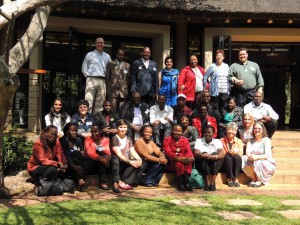
BHL Africa Launch attendees from all over Africa and some of us from the US.

The next step was to elect officers for the BHL AfricaSteering Committee so  everyone can get to work!  We look forward to sharing content along with our process and seeing a whole new set of information added to the BHL with open access for all.

BHL Africa Steering Committee, from left to right: Lawrence Monda (Technical Advisor), Ashah Owano, Loi Namugenyi, Anne-Lise Fourie (Chair), Ria Groenewald


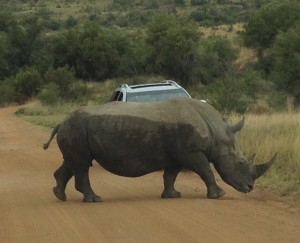
There was even time to do a little sight-seeing.  Congratulations to BHL Africa–the energy, enthusiasm and sheer hard work we witnessed will ensure success.

Field Notes and Cockroaches

Tuesday, November 6th, 2012

Field Notes from the Ernst Mayr Library collection.

Last week there were a couple of events in the Ernst Mayr Library. On Thursday we were visited by about a dozen attendees from the “Take Note” conference held at the Radcliffe Institute for Advanced Study. This conference brought together scholars from a variety of disciplines to explore the role of note-taking in different disciplines. The conference also launched a virtual exhibition entitled “An Exploration of Note-Taking in Harvard University Collections“. There was also discussion and review of emerging digital annotation tools.

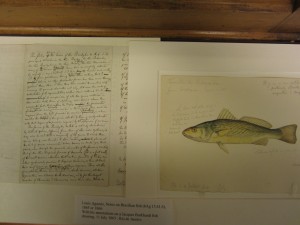
The students and scholars who visited the Ernst Mayr Library were treated to a lecture and note-taking session organized by Michael Canfield. Additionally they viewed biologists’ field notes from the 19th and early 20th century. The display included one of John James Audubon’s notebooks–mostly text, field notes from Louis Agassiz coupled with illustrations by his travelling artist, Jacques Burkhardt, a psychiatrist’s bird watching lists,sketches and notes along with field notes and analytic compilations from William Brewster, Curator at the MCZ from 1885 to 1902. Connie Rinaldo gave a brief presentation about the Biodiversity Heritage Library partner IMLS grant Connecting Content: A Collaboration to Link Field Notes to Specimens and Published Literature to which the Ernst Mayr Library is contributing digitzed versions of Brewster’s field notes, diaries, photographs and correspondence along with MCZ specimen images from Brewster’s collection of birds from Cambridge, MA.

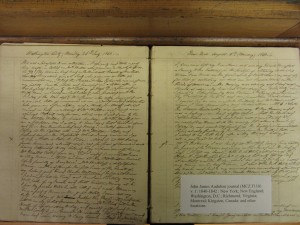
Pages from Audubon’s field notes (1840-1842)

Agassiz’s notes on Brazilian Fish, 1865 or 1866 along with Burkhardt illustration.

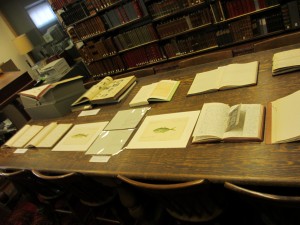
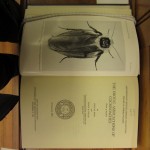
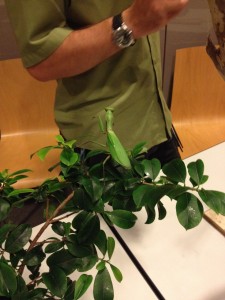
So what about the cockroaches? The library pets, hissing cockroaches, have new and more spacious digs so we thought it was a great time to show them off along with some books from the amazing collections of the Ernst Mayr Library. Since the field notes were already on display, we added some books with cockroach images and announced a Friday afternoon “flash” exhibit complete with snacks. We know some folks were unable to attend and were disappointed, so feel free to ask for a tour, either private or for your lab. Check with Connie Rinaldo, Dana Fisher or Mary Sears.

Checking out the Hissing Cockroaches.

BHL and EOL at the Ecological Society of America

Tuesday, September 18th, 2012

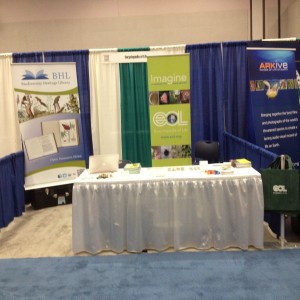
In early August, I had the privilege of representing the Encyclopedia of Life and the Biodiversity Heritage Library at an exhibitor’s booth at the Ecological Society of America annual meeting in Portland, Oregon. The theme for the 2012 annual meeting was: Life on Earth: Preserving, Utilizing and Sustaining our Ecosystems. This theme certainly fits the broader goals of EOL and BHL.
BHL/EOL booth at ESA

It was challenging to be the only representative at the booth because there were many visitors since ESA provided a great match of people for BHL and EOL. Faculty members, contractors, postdoctoral associates, undergraduate and graduate students working in the fields of biology, conservation and ecology stopped by to hear about the work done by EOL and BHL. Many were interested in how they could contribute. It was very rewarding to show this crowd what literature is available on the BHL portal, how it links in with EOL, how they could make requests and follow our progress using social media. It was exciting to get into deep discussions with the many interested parties about how they might be able to contribute to EOL as curators/users/teachers. And best of all, I frequently was asked the question “How much do you charge to access BHL/EOL?” The amazed looks on everyone’s face when I said access is free–I wish I had taken some pictures. I was sure to note that there are “Donate” buttons available but that these are optional.

I handed out BHL buttons, BHL pens, EOL magnifying glasses, EOL bags and BHL cards. Pens, bags and magnifying glasses went very quickly. Many more people who stopped by were more familiar with EOL than with BHL, but many who recognized EOL did not know much about it. One person with some in-depth knowledge of EOL was 2012 Rubenstein fellow Kelly O’Donnell. She noted that until the fellow training she wasn’t aware of BHL and was thrilled that she was able to test-drive it and now incorporates it into her work.

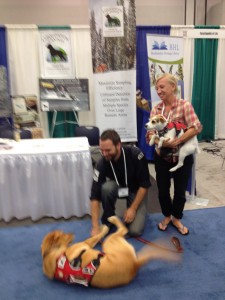
Another positive experience was that the BHL/EOL booth was sited in between booths for ARKive and the Center for Conservation Biology Conservation Canines. ARKive is an organization that is “creating the ultimate multimedia guide to the world’s endangered animals, plants and fungi” which fits nicely with the goals of EOL and BHL. Conservation Canines is an organization that trains dogs to locate wildlife scat (including from marine mammals) so the scat can be used to provide genetic and physiological information as well as identify local species and estimate population abundance. It was fun to visit with their dogs–and they brought a lot of traffic to our exhibit area!
conservation canines