Archive for September, 2022

Leveraging recyclables to hedge against rising prices of raw materials

Friday, September 23rd, 2022

Written by Zeng Han-Jun


The driving force that is pushing for cleaner energy is clear. Urbanization will continue in many parts of the world and the challenges for the next lap, will still be the same, that is to provide relatively good quality housing, adequate nourishments and sufficient economic opportunities. Albeit this time, there is an intense focus on ensuring sustainability of global resources against our growth trajectory, while ensuring that our continuing and new actions do not add to the environmental pollution.


It’s really easier said than done, because our industries are hardwired for many decades, to produce goods and services in a certain way. Some of which are responsible for emitting high level of Greenhouse Gases (GHG) into our atmosphere, irresponsible extraction of water that leads to degradation of environment, non-circular agriculture practices that strip Earth clean of its natural carbon capture capabilities, etc.


On one hand, we have had significant number of investments that were poured into erecting these business DNAs. Business schools around the world extol these business constructs to its students, who then flock to all corners of the world, propagating those school of thoughts in words and in actions. On the other hand, we also have had growing demands for some of these goods and services, which really is a form of market confirmation. All these drive profits and further cement the ways of production like the ones we see now.


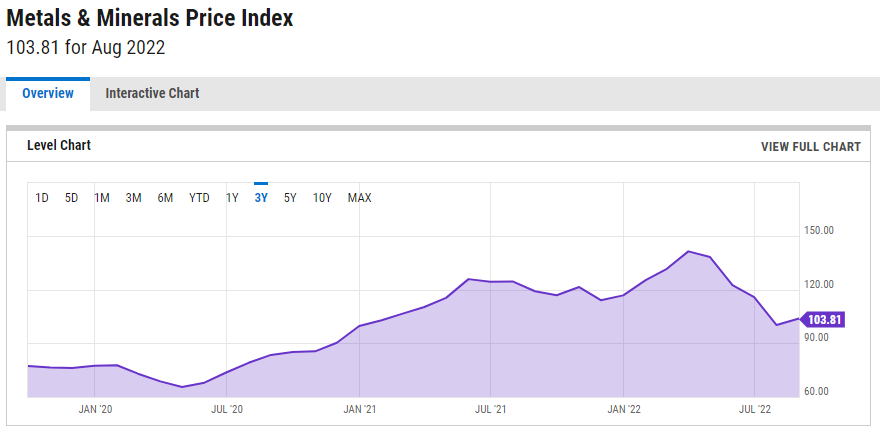
In preparing for the next few decades of growth, I believe that we need stronger push to pioneer more effective and cheaper ways of recycling materials, to the point that it makes market sense to adopt recycled materials for industrial production. It is practical to do so because raw materials are becoming pricier. Below is a chart from the World Bank showing the weighted average of aluminum, copper, iron ore, lead, nickel, tin and zinc prices. It has grown to 103.81 points in August 2022, from 65.55 points in April 2022 (start of the pandemic) and that is 58.37% growth over that period.


The 2008 recession sent this index way above 200 points. If a deep recession does occur in the short-term future, I would not be surprised to see similar dynamics playing out again. And with this possible development, any businesses that rely on new raw materials for production, could be in for a deep shock in the short-term future. Due to this, the operational costs of some businesses could rise approximately by more than 100%, completely eroding any profits and maybe even cash reserves.


A lot of companies could fall into this category, for example, window and door frame manufacturers, glass product manufacturers, tools and diecast products manufacturers, etc. Many of these companies are value-adding to our societies with their products and it would be great to see their continual contributions into the far future.


For this to happen, I strongly believe that the procurement and sourcing function has to work hand-in-hand with the recycling and development (R&D) function. Instead of sourcing for raw materials and procuring those resources directly from places of extraction, we have to shift our focus to looking for resources among waste. That is to think of waste as precious resource, and why not?


Many of the electronic products that were thrown away, do contain a lot of precious metals and minerals, and a lot of it could be put to good use again and again. Which is why I think that we need to identify the top 20% of the waste generators and from there, further filter out those that have performed excellently in tackling this problem, distill from their experience and scale it.


We need to tackle the “why”, asking really deep questions and coming up with answers that could shape our subconscious behaviors, activating a top-down reframing of societal values that could hopefully, gear us towards environment-friendly consumerism. At the other spectrum, we also need new tools to shape the risks and returns of corporate behaviors.

We genuinely have a growing waste problem, one that is driven by rapid urbanization and growing populations, our global annual waste generation is expected to jump to 3.4 billion tons over the next 30 years, up from 2.01 billion tons in 2016. To give some perspective about the size of this mammoth trash, a 1-ton truck can house about 10 people comfortably. 3.4 billion tons worth of 1-ton trucks can house about 34 billion people. At the moment, our global population is nearing 8 billion people and it is still nowhere near that size. We have a lot of trash, and we should be looking at ways to reusing these resources instead of dumping it into landfills or incinerating it. 


There is a lot of business sense in developing corporate recycling programs. For example, a kitchen knife manufacturer that offers discounts or token points for consumers who decided to trade in their old kitchen knives for new ones. One, it promotes loyalty among the existing customers. Second, if the program extends to people who bought knives from elsewhere and want to upgrade with your kitchen knives. Then, you would have gotten yourself a new customer base and also more recyclable materials for your production. Third, your company is hedging against future prices of raw materials when it is able to tap on recyclables Fourth, when potential customers chose to upgrade their knives with your program, your company is, in a way, helping to reduce the amount of global waste. Fifth, it just shows how committed your company is to the sustainability drive and there is also a lot of good marketing in that.


There is a lot of business sense in recycling.

Moving the global mindshare towards a sustainable green future

Friday, September 16th, 2022

Written by Zeng Han-Jun


Looking through the recent report released by Vivid Economics (VE), I cannot help but zoom into the stellar performance of Canada, how they have reversed their poor performance and topped the chart in creating stimulus packages that better our natural environment. The chart below, reproduced from VE’s report, is an index that attempted to capture the so-called greenness of stimulus package by 11 major economies.  Basically, it is a measure of the amount of money that governments spent on stimulating their economies during the Covid-19 pandemic, and to check on how much of that contributed to greening our environment.

Canada did well, as you can see from this chart. The country managed to secure third place, ranking just behind the European Union, and they managed to pull this off from a negative Greenness of Stimulus Index (GSI) score in October 2020. Additionally, the country further pledged more than USD$12 billion over five years for public transport, cementing their support for their sustainability drive. This showed that the government is committed to improving and that strong environmental stimulus measures can overcome even poor past performance.

What Canada has done to achieve this, is that they have provided an entire suite of measures such as tax deferments, direct payments and wage subsidies in order to support local businesses.  Those portions that went to supporting the agriculture, energy, green transport and nature-based solutions initiatives, helped to improve Canada’s GSI score. Those that went to supporting airport, airline support and road network development policies, contributed to the decline of Canada’s GSI score. Overall, after netting the improvements against the declines, Canada turned out pretty well, and as I mentioned earlier, the outcomes made me very interested in the details of the GSI framework.


The GSI framework took into account the amount of stimulus money that went into environmentally relevant sectors, existing green orientation of those sectors and the efforts to steer stimulus toward (or away from) sustainability. Based on the report, the environmentally relevant sectors are agriculture, industry, manufacturing, waste, energy and transportation.


We do not know the exact details of the calculations and what goes into the equations; Are there any weightages to the sectors? If so, how are the weightages are derived? Are the weightages adjusted for the environmental viability of the sectors for the short-, medium- or long-term outlook (for example, how does the introduction and impact of emerging technology such as sustainable aviation fuel, road surface chargers, etc, affect the transport sector)? Is the money spent, averaged against land size or per capita? How do they deal with those countries that do not have all the environmentally relevant sectors for example, agriculture? What about extremely pollutive sectors that cause direct and indirect environmental harm such as the fashion industry? Why do they exclude these sectors and include others?


We have no way of knowing these. In the case of Canada, the country pumped significant stimulus into the agriculture sector and that helped to push up the GSI score. Some countries may not have or are unable to have significant presence in certain sectors due to geographical limitations. Should these countries be included in the basket?


There are so many questions, but, then again, the survey and the index managed to give a rough sense of what each country is doing for their respective sustainability journey. Plus, it sort of emphasizes the importance of the role that government plays in advancing the green economy.


In fact, there are so many things that we have to do to green our future. My only fear is that we cannot visualize the vast number of details to keep things going; some of which require a total transformation of job scopes, in others the creation of entirely new jobs that we cannot even imagine now. All of which require substantive efforts in education, re-education, encouragement, policy shifts and private-public partnerships. All these, in order to shepherd as much interest as possible towards positive transformation. So, what else can we do?


Sustainability policy

We need a roadmap that fosters innovations to reduce dramatically the cost of adopting renewable energy. We know that the cost of production, especially for solar, is dropping. By right, that should tease countries into wider adoption of solar, but I argue that the adoption dynamics is not simply due to a single factor. The below chart is reproduced from IEA, and it showed that China accounted for 46% of the new generating renewable capacity added in 2021, mostly in offshore wind which increased sixfold. In Europe, solar accounted for most of the growth, with notable projects in Germany, Poland, France and Spain. India’s, ASEAN’s and MEA’s take up rate in the measured categories of renewable energy, paled in comparison to those of China’s, USA’s and Europe’s.

According to recent trailing 12 months estimates by IEA, the cost of polysilicon used in solar panels has more than quadrupled, while the price of steel rose by 50% and copper by 70%. Overall, raw material costs for all types of renewable energy were 15% to 25% higher. Inflation and uncertainties of global markets could add inflationary pressure on the already rising cost of materials, materials acquisitions and construction of renewable energy facilities.


Additionally, ESG regulations are closing onto mining activities, putting the lenses on mining’s impacts on the environment and nearby communities, energy sources used in mining operations, behavior of security forces in mining areas, treatments of waste discharges, exit strategies of miners from exhausted mines and the list continues. Plus, countries are going after the same materials that exist in finite amounts. All these compounds and complicates the acquisition of materials, but at the other end of the spectrum, I say that there has never been a brighter future for companies that are providing advanced recycling services.


Also, on the upside, I argue that there is a lot of potential for India, ASEAN and MEA to play catch up and it is important that they do. The military aggression by Russia in Ukraine has exposed not only vulnerabilities in the global supply chain network but also in energy policies. Renewable energy capabilities are ways to mitigate this issue, but we need innovations that further reduce the cost of adopting these alternative energy sources, for the reasons that I have stated above.


Transition strategy

Steering away from this, I want to dive somewhat into the operations underlying policies. Effective changes take time, require investment and need effort. All of these cannot gel unless there is significant cooperation between the people, public and private segments. In this, I see clearly that there is a lot of opportunities for transition finance to play a critical part in shaping the ongoing narratives that are brewing in different sectors along the short-, medium- and long-term future.


The details are important. For example, preparing the student body for the future of work, requires clever policies, cleverer implementations and smart monitoring. Smart monitoring is critical especially for large jurisdictions. Quick and drastic pivots are often… disastrous.  Likewise for the existing workforce, judicious attempts should be made to pinpoint and identify largely similar work patterns between existing industries and future industries, thereby using the observations as a bridge for the transition. Similarly for equipment, just as Heckler and Koch adapted their sewing machines into the present-day sub machine guns HK MP5 or how some countries are adapting their hydropower dams into solar power plants, we must also adapt accordingly with the times. All these require innovators, scientists, engineers, education specialists, etc to come together and focus their collective intellectual prowess to effect a transformative change.


Establishment of climate change measures by the government

Elected governments should also play their parts well. Apart from establishing decarbonization policies and roadmaps for climate change measures, they could further enhance their value-add by (1) coordinating and facilitating collaborations between industry groups, financial institutions and various government agencies, (2) fostering an environment whereby public sector agencies and educational institutions are able to advance, retain and accumulate knowledge in specialized technical domains, (3) increasing awareness of sustainability and climate change issues among the citizens and encouraging them towards a Net Zero future, and (4) deploying government funds properly with an incentives and subsidies system that uplifts citizens towards a sustainability-oriented mindset – which is what I hope that the Green Stimulus Index (GSI) is trying to promote.


Public sector, unlike most in the private sector, have the capacity to look further across the horizon, and plan for the future. Public sector agencies usually are not tied to short-term demands for financial performances that are largely driven by profit-seeking actors. In fact, some public sector agencies are able to aggregate data from various sources, to construct a slightly better-informed picture of what is going on in the world, and they should make good use of that advantage.


These public sector players are able to establish trends and recognize patterns that may not be so obvious to some of their private sector counterparts. As such, they should work closely with the markets to shape and move the conversation towards the greater good for everyone, all these while balancing the private sector’s profit-seeking behavior. This creates a win-win-win outcome for people, public and private sector. Some private sector counterparts are in the better position to harness useful data and subsequently develop meaningful information. These organizations could explore to ease any potential frictions with policy makers, by extending their capabilities to augment policymaking and of course, treading carefully along and around privacy issues.


Establishment of a green financial system

The financial system should play a strong support role to what the governments are doing. According to the result of a survey conducted across 9,443 respondents in 2020, published by Statista in 2022 and reproduced below, 14% of small- and medium-sized companies in the United States had debt outstanding between USD$50,000 and USD$100,000. This means that 79% had outstanding debts. Plus, NASDAQ recently reported that there are still strong demands for bonds despite the Fed looking to raise interest rates in order to keep inflation in check. This goes to hint that the financial markets, through its various instruments, should still have some level of influence over corporate behavior.
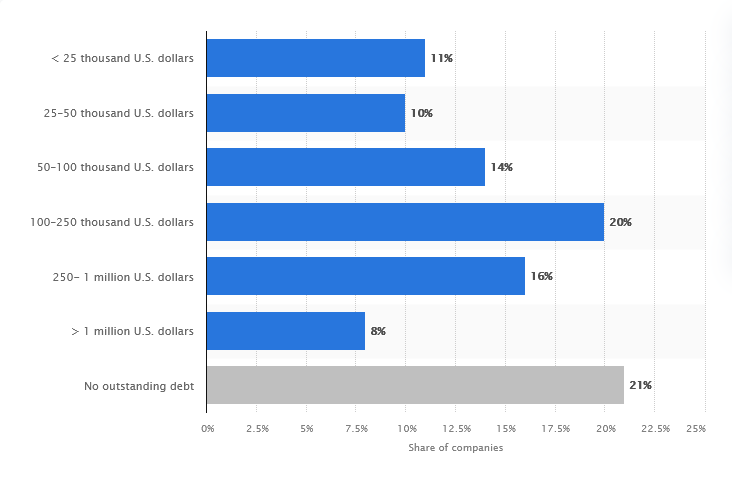
 

If they are seeing what the public sector is seeing, and also in preparation for changing consumer behavior and job-seeking behavior for example, like those that would surface from the emerging Gen A cohort. Then, it would be logical to put in place the pillars and sandboxes for innovations, digital platforms, external certifications, ratings, accounting standards, risks metrics, risks appetites, etc. Additionally, also shaping intermediaries like venture capitalists, private equities and working with game-changing actors like FinTech providers.


This could enable a new financial market that is in a better position to handle green products with clear sustainability-linked KPIs, for example, private-public partnerships, infrastructure finance, transition finance, blended finance, green bonds, ESG funds, sustainable indices, securitization and derivatives, etc.


Financial markets should work closely with industry experts and government bodies to chisel and chip away bits and pieces of old financial framework, artfully hammering out a roadmap for green finance in general. Changes such as developing a sensible carbon pricing system, strengthening transparency, promoting information disclosure and tweaking the incentive framework amongst others, to shape risk and return, is a definite must. This would help in proliferating extensively and intensively the sustainability mindshare.


 

The future outlook of Asia’s agriculture sector and its sustainability and manpower issues

Saturday, September 10th, 2022

Written by Zeng Han-Jun


Sustainability issues are growing concerns for many individuals, small, medium and large businesses and government bodies. Our food sources, as many would already know, could be disrupted in many ways by climate change. Supply chain, logistics, energy consumption, and even farming, are just some of the elements that could be affected. Farming is becoming more challenging as crops are being affected by the rapidly changing weather patterns.


Some crops are unable to survive the increasing heat condition and lack of water. Flooding caused by extreme weather destroys the soil condition that is important for crop reproduction and survival. Adding to the list of woes, the younger generations are turning away from such labor-intensive industries, preferring to work in office-based jobs. These factors make it more challenging to keep afloat the agriculture sector.


Declining agricultural production due to climate change

For example, let’s use the example of rice. Rice is a staple for more than half of the world population and it is also a problematic crop to farm. It requires massive amount of water and the paddies in which it grows emit methane, a potent greenhouse gas. Methane contribution from rice farming was estimated at 10% of total global methane contributions, behind enteric fermentation (29%) at first place and oil and gas (20%) at second place.  Precisely because of these factors, it is difficult to ignore this crop.

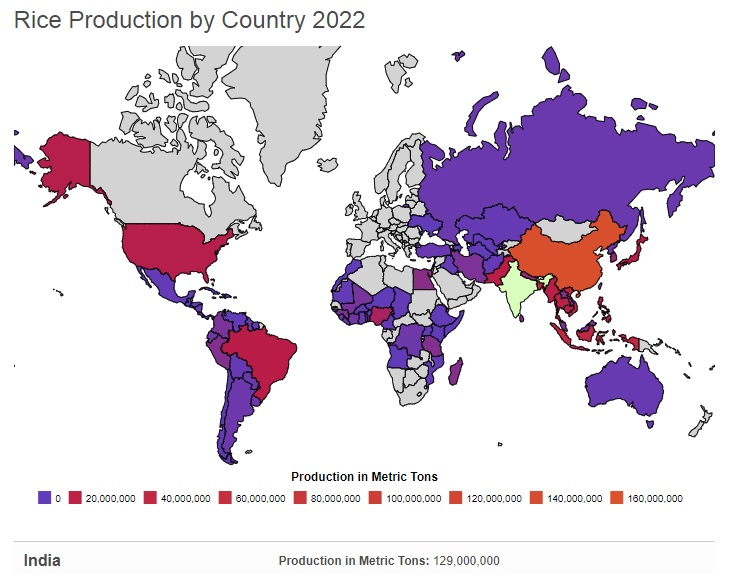
I attached a heat map from the World Population Review so that we can have a better perspective of the amount of rice produced in different locations around the word. Basically, the top rice producing countries in this chart are (arranged according to production, with the first being the top producer):

1st – China

2nd – India

3rd – Bangladesh

4th – Indonesia

5th – Vietnam

6th – Thailand

7th – Burma (Myanmar)

8th – Philippines


All of these countries are located in Asia region and myriad sources forecasted varying effects of climate change on different parts of Asia. There are some studies that predicted rising sea levels, heat waves, more intense and frequent rains and drought in many parts of Southeast Asia. Other scientific research also forecasted that there would be frequent and more severe heat waves in East Asia and South Asia. By and large, climate change might reduce global rice production to 309 million tons in 2100, from 515 million tons in 2022, and this is taking place in tandem with burgeoning population growth in most parts of Asia.


Growing Asian population to feed

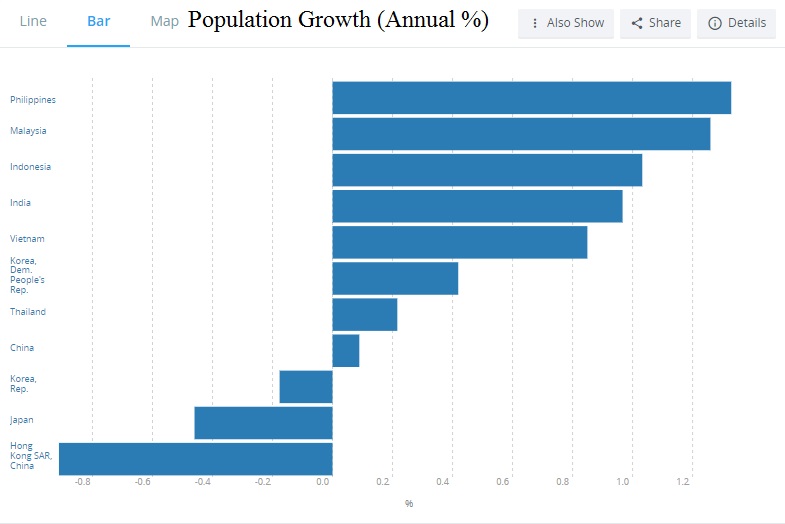
Asia’s population would definitely continue to grow for quite some time, which could strain the region’s resources. Based on the chart that I have reproduced from the World Bank, it is shown that population would continue to grow substantially in countries like Philippines, Malaysia, Indonesia, India and Vietnam. Overall, Asia’s entire population grew at 0.9% in 2020, 0.62% in 2022. Overall, it is slowing down and even though other ageing countries like Japan and Hong Kong are showing glaring statistics in population decline, their collective impact on the Asia’s population growth is minimal and as such, I believe that Asia’s population growth rate would slow down but stay positive in the short-term to medium-term future.

What this means is that we would have less food for more people annually. Furthermore, even though there are a lot of scientific estimates predicting the decreasing trend of food supply, I must highlight that those are just mathematical predictions that serve as guides (not absolute truths), because we cannot be really sure how reality might pan out. In reality, the food supply might trend downward even faster than predicted (or maybe even slower).


Manpower risk to agriculture sector due to shifting work preferences

Honestly, rice is just one part of the food equation. There are also other types of food sources plus our water supply that face the same climate change challenges and, are at risk of being disrupted as well. On top of that, most countries would have fewer young people who are interested in working in these sectors. Many are already shifting to non-farm work therefore there are substantial manpower risk in this sector.

From the graph above, you can see that China has been witnessing a dramatic shift in the number of labors employed in agriculture. In fact, the country has registered the highest rate of change among all Asian agriculture producers for the past two decades. While the trend seems to have somewhat slow down, I believe that the downward trend would persist and create substantial manpower risk to its local food production in the medium- to long-term future. As such, it would be logical for China to continue to seek greater productivity through technology breakthroughs and/ or strengthen food trade agreements with the rest of the Asian agriculture producers


Those who are unfamiliar with the agriculture sector, would incline towards higher level of mechanization and even greater reliance on technology. The fact is the sector has already mechanized to a large extent. So much so that some observers noted that agricultural modernization has already been associated with some negative outcomes, including continued degradation of natural resources like water and forest areas. Increasing agriculture sector’s productivity through technology, will require new breakthroughs and transformation of jobs.


Many countries, especially China, would need to go beyond mechanization and seek new breakthroughs in artificial intelligence (AI), machine learning, internet of things (IoT), data management and traceability. AI, robotics and automation would allow producers to ensure continuing farming when they are away from these operations or working on other projects. Predictive analytics from models could provide insight into potential losses from future environmental or pest events. Data management augments the storage and transportation system, while providing ledgers of information and data flow help producers to ensure that they have the right products and prevent mix ups and confusion of flow. Data collection, insights, and connectivity from the field can be provided via IoT sensors to check on parameters such as soil moisture, health, fertilizer tank levels, fuel levels, irrigation system monitoring, and many more. These various IoT-related technologies form a large data pool that may be fed into technologies such as machine learning as part of AI for faster decision making and continuous operations.


India is in a strong position to take over as leading agriculture producer

India is the second leading agriculture producer in the globe, and their agriculture labor force has been decreasing but relatively stable when compared to the rest of the Asian producers. I think that India will be least affected by manpower risk among the Asian producers. Even if they continue to face decreasing manpower in the agriculture sector, they could still try to draw more people into the agriculture sector from the untouchable caste.


The country has an estimated 200 million people from the untouchable caste, more than the respective populations of Japan, South Korea, North Korea, Taiwan, Hong Kong, Philippines, Vietnam, Thailand, Malaysia, Cambodia and Laos.  Several non-profit organizations are already working at this front, drawing additional workforce into the agriculture from the untouchable caste and in many ways, opening up more employment opportunities for this group of people. So far, these organizations have been very successful and there are a lot of precious lessons to distill from their experience.

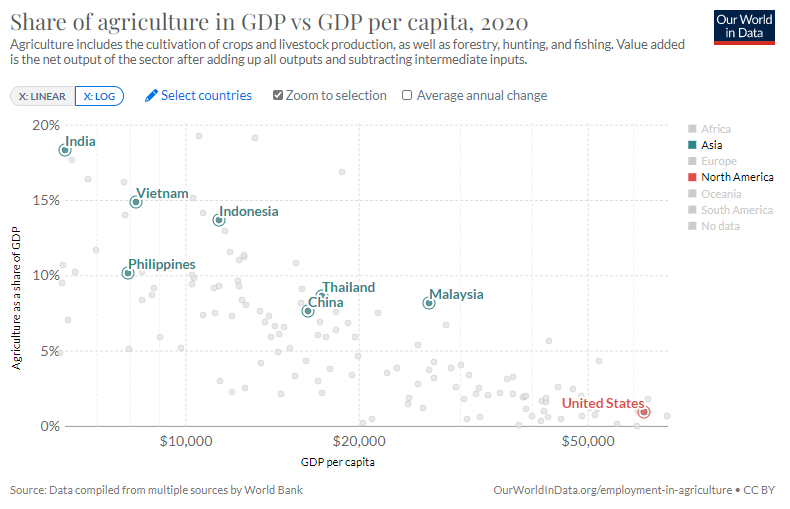
Additionally, India’s GDP per capita in 1990 was behind most Asian nations except for China and Vietnam. Fast-forward thirty years, China and Vietnam have far surpassed India and joined the rest of the Asian countries. India remained as one of the lowest performers in terms of GDP per capita among the Asian nations. Evidently, both China’s and Vietnam’s developmental policies have, over the years, favored moving capital and manpower into producing higher value goods and services, which might explain their significant progress in GDP per capita. Apart from this, many have argued that as countries become more prosperous, agriculture as a share of GDP would reduce. That has certainly been the case for many Asian countries, except for India. Agriculture continues to form a significant portion of India’s GDP and is currently the highest among all Asian countries.


Both indicators seem to point out that India was a poor country and has become even poorer over the years, but I think otherwise. Because of what I argued earlier, I believed that (1) a food crisis due to climate change is creeping steadily, (2) decreasing manpower in the agriculture is disrupting the sector but (3) India would remain in a good stead to become the leading actor in the agriculture sector in the medium-term to long-term future. Even though the country is unable to catch up with the rest in GDP per capita and might continue to face severe brain drain, I believe that they would still be able to sustain their agriculture sector. When climate change and manpower risks start to disturb the agriculture sector of Asian countries, these countries might then have to rely on India as part of their food supply diversification strategy.


There will still be other challenges, but I believe it could be mitigated by improving/ introducing circular farming techniques and these could be achieved through capability development workshops, creating a very simple financial payment system and as I argued in my earlier think pieces, setting up a co-op system that allows for integrated planning, transparent loan system and education among the farmers. During my working trips to rural parts of India, I noticed that there are very few visitors apart from those already staying in these places. Most city people would not go to these places unless there are very good reasons to do so. The rural areas have their own ecosystems, very much confined to among themselves, always supplying the same basic goods and services to one another and I suspect that the money supply has remained largely the same throughout the years. Carefully curated farming opportunities could help these rural ecosystems to achieve new breakthroughs.


It is highly likely that, in the worst case, some of these countries could experience internal conflicts due to food and water shortages in the medium- to long-term future and this cannot be solved by electing a new government. I believe that the knots could only be disentangled by adopting an open mindset to international, interstate and city-to-village cooperation and nurturing the local’s ability to solve problems with scientific and engineering methods. These countries would need a strong core group of people who are well-trained in science and technology and more critically, they must be motivated to solve problems, not just the ones that pay the most. Before the situation worsens, elected governments should work closely with capitalists to identify the core issues and solve the problems.