Archive for August, 2022

Potential future scenario of Lithium, Electric Vehicles (EVs) and the rise of alternate energy like Hydrogen

Sunday, August 28th, 2022

Written by Zeng Han-Jun


The energy crisis sparked by Russia’s military aggression had many rethinking about the future of energy and justly as well, because both events, the Covid-19 pandemic and Russia’s military aggression have disrupted supply chain and caused energy prices to spike. This has affected many people’s standard of living in many ways, one of which is to physically suffer through the cold weather and it might get worse during winter. I strongly believe that those who spent most of their lives in the global south, might find it difficult to understand how bitter cold winters can be in some parts of the world and the importance of keeping warm when it freezes. It is a very painful lesson that stemmed partly from over-relying on a handful of traditional energy sources.


As such, it is logical that there is a growing demand for alternative energy sources in many areas, from powering factories, heating up homes and offices, to moving vehicles. In the earlier phase of the growing demand, the narrative was that using fossil fuel is bad for the environment because of the substantial release of carbon into our atmosphere. That awareness played an important role in promoting electric batteries as an alternate mean of powering vehicles.


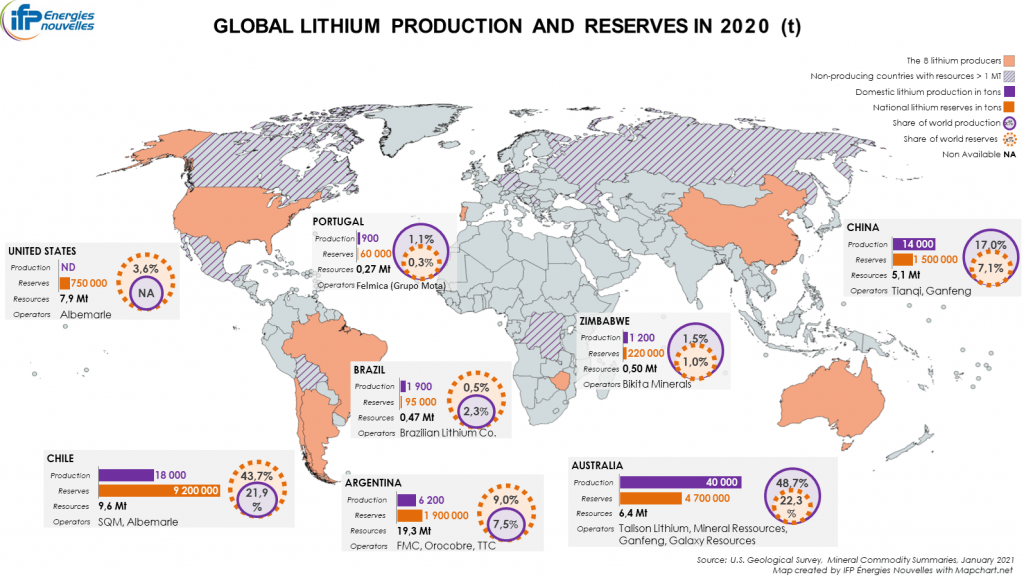
In my earlier think piece, I discussed about the current production level of lithium, which is an important component of the EVs’ electric battery, and how it pales when compared to the estimated demand for lithium by 2030. If you refer to the heat map below, you would be able to estimate that the total global lithium production stood at roughly around 82,200 tons. Several current estimates and studies showed that the total global demand for lithium in 2030, will go far beyond 82,200 tons. In exact figure, it is more than 1.9 million tons which is equivalent to 23 times more than the total global production figure in 2020.


Now, if you were to refer again to the heat map produced by the U.S. Geological Survey, you will gather that the total global store of lithium is roughly about 50 million tons. At the first glance, it may seem that we have enough lithium to go around and technically could continue with mining. If the global demand is to peak at 1.9 million tons in 2030, there is still enough lithium to extract for another good 26 years, but in reality, demand for lithium will most likely continue to grow after 2030.


This is why analysts have put out the figure that we could be in short supply of lithium by 2050. Some people that I have spoken to, believe that lithium recycling technology would be more stable and productive, thus enabling the circulation of mined lithium for industrial uses for many more years after 2050. And this is their justification for greater activity in lithium mining.
 

We would if we could but should we really do so?


I think that it is not feasible because of the following five reasons. First of all, the physical disturbances to the environment and communities that are living near to the mines. Second, carbon emission of the mining operations. Third, the future geopolitical tension that it creates and fourth, creating a single point of failure by focusing too much on electric batteries. Let me explain why.


1. Physical disturbances to the environment and nearby communities

Now, partly because of expanding interest in sustainability, people are starting to understand the impacts that some human activities, including mining, has on the environment. I see that the current narrative has evolved into questioning whether or not Electric Vehicles (EVs) are truly one of the silver bullets to saving our environment or merely just kicking the can down the street. First of all, I noted that many apply a broad understanding of what they know of mining i.e. the usual digging of earth, crushing boulders and deployment of many environmentally unfriendly technology, to lithium mining. Mining activities are generally all the same, but it is quite different with lithium mining at the moment.


Lithium is historically known to be produced from two sources: brines and hard rock mining. Lithium produced from brines is a cost-efficient process. These brines containing lithium are derived entirely from the leaching of volcanic rocks. The cost of lithium produced from hard rock mining is double than that of what is extracted from brines containing the metal. Mining starts by drilling a hole and pumping brine to the surface. Miners then leave it to evaporate for months, first creating a mix of manganese, potassium, borax, and salts which is filtered and placed into another evaporation pool.


It would take roughly between 12 and 18 months for that mix to be filtered enough in order to be able to extract the lithium carbonate. While it is relatively cheap and effective, the process needs a lot of water, estimated at 1.9 million liters per ton of lithium extracted.


For perspective, it was estimated that it would take around 63 kg of 99.5% pure lithium to make a 70 kWh EV battery pack. This means that the manufacturing would use up more than 119,000 liters of water, equivalent to satisfying a single full grown person’s drinking need for 32,162 days (~ 88 years).


That’s just one way to see it. Here is another way. Estimates of water audits showed that it takes about 237 liters of water to produce about 1 kg of cabbage, so instead of producing one battery pack, with the same amount of water, you could technically produce about 502 kg of cabbage which I think, could be used to feed a small family for about a year or so? Instead of cabbages, you could also divert water to planting trees as well. So, the mining process diverts water away from what the environment and man need.


These are the opportunity cost to manufacturing a single EV battery pack. However, I could also reframe my thinking and adopt a green and longer-term perspective. I could adapt the single battery pack to other environmentally friendly uses that might potentially produce more water, food, greenery or other social benefits than what the manufacturing originally consumes. That being the case, I might essentially, at multiple levels, be producing an ESG- (Environmental, Social and Governance) friendly product.


2. Carbon emission of the Lithium mining operations

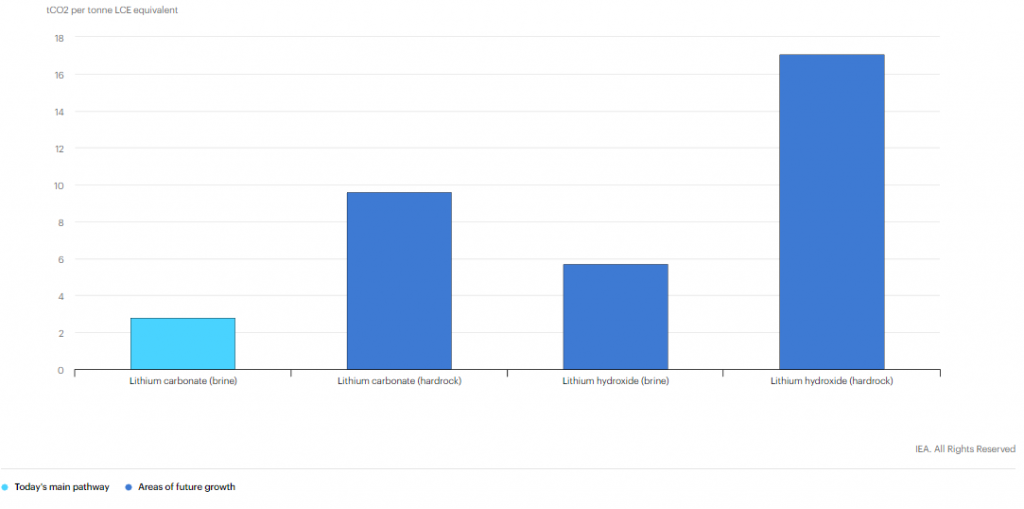
The below graph, produced by the International Energy Agency in 2021, is a very interesting chart. It shows that the current Lithium mining pathway produces roughly about 2.8 tCO2 per tonne LCE equivalent, much lower than most other types of mining operations.


At this level of activity, the production houses are churning out roughly about 82,200 tons of lithium (2020 figures). We would have to activate or maybe even develop other ways of extracting lithium if we are going to meet the growing demand. Meeting growing demand for lithium could lead to higher carbon emission. Based on this graph, by activating all known means at the moment, we would increase the carbon emission of lithium mining to 35.2 tCO2 per tonne LCE equivalent, from 2.8 tCO2 per tonne LCE equivalent (~ 1,257% increase).
Most people would think that since other types of activities are faring much worse, so why the focus on lithium mining? The thing is, every bit counts, and the ESG and sustainability focus is slowly and surely extending to all domains, not just lithium mining. Provided that no major events occur and shake the fundaments of the current world structure, ESG and sustainability certifications and regulations most definitely will cover all industries in the future, hopefully moderating carbon emission and ease the global temperature rise to a more human-acceptable level.


3. Potential geopolitical tension

It is no secret knowledge and almost everyone knows about it, dominance over or at least keeping close to raw materials, is one of the key chess moves that could advance one’s strategic position. If EV ecosystem, comprising all types of mobility devices or modes, is the chess game, then lithium is one of the key components to triumph. Looking at the above heat map produced by the U.S. Geological Survey, one could get a rough give-or-take intuitive sense of who is dominating the chess game.


What this means is that, if there is anyone who is a little bit keen on any of the EV-related businesses, they should start to join the winning side or at least slowly start divesting away from the disadvantaged side.


4. Creating a single point of failure by focusing too much on electric batteries


If there are any learning lessons to distill from the Covid-19 pandemic and Russia’s military aggression, I would say that it is the identification and continual mitigations of any single points of failures to important functions. Electric batteries are merely a store of energy, and this energy could directly or indirectly be derived from different sources such as fossil fuel, alternative energy or renewable energy. With the current technology, it is entirely possible to recreate a vehicle that is powered entirely by alternative or renewable energy, without the use of electric batteries.


When energy sources were threatened, scientists and engineers quickly leaped forward to develop new ways to powering vehicles. Similarly, if anyone were to push too hard the narrative of EVs while at the same time stifling competition, the tables could flip, thereby forcing competition to try to develop alternate propulsion methods which sidesteps entirely the use of electric batteries. In fact, the technology is already there and energy sources like hydrogen, ammonia, ethanol (from sugar cane), hydrogen fuel cell, solar, road-power, to name a few, are being implemented, adapted and integrated into existing vehicle technology. Even fuel stations are currently being adapted to provide different types of energy sources to vehicles. However, when it comes to safety, I place higher favorable weightage on electric batteries than hydrogen, and I will explain why later.


Hydrogen is a promising energy source, and another potential energy source is ammonia. One of the key areas to improve on, is to refine the waste collection and management system, then integrating that understanding into the process of producing hydrogen. This area holds a lot of potential to solving important environmental issues. As such, it is critical to adopt a holistic approach to tackling this challenge and I believe that it could only be achieved by viewing through the lenses of multiple urban system sciences without forsaking the operational details.


All details must be considered from an urban system science point of view. For example, positioning of the waste management plants, auxiliary waste management centers and hydrogen power plants, must be precisely planned, according to the future development plans, traffic patterns, national defense considerations, weather patterns and other natural phenomenon. More does not mean better, neither is less bad, but an optimal number of placements should enable complement strengthening of each other’s capabilities.


This is important in itself, and also extends its influence on the transport patterns of the waste management vehicles and the hydrogen transport vehicles, affecting factors like traffic volume and national defense. Exploration of Artificial Intelligence in augmenting this area is a promising area, still at a nascent level but definitely achievable.


In terms of safety, I think that electric batteries are the better solution compared to hydrogen. Electric batteries burn but hydrogen can cause extremely life-threatening explosions that can take down entire buildings within the destruction perimeter. Protective engineering techniques such as the strategic use of reinforced concrete, steel sheets and others, become very important subjects. The greater the underground hydrogen pipeline network proliferates, the greater need to build in more safety factors. Such consideration becomes exceedingly critical to providing a safe space in highly built up and dense urban environment. There were several past explosions involving natural gas pipelines in New York and the results were skyrocketing.


A lot of advance work is needed to develop the certified framework for pyrolysis process, hydrogen production and safety inspection at different stages of the value chain. Apart from that, substantial amount of time must be planned for the local workforce to gain sufficient expertise in these areas before rolling out the initiatives.

Climate risks’ effects on the salt production sector and its relationship to the rest of the value-chain

Friday, August 26th, 2022

Written by Zeng Han-Jun


The extreme heavy raining season during this summer, has affected many places around the world. More than 900 people have died in Pakistan from severe rains and flooding this summer, as the country sees its eighth cycle of monsoon rains. In New Zealand’s northern and central regions after four days of downpours, forced hundreds of people from their homes. In New Mexico’s Carlsbad Caverns National Park, around 200 people had to be evacuated after being trapped for several hours by rising waters.


These are just some examples of what has happened during this summer and there are actually many more cases like these around the world. As climate change persists, we are going to witness more frequent cycles of hot and cold weather patterns therefore, giving rise to even more extreme weather conditions.


As such, consideration and inclusion of ESG and Sustainability principals into business operations should logically be a growing concern. Businesses that do not understand how climate risks will impact their operations, are at severe disadvantage. There is no point in arguing whether climate change is caused by humans or is a natural phenomenon. The fact is that the entire global environmental condition is changing faster than ever. Sunk costs into operational infrastructures are most likely built based on past climatic conditions and may not be future-ready. While analysts can look to the past for references, it is definitely not indicative of future changes.


ESG and sustainability principals and risks go far beyond the determination of Scope 1, 2 and 3 carbon emissions. It is not just about paying a consultant to settle the paperwork after the scholars and regulators have decided on the materiality, double-counting issues and other intricate details in ESG frameworks and certifications. Like I said, it goes far beyond that, and may even reach deep into business reserves. Let me share more using an example.


The salt production sector has been badly hit by the intense raining and floodings. Take note that this sector accounted for 270 million metric tons of salt in 2020, and the global market for salt manufacturing was valued at more than USD$28 billion that year. It is a very important industry because its production serves as feeder to many important sectors such as the chemicals, animal feeds, food and beverages and many others. Even items like butter, cheese and dairy dips depend on salt for taste and texture, and you will be mildly surprised by the lack of salt in common food like this.


During this rainy summer season, several producers’ salt piles were washed away by the floodings, and this has cause substantial losses to these companies, and in some cases, significant damages to the entire country. This is especially so for places that rely heavily on food exports that are made partly with salt. You will be surprised at how easy such risks could have been mitigated long ago by cost-effective and practical engineering solutions. Yet the business owners remained nonchalant despite the growing awareness and understanding of how climate change is turning out.


We are about to exit summer; these businesses are now in a hurry to account for their losses and most likely will pass on these losses to the rest of the value-chain, affecting the prices of many end-products and, eventually, pass the repricing on to the consumers.  The business and operational teams of many salt production companies are scrambling to replenish stocks so that they could fulfil the upcoming orders. There is a high chance that some customers will turn to salt replacements once the acute shortages of salt hit the market later.


ESG and Sustainability risks are very real, and it is going to affect many industries. Some risks are unpredictable so we cannot do much about it. But business owners should once again review, assess and plan ahead for the obvious risks that we can see right now.

How digitalization could disrupt advancements in sustainable urban development

Wednesday, August 24th, 2022

Written by Zeng Han-Jun


Even with the easing of Covid-19 restrictions, economic recovery still seemed to be hampered by the global manpower crunch that is faced in many countries. On this point, it appears that this trend might continue to worsen in the short- to medium-term future and is expected to impact many industries, more so in those that rely heavily on manpower.


Logistics is one such industry. It is one of the key enablers of the world’s supply chain and entire countries depend on it for movement of goods within countries and across borders. This industry is a critical node to the entire global business system because it interacts with many resources such as equipment, machinery, components, materials, fertilizers, seeds, food and drinks and items, to homes, supermarkets, stores, etc. Many research houses also look at logistics as a proxy to economic performance therefore this gives one a perspective of how important it is.


In fact, today’s global distribution, manufacturing and procurement depends heavily on logistics. Even with the growth of additive manufacturing, we would still need to depend on the logistic sector to transport the raw materials for most additive manufacturing operations.


The subset components of logistics could be broadly categorized as land, sea and air transport. Simply phrased, goods and materials can be transported to its destination via land, sea and air transport, all of which are important functioning gears to the great machinery of a sustainable urban development.


For those reasons, that is why I decided to write about sea transport in this think piece. If people were to draw parallels between cities and urban development to living bodies, then I would boldly say that the sea transport component comprising the shipping capabilities, port management and its connectivity paths to the rest of the inland transport systems, is similar to the mouth of the living body.


Just as the mouth receives nourishments to sustain and grow the living body, the entire combined functions of the shipping capabilities and port management, too receives the necessary goods and materials to sustain and build a country. Even large, prefabricated building components are now constructed overseas, then shipped to the designated country for further assembly into residential, office, entertainment or factory buildings.


The shipping-related industry is manpower-intensive yet persistently faces the problem of manpower shortages. The pipeline of talents is expected to continue to veer away from this industry in the future. Developed countries are facing similar issues but for different reasons. For developing countries, I believe that one of the reasons why this is happening, is because more people are able to find equal if not more financial compensations in freelancing, office-based jobs, sales career in insurance and real estate or emerging opportunities in content creation, cryptocurrency, web3, etc. Most of these jobs can be performed remotely and also from anywhere in the world as long as there are internet services.


Things might worsen when digitalization tweaks up its knob. Once internet services become even more affordable and accessible, developing countries might start to face growing challenges in finding good and reliable workforce and also, find it increasingly difficult for any hope of creating a future-proof sustainable urban development.  The stages of development will be as such. First, the manpower will be affected. Second, means of trading will be affected. Third, economy will be affected. Fourth, social dynamics will be affected.


For perspective, let’s use Rwanda as an example. A Maritime engineer in Rwanda, earns an average salary of about USD$500 to USD$700 per month. This is a very good and respectable salary for a Maritime engineer especially after he/she/they/zir have received a number of years of professional trainings in subjects like mathematics, sciences and engineering. All of these culminate in a professionally trained mind that is skillful enough to solve difficult and complex challenges. Furthermore, it is usually in solving these complex challenges that helps to improve the ecosystem. Also, not forgetting the fact that such trainings serve as fundament to receiving and understanding even more complicated and difficult subjects, thereby enabling one to push the envelope for innovations in specialized areas.


So, with this perspective in place, let me explain how digitalization, and cheaper and affordable internet services, could disturb the efforts of sustainable urban development. Digitalization is going to enable more innovations which then allow people to monetize digitally in more ways than ever. Cheaper and affordable internet services will allow more people to access these means of livelihood. One popular example of how people can monetize digitally, is on the social media platform, TikTok.


The platform offers a variety of content, presented in such easy-to-consume format and its entire user experience leaves many wanting for more. Plus, TikTok performances by people in developing nations, present fresh and never-before-seen content that many global consumers crave for, which is why, many content creators from developing countries did very well during the pandemic.


Cross-cultural fascination is one of the stronger and prominent factors in drawing large crowds to these performances. If the audience likes these performances, they can reward the performer by leaving tips.  It was estimated that on an average, a creator with half a million followers or views can earn up to USD$450 a month. There are also other benefits that come along with persistency in content creation, such as sponsorships, advertisements, live shows, plus the ability to work from anywhere. All of these might add up to more than a Maritime engineer’s monthly salary of around USD$500 to USD$700.


In fact, there are several other emerging avenues that compete directly at that salary level for talents, which I have already mentioned earlier. The best part about these career alternatives is the low barriers to entry and yet they still remain financially rewarding. Well, of course one can argue that emerging opportunities present new sources of income to individuals and also to the nation but at the expense of what? Conventional strategies of relying on tax revenue to fund studies or subsidize salaries, are dependent on students’ interest in the subject and market forces at play. In the worst-case scenario, digitalization could further hollow out the remaining of what is left of the shipping industry.


Countries at risk from the rise of digitalization could be the ones that show the smallest salary gap between professional salaries in the Maritime industry and the potential salary offered by these emerging opportunities. Besides that, those countries with stagnating salaries will face the greatest risk because they might continue to face challenges in keeping pace. In addition to this, we also have inflation to account for. Turnover is going to continue if salaries cannot keep up with global inflation and this might make it even more appealing to turn to alternative livelihoods.


Also, more people are starting to question the sustainability quotient of the shipping sector as Environment, Social and Governance (ESG) concerns start to gain traction among the regulators, interest groups, financiers and consumers. Several prominent players are starting to explore alternative energy sources like wind-assisted propulsion, electric batteries, solar, hydrogen, ammonia, etc but overall, the perception of shipping still pales in the area of sustainability. I believe that this would have substantial impact on young people’s future career choices.


Automation combined with Artificial Intelligence is definitely one way to overcome constraints, but it involves significant investments, rigorous long-term planning and continuing execution. An intensive study of the organization is required so that some roles could be streamlined, some roles to be eliminated, some roles to be changed entirely, funds and salaries re-allocated and in many cases, knowledge management practices to be enshrined.  The outcome would be an organization that has shrunk in headcounts, to perhaps a few hundred people armed with automation that is powered by Artificial Intelligence, replacing the work performed by more than few thousand workers previously.


There are many other ways to explore but that is not the point of this think piece. Perhaps I might reserve it to a future piece (or maybe not). The main point that I am trying to drive across and to get anyone to ponder over is that, firstly, digitalization is going to create new economic opportunities but at what opportunity cost? Second, what are the possible impacts in the short-, medium- and long-term future, and finally, what strategic moves to safe-guard optimally against these impacts?

Some thoughts about cryptocurrencies and the banking system

Wednesday, August 17th, 2022

Someone recently asked me about the future of the financial sector, especially that of the banks. To be upfront about it, I don’t work in the finance sector but this is my take on it.


With the development of Web 3, blockchain and cryptocurrency, the concept of money is going to continue with its current trajectory of journeying towards digitization and decentralization. Money has already been existing in the digital format for quite some time and I believe that this transformation was actually integral to the early growth of the financial sector at the turn of the century. Along this journey, the digitization of money also helped to spark the proliferation of many creative pursuits, ones that help to reimagine currency and its storage.


First, we witnessed the emergence of DeFi, which is an emerging financial technology that is based on secure distributed ledgers. This technology removes the control that banks and institutions have on money, financial products, and financial services. This means that anyone can potentially just store their money in their digital wallets without ever going through any third-party organizations.


I think that this trend of viewing cryptocurrency as an legitimate medium of transactions, will become stronger when Gen As enter the workforce. Gen A is the generation after Gen Z. This generation is one that lives and breathes cryptocurrency.  Why? This generation is being brought up on a steady diet of games like Roblox and MineCraft.


In these types of gaming construct, aside from playing the games, players can also create games for others to play and they can monetize their gaming creations in various ways, such as charging entry fees, paying for superpowers, paying to skip difficult levels, etc.


Plus, they can also design digital assets like jewelries, clothing’s, accessories, etc and sell these for a tidy sum of money. Last I checked, one of the players sold a piece of game weapon for around USD$32 and he/she/they/zir sold it more than 1,000 times.  There are many of such cases. Instead of USD, players/ creators earn Robux, which is the digital currency used in the Roblox game and they can store it on Roblox’s server.


Through platforms like these, Gen As are exposed to and have become very familiar with earning/ using digital cash. Their first experiences with money never involved any banks, unlike the earlier generations. As such, it is natural for them to view/ use cryptocurrency as an legitimate medium of transactions when they step into the workforce. Salaries by then, could be deposit directly into their digital wallets. Many mom-and-pop stores now also accept cryptocurrency.  By then, they may not even need to step into a bank or use any banking apps for any financial transactions.


Second, hackers and scammers have been persistently exploiting banks’ cybersecurity weaknesses and have shaken substantially the consumers’ confidence in banks. During the peak of Covid-19, the Hong Kong Monetary Authority has been busy dealing with such hacking and scamming incidents in Hong Kong. Media platforms have also been reporting similar incidents in other parts of the world and this really added fuel to the fire.


At the other end of the spectrum, there were also reports of spectacular weaknesses within the cryptocurrency system. Proponents of cryptocurrency like to promote the view that the blockchain is unhackable but anyone who has done some research will know that this is not true. It just takes a lot longer to hack the system with current technology.


These blockchains and nodes, after installation, will always become legacy systems and lagging behind new technology. Even when upgrades have been applied to these legacy systems, the improvements provided by the enhancements are still limited by previous algorithms. New technology can be developed from scratch, and that in itself can be considered as an advantage because it is not encumbered by old build. When new technology develops and computer processing power increases, hackers in the future are going to test the new technology against these legacy systems. I believe that one day it might have sufficient computing power to hack and manipulate the systems.


Now, its like watching a tennis match with both sides taking hits, and the bystanders glued to see which side will buckle under first and then they will flock to the safer haven. So, on this second point, I think that the resiliency, stability and security of the system, are extremely important functions of a financial system, and it signals its ability to preserve the wealth of the user. Now, it seems like banks are doing a better job at this, but I noted that not everyone is drawn to this (which I will explain later).


Third, the value of services provided by banks are slowly being whisked off by innovations stemming from DeFi. For e.g. people currently buy houses with vanilla products like housing loans from banks. Now, people can potentially buy houses or take out loans by crowd funding from multiple people on the blockchain. Monthly repayments can be split through smart contracts apportioned to the multiple lenders.


Failing to repay loan? Well, smart contracts can be designed to pick up on that after certain number of buckets, reassigning titles and activating an automatic auction through a linked property website.  Anyway, smart contracts can potentially be programmed to give out tenders for repossessions on behalf of all lenders. All these actions can be performed without a bank, lawyer(s), and maybe even without a real estate broker.


Fourth, at the moment, growing body of organizations and consumers are increasingly concerned about ESG and sustainability issues and how business operations contribute to carbon emissions. Cryptocurrency and its exchanges were previously under a lot of attacks for how much their technology consumes electricity and accelerates climate change. All these time, I noted that coders and technologists have been working extremely hard to make their operations more green and as many already know, some of the exchanges and mining operations are shifting to harvesting renewable energy like hydropower and leveraging proof processes that use less energy. I must say that the people who are on the side of cryptocurrency are making significant headwinds by ensuring that their Scope 1, 2 and 3 emissions are fully minimized.


However, I can’t say the same for the banks. The finance sector is a well-aged industry therefore it is involved in different sectors, so even though they may score well in Scope 1 and 2 carbon emissions, I am not too sure about how they will fare in the Scope 3 category. I’ll be really concerned if banks’ Scope 1, 2 and 3 carbon emissions are more than the crypto exchanges and mining operations. I belong to the Millennial generation and I think that the Gen Zs and Gen As are even more concerned about ESG and sustainability issues and this is going to affect their future choices.


Fifth, if you notice, we have amazing real stories of how people betted on cryptocurrency and became overnight millionaires and billionaires. People are drawn to such stories because it gives them hope of a better future. As such, many are on the lookout for new Initial Coin Offerings, hoping for a repeat of the BitCoin story. These people are not on the lookout for stability. On the other hand, they are seeking a lot of fluctuations so that they can flip their digital assets at a higher price.


Apart from this, we have witnessed extraordinary news reports of Non-Fungible Tokens (NFTs) artists who sold their NFT artworks for millions of dollars and because of this, we have incredible number of people flocking to peddle their NFT artworks. I am actually not concerned about how NFTs could potentially be used as a vehicle for money laundering although it really is a concern. I am more amazed at the social effects created by the invention of NFTs, how NFTs can only be purchased by using cryptocurrencies, how it has activated an extremely large global group of artists and artist wannabes and finally, how all these combined to play a critical role in generating enormous amount of demand for cryptocurrencies.


So I currently have these five thoughts and to quickly summarize, it will be that the draw towards cryptocurrencies will become stronger because of firstly, NFTs and second, Gen As coming into the workforce. On the accounts of ESG and sustainability, we cannot be sure that Scope 1, 2 and 3 carbon emissions of banks are more than that of crypto exchanges and mining operations. If cryptocurrencies are indeed more environmental-friendly, it simply adds another point to attracting consumers. In additional to that, innovations stemming from DeFi are competing directly with the traditional financial products offered by banks. This makes both sides equal in some sense and since its equal, consumers would have less resistance in choosing alternatives to banks. Last but definitely not the least, the cybersecurity of the financial system. It influences the consumer’s (or at least just my) perception about the resiliency, stability and security of the financial system, and how these inter-play to preserve the consumer’s wealth.

Genkii ! AI System Update 14 August 2022

Saturday, August 13th, 2022


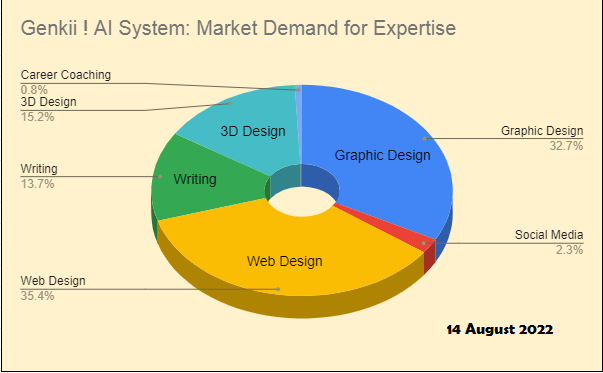
I’ve released the Genkii ! AI system into the digital space on 27 July 2022. Since then, it has been assessing the digital space for different types of market demands and comparing this information to its current capability.


If it detects that it doesn’t have the capability and capacity to provide for a particular market demand, it will then persistently try to grow in that area until the system could match them. It is performing this function for many expert domains at once and continuously throughout the day. I’d just basically let it evolve by itself without much interferences.


Now, it has presented its findings and helped to provide clarity in different types of market opportunities, as shown in the pie chart above.


At the moment, I am trying to improve the system by developing an anti-fraud module. The system has actually picked up a couple of bad actors and it is trying to analyze their behavior, and I want to hard-sequence this knowledge so that it can automatically watch out for the bad behaviors then self-improve to provide better customer experience.

Turning the fast-growing problem of water hyacinth into sustainable energy solution

Thursday, August 11th, 2022

Photo by Wichian Wichitsak

Written by Han-Jun, Zeng


The sprawling presence of water hyacinth in some water bodies, presents a growing challenge to some governments around the world right now, especially those that are situated in places with hotter climate. Water hyacinth multiples rapidly in such climate and it is expected that its rate of growth might increase as the global temperature and rainfall increase.


Already, these plants are suffocating some river bodies with their large foliage, often covering the entire surfaces of rivers thereby disrupting the photosynthetic process that is taking place between the sunlight and the fauna and flora in the river. The growth sprawl decreases the amount of sunlight received by these plants, slows down the oxygen creation process and disturbs the natural ecosystem.


A lot of things are happening at this point. Certain plants wither then die off, and this affects organisms that thrive off these plants. Fishes and other living organisms are also affected due to insufficient oxygen. Water flow slows down significantly because the stalks of the water hyacinths pack so closely together, affecting water movement. The entire water body then slowly becomes a huge mass of stagnant water, giving rise to a huge array of disease vector issues.


This has drastic negative implications on the nearby land ecosystem as well. The land ecosystem, comprising people, animals, insects and plants depend heavily on the adjacent water bodies for their daily needs. Rural people who depend on the water for daily needs such as washing, food sources, etc, might have to seek alternatives if the river system fails. If none are available, they’ll have to migrate to other places. This means that they might have to integrate into other communities thus giving rise to potential social implications.


The same goes for animals and insects. If they are not able to adapt to the new situation, they too might have to migrate elsewhere and therein lies the possibility that their migration will disturb other ecosystems. New animals and insect immigrants have to compete for resources with existing living organisms in those ecosystems. Changes to the food chain could sometimes create unexpected outcomes. For e.g. certain incumbent living organisms may proliferate because its predator population was reduced drastically by the changes. Or it may turn out differently too, in many unpredictable ways.


While the leaves of water hyacinth generally turn brown and die during the winter, many water hyacinth plants survive the winter and grow new leaves in spring. This is not the case for countries that are located in tropical areas where temperature remains warm throughout the year. The warm temperature causes the plants to grow stolons, or spreading stems, from which daughter plants grow. Stolon growth is a key driver of water hyacinth dispersal.


Once it starts to flourish, it will clog up waterway which presents a lot of problems to waterway transportation, hydropower stations, etc and these are often very important topics underpinning sustainable urban development. For e.g., in lieu of cars, trains and trams, some societies are contemplating the use of sustainable waterway transportation to decongest land traffic.  Additionally, many countries are turning to hydropower station for their energy needs. These tools can be rendered useless by natural outcomes of climate change, in this case, growth of water hyacinth.


Significant investments have already been poured into such sustainable development initiatives. I predict that more investment will go into these areas as the financial markets, regulators and consumers are starting to emphasize on Environmental, Social and Governance (ESG) topics. Once the fundaments are cemented, we can also expect financial derivatives to sprout off from the vanillas, creating an even larger market.


These extremely fast-growing water hyacinth (and will grow even faster when global temperature increases), can derail water supplies’, waterways’ and hydropower stations’ operations, affecting significant future investments and government’s capability to provide for their people.


Since the 1970s, many methods have been proposed to cull these water hyacinth, but this issue still persists. Unfortunately, I think that this challenge will persist into the short to medium term future.


However, I propose for those that are facing these issues, to reframe their thinking and view these water hyacinth as a resource. Through proper pyrolysis process and manufacturing techniques, these water hyacinth can be harvested and transformed into water hyacinth biomass briquette. This product can then be burnt in electric power plants to generate electricity.


According to different studies, the average heat value of water hyacinth biomass briquette is about 14 MJ/kg to 20MJ/kg, averaging 15MJ/kg. For perspective, the heat value of natural gas is about 42 MJ/kg to 55 MJ/kg and hard black coal is about 25 MJ/kg. Though not generating as much heat as the latter two, water hyacinth biomass briquette could present itself as a sustainable energy solution, provided that we can control the carbon output.


Apart from this, if the water hyacinth biomass briquette is manufactured to be transport-friendly, producers can export these products in larger volumes.


Of course, consultants might have to step in to reconfigure the electric power plants in order to accept water hyacinth biomass briquette as a burning agent. Harvesting contracts too, has to be given out. Factories need to be set up or reconfigured, to produce the biomass briquette. Logistics like land and sea transport are also essential part of the whole equation. Not forgetting about all the required certifications and licenses. All these translate to substantial financial commitment but give and take, the investment might be able to create new jobs, expertise and experience, all of which might contribute to creating positive economic and social values.