Learning, freedom, and the Web
In late 2010, the Carnegie Foundation convened a few discussions leading up to the first Drumbeat Festival. I took part in the last of those, and my detailed notes from the meeting are finally up on the Mozilla wiki. Our discussions from the day have aged fairly well; covering critical issues about learning, the web, and the importance of being free to learn online. We had a varied group of technologists, educators, hackers, and foundations trying to solve these issues.
Some of the projects mentioned there have already borne fruit, most notably Drumbeat itself; others are seed for good future efforts still waiting to be planted in fertile soil. While I wish I had a universal projects platform/database where each seed could be broken out for improvement over time — until that exists, detailed notes are at least a world-archived first step. Enjoy!
OER awards: an annual celebration of free knowledge
This week I returned to the hack that Jutta Treviranus and I and a few others put together at the OER Hackday for an annual awards ceremony celebrating the world’s best educational materials — where ‘best’ includes openness, accessibility, and flexibility. Right now it seems the focus will be on materials that are:
Open and accessible
- open and gratis: available for anyone to use, online or offline, at no charge
- educational: useful for both K-12 students and autodidacts of all ages
- repurposable: licensed to allow use and reuse as widely as possible
- accessible: available in many formats and languages, usable by all sorts of learners
Modular and editable
- modular: available as collections / libraries, with sections and components marked for easy remixing
- annotated: with tags and categories, structured data and metadata.
- clustered: with links to similar works and information on how it has been used or modified
- editable: published and maintained in a way that makes it easy for users to share revisions and variants.
These are still draft ideas; your thoughts are welcome. This will be the first year of the effort; we will likely allow submissions that do not meet all of these guidelines. Each focus describes a spectrum, at any rate. For example:
Ease of reuse may range from highest marks for “public domain” to lowest for “single copy for personal educational use”.
Accessibility may range from “in major free archives, designed for many extremes of ability” to “on a public website, no DRM”.
Submissions: The awards will allow for direct nomination of great materials by curators in each category, but this year aims mainly to bring greater attention to existing contests in narrow fields, and to recognize the curatorial work they do. So many entries will be the finalists and winners from those existing contests. Some of the free knowledge awards and events we mean to ask to participate:
Categories: There are a variety of formats and a variety of topical fields to consider. We will have a limited set of categories for the contest, and map the intersections of formats & fields onto them. This year we may not distinguisn text and physical media from software and digital media in the categories. We are aiming for enough cross-discipline competition to be valuable without making judging impossible.
Location: We are still discussing where and how to hold a ceremony honoring the winners, or perhaps a number of small events recognizing the year’s most excellent work at other major gatherings honoring developments in education, knowledge, and collaboration. Assuming we do this in person and not virtually, relevant events include:
July 12-15: Wikimania, DC.
August ??: Stockholm Challenge.
Oct 16-18: Open Ed, Vancouver.
Oct 22+?: oXcars, Barcelona
Stay tuned for updates on this front. And send in your favorite places to find amazing data, books, art, media, and other free knowledge.
Malagasy, Yoruba, and Amharic wikipedias are growing rapidly
A few updates from the African-language Wikipedias, courtesy of Ian Gilfillan’s blog. [HT to Don Osborn]
The last year has seen tremendous growth in Malagasy, Yoruba, Amharic. Malagasy is a popular language among linguists and historians, who make great Wikipedians; and both Yoruba and Amharic have extensive historical literary cultures.
Swahili and Afrikans projects are still quite solid, but their growth has slowed somewhat. And among the very small languages, Setswana grew from almost nothing to over 400 articles as well, thank to the Tswana Wikipedia challenge suppoted by Google. So if you have been looking for an afrophone wiki to get involved with, now is a great time to start.
Wikipedia Zero
Free access to Wikipedia on mobile devices.
That is Wikipedia Zero in a nutshell. With a current focus on making this possible through mobile partnerships in the developing world. It’s a bold and lovely project, a focus of Wikimedia outreach this year, and deserves wider visibility.

Mission of the day: Sister Project Committee mesh
There have been many threads about sister projects since I recently reraised the idea of fixing our process for reviewing new project proposals. The past two weeks saw a dozen brainstormers, a few etherpads with notes on how to form a related committee, 2 ideas for how to stage and review proposals to replace the current dated process, and a few serious new project proposals raised. Thanks to all of the enthusiastic participants, it brings back the visceral joy of being on a knowledge frontier that characterized the earlier days of Wikipedia.
If you have a favorite project concept, ideas from an existing sister project, or related strategy proposals from our brainstorming two years ago: please bring them up again now on Meta to give the discussions a well-rounded and practical focus.
I’ll try to summarize these threads and proposals today. I am eager to see us start to actively incubate new project ideas that experiment with gathering new types of knowledge. As a community we have the infrastructure to do this today, we just need a little more flexibility and guidance for how we empower enthusiastic project founders to create a new workspace and gather their initial community and visionaries.
Context of the day: Digital Public Library vision and participants
I am spending most of the day in literacy and library discussions, helping define the audience of the Digital Public Library [of America]. It is a fantastic project. And I am warmed by the society-spanning groups that come together aound this vision for the evolution of libraries.
We should to bottle this type of shared sense-making, social diplomacy, and brainstorming. “How do we solve the collective action problem for all of us who share these common goals?” It must unfold from an institution-managed process to one that is low-cost, almost entirely online, and driven by the passion of its crowds. That would revolutionize planning for many walks of modern life.
I will be posting discussion transcripts where I can; keep your eye on #dplawest for pointers.
Awesome 1-yr Wikipedia Fellowship open at Harvard’s Belfer Center
Wikimedia and Harvard’s Belfer Center for Science and International Affairs are looking for a Wikipedia Fellow to work on-site in Cambridge, Massachusetts for a year, on topics related to international security. From the full jobvite posting :
The Wikimedia Foundation and Harvard’s Belfer Center for Science and International Affairs are accepting applications to be a Wikipedia Fellow at the Belfer Center, for one year starting July 1, 2012.
This is a full-time position, tasked with
- improving the quality of WP articles related to international security:
- liaising between the Wikimedia community and Belfer Center experts, facilitating resource sharing;
- coordinating projects and events, online and in-person, to support improving Wikimedia projects.
- working with faculty, staff, and fellows at the Center to increase understanding of and participation in Wikipedia and other free content;
- sharing this experience at Harvard with the global community of Wikipedians, and among academics, via articles, blog posts, and multimedia.
Managing the Scholarship Dilemma of well-funded communities
I have been dealing recently with reimbursements for OLPC community events, more difficult this year than in years past. Among other things, this year we asked event organizers to cap travel support at $150 per person, to avoid having a few all-stars soak up available funds.
Within Wikimedia, in contrast, it is becoming the norm for some well-respected community members to get full rides to multiple conferences each year. This made me reflect on how different communities set expectations of scholarship and support, and the long-term implications for the movement.
Expanding travel scholarships always seems like a good short-term idea, but has negative side-effects; raising what I think of as the scholarship dilemma – something most strongly affecting large communities that are flush with funds. A similar dilemma exists within academia and other communities, but this essay focuses on grassroots and volunteer communities.
Too much of a good thing?
The progression from benefit to dilemma goes something like this:
- Early community events are a shared hustle: whoever can come and is passionate about them makes them happen, helps find funds for themelves and their proposed speakers, and the whole event powered by love and enthusiasm. Special guests are encouraged to find their own funding; reimbursements and support for travel and lodging are reserved for those who absolutely can’t come without it. Some outside supporters may offer limited scholarships to the needy.
- With experience and perhaps central organization, this gets easier every year. Sponsors return for many years running. The movement itself enjoys the events and starts finding funds to bring people representing the diversity of the movement. Local branches of the community start funding travel for a few people from their region.
- The movement becomes well-funded, and starts supplying most or all scholarships from their central organization/foundation. They begin hiring many of the core community members, and funding attendees who are contractors or staff. The major meetings become a place to hold in-person business meetings for core parts of the movement, and those start applying for their own pools of travel funding.
- Suddenly, getting travel support of some sort is a prize that everyone who would like support, or thinks they may deserve it thanks to their good work, applies for. It is a minor status symbol, rather than a sign of need. Expectations start to be set that certain ‘core’ or active people will always be at such events – or will at least be funded to get there.
Herein lies the dilemma: some great participants can’t come on any given year for financial reasons. And most people enjoy in-person meetings. On the other hand setting expectations that you can get scholarships if other people want to meet you can split the community, and may mean that when funds inevitably become tighter, people stop showing up. The sense of pulling together to make the first conferences happen — that everyone should be able to raise their own funds, or share the cost of the event — is lost.
More on unwanted side effects and possible solutions, after the jump.
(more…)
Why and how to build free collaborative services.
Here is an edited/clarified version of a mailing list thread many weeks ago, in which Wikimedians were discussing starting a Q&A site, or setting up a hosted solution for same.
I drafted a post about this to reprise here, but am just now finishing it off.
It is a disappointment… that Stack Overflow uses proprietary software
(not least because it is so wonderful) because in all other respects, as
a community, they do a great job. I have had wonderful experiences with
them and would urge anyone to get behind them.
I like their spirit and community too. I would be happy to see a StackExchange site for Wikipedia/MediaWiki questions exist. [that was the context of this email thread.] But it won’t contribute to the global free toolchain for collaborative knowledge, which we are part of. So the templates and environments for discussion that we build by customizing those tools will have only limited long-term value.
} Sure, they do things slightly differently — but that doesn’t mean
} they do things wrong.
From the perspective of Wikimedia’s mission, they are indeed doing things wrong. [.From the perspective of running a small business, they may be doing just fine.]
Effective access to collaborative knowledge is important to a harmonious society. As a result, basic knowledge-sharing tools and toolchains should be free, for any sort of use, customization, and improvement. The universal value of a Q&A system is directly tied to the importance that good free tools should be available to set one up.
We want to support these free toolchains, which is why we release all of our own code. This is also why, when there are good free versions of proprietary tools, we should support them and help them grow. That support is one of the ways we contribute to long-term knowledge development, in everything we do.
Whether we host the result ourselves is a totally separate question. Both OSQA and Question2Answer offer hosted services. But any solution we use must be one that we could choose to host ourselves, if necessary.
Thomas wrote:
} the main advantage is that your putting it under a name and community
} who are already experienced at doing really good QA – so your seed of
} volunteers is going to be that much better! SE have nailed that vibe.
I agree that they have a good shared vibe. Quora have as well. It is a valuable thing, and also one deeply rooted in human nature, like wiki editing. 🙂
For precisely the reasons you mention, it is important for us to have a better in-house QA tool. We need a better channel for the people who are in that zone to shine on Wikipedia — beyond simply manning the Reference Desk and similar pages in various languages (which many hundreds of them already do), or removing themselves to other sites where inter-article linking to WM articles is difficult, answers are not directly editable, there is a new framework for logging in, messaging, &c.
We have some stellar community groups to seed such a site with ourselves — and this will offer a place for many more who like Q&A work but not other wiki editing to become involved in a rewarding way.
On building a global network, and collaborative fundraising
Wikimedia has recently been discussing how and why we fundraise, and how we determine where to direct the stream of visitors to our shared global websites when we ask for donations. In particular, two years ago we directed visitors to over 10 chapters who then each processed their donations directly; this was cut back to only 4 of the larger chapters last year, with clearer standards for accountability and financial transparency for those groups.

A few months ago our eloquent executive director, Sue Gardner, began a detailed consultation on the aptly named Meta-wiki to discuss ways to improve this process, which has grown organically over the past five years. She is publicly drafting and annotating her own recommendations to the Board, which will be presented to us in a few weeks’ time. Since this is such a transprent process, we have already had preliminary discussion at our last board meeting, resulting in a letter varying slightly with the draft recommendations at that point. An annual community-wide finance summit, organized this year by the French chapter, was held last weekend in Paris, and these discussions occupied much of the agenda there.
My fellow Trustee and Wikimedia Treasurer, Stu West, recently published and later summarized his personal views on these matters.
I would characterize this view as “centralize all donation-processing”: he feels the global Foundation can gain economies of scale, and economies of specialization, by processing all donations centrally in the US, and then distributing funds back out to Chapters and other groups around the world — enough to offset the loss of tax-deductibility and other advantages to local processing. (choices of where to distribute, and donor relationship management, would still be made in a communal fashion.)
My own personal view is to “decentralize where excellence and desire meet“: I feel we should support decentralized processing by all highly competent groups with demonstrated skills in these fundraising matters, where they have some local benefit or other reason to process donors directly, and where they decide to take on that challenge. The skills involved are not trivial; some will not develop them, others have no local incentives to do so, still others may not want the extra work entailed. This include competence (and legal ability) to redistribute surplus funds raised to projects around the world, through whatever global allocation/prioritization process we build together. Decentralization of this donor and fundraising work may lose some economies of centralization, but it will gain many others: including direct financial advantages in some regions (tax deduction, matching), and ensuring that we have redundancy of relevant expertise across our movement.
I repost below the comment (copyedited for clarity) that I left on his blog:
I interpret our Board letter in the opposite (positive) sense to Stu’s summary on his blog. I believe that at least some Chapters should payment process, because in some cases we already see that it offers a net benefit for the movement. And I think that any chapter that is sufficiently mature — skilled in dealing with donations, efficient in its work, meets a high standard of financial accountability, and has a history of supporting community-driven dissemination targets — and *wants* to payment-process for banner-driven donations, should be able to do so.
By this description (and reflecting on your four points above), such chapters, before they could process payments from sitewide-banner campaigns, would first have to be:
- Already processing payments locally, managing their national messaging in sitewide campaigns, complying with local financial regulations, and handling donor relations. (They would already be processing payments from local email and media campaigns)
- Efficient in their financial work; so that this would not be significant additional time and money on top of their normal operations
- Demonstrably skilled in their financial work, and able to meet strict standards maintained by the Foundation and the movement as a whole.
- Lacking in a sense of entitlement, and participating in community-led allocation work to identify and support impactful work worldwide
This would be a limited set of large, respected Chapters. It would not be a natural step in chapter growth, and only those with a financial and donor-focused bent would be in a position to pursue it (or to implement it efficiently). Other options exist now and will only grow for smaller chapters. Some chapters will be founded in countries with strict financial laws that make it too difficult to distribute funds outside the country.
Enabling groups to grow in areas where they have demonstrated excellence and foresight is consistent with our culture of empowerment; and having more than one body competent to do any significant task is consistent with our culture of decentralization.
Naming and familiarizing the unknown
Phoebe wrote a lovely essay recently about the unknown on her phlog. She reflected on the many uncertainties in recent complex discussions in the Wikimedia universe.
It reminded me that gaining familiarity with the unknown, and an ability to grapple with unknowns without losing all direction or perspective, is a most valuable skill.
We would ideally be able to highlight large areas that are unknown, to label them, to include them as variables in even larger equations and balanced. Indeed, we should be able to derive some of their properties befor they are understood in fine detail.
Moving from working only with known quantities to working with unknowns was an essential stepping stone towards developing most of modern mathematics, and much scientific reasoning. This may apply no less to areas of social and civic growth.
SOPA – PIPA math: 61% >> 28%
Three cheers for participatory democracy! The percentage of stated opposition to SOPA and PIPA in Congress changed dramatically over the past two days, from 28% to 61%. [If you count people who are “leaning No”, by ProPublica’s estimate, this goes up to 69%.]
How many politicians announced they would be co-sponsoring or otherwise outright supporting SOPA/PIPA on Wednesday? By our count: Zero.
Update: Harry Reid releases Dems in the Senate to vote against PIPA if their conscience demands. And Chris Dodd, former Senator and current MPAA Chairman, just called for a summit between Internet and traditional ‘content’ companies, convened by the White House, to reach a compromise. (He hasn’t yet realized that major content companies today are Internet companies.)
We are experiencing the growth of social unity and a certain moral sense across the Web, among people who have found something wonderful, worth defending with all their heart. This is a small piece; it is thrilling to be part of it. I hope you feel it too.

Blackout Wednesday wrapup #3: impact edition
Over a dozen Congressmen have changed or clarified their position on PIPA and SOPA over the course of the past 36 hours, towards opposing the bills. This includes six senators and two representatives who had previously been co-sponsors or solid supporters of the relevant bill in their chamber. Many more who formerly were neutral about the bills or leaning towards opposing them, are now calling them “misguided”, saying they will “cause more harm than good”, “harm free speech rights”, “weaken freedom of expression on the Internet”, and would “harm Internet innovation and jobs”. Most agree that the bills as written “need to be stopped”. It seems that some of them have looked at the bills with a magnifying glass for the first time.
Senator Boozman summarizes: “Over the past few weeks, the chorus of concerns over Congressional efforts to address online piracy has intensified“. A week ago it looked like there might be a straight 60-vote approval of PIPA in the Senate; now it is losing suppoters by the hour, and may have a hard time getting majority support; making it unlikely to make it to a vote at all.
Blackout impact
Politico and others suggest that much of this movement was a direct result of the strong online statement made by the EFF, Reddit, Google, Wikipedia, and others – and the protest organized by those groups to express their views to every representative and senator in the country. Wikipedia produced a ‘find your local representative’ widget, to ensure that we encouraged readers to call their representatives directly; Google simply encouraged signing a petition.
Once the blackout launched, it trended worldwide on Twitter, with hashtags such as #factswithoutwikipedia, #SOPAstrike and #wikipediablackout. At one point, according to Trendistic, #wikipediablackout was used in 1% of all tweets. Hotspots claims that SOPA (and #SOPA) has accounted for a quarter-million tweets an hour since then.
The EFF reports that by 5pm, over 250,000 1 million people had contacted their representatives through the EFF blacklist site. Wikipedia reports roughly 160 million people have seen their blackout page, and eight million of those have looked up their elected representatives’ contact information through its tool. (No word on how many made contact; if there is a dropoff rate similar to the first clickthrough, then that would make another 400,000 contacts.) Google reports gathering 4.5 million signatures on its petition.
Statements today from members of Congress:
Senators noting their disapproval of PIPA yesterday and today: (those who switched away from previously indicated support are listed in bold)
- Mark Begich (D-AK)
I oppose PIPA…Online piracy needs to be addressed, but the current form of the bill isn’t the proper way to do it.
- Roy Blunt (R-MO) @RoyBlunt
I strongly oppose sanctioning Americans’ right to free speech in any medium, including over the internet. #SOPA #PIPA
- John Boozman (R-AR) [facebook]
Over the past few weeks, the chorus of concerns over Congressional efforts to address online piracy has intensified… I intend to withdraw my support for the Protect IP Act. I will have my name removed as a co-sponsor of the bill and plan to vote against it…
- Scott Brown (R-MA) @ScottBrownMA
I’m going to vote no, the Internet is too important to our economy …
- Jim DeMint (R-SC) @JimDeMint
I support intellectual property rights, but I oppose SOPA & PIPA. They’re misguided bills that will cause more harm than good.
- Orrin Hatch (R-UT) [thehill] @OrrinHatch
That’s why I will not only vote against moving the bill forward next week but also remove my cosponsorship of the bill. #utpol #tcot #PIPA
- Jim Inhofe (R-OK) [facebook]
SOPA is the wrong response from the US Congress. (also now opposes PIPA)
- Johanns (R-NE) [ journalstar]
- Mark Kirk (R-IL) [kirk]
Freedom of speech is an inalienable right granted to each and every American, and the Internet has become the primary tool with which we utilize this right… This extreme measure stifles First Amendment rights and Internet innovation.
- Jeff Merkley (D-OR) @SenJeffMerkley
Thanks for all the calls, emails, and tweets. I will be opposing #SOPA and #PIPA. We can’t endanger an open internet.
- Lisa Murkowski (R-AK) [adn]
The bill raises serious concerns about our civil liberties. That’s why next week I plan to oppose the current PIPA bill.
- Marco Rubio (R-FL) @marcorubio
After hearing from people with legit concerns, have withdraw support for #PIPA. Let’s take time to do it right. http://t.co/9fFMRgOU #SOPA:
Senators who changed from support, to advocating a delay in voting for revision and reconsideration:
- Ben Cardin (D-MD)
- John Cornyn (R-TX) @JohnCornyn
SOPA: better to get this done right rather than fast and wrong… the potential impact of this legislation is too far-reaching to ram it through Congress.
- Charles Grassley, (R-AL)
Since the mark-up, we have increasingly heard from a large number of constituents and other stakeholders with vocal about possible unintended consequences of the proposed legislation, including breaches in cybersecurity, damaging the integrity of the Internet, costly and burdensome litigation, and dilution of First Amendment rights…
- Robert Menendez (D-NJ) @SenatorMenendez
#NJ: I hear your concerns re: #PIPA loud & clear & share in these concerns. I’m working to ensure critical changes are made to the bill.
House Representatives stating disapproval or opposition: (those switching away from previously indicated support or cosponsorship again in bold, but this was harder to ascertain):
- Akin (R-MO)
Copyrights must be protected, but not at this cost. Open internet and free speech!
- Baldwin (D-WI)
I do not believe it is the responsibility of Internet service providers to become the police of the Internet.
- Gus Bilirakis (R-FL) @RepGusBilirakis
Piracy should be prosecuted, but I have deep concerns about SOPA’s effect on free speech rights and am opposed to it in its current form.
- Blumenauer (D-OR)
Rep. Blumenauer’s website joined the blackout for an hour: Today I am joining the millions of Americans who are standing with the world’s most innovative websites against the proposed censorship of PIPA and SOPA
- Bruce Braley (D-IA) @BruceBraley
I’ve heard you. I strongly oppose #SOPA. http://t.co/iM2MsbiA
- Courtney (D-CT)
SOPA as it exists today… should be scrapped entirely. An axe instead of a scalpel, this bill would unacceptably and fundamentally change the architecture of the internet.
- DeFazio (D-OR) [facebook]
Wikipedia, Craigslist and others are dark today to bring attention to the atrocious SOPA bill that will take away freedom on the internet.
- DeGette
I want to thank everyone who has taken the time to contact me about SOPA… Without serious changes I’m not convinced SOPA effectively solves the issue and am concerned about the implications it would have for online innovation.
- Keith Ellison (D-MN) @keithellison
#SOPA would harm internet innovation and jobs. Better ways to fight piracy.
- Jeff Fortenberry (R-NE) @JeffFortenberry
I oppose #SOPA–it would disrupt the structural integrity of the internet
- Jeff Flake (R-AZ) @JeffFlake
I oppose #SOPA because I’m concerned it will restrict free speech.
- Cory Gardner (R-CO) @repcorygardner
online piracy is a real issue but we must maintain a free & open internet #opposeSOPA #endpiracynotliberty
- Gosar (R-AZ)
- Graves (R-GA)
We’re getting a bunch of questions this morning about the ‘Stop Online Piracy Act.’ I wanted to let you know that I oppose the bill.
- Grijalva (D-AZ)
This legislation has moved beyond protecting legitimate intellectual property rights and is now headed down a path that would let companies decide what you get to view online.
- Tim Holden (R-PA)
An open Internet requires that we find a better approach that is acceptable to all sides. [politicspa]
- Holt (D-NJ)
- Honda (D-CA) [politico]
The bills as currently constructed, with overbroad definitions, will do much more harm than good, hurting the very people they are supposed to protect.
- Hultgren (R-IL) @RepHultgren
Given the widespread coverage the Stop Online Piracy Act (SOPA) has received, I want to let you know that I oppose it in its current form.
- Inhofe (R-OK)
- Steve Israel (D-NY) @RepSteveIsrael
I oppose #SOPA. We must protect innovation without weakening free expression on the Internet.
- Darrell Issa (R-CA) @DarrellIssa
83 Internet pioneers: #SOPA & #PIPA would destroy web #DNS system as we know it. LETTER: http://t.co/nfx0SAy6 #SOPA #stopSOPA #PIPA
- Lynn Jenkins (R-KS) @RepLynnJenkins
I do not support SOPA, will fight against any efforts to advance it, and will vote against it if it comes to the floor. …
- Kinzinger (R-IL) [facebook]
the way these bills are currently written does not ensure an open and free internet and that is not something I can support.
- Latham (R-IA)
I oppose SOPA or any bill abridging freedom of speech.
- Lee (D-CA)
SOPA in its current form is far too close to internet censorship, something I strongly oppose.
- Marchant (R-TX)
- Jim Matheson (D-UT) @RepJimMatheson
Oppose SOPA and PIPA; online piracy is a serious issue, but these bills are not the way to go. Complicated issue…
- McCotter (R-MI)
- McDermott (D-WA) [facebook]
I’ve heard from many of you about the “Stop Online Piracy Act” (SOPA). We need to do something about online piracy, but this bill is not the right way to do it.
- Patrick McHenry (R-NC) @PatrickMcHenry
I oppose #SOPA in its current form and have signed on as an original co-sponsor of the #OPEN Act. Check out …
- Mike Michaud (D-ME) @RepMikeMichaud
#SOPA need to be stopped. Speak out and make sure Congress hears you. http://t.co/W1sso3uG
- Jim Moran (D-VA) @Jim_Moran
I oppose #SOPA. Keep the internet open.
- Nugent (R-FL)
I’ve gotten a lot of calls from people today urging me to oppose SOPA (or PIPA, as the Senate companion bill is called). I do oppose the bill as it’s currently written.
- Pascrell Jr (D-NJ)
- Price (D-NC)
I am opposed to the proposed SOPA bill… Today’s ‘black-out’ campaigns by Google, Wikipedia and other major websites echo the voices of the many constituents I’ve heard from.
- Chellie Pingree (D-ME) @chelliepingree
So many contacting me today outraged with #SOPA and I couldn’t agree more. #mepolitics
- David Price (D-NC) @RepDavidEPrice
Release: Price Opposes #SOPA, Calls on Congress to Protect Open Internet http://t.co/fPqmflT1 #ncpol
- Ben Quayle (R-AZ) [politico]
- Dennis Ross (R-FL)
“I believe #SOPA is dead.”
- Tim Ryan (D-OH) @RepTimRyan
Web piracy is a an issue that should be dealt with, but I oppose #SOPA bc it does too much harm to innovation & speech @eff @boingboing
- Jan Schakowsky (D-IL) @JanSchakowsky
Thank you all for the many calls today to #StopSOPA! I want you to know that I oppose #SOPA & will vote against it #p2
- John Shimkus (R-IL) @RepShimkus
We can protect intellection property through anti-piracy legislation w/o censoring free speech or stifling innovation. #SOPA is not the way.
- Adam Smith (D-WA) [adamsmith]
these measures, if enacted, would place unacceptable limitations on the accessibility of online information and content, impose undue burdens on small and innovative websites and applications, and would not be the most effective way to curtail overseas illegal piracy and theft of intellectual property.
- Lee Terry (R-NE) [omaha.com]
SOPA, as currently drafted, isn’t the solution.
- Joe Walsh (R-IL) @RepJoeWalsh
Thank God twitter isn’t blocked today so I can tell you that I refuse to vote for #SOPA. #uncensored #StopSOPA
- Yarmuth (D-KY)
Thanks for your calls and emails this morning. I am opposed to #SOPA.
- Yoder (R-KS)
A doff of the hat : Much of this data comes from or was confirmed through ProPublica‘s excellent timeline of public statements by Congressmen about SOPA and PIPA.
12000 comments 1 post, Part 1
The Wikimedia Blog has 1013,000 comments on Sue’s SOPA/PIPA blackout post – roughly 3x the total volume of posts in the entire previous history of the blog. By my casual estimate, 90% of comments are opsitive, 5% neutral, and 5% opposed (generally on the grounds that WP itself should be neutral).
They are a goldmine of interesting quotes. A selection, for your entertainment:
- I was at first very irritated when I saw that Wikipedia was taking a political stand on any issue, I actually had no knowledge of these bills and after reading these bills, not only am I too very opposed to them but I also understand the threat these bills pose to Wikipedia itself. – Donald Langhorne
- The issues go far beyond the US. -FT2
- dis is retarded -____- im 13 and i NEED wikipedia!!!!!How else do u think i get good grades on my essays?!? -LLAMAZRULE
- Good. Great. Fantastic. Amazing. I love it. Public figures, be they people or webpages, never take a bold stance on anything important. Thank you for doing so. – Quarex
- Not only is Wikipedia the easiest, quickest and most hassle-free place to check up on facts, but now it also has the courage to take a stand against restrictions of our freedom online as well! – Jennifer Fricker
- Black it out for a week if you have to. GO WIKIPEDIA!
- i don’t really know about this man. I know it’s got to be a hard decision but i don’t think it’s a good thing. what if somethin’ happens because someone hacked the government lately so please don’t do this. -rhedeosi
- blindness seems so easy..while vision is so hard to bear…
- Just learned of your blackout in support of intellectual property thievery. I disagree with your position. I have for several years sent a year-end contribution to Wikipedia. Since you have thrown your support to brigands, thieves, miscreants and malefactors, I will send no further contributions. This is NOT a free speech issue as you claim. This is about appropriating work of others without compensation. We call this theft. It is a crime. You can look it up in Britannica. -tcement
- It is the movie companies etc who are the pirates. The films they produce are mainly rubbish these days and actors are paid way too much.
- I kinda hate you for shutting down my favorite recreational website for 24 hours, but not only do I agree with why and what you’re doing, I’m also glad such a large user website is taking their time to shut down and bring awareness to this nasty piece of legislation. -Joey
- I am extremely disappointed that the issues raised by those opposed to this action have not been addressed. The English Wikipedia community is not 100% behind this action… this is a sad day in the history of Wikipedia. seem[s] like a rash action to me and one pushed forward by the tyranny of the majority – RobertHorning
- Didn’t have any idea about this so thanks for not only informing me but taking steps to protect us from this legislation. – Alice Miller
- Yo apoyo su postura y desearía conocer de que otra forma puedo apoyar la causa de una libertad que es inherente absolutamente a todos los seres humanos. – Jorge, Mexico
- I support this plan, but I hope that WP still open and not close forever.
- As an artist and so-called “content provider,” I totally support this blackout. – Gary Lee
- I was not aware of the choices being made. I am therefor very proud to have found this blackout ideal going on. I do not think the men and ladies of our government offices will care to much about the black out… ON the Common man in central Illinois. I would say I do so enjoy your web help on so many levels. I thank you all so very much for many years of dedication. – Micheal Raleigh
- I am thirteen years old and i love wikipedia. Have gotten good marks on most of my essays thanks to Wikipedia. You have my support. – Tristan Wong
- I remember when television was free, and the first cable companies came to our smallish U.S. town with promises and packages for the city commissioners (the governors of our city) to admire. They courted us, then they took over so there weren’t any alternatives any more… – Judy Allensworth
- A great decision, people need to be made aware of SOPA/PIPA. You have my support in future fundraisers because of this. – jam12
- We, as a global people, need access to an Internet that crosses borders without restraint. I say this as an American, living behind China’s Digital Great Wall. Yes, I can go around it, but why should I have to? – Eva Richardson
- As a financial contributer to Wikipedia I must say that I am dissapointed that this protest is planned. My so far unsubstantiated fear is that opponents of this law… want no legal interference with the internet… so that they can file share stolen intellectual property… I wish Wikipedia would stick to its primary purpose. I am unlikely to continue my perpetual support of the Wikipedia community if I feel I am likely to support political causes too–even if they are at times causes I support. – C. Becker
- I’ve been something of a Wikipedia fanatic since its debut, when I could barely reach the keyboard. Sure, a six year old kid can’t really learn that much about applied physics—but the thought that I was reading “smart stuff” worked wonders on my little noggin. Now the thought that any number of bills could take away… one of my best sources of information enrages me. And this isn’t even taking into consideration the damage SOPA and PIPA could cause in other sites which can only subsist with the free transfer of media and information (Youtube, Reddit…) – sebastian
- How do I, as a High School Senior, talk to my political leaders to stop these acts from being signed.regards, Dixon Romeo
- ..en el nombre de un internet libre apoyamos esta movida. – edwin
- Not only english Wikipedia must blackout this next Wednesday, the other languages too… we have a saying here in South America: “When the USA sneezes, the rest of the world catch a cold”. Those bills are very dangerous for freedom of expression, and if that happens in the so called “land of the free”, what can other countries expect? My full support for you, Wikipedia, we will win! – David
- Great news… This is a milestone in the decades-long reformulation of intellectual property rights during the age of computers. The solution still eludes us. Creative people must have rights to their creations, but tyranny must be avoided. – Jeff Laird
- I’m so confused with the SOPA… USA is very honor the freedom, but why you do this?
- While I oppose SOPA as well, so much for wiki’s NPOV. – Glenn
- This is finals week at my school so it will be difficult to not have Wikipedia for a day, but I support what y’all are doing and I am glad such a large website like wiki is standing up for our rights, maybe our congress people will listen. – Morgan
- As a longtime fan of Wikipedia, this decision saddens me… Wikipedia’s voluntary blackout doesn’t affect my feelings on SOPA. I still support it, and I suspect that the only people whose opinions change are those who know little about the subject – Mark
- this sucks I will lose my brain for 24 hours – gelly909
- the blackout is already being run on the local news networks. So the protest is already making headlines. No pain no gain. – Neale Family
- Though I wholeheartedly support the blackout (and think a 24 hour blackout is too short)… this form of protest is a one-time deal… Any protest afterwards may make Wikipedia appear politically skewed; consequently, this is a temporary solution to stopping internet censorship. Real solutions must be made by limiting corporations, redefining outdated laws… – Kevin
- DEAR WIKY–WIKI TEAM
NO NO NO PLEASE DONT DO IT
NO MORE SOPA / PIPA
– SRK
- You should also black out the Spanish language version of Wikipedia. It’s just as much the language of the United States as any other. And add German, French, Italian, Chinese, Hmong, Sanskrit, Pashtun, etc. while you are at it. All cultures have been welcomed here. – tooluser
- This should not have been done without widespread participation… Many people want to contribute to Wikipedia without getting entangled in Federal policy debates. – Racepacket
- A kid, first, talks by it own way,
after learning and teaching it talk right words.
Institution should teach how to provide right content and publishers should learn
– Rajagopal Jeyaraman
- The 24 hour silence of Wikipedia will be most eloquent. Thank you for taking such a stand!
- love wikipedia for things like this, its so…open. For the people, by people.
- I am in complete and utter shock. I had been quietly reading what everyone thought and kept thinking no, Wikipedia wouldn’t take such a political stand. Now it is. I never thought I’d see the day… this is amazing to see happening. – cycloneGU
- While I totally approve of Mrs. Garnder’s letter and of the blackout protest, what is missing are clear specific reasons to oppose SOPA and PIPA.
- Although it is hard to pick what battles to fight that wall seems to be coming closer to our backs every day.
- Sorry, friends… fewer great minds will be willing to risk creating great things knowing that Wikipedia will confiscate the fruits of their labors, like a thuggish pimp, and whore them out. Put away your self-righteousness, something that is so typical of mobs, and learn to honor the individual–the only thing that has ever made any great advances in any free society. Read “Atlas Shrugged” and learn.
Do you have a response? I’d like to read it. – Mike Whitehead
- As a scientist and as a professional engineer… I endorse the Wikipedia stand on the free flow of Internet information. Wikipedia is the best social institution to arise since the creation and distribution of written script via the printing press, second only to the publication of those social concepts and ideals of our founding fathers set down thereupon to guarantee their preservation. – Anthony Bielecki, P.E., PhD
- After WWII in Japan, GHQ censored all publications in Japan. Then gradually they lifted censorship, but… step by step the publishers were trained to do what the authorities wanted; to submit to effective censorship of free expression and speech. Too bad I won’t be doing my Media class on Friday at Toyo University. If the class was tomorrow, I would have the students get on Wikipedia, define their shock, and introduce the very important topic of free speech. – Sarah Brock
- Even light-weight tabloids will notice and report it. – Michael Wild
- Many of the objections raised about the powers of corporations to control user access to foreign sites… prohibit streaming… throttling of bandwidth… threatening ISP providers with shutdown, are already a reality here in Canada. If you can’t prevent this in the U.S., the rest of the world won’t have a chance. Good luck. Our children’s freedom is at stake. – stephen
- you guys are doing the right thing… Luckily for me, I am Canadian but hold dual citizenship. If this passes, I will definitely pay the $500.00 to lose my dual citizenshi – Sean
- SOPA will never be used to take down the largest encyclopedia in the world–to suggest otherwise is just disingenuous… Wikipedia should never take such an obviously political stance on something that will not affect them directly.
Stopping SOPA+PIPA: Blackout Wednesday #2
It has been 12 hours since the blackouts protesting SOPA and PIPA started. Below is coverage from the English-language Net.
Best quotes so far:
“Wikipedia blacked out. Fine, I’ll buy some used encyclopedias from Craigslist. WTF? I’m going to Reddit to complain about this. OMG!!”
“Icanhazcheezeburger?! OK, this is serious now.”
In Wikipedia land:
- The response to the English Wikipedia blackout has been overwhelmingly positive. The OTRS team (a community group that handles most email inquiries about Wikipedia) has been handling the surge of correspondence beautifully.
- a post by Sue Gardner on the WMF blog about the blackout have together received over 10,000 comments from readers — roughly 3x the total # of comments received in the entire history of the blog. 90% of them are supportive of the blackout, 5% are opposed, and 5% are neutral.
- Fellow trustee Stu West suggests that 100M Wikipedia readers may read about the bills today via Wikipedia – half via the blackout on English Wikipedia, and half from banners on other language projects and the mobile sites. (Another large audience saw the ‘heads-up’ banner we ran all day yesterday.)
Elsewhere on the Web
In Washington, politicians are beginning taking notice. They seem to be seriously considering and commenting on the demonstrated failings of the legislation on hand, not just backing off (as GoDaddy did) to await ‘consensus’.
Other coverage online:
Preserving Internet freedom: protesting SOPA and the Wikipedia blackout

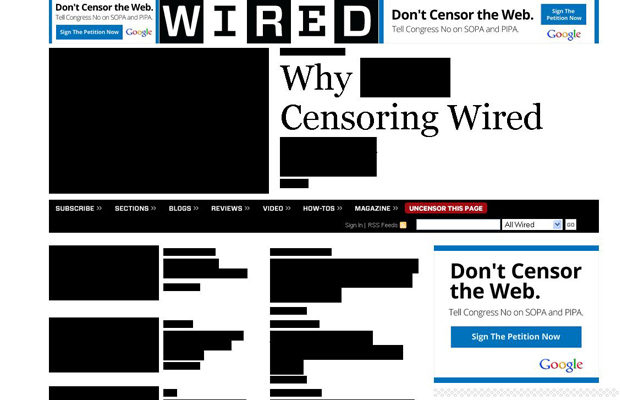
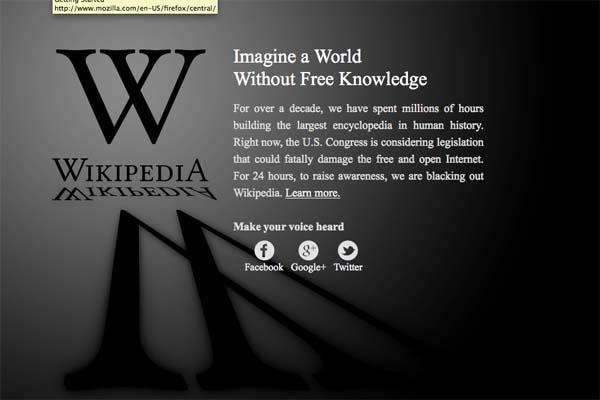
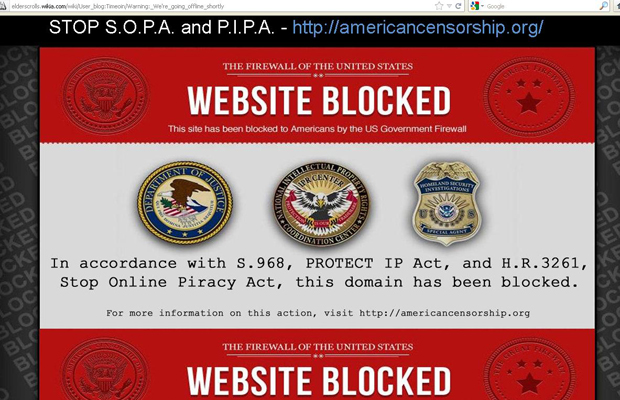
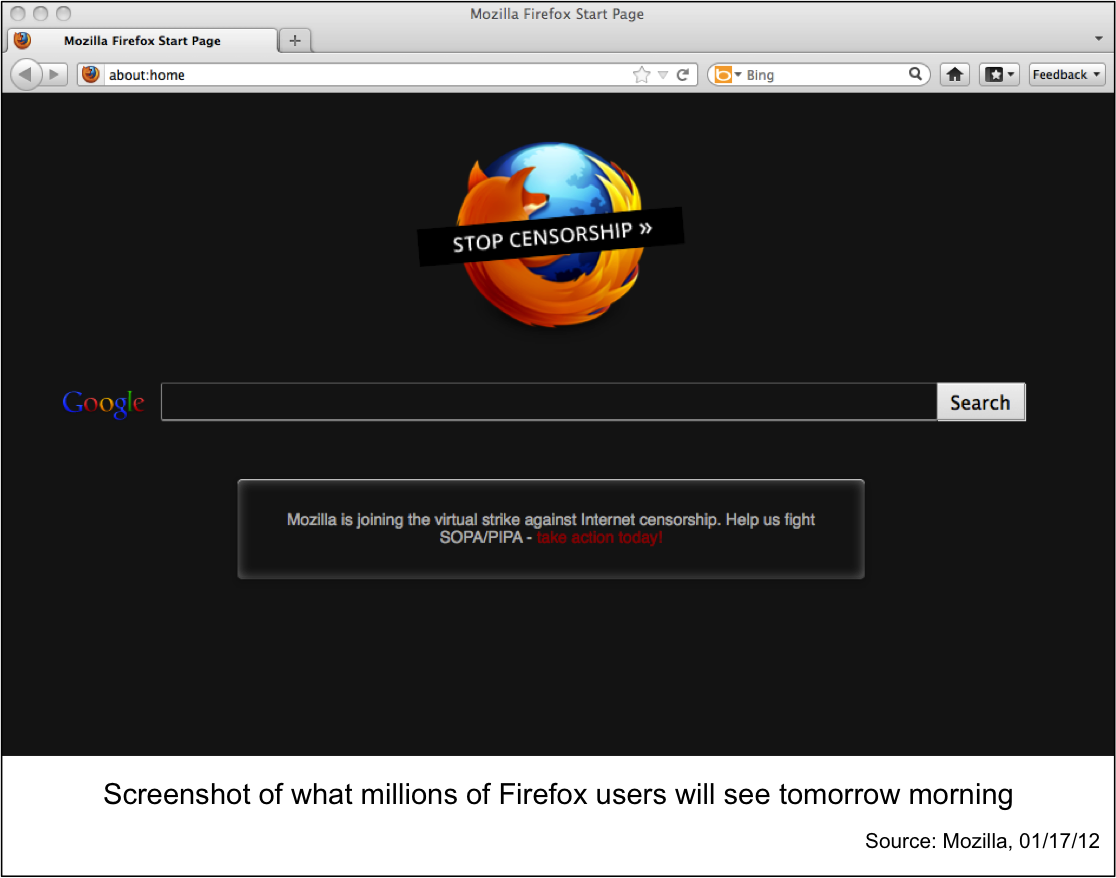
Thousands of web sites across the Internet are shutting down today to protest proposed U.S. laws (
SOPA and
PIPA) that would make it difficult for websites to host community-generated content on the Internet. Most notably, the English Wikipedia is
implementing a 24-hour blackout, replacing articles with a notice describing the two bills and encouraging readers to take action to stop them.Please take a moment to
learn more about the bills and why they would be harmful to the open Web, to open education, and to present and future collaborative projects.
The Electronic Frontier Foundation and other non-profit organizations dedicated to preserving freedom on the Web have ways that you can make your voice heard in the national and international debate about these proposed laws.