Awesome 1-yr Wikipedia Fellowship open at Harvard’s Belfer Center
Wikimedia and Harvard’s Belfer Center for Science and International Affairs are looking for a Wikipedia Fellow to work on-site in Cambridge, Massachusetts for a year, on topics related to international security. From the full jobvite posting :
The Wikimedia Foundation and Harvard’s Belfer Center for Science and International Affairs are accepting applications to be a Wikipedia Fellow at the Belfer Center, for one year starting July 1, 2012.
This is a full-time position, tasked with
- improving the quality of WP articles related to international security:
- liaising between the Wikimedia community and Belfer Center experts, facilitating resource sharing;
- coordinating projects and events, online and in-person, to support improving Wikimedia projects.
- working with faculty, staff, and fellows at the Center to increase understanding of and participation in Wikipedia and other free content;
- sharing this experience at Harvard with the global community of Wikipedians, and among academics, via articles, blog posts, and multimedia.
Inspired by life: architecture + biology + design
I had the great fortune of attending a workshop recently with a provocative MIT architect, Neri Oxman, whose artistic work I have seen showing up in museums across Europe and the US – it is truly awesome.
I was struck by the excellent practical end results produced from designs with varying textures/ colors/ qualities that are defined by artistic parametric equations. The group’s past prototypes include some armor and body sheaths – presented as art, not as fashion – that were very much what I was looking for years ago when I wanted better load-bearing clothes.
Future projects promise to include living structures and buildings… and, I hope, a line of designs suitable for the public. Work like this deserves to be shared, and should not be hidden in museums and universities.
From the Oxman files
Managing the Scholarship Dilemma of well-funded communities
I have been dealing recently with reimbursements for OLPC community events, more difficult this year than in years past. Among other things, this year we asked event organizers to cap travel support at $150 per person, to avoid having a few all-stars soak up available funds.
Within Wikimedia, in contrast, it is becoming the norm for some well-respected community members to get full rides to multiple conferences each year. This made me reflect on how different communities set expectations of scholarship and support, and the long-term implications for the movement.
Expanding travel scholarships always seems like a good short-term idea, but has negative side-effects; raising what I think of as the scholarship dilemma – something most strongly affecting large communities that are flush with funds. A similar dilemma exists within academia and other communities, but this essay focuses on grassroots and volunteer communities.
Too much of a good thing?
The progression from benefit to dilemma goes something like this:
- Early community events are a shared hustle: whoever can come and is passionate about them makes them happen, helps find funds for themelves and their proposed speakers, and the whole event powered by love and enthusiasm. Special guests are encouraged to find their own funding; reimbursements and support for travel and lodging are reserved for those who absolutely can’t come without it. Some outside supporters may offer limited scholarships to the needy.
- With experience and perhaps central organization, this gets easier every year. Sponsors return for many years running. The movement itself enjoys the events and starts finding funds to bring people representing the diversity of the movement. Local branches of the community start funding travel for a few people from their region.
- The movement becomes well-funded, and starts supplying most or all scholarships from their central organization/foundation. They begin hiring many of the core community members, and funding attendees who are contractors or staff. The major meetings become a place to hold in-person business meetings for core parts of the movement, and those start applying for their own pools of travel funding.
- Suddenly, getting travel support of some sort is a prize that everyone who would like support, or thinks they may deserve it thanks to their good work, applies for. It is a minor status symbol, rather than a sign of need. Expectations start to be set that certain ‘core’ or active people will always be at such events – or will at least be funded to get there.
Herein lies the dilemma: some great participants can’t come on any given year for financial reasons. And most people enjoy in-person meetings. On the other hand setting expectations that you can get scholarships if other people want to meet you can split the community, and may mean that when funds inevitably become tighter, people stop showing up. The sense of pulling together to make the first conferences happen — that everyone should be able to raise their own funds, or share the cost of the event — is lost.
More on unwanted side effects and possible solutions, after the jump.
(more…)
Hacking Open Education, Take 2
Hewlett Hack Day last Friday was an energetic stone soup affair. Erhardt Graeff, Andrew Magliozzi and I planned it with Amar and Nathaniel from Berkman, and Josh Gay. Erhardt emcee’d the event, and Meredith Beaton, Una Lee, Becca Nesson, and Matthew Battles all helped make it happen. Some 40 people attended over the course of the day.
The past two days had seen the development of two dozen project ideas, many of them hackable, by the Hewlett grantees. We spent the first hour condensing those and some new proposed hacks down to 10 that seemed compelling and doable. People self-selected into groups to tackle these (in hindsight: we should have set a max team size of ~6). 7 projects were attempted, and 6 produced a hack – a pitch or minimum product that could inspire others to move it forward. At the end of the day, everyone gave 2-minute pitches to a panel of judges (a schoolteacher, a highschool student, and two berkman staff) who reviewed the results for hackability and near-term usefulness for OER.
Result: two new github repositories, a ‘Learning metacognition via Poker‘ course up on P2PU, a mobile app for ‘Free Pencils’, a hackable version of FreeRice for standardized test problems, a plan for a high-profile annual OER Awards, a wireframe for a cleaner student portfolio platform, a new OER WikiProject on Wikipedia, and a draft design for Octocat a variation on github for OER materials. The PokOER concept drew the most attention – almost ten team members and three different ideas merged – and many hackers agreed they would love to take a P2P course on the topic. And a hack to make it easy to generate your own Mozilla-friendly badges made partial progress, including testing and filing helpful bugs against the badges API.
The Free Pencils and OER Awards projects won judges’ awards’. They were specific and partly implemented (Becca garnered the admiration of all for producing a working prototype in 4 hours), and addressing particular needs raised in the brainstorming the day before. Their hackers have free passes to the Open Ed conference in Vancouver, thanks to sponsorship by hackday participant David Wiley.
Hacking Education with Hewlett’s OER Grantees
A few months ago, Colin Maclay got me thinking about how to make this year’s Hewlett Foundation OER grantees meeting different in good ways. Last week I spend three days at the event, and was honored to meet the many remarkable people and projects there. I have been to one of the past grantee meetings, and it is a warm family of practice — I knew many of the groups and people in the room through my own work in open education. Two newcomers worth special note:
The organization I was happiest to meet was the Saylor Foundation — I have been a fan of theirs since discovering them last year; their work addresses the heart of a core problem in the world of educational resources: a free comprehensive collection of texts drawn from all manner of sources — whatever is useful and to hand. Aside from the typical modern-charity peccadillo of feeling organizational ownership of what is a universal mission, and articulating a vision in which they accomplish it through sweat and brand, I find their approach humble and excellent.
My favorite invitee was CoolCatTeacher Vicki Davis, who shared some pointed advice and wit, contributed in most of the sessions I attended, and shared my penchant for live transcription. (We commiserated about how funny it was to be at an event highlighting collaborative creation, where most attendees had computers but were shy of using etherpads or shared docs.) She was not a grantee; Berkman, in their take on this rotating annual event, invited about a quarter of the total guests from a variety of backgrounds, for pursuing in their own way more universal access to education. Her prolific writing and multitasking online, has inspired me to spend much more time writing. But more on that in a future post.
I also met the pedagogy lead for Intel’s global education program – a teacher full of good ideas and strong support for making OER the norm in primary school – and part of the Metalab team working on narrative tools.
I spoke to the grantees about the needs of content Builders, along with Hal Abelson and Ahrash Bissell, and took part in a variety of brainstorming sessions. My favorite moment was a debate about whether free knowledge and educational resources are (as I maintain) civic infrastructure, worth investment by cities and locales the way roads and libraries and wiring are. An unresolved question there: how a local government would identify what part of that global problem is theirs to locally provide or fund.
On Friday I helped plan and run a Hack Day after the traditional meeting ended, something new for this sort of gathering. It was great fun, and refreshing after a few days of simply talking to move one or two ideas closer to realization. I wish most of every conference were like this, since we still managed to get in our share of discussion, presentation, show & tell, and otherwise sharing inspiration. Thanks to the Berkman team for their creativity in the organization, and to the organizers for inviting me to take part. Open education is an idea ready for global adoption, and one we should pursue mindfully, in norm and nuance, as a society.
On building a global network, and collaborative fundraising
Wikimedia has recently been discussing how and why we fundraise, and how we determine where to direct the stream of visitors to our shared global websites when we ask for donations. In particular, two years ago we directed visitors to over 10 chapters who then each processed their donations directly; this was cut back to only 4 of the larger chapters last year, with clearer standards for accountability and financial transparency for those groups.

A few months ago our eloquent executive director, Sue Gardner, began a detailed consultation on the aptly named Meta-wiki to discuss ways to improve this process, which has grown organically over the past five years. She is publicly drafting and annotating her own recommendations to the Board, which will be presented to us in a few weeks’ time. Since this is such a transprent process, we have already had preliminary discussion at our last board meeting, resulting in a letter varying slightly with the draft recommendations at that point. An annual community-wide finance summit, organized this year by the French chapter, was held last weekend in Paris, and these discussions occupied much of the agenda there.
My fellow Trustee and Wikimedia Treasurer, Stu West, recently published and later summarized his personal views on these matters.
I would characterize this view as “centralize all donation-processing”: he feels the global Foundation can gain economies of scale, and economies of specialization, by processing all donations centrally in the US, and then distributing funds back out to Chapters and other groups around the world — enough to offset the loss of tax-deductibility and other advantages to local processing. (choices of where to distribute, and donor relationship management, would still be made in a communal fashion.)
My own personal view is to “decentralize where excellence and desire meet“: I feel we should support decentralized processing by all highly competent groups with demonstrated skills in these fundraising matters, where they have some local benefit or other reason to process donors directly, and where they decide to take on that challenge. The skills involved are not trivial; some will not develop them, others have no local incentives to do so, still others may not want the extra work entailed. This include competence (and legal ability) to redistribute surplus funds raised to projects around the world, through whatever global allocation/prioritization process we build together. Decentralization of this donor and fundraising work may lose some economies of centralization, but it will gain many others: including direct financial advantages in some regions (tax deduction, matching), and ensuring that we have redundancy of relevant expertise across our movement.
I repost below the comment (copyedited for clarity) that I left on his blog:
I interpret our Board letter in the opposite (positive) sense to Stu’s summary on his blog. I believe that at least some Chapters should payment process, because in some cases we already see that it offers a net benefit for the movement. And I think that any chapter that is sufficiently mature — skilled in dealing with donations, efficient in its work, meets a high standard of financial accountability, and has a history of supporting community-driven dissemination targets — and *wants* to payment-process for banner-driven donations, should be able to do so.
By this description (and reflecting on your four points above), such chapters, before they could process payments from sitewide-banner campaigns, would first have to be:
- Already processing payments locally, managing their national messaging in sitewide campaigns, complying with local financial regulations, and handling donor relations. (They would already be processing payments from local email and media campaigns)
- Efficient in their financial work; so that this would not be significant additional time and money on top of their normal operations
- Demonstrably skilled in their financial work, and able to meet strict standards maintained by the Foundation and the movement as a whole.
- Lacking in a sense of entitlement, and participating in community-led allocation work to identify and support impactful work worldwide
This would be a limited set of large, respected Chapters. It would not be a natural step in chapter growth, and only those with a financial and donor-focused bent would be in a position to pursue it (or to implement it efficiently). Other options exist now and will only grow for smaller chapters. Some chapters will be founded in countries with strict financial laws that make it too difficult to distribute funds outside the country.
Enabling groups to grow in areas where they have demonstrated excellence and foresight is consistent with our culture of empowerment; and having more than one body competent to do any significant task is consistent with our culture of decentralization.
Alain de Botton plans numinous nooks for atheists
AdB, building on ideas from his recent book Religion for Atheists, is designing atheist temples in London, with Tom Greenall Architects.
He imagines a network of them one day, but is far from his usual eloquence when talking about them. To offer inspiration, surety, and perspective — and to develop cultures to sustain such glorious monuments — will require a more assured and positive description of why they exist.
13000 comments 1 post, part 2
Update: see also Clay Shirky’s brilliant talk explaining SOPA and PIPA, and why they were drafted.
More comments on the Wikimedia community blog:
- I didn’t even know about the proposed legislation by America until just now reading here about the blackout and I’m sure that most people, including most Americans have no idea about it… I have been going to Wikipedia since I was little as a site that I could trust not to have an agenda. I have grown up with Wikipedia as a part of my life and I am grateful for your existence. – Sigrid Anderson
- The comments show that Wiki has generated a considerable amount of uninformed hysteria about proposed legislation that is not going to be adopted – Bill Wood
- You should blackout every language version. The whole world is against of this dumb law. – Jesús Manuel O.
- I’m an Australian man facing similar legislation. I have been hoping that Wikipedia, Google, and similar organizations would make their position known in the form of a black out protest, to say what my little voice can’t get across – Uriah
- “It’s political, but it’s not partisan politics. SOPA is not a left-right issue. It’s a new media, old media issue. New media has every right to get political about its future. Congress should not be in the business of protecting one business model at the expense of another, especially when the new model is the only true source of growth in the nation’s economy for the last 20 years.” – Factoid (via Reddit)
- SOPA in it’s current form is scary, yet preventable, and I support Wikipedia for making a stand. – Brande Kramer
- Oh…no…witnessing the gagging and chaining of our only remaining freedoms: healthy freedom of speech and self expression on the internet would surely break my heart! – Alejandro Bina
- A word of advice for everyone, like myself, who will suffer the inconvenience of this black out:
Don’t Panic. – Rowdy
- THANK YOU FOR STANDING FOR INTELLECTUAL FREEDOM. – Justin Felder
- Working within an Indigenous community in Australia, it is clear to me that poverty begins and becomes generational, with lack of access to information. – Ron West
- Wikipedia… is a source for great knowledge.
Wikipedia team is not an ordinary team.
The protest must be supported in a resounding tone of echoes. – Karthik Yerramilly
- A G R E E !!! – George MacNabb, M.D.
- This message has brought me to tears, literally. – Carol
- These bills restrict not just freedom of expression, but considerably worse, will constrain an individual’s right to knowledge. – Aisha
- America isn’t the world. If members of the American parliament are planning on doing something in America, it’s YOUR problem. – Thomas Marshall
- WHAT AM I GOING TO DO WITH MY TIME!? – Adam
- I don’t really see how protesting a restriction on the free flow of information by restricting the free flow of information is at all helpful. Aren’t you just doing exactly what they want you to do? – jjs
- AWESOME! The internet is a tool for the evolution of our entire species, not just another control mechanis… – Trevor Allen
- about time someone takes action against SOPA and this nonsense!! YOU’RE AWESOME WIKI! – brittany
- Thumbs down to Wikipeida. What’s wrong with you guys? I read the SOPA and I don’t see in any way will harm free speech. SOPA is about IP and business, different stuff alright. – James
- Wikipedia has created a permanent shift in human awareness, and has probably altered the very structure of our minds by abolishing “I don’t know” from out lives so many billions upon billions of times. Wikipedia going dark will hurt. It will be frightening, and I’m going to hate it. But if they chose to go dark for a month in protest of such terrifyingly dangerous laws, they’d still have my absolute support. – Ehren Turner
- The balls (or ovaries) of the administrators are commendable. As much as it will hurt me if it does happen- I am aware it’d hurt me more if it didn’t – jUrk
- como en mexico como en america latina y no me reservo al todo el mundo, nos sentimos indignados y ultrajados por esta tonta accion, que conlleba a lo que por muchos años idealistas han peleado y han muerto por ello. la libertad, la idea de controlarla de esta manera me parece arrogante y de mal gusto. – gerardo perez
- I love Wikipedia, but I think you’re making a big mistake in opposing laws that restrain intellectual theft. – Hal Barwood
- If some industries must rethink their economic models in the face of the fundamental changes the internet has afforded the larger world, then so be it. That is by far the lesser evil – Steven Burg
- Yeah, I get it, but 24 hours, really. How is that a protest. The library closed for 2 days over the weekend every week…big deal. I know your head is in the right place but really, man-up and do something that makes noise. – Mehnert
- From Iran.
It is very disappointing to see what my people are trying to fight here is emerging in the U.S.
…we can live one day without Wikipedia to make sure it remains there forever. – AgentTheGreat
- I definitely concur Team Wikipedia. Do what you have to do. ‘Nuff respect! – Kush Barnes
- <quotes Spiro Agnew>
- Here in South Africa the government is in the process of passing a secrecy bill, which will, in effect muzsle the media as well as free speech. I definately support the blackout. – Walter Hutchison
- I would also like to offer my country – South Africa – as the potential host if you need to move. – Adam Brink
- Do not disrupt Wikipedia to make a point. Shame on you. – Kyaa
- dear wiki-world, i experience ms. gardner’s statement and wiki community’s mandate to be nuanced and reasoned—neither overly interventionist/hysterical nor frightened into inaction—not making wiki (this gynormously birthed baby) an overly precious object, nor being so lax as to be w/out any integrity. – mazal
- This is actually a very serious decision. In all its years of existance, i have never seen Wiki go down. Just yesterday, a national stock exchange was DDOSed and hence out of service. I have seen the PSN go down. I have seen gaming clients’ networks go down. I have seen news clippings of “such and such site attacked and compromised”. But never Wiki was attacked or down, because everyone accepts it to be a neutral ground, a safe no-nonsense ground, where everyone turned to for information, regardless of language.This is one of the unwritten rules of the internet.
This blackout just shows how serious this SOPA and PIPA problem is.
I completely and unconditionally support Wikimedia in this. –jmd.akbar
- Not only Wikipedia, but also the structure of Wikipedia is quite dependant on the freedom of expression on the [W]eb. Even if wikipedia itself is not blocked in any way, we would still feel the backlash if other websites with legitimate information are blocked… badly defined laws with a broad spectrum such as these tend to be abused for purposes they were not (or perhaps were) intended for. – Excirial
- “We want people to trust Wikipedia, not worry that it is trying to propagandize them.” But then just a few lines down in the same letter it says… “I have increasingly begun to think of Wikipedia’s public voice, and the goodwill people have for Wikipedia, as a resource that wants to be used for the benefit of the public.” So they don’t want people to think they are engaging propaganda, but… want to use the “voice” of Wikipedia to influence public policy? …I imagine I will support many/all of the positions they would support, but I dislike the idea of eroding Wikipedia’s neutrality. – Dan
- If I start replicating Wikipedia pages on a gigantic website of my own, for my own purposes such as to put ads on them generating revenue for myself, you wouldn’t like that would you? Oh, but by your standard, wouldn’t that be “freedom of expression”? I think you need to explain your position a lot better than you have done. – jrbt2647
- I think we can cope without Wikipedia for 24 hours if it is for something like this. We should not be bullied.
- Today on MLK day! I’m reminded it’s my duty to continuously keep watch over and non-violently fight for our civil rights. Thank you, Wikipedia! – Maggie Evan
- piracy… is a very real economic threat to the creative community. However, the methods by which these acts combat it are heavy-handed and overreaching; like fighting cancer with grenades. I am an artist who is opposed to piracy, and I applaud Wikipedia for this stand.
- “Although Wikipedia’s articles are neutral, its existence is not”, the statement is what strongly influenced on me. Thank you, all Wikipedians, for letting them know what is the right thing to do! – Jerryz Tschin
- Doing a blackout to protest against censorship is like shooting random people in the street to protest against the death penalty. – Björn
- Here in New Zealand we have a similar law. The legislation here means that anyone even suspected of disobeying the current piracy laws can have their internet access withdrawn at the ISP level. No burden of proof is required, just a certain number of unsubstantiated complaints from a copywrite holder. I understand and support the protest and hope that everyone can see the requirement to speak out now before things get any worse. – Matt
- No argument is available why it helps or is good for media companies to not have protection. Who cares anyway, it won’t hurt Wikipedia. Or does Wikipedia now plan to host copyright content.
- I agree that the blackout is a good idea, but it is a shame that in its statement, Wikipedia/Wikimedia did not also make a strong statement to distance themselves from online piracy. This would have clearly confirmed that, while we do not condone online piracy, that we do want preservation of online freedom. – Daeld
- I fear a world in which someone might be sued for humming a tune or quoting a line from a movie!
- The internet… from the very beginning has always seemed to me like a world mind. From my first log on so many years ago I was amazed at the open sharing on so many levels that was available. Year by year it has matured, with more reliable sources of information becoming available… a rich depth of knowledge, experience, and opinions: brilliant and beautiful bits… The entire festival of words, pictures, history, music, and vidography is like one enormous love poem to ourselves… The idea that we would allow anyone to tamper with this or take it from us without a fight is unconscionable.I find the current trend in this legislation to be highly suspect. I think it has much more to do with inserting fingers of control which can then be tightened into an iron grip than it does with the putative problem of piracy. As someone who is trying to make her living as a writer I rely on Wikipedia among other things as resources but I think I can suck it up for one day. – Marilyn Melnicoe
- It is not advocacy to fight for your survival. Everyone is affected by this legislation, within and outside the US… The WWW is at risk of being ‘enclosed’ (removed from shared public ownership)… vested interests assert ownership of large parts [and] remove them from shared possession. We’ve seen this with land, with music, with software (leading to the need for CopyLeft) and now the right to index knowledge… It is certainly about piracy – the theft of public property for personal gain. – Loftwork
- I fully support this shutdown. SOPA, PIPA and NDAA… inflict unjust impediments on freedom of the common person, two online and one in “real” life… justified by exaggerated causes that can’t be fought by that legislation
- This is an act NOT of politics, but of self-preservation. Please make sure that, when the site comes back up, there is another banner explaining why it was down, for those who missed this message. – LTL
12000 comments 1 post, Part 1
The Wikimedia Blog has 1013,000 comments on Sue’s SOPA/PIPA blackout post – roughly 3x the total volume of posts in the entire previous history of the blog. By my casual estimate, 90% of comments are opsitive, 5% neutral, and 5% opposed (generally on the grounds that WP itself should be neutral).
They are a goldmine of interesting quotes. A selection, for your entertainment:
- I was at first very irritated when I saw that Wikipedia was taking a political stand on any issue, I actually had no knowledge of these bills and after reading these bills, not only am I too very opposed to them but I also understand the threat these bills pose to Wikipedia itself. – Donald Langhorne
- The issues go far beyond the US. -FT2
- dis is retarded -____- im 13 and i NEED wikipedia!!!!!How else do u think i get good grades on my essays?!? -LLAMAZRULE
- Good. Great. Fantastic. Amazing. I love it. Public figures, be they people or webpages, never take a bold stance on anything important. Thank you for doing so. – Quarex
- Not only is Wikipedia the easiest, quickest and most hassle-free place to check up on facts, but now it also has the courage to take a stand against restrictions of our freedom online as well! – Jennifer Fricker
- Black it out for a week if you have to. GO WIKIPEDIA!
- i don’t really know about this man. I know it’s got to be a hard decision but i don’t think it’s a good thing. what if somethin’ happens because someone hacked the government lately so please don’t do this. -rhedeosi
- blindness seems so easy..while vision is so hard to bear…
- Just learned of your blackout in support of intellectual property thievery. I disagree with your position. I have for several years sent a year-end contribution to Wikipedia. Since you have thrown your support to brigands, thieves, miscreants and malefactors, I will send no further contributions. This is NOT a free speech issue as you claim. This is about appropriating work of others without compensation. We call this theft. It is a crime. You can look it up in Britannica. -tcement
- It is the movie companies etc who are the pirates. The films they produce are mainly rubbish these days and actors are paid way too much.
- I kinda hate you for shutting down my favorite recreational website for 24 hours, but not only do I agree with why and what you’re doing, I’m also glad such a large user website is taking their time to shut down and bring awareness to this nasty piece of legislation. -Joey
- I am extremely disappointed that the issues raised by those opposed to this action have not been addressed. The English Wikipedia community is not 100% behind this action… this is a sad day in the history of Wikipedia. seem[s] like a rash action to me and one pushed forward by the tyranny of the majority – RobertHorning
- Didn’t have any idea about this so thanks for not only informing me but taking steps to protect us from this legislation. – Alice Miller
- Yo apoyo su postura y desearía conocer de que otra forma puedo apoyar la causa de una libertad que es inherente absolutamente a todos los seres humanos. – Jorge, Mexico
- I support this plan, but I hope that WP still open and not close forever.
- As an artist and so-called “content provider,” I totally support this blackout. – Gary Lee
- I was not aware of the choices being made. I am therefor very proud to have found this blackout ideal going on. I do not think the men and ladies of our government offices will care to much about the black out… ON the Common man in central Illinois. I would say I do so enjoy your web help on so many levels. I thank you all so very much for many years of dedication. – Micheal Raleigh
- I am thirteen years old and i love wikipedia. Have gotten good marks on most of my essays thanks to Wikipedia. You have my support. – Tristan Wong
- I remember when television was free, and the first cable companies came to our smallish U.S. town with promises and packages for the city commissioners (the governors of our city) to admire. They courted us, then they took over so there weren’t any alternatives any more… – Judy Allensworth
- A great decision, people need to be made aware of SOPA/PIPA. You have my support in future fundraisers because of this. – jam12
- We, as a global people, need access to an Internet that crosses borders without restraint. I say this as an American, living behind China’s Digital Great Wall. Yes, I can go around it, but why should I have to? – Eva Richardson
- As a financial contributer to Wikipedia I must say that I am dissapointed that this protest is planned. My so far unsubstantiated fear is that opponents of this law… want no legal interference with the internet… so that they can file share stolen intellectual property… I wish Wikipedia would stick to its primary purpose. I am unlikely to continue my perpetual support of the Wikipedia community if I feel I am likely to support political causes too–even if they are at times causes I support. – C. Becker
- I’ve been something of a Wikipedia fanatic since its debut, when I could barely reach the keyboard. Sure, a six year old kid can’t really learn that much about applied physics—but the thought that I was reading “smart stuff” worked wonders on my little noggin. Now the thought that any number of bills could take away… one of my best sources of information enrages me. And this isn’t even taking into consideration the damage SOPA and PIPA could cause in other sites which can only subsist with the free transfer of media and information (Youtube, Reddit…) – sebastian
- How do I, as a High School Senior, talk to my political leaders to stop these acts from being signed.regards, Dixon Romeo
- ..en el nombre de un internet libre apoyamos esta movida. – edwin
- Not only english Wikipedia must blackout this next Wednesday, the other languages too… we have a saying here in South America: “When the USA sneezes, the rest of the world catch a cold”. Those bills are very dangerous for freedom of expression, and if that happens in the so called “land of the free”, what can other countries expect? My full support for you, Wikipedia, we will win! – David
- Great news… This is a milestone in the decades-long reformulation of intellectual property rights during the age of computers. The solution still eludes us. Creative people must have rights to their creations, but tyranny must be avoided. – Jeff Laird
- I’m so confused with the SOPA… USA is very honor the freedom, but why you do this?
- While I oppose SOPA as well, so much for wiki’s NPOV. – Glenn
- This is finals week at my school so it will be difficult to not have Wikipedia for a day, but I support what y’all are doing and I am glad such a large website like wiki is standing up for our rights, maybe our congress people will listen. – Morgan
- As a longtime fan of Wikipedia, this decision saddens me… Wikipedia’s voluntary blackout doesn’t affect my feelings on SOPA. I still support it, and I suspect that the only people whose opinions change are those who know little about the subject – Mark
- this sucks I will lose my brain for 24 hours – gelly909
- the blackout is already being run on the local news networks. So the protest is already making headlines. No pain no gain. – Neale Family
- Though I wholeheartedly support the blackout (and think a 24 hour blackout is too short)… this form of protest is a one-time deal… Any protest afterwards may make Wikipedia appear politically skewed; consequently, this is a temporary solution to stopping internet censorship. Real solutions must be made by limiting corporations, redefining outdated laws… – Kevin
- DEAR WIKY–WIKI TEAM
NO NO NO PLEASE DONT DO IT
NO MORE SOPA / PIPA
– SRK
- You should also black out the Spanish language version of Wikipedia. It’s just as much the language of the United States as any other. And add German, French, Italian, Chinese, Hmong, Sanskrit, Pashtun, etc. while you are at it. All cultures have been welcomed here. – tooluser
- This should not have been done without widespread participation… Many people want to contribute to Wikipedia without getting entangled in Federal policy debates. – Racepacket
- A kid, first, talks by it own way,
after learning and teaching it talk right words.
Institution should teach how to provide right content and publishers should learn
– Rajagopal Jeyaraman
- The 24 hour silence of Wikipedia will be most eloquent. Thank you for taking such a stand!
- love wikipedia for things like this, its so…open. For the people, by people.
- I am in complete and utter shock. I had been quietly reading what everyone thought and kept thinking no, Wikipedia wouldn’t take such a political stand. Now it is. I never thought I’d see the day… this is amazing to see happening. – cycloneGU
- While I totally approve of Mrs. Garnder’s letter and of the blackout protest, what is missing are clear specific reasons to oppose SOPA and PIPA.
- Although it is hard to pick what battles to fight that wall seems to be coming closer to our backs every day.
- Sorry, friends… fewer great minds will be willing to risk creating great things knowing that Wikipedia will confiscate the fruits of their labors, like a thuggish pimp, and whore them out. Put away your self-righteousness, something that is so typical of mobs, and learn to honor the individual–the only thing that has ever made any great advances in any free society. Read “Atlas Shrugged” and learn.
Do you have a response? I’d like to read it. – Mike Whitehead
- As a scientist and as a professional engineer… I endorse the Wikipedia stand on the free flow of Internet information. Wikipedia is the best social institution to arise since the creation and distribution of written script via the printing press, second only to the publication of those social concepts and ideals of our founding fathers set down thereupon to guarantee their preservation. – Anthony Bielecki, P.E., PhD
- After WWII in Japan, GHQ censored all publications in Japan. Then gradually they lifted censorship, but… step by step the publishers were trained to do what the authorities wanted; to submit to effective censorship of free expression and speech. Too bad I won’t be doing my Media class on Friday at Toyo University. If the class was tomorrow, I would have the students get on Wikipedia, define their shock, and introduce the very important topic of free speech. – Sarah Brock
- Even light-weight tabloids will notice and report it. – Michael Wild
- Many of the objections raised about the powers of corporations to control user access to foreign sites… prohibit streaming… throttling of bandwidth… threatening ISP providers with shutdown, are already a reality here in Canada. If you can’t prevent this in the U.S., the rest of the world won’t have a chance. Good luck. Our children’s freedom is at stake. – stephen
- you guys are doing the right thing… Luckily for me, I am Canadian but hold dual citizenship. If this passes, I will definitely pay the $500.00 to lose my dual citizenshi – Sean
- SOPA will never be used to take down the largest encyclopedia in the world–to suggest otherwise is just disingenuous… Wikipedia should never take such an obviously political stance on something that will not affect them directly.
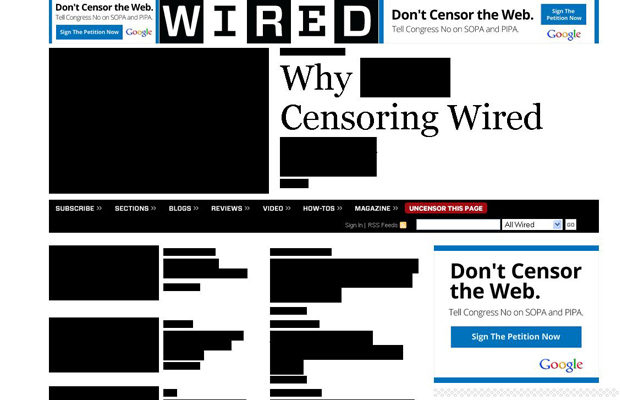
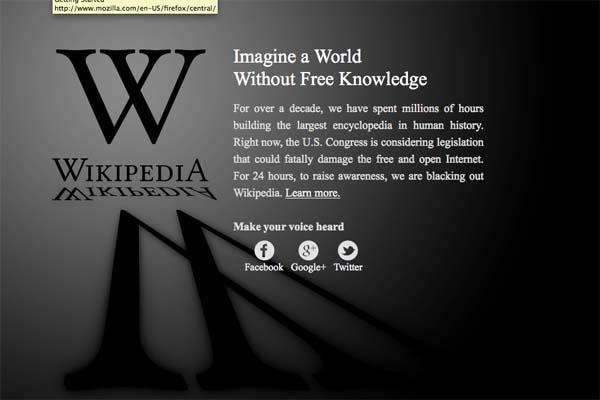
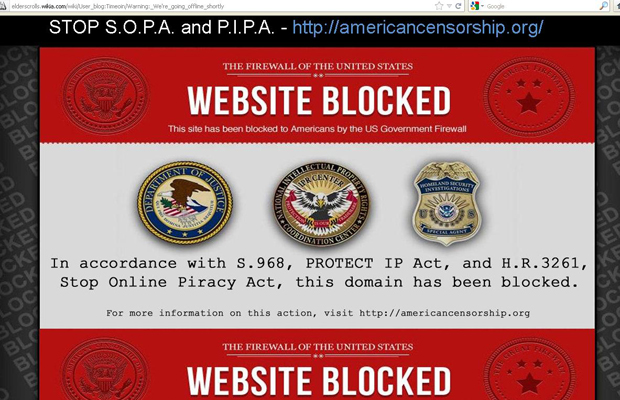
Preserving Internet freedom: protesting SOPA and the Wikipedia blackout

Thousands of web sites across the Internet are shutting down today to protest proposed U.S. laws (
SOPA and
PIPA) that would make it difficult for websites to host community-generated content on the Internet. Most notably, the English Wikipedia is
implementing a 24-hour blackout, replacing articles with a notice describing the two bills and encouraging readers to take action to stop them.Please take a moment to
learn more about the bills and why they would be harmful to the open Web, to open education, and to present and future collaborative projects.
The Electronic Frontier Foundation and other non-profit organizations dedicated to preserving freedom on the Web have ways that you can make your voice heard in the national and international debate about these proposed laws.
Mystery Hunt 2012: Romancing The Notes
Every January I spend a weekend in the Land of Mystery, tucked into a facet of MIT: that is, the MIT Mystery Hunt.
It is somewhere between a religious experience, performance art, and an exercise in observation, pattern matching, and problem solving. It is also wickedly tricky, a pinnacle of amateur puzzle contests: teams of 50+ people spend two full days solving a series of interlocked puzzles to find a coin hidden somewhere on campus.
This past weekend I took my annual pilgrimage across Cambridge to MIT for the Hunt, but for the first time my team was running the event, rather than competing. This was our tenth anniversary as Team Codex (we started out the year before as the aduni team, then adopted a proper codename), and producing the Hunt was a fitting way to celebrate. Many of us had a backlog of puzzle ideas that were converted into working puzzles over the course of the past year, with much iteration and satisfaction. Few of us had ever designed Mystery Hunt-caliber puzzles before, though we knew in principle how it was done.
We staged the first musical-themed Hunt on record, in an effort to encourage teams to share their own creativity while solving. Max and Leo from The Producers showed up at MIT, now out of jail and looking to make goo^B^B^B out like bandits, this time for good. They staged a short production of their own to get everyone in the mood, and then invited students to help them research and put on a series of guaranteed musical flops… While this didn’t work out exactly as planned, along the way were fancy cocktail parties with potential stars, swimming-pools full of Sets of ducks, research into the private peeves and longings of theater critics, campus spelunking, video game hacking, and a denouement in which, unbelievably… . . . well, it’s complicated. You’ll just have to explore the Hunt site itself to see how the saga ended.
We had roughly 70 active people on our organizing team, and everyone played multiple roles — writing, testing, and implementing puzzles, software, and skits. Our lead performers, in addition to being fine actors and musicians, happened to be professional puzzle writers and editors, and wrote many of the Hunt’s 107 puzzles as well as the book for our productions. Our lead editor also kept the production team together through stressful moments, providing black humor as needed, and preserving a fast editing pace all Fall without upending our minimal-heirarchy team. Hotshot solvers shifted gears to rewrite swaths of code. When puzzle-lover Neil Patrick Harris declined to MC the awards ceremony, we called on a home-grown rock star instead. Dozens of people joined the cast in the final weeks and picked up their parts without a hitch.
Having been involved with organizing perhaps a dozen events of similar size, I can say without hesitation that this was the most satisfying and life-affirming. We had varied and prolific organizers, an elaborate and dynamic schedule, a completely committed audience, and an extraordinary host-participant collaboration, with continual feedback. While the event ran for only 1500 people, its primary output was a broadly valuable story, told through puzzles: something that may be enjoyed for years or generations to come: a set of curious, colorful, maddening, marvelous puzzles, illustrated and interlinked, free to solve and repurpose. Just one more Act in the perennial romance between creative puzzlers and scientific endeavour.
Here is a sampling of this year’s puzzles, drawn from my favorites. Happy hunting! The average puzzle takes 2-10 person-hours to solve, depending on your experience and how quickly the right insights come to you.
Sounds Good To Me
(my all-hunt favorite)
Slash Fiction
(best casting and music, and the most expensive puzzle production)
Paper Trail
(an elegant, satisfying black box)
Yo Dawg I Herd You Like Puzzle Hunts
(yo dawg, i herd you like herd you like)
Itinerant People Of America
(man, this one is a hodge-podge.)
Picture An Acorn
(the final aha! will make you chump for joy)
The Rainbow Connection
(Now that’s rainbow-bright…)
Google Bodyslam
(“so, we’re working on a pro wrestling puzzle. what should we call it?”)
JFK SHAGS A SAD SLIM LASS
(the puzzle consists of nothing more than the title)
Coming To A Location Near You
(a wikipedia-based scavenger hunt)
Electron: 0.5Mev… Proton: 1Gev… Higgs: 125Gev?
An example of deep understanding vs. casual understanding:
Matt Strassler provides an eloquent, balanced summary of what we have recently learned about a possible Higgs particle (or particles). He notes that recent data have simplified the possible answers to an important question, there are a limited number of possibilities left, and we can find an answer among those possibilities within the next year. He offers a useful diagram of what we know and don’t know, as it has changed over the past year — the most significant change is the broad realm of possibilities we can now exclude, leaving a small gap to be explored further:

In a related post he noted both the hints in recent data that suggest there could be a single Standard-Model Higgs particle, but also some of the contrary evidence: cross-sections of the data which should show the same signal but do not, or hints that there might be something more complicated going on.
In contrast, Phil Gibbs of viXra (an alternative to arXiv.org requiring no peer vetting) offers a deceptively neat faux distribution of observations, optimistically combining data from different experiments and suggesting the result likely corresponds to a single Higgs-like particle massing around 125Gev. Note how more jargon is used here, and less historical perspective; with a focus on coming up with The Answer, rather than providing a broad picture.

Then there are physicists who take this opportunity to promote their own pet theories, quickly publishing preprints that suggest those theories predicted this all along — subtlely modifying their past work to hone in on the remaining possible energies for a Higgs particle.
Strassler’s approach is universally useful. It teaches others about this particular experiment, about the field of particle physics, and about how to do science.
Gibbs’s approach is a quick hack, of temporary value in the current discussion, but gives a limited understanding of the state of research and may give the wrong idea about how to analyse and interpret research.
Scientists trying to ride the coattails of a pending discovery often have received no new information about whether their ideas are right or wrong. To show their work in the best light, they misstate the current understanding of their own field, give students a harmful model to follow, and damage the public understanding of what science does and how to understand it… in addition to possibly promoting ideas that are simply wrong.
Paramilitary police protocols in the US : context and consequences
Update: BoingBoing has a lovely interview with one of the students who was sprayed by the police.
He also notes with compassion that aggressive police are a symptom of a system we have deliberately chosen as a society. He references past phases of the public-police social contract, and notes that brutal treatment of students by police
a) isn’t new (it was common in the 1960’s before being toned down), and
b) isn’t a matter of a few bad actors like Lt. John Pike
We need to recognize the systemic problems everywhere in the US, now filtering onto university campuses, and address them at their heart.
That said, we still have clear
legal standards for when it is and is not appropriate to pepper spray civilians in the course of policing. In prisons, riots, or public squares,
precedent suggests it can not reasonably be used on seated or immobile protesters.
Pike violated federal law in his use of
excessive force, and is
unlikely to be protected by the qualified immunity sometimes granted to officers. Since a number of the students sprayed were injured, some still hospitalized the next day, and this use of pepper spray is usually considered to ‘exceed reasonable bounds’, Pike and his department face significant legal challenges. They will almost certainly try to settle any claims out of court.
(more…)
The 99%
This pair of single topic blogs are excellent and to the point:
Worldwide: the top 1% of household wealth/personal income starts at roughly $10M/$100K (though the available data are weak, and neither is measured consistently).
Many in the top 10% feel as though they are in the top 1%, thanks to the same effect that causes people of all backgrounds to underestimate the imbalance of wealth distribution.
The Metamovement
Read this solid post by Umair Haque on the rise of the metamovement in our global society. This is a movement of movements that we are seeing develop unbidden, transcending national, cultural, and social norms across the world.
The opposite of a filter bubble, this directly taps into a universal need for agency and our newfound capacity to cooperate by the millions.
Hat tip to the perceptive Priya Parker.