You are viewing a read-only archive of the Blogs.Harvard network. Learn more.

Silverman Hater

There’s a Sarah Silverman debate that I forgot I was having over at Greencine,
and I think by now the people I was arguing with have forgotten it too,
so I’m pasting the comments here to continue. Isn’t there anyone else
out there who hates her?

Comments

it’s so lonely being a silverman-hater.

Posted by: cynthia at November 14, 2005 11:36 AM

I doubt you’re completely alone, Cynthia. Of course, I’ve seen
reserved praise, concerned critique and so on, but I haven’t seen
severe dislike out there yet. But you can’t be completely alone.

Myself, I missed Jesus is Magic at SXSW, blast it, but I’ll freely admit that the clips I’ve seen have made me laugh. Sorry.

Posted by: David Hudson at November 14, 2005 01:33 PM

There was a great article on Silverman in the New Yorker a few weeks
ago. Her act seems to upset people. Why is it that the same
words,issuing as they might from the mouth of Jimmy Kimmel, don’t seem
nearly as jarring as when we hear them spoken by Sarah Silverman? It’s
something to ponder.

Posted by: Stacy at November 15, 2005 02:36 PM

I think if you go by the New Yorker profile, I could see people
especially not “getting” her, or her act – though it was interesting…
But I think she is all about what Stacy points to here, the “How can a
cute girl say such filthy, awful things?” But the filthy part wouldn’t
matter if she wasn’t clever, and funny. Matter of personal taste and
mood, I suppose.

But c’mon, how can you say this is not funny (from the Nerve interview):

How do your parents feel about your act?
They totally love it. Sometimes my mom will have her opinions. Like
there’s this riff at the end of the movie, during the credits when they
show that B-roll montage, where I’m looking at a picture of myself in
this ’60s costume and I say something like, “God, I look like Marlo
Thomas if she’d just walked in on her father lying under a glass coffee
table while someone’s taking a shit on it.” Because, you know, there’s
that rumor about Danny Thomas. And my mom begged me to take that out.
She was like, “He was such a great man and he shouldn’t be remembered
that way! He opened a children’s hospital!” And she’s right, he was a
great man and I totally don’t want to contribute to him being reduced
to just that one rumor, but what are you going to do? Also, I don’t
know if this is just coincidence, but at Canter’s Deli in L.A., the
Danny Thomas sandwich is number two on the menu.

Posted by: Craig P at November 18, 2005 02:39 PM

easy. it’s not funny. and it’s interesting that she is compared to
her boyfriend jimmy kimmel here, because i always wondered if he writes
her jokes. they are a man’s jokes, written to entertain men. i don’t
actually believe that he writes them, but it’s what i hate about her.
she’s a guy’s girl, and she’s speaking to/trying to turn on guys. plus
the fact that she makes fun of her vanity doesn’t change the fact that
she is phenomenally vain.

Posted by: cynthia at December 2, 2005 08:50 PM

Something A Director Doesn’t Want To Hear From Her Actor On Day Of Shoot:

“You don’t want me to memorize these lines, do you?”

Puffy Old Men

It is frustrating for most of us women that men are considered
“distinguished” as they age while women don’t get the same respect. But
lately I’ve been noticing some male actors in movies that hit a certain
point where they are no longer “distinguished,” they just look bad.
Steve Martin in Shopgirl is one. He looks puffy. Or as my companion said, “like he’s been floating in water for a few weeks.” Another is Richard Gere in Bee Season
(a terrible, terrible movie by the way–just read the book instead). He
also looked puffy and flabby. It’s not fatness–neither of them are
overweight–it’s just a sort of loose flabbiness. I guess these are men
who have forsaken plastic surgery, maybe that’s why it’s noticeable.
And now, unfortunately, I must say that the super-sexy Jean Reno has
hit that puffy point. I am watching the (terrible) French film Crimson Rivers right now, and he has the Martin-Gere middle-aged puffiness that even his supersexy voice can’t make up for. Sad.

Funnygirl

We screened the footage of my werewolf spoof last night and people laughed, which is good. But I laughed more than anyone…like uncontrollable painful laughter…embarassing. Something about viewing your own footage, your own connection to a project, makes it so much funnier–seeing someone bring your dialogue to life, their mannerisms filling out the characters you created, intensifies the humor. It’s not unlike the way new parents are so delighted with the smallest and most mundane things that their new baby can do: look, he smiled, isn’t that amazing? Um, not so much. We screened other people’s films which I found mildly amusing but which the makers were hysterical over, so I’m not alone. And I’m guessing that the more movies you make, the less intense this effect becomes.

Shopgirl

Don’t bother seeing Shopgirl. Just see Me And You And Everyone We Know instead. I think that’s what Shopgirl is
aspiring to, but ends up just a flabby hollow spineless film with
absolutely zero chemistry between any of the characters. Jason
Schwartzman is trying hard to save this sinking ship, but even his
wackiness couldn’t save it. Claire Danes and Steve Martin are
incredibly boring here, and Steve Martin is boring and puffy. I hear
the novel on which it was based is a lot wackier than the movie, but
it’s unfortunate that in the translation to the screen it lost all of
the interesting stuff.

A.O. Scott seems to think
there’s more to this film…and I wish I could agree–I would like the
film he describes. But it’s not the film I saw. Maybe the novel had all
of this, but the movie is just a lifeless blob.

Hot Hasid

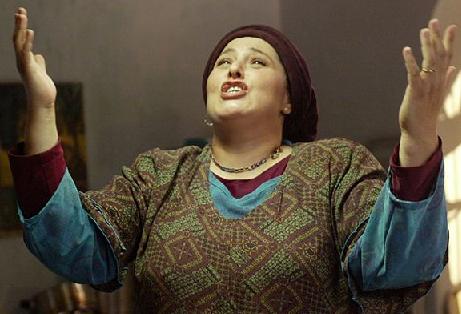
My companion at the Opening Night Gala for the Boston Jewish Film Festival thought I was nuts when I said I thought the star of the night’s film was hot. The film was Ushpizin, a fiction film (the first ever) made by and about orthodox Jews in Israel. Here’s the sexy Moshe:


The star, Shuli Rand, was an actor before he turned religious, and he has definite charisma. And a great deep voice. A sort of brooding quality. Even when wearing a shtreimel.

But beyond Moshe’s brooding sexiness, it was an interesting film. A fable, nicely told. And I loved the female co-star, who is also Rand’s wife in real life–he would only make the film with her, as it would be improper otherwise. I love that she’s a big woman–a big tough broad whom he adores. We need to see more of that in movies.


Defending My Integrity

Apparently there is now some tv commercial out there that has a guy in
a dumpster being swept away by a trash truck. WTF? I would just like to
state for the record that I get no tv reception so had not seen nor
heard of this commercial until two friends told me about it, I had the idea first!

Dumpster Movie: Exegesis

Here’s one man’s take on my dumpster movie:


I thought the man in the dumpster represented the soul, sunning itself in divine light and finding beauty even in the most unlikely of places, a dumpster, and the man showed the limitations of his judgements to not respond to this, and he let his soul connection be lost as he let the dumptruck take away his opportunity for enlightenment. Clearly a mystical movie, I see Jim Carrey in the feature film version.

and another:


I thought he represented the masses in their confinement of ruling class ideology (the dumpster) and Sean, the meta representation of said class. Clearly represented in his privileged gaze- outside and ABOVE the aforementioned ideology, the man looks on with detached, even bored apathy, as the masses are swept away in a sea of garbage. Clearly this is a film about the media.

Stig of the Dump

Seasull takes out my trash. A slideshow.

Switching Sides

I once told someone that watching Control Room made me ashamed to be American. Looks like starring in the film had that effect on someone as well:

Josh Rushing, who was stationed in Doha at the United States central command media office and later gained an international profile in the documentary Control Room, will be based in Washington DC in an unspecified role for the English language version of the Arab satellite news channel, which starts broadcasting early next year.


Rushing left the US Marine Corps after 14 years disillusioned over its media management and became an independent commentator.


“In a time when American media has become so nationalised, I’m excited about joining an organisation that truly wants to be a source of global information,” Rushing said.


from the Guardian, via chuck


The Lonely Americans

Tonight I watched The Lost Boys of Sudan and it’s a film that won’t leave my thoughts. The film is much more about America than about these Sudanese refugees, and what it reveals about the American experience, through the fresh eyes of immigrants, is quite unsettling. Very subtly the film shows the way success in America requires isolation from community and support–the only person who is successful is Peter, who succeeds by suddenly leaving behind his friends in Houston and moving to Kansas on his own, living with a white host family in the suburbs, and getting an education. Meanwhile the friends he leaves behind, all living together in Houston, remain in low-paying menial jobs barely able to make rent. One has “success” but is lonely and isolated, the others have no outward “success” but have the love and emotional support of community. Acting out of self-interest rather than group interest is what it takes to succeed. Peter even stops sending money to his sister in Africa, and calls her less and less frequently, and defends his right to self-improvement when she calls to criticize him. The friends Peter left behind were hurt and angry at his abrupt departure, but he doggedly pursued his plan of self-improvement and he “made it”–a perfect image of “the American Dream.” Though I detect a subtle question mark at the film’s final frame–a shot of Peter in his cap and gown on graduation day–a question mark regarding the definition of “success.”

The immigrants all discuss how difficult it is for them to make friends, that Americans are not receptive, that everyone is “always busy, busy,” and they learn quickly that in America two men cannot walk in public holding hands, as they did regularly in Africa … sign after sign of the lack of community here, the isolated and isolating nature of success-driven American life. Here you are “on your own,” they learn quickly.

All of this reveals pretty standard American individualist dogma, one might say. But watching this film I felt that Americans must be the loneliest people in the world. By design. (Though all my readings about Japanese culture tell me that the Japanese might be the only population lonelier than we.)

More Me And You

A quote I like about Me And You And Everyone We Know, ripped from the Amazon.com review:

Me And You

I’ve been seeing some movies lately. I got into a friendship-testing argument with a good friend over one of them, that should tell you it’s worth seeing. It’s Miranda July’s Me And You And Everyone We Know. I loved it, my companion hated it, and was actually angry with me for liking it at all, much less loving it so completely. We argued and eventually I said “Why are you angry?” That punctured the conversation and we then decided to talk about something else. I never did get a reason for why it caused anger, but I think it was personal. And this is a film that will certainly provoke a very personal response in anyone who sees it. I like everything that Cinetrix has to say about it, especially the film’s gentleness. It’s a film that flirts with some very disturbing themes, but dances so lightly that it never crosses the  line. It is a low-fi work of art, a finely crafted one at that, a “House of Mirrors” or “Hall of Echoes” as my former Professor Carney would say. It is adorably creative, original, clever, inventive.

I most liked the film’s layering of the child-like and adult, of the purity of love with the raunch of sex, which is the film’s overarching structure. The film lays the two side by side, but never really blends them, over and over again–from the frightening yet touching and funny online chat relationship between a six-year-old boy and a 40-year-old woman, to the discomforting-yet-not-quite-dangerous flirtation between two teenage girls and a 30-ish man, to the childlike and playful nature displayed in the adult characters of Christine and Richard. And it is of course all summed up perfectly in the film’s infamous slogan, “Back and forth forever.” Loneliness, love, and the desire to connect is universal and age-blind, the film seems to say. That seems too simple, though, and I need to think more on this. All of these age-inappropriate relationships are doomed, they reveal the desire to connect without allowing it to ever actually happen. We as viewers don’t want, nor does the film want, for a 6-year-old boy to start a real-life love relationship with a 40-year-old woman. But their ability to connect in some ethereal way reveals that much of the time we really are just big kids walking around in adult bodies. Or, perhaps, that we should be. Child-like, but not childish. It is the openness and curiousness and creativity of a child that this film celebrates, and tries to protect, even in the bodies of lonely adults. Therefore it is the two characters who retain their child-like nature who do manage to connect, appropriately, while the others in aborted age-inappropriate relationships seem to have at least been awakened to that part of themselves they have left behind. And it is implied they are changed by it, and will move on in their lives now carrying it with them rather than letting it sleep.

I tend to dislike films that position two people as absolute soulmates destined for each other, which this film does–I like a little more reality in my fairy tales. I believe there are a few dozen people out there that we each are compatible with and it is our own readiness (or not-readiness) that determines whether someone is right for us. But in this film for some reason I didn’t find it grating. Perhaps it’s because at one point the male love interest actually takes Miranda to task for her silly Amelie-like behavior, injecting some reality into the fairy tale. (And also providing material for another terrific line that reveals the child-adult theme: “He turned out to be a child-killer,” she says to a friend, after he “killed” her child-like attempts to connect with him.)

I also discovered that Miranda July has a blog. I like her.

Dreaming


“I have an unconventional way of working. I can stay in bed and dream for days. That’s my path into a character.” –Israeli Actress Ronit Elkabetz

My Funnyman

Hi. I have zero will to blog these days but thought I’d pop back in to share with you a video that my wonderful friend Seasull made for me at the Comedians of Comedy show at the Paradise. You see, I convinced him and Tangerine to go, then I backed out because … something suddenly came up. So they went to see MY show which featured MY man Zach Galifianakis, a show they would never have gone to without my instigating the whole thing. But despite the fact that I ditched them, Seasull was thoughtful enough (or drunk enough) to push his way to the front of the signing table to get my man Zach to record this special greeting for me. Unfortunately you can’t hear a word of it, but he says something along the lines of “Hi Cynthia, thank you for the awkward conversation, and we really didn’t like you.” This is of course in reference to my awkward, starry-eyed conversation with him and Brian Posehn at Silverdocs.

See my man on video here.

Aside from all this, Seasull and Tangerine said the show was great, so you should check it out when it rolls through your town. Especially if you are looking for a man, as I hear it was a total sausagefest.

Film Noir Bitch

I am an expert at coddling male egos but I’ve decided it’s no longer
worth the effort. Here is my new approach to men, via the screenplay
for The Verdict:


            LAURA
                       
You thought maybe you’d get
                       
some sympathy.  You came to the
                       
wrong place.

                                   
GALVIN
                       
And what makes you so tough?

                                   
LAURA
                       
Maybe I’ll tell you later.

                                   
GALVIN
                       
Is there going to be a later…?

                                   
LAURA
                       
Not if you don’t grow up…

                                   
GALVIN
                       
If I don’t ‘grow up…’

                                   
LAURA
                       
You’re like a kid, you’re coming
                       
in here like it’s Sunday night,
                       
you want me to say that you’ve got
                       
a fever — you don’t have to go to
                       
school…

Movie Making Me Laugh

“Don’t touch me! You could be menstruating!”

— in Only Human, spoken by a teenage boy whose form of rebellion is becoming an orthodox Jew, as he fights with his sister

We’re Like, So Mature

I watched Closer
and what a pile of pretentious shit that movie is. There were
occasional nice moments but overall the movie was screaming “THIS IS A
MATURE MOVIE ABOUT ADULT RELATIONSHIPS. WE ARE SO ADULT. ADULTS ARE SO
COMPLICATED. SO THORNY. THIS MOVIE IS VERY THORNY.”

The movie reminded me of We Don’t Live Here Anymore
in the way it tries WAY too hard to seem adult and complicated and
therefore just announces itself as adult and complicated without really
having the substance. The most ridiculous moment: Natalie Portman
turning away to look out the window after acknowledging that she heard
her boyfriend Jude Law hitting on Julia Roberts, then turning back and,
with a tear running down her face, asks Julia to take her picture. Oh
how meaningful (spit). Then the picture of course becomes part of
Julia’s exhibit and becomes famous. (vomit.)

Plus, what woman anywhere, ever, for any reason, would ever leave Clive Owen? For smarmy Jude Law, no less. I mean, seriously.

But as I said there were some nice things about it. I liked that Clive
Owens was set up as the brutish former working-class doctor who is
oriented toward the concrete and physical world, to contrast with Jude
Law’s arty dreamy romantic writer-type guy (who I wanted to punch the
entire time, and not just becaues he’s Jude Law), and that Jude Law’s
type was shown to be the true brute, as most romantic arty men are
(spit). One good line–Jude is confronting Clive in his doctor’s office
and is going on about his heart, and Clive jumps up and yells “What do
you know about the human heart? Have you ever seen a human heart? It
looks like a fist wrapped in blood.”

But the film didn’t live up to its potential. It tried too hard and was
too impressed with itself. It had zero subtlety. And it had three of
the most annoying actors in Hollywood as its co-leads (Jude Law,
Natalie Portman, Julia Roberts). I wish they had all committed suicide
and ended their suffering–and mine. And leave lovely Clive free to
find less pretentious, self-absorbed assholes to hang out with.

And, finally, if you want to see the way a film about “mature” and
“complicated” relationships is done well, see Andrew Bujalski’s Mutual Appreciation.

Cute Short Films

This guy sent me a link to
his web page to check out his short films and I did, and they are very
funny and cute. I am a fan. Check them out, I highly recommend!

Silverdocs Wrapup, Revisited

I know I promised a final Silverdocs wrapup a few days ago but I have had trouble working up the enthusiasm to rewrite it after losing the whole thing through a crack in cyberspace. So I will just post a few points here.

  • Shorts. I like shorts. Possibly better than features. Because the short format is so useless commercially, it means there are no constraints on the artist and they are free to be as creative/weird/different as they want to be. So you’re far more likely to see something exciting and innovative when watching shorts than when watching features. That said, my favorite short at Silverdocs was Jay Rosenblatt’s Phantom Limb. Have you seen a Jay Rosenblatt film? They are not easy to see, but if you can, see some. Especially The Smell of Burning Ants. But his new one, Phantom Limb, is just as disturbing and emotionally wrenching as his others. There is one scene that I will remember for the rest of my life. The film is a meditation on the guilt he has felt his whole life over the death of his young brother when he was a child. Their parents never talked about it, and he thought it was his fault because he used to tease his brother. The film is very heavy and oppressive…until the sheep-shearing scene. I don’t know if you’ve ever seen a sheep sheared (I haven’t) but the sheep is sitting on its hind legs, held between the shearer’s legs as he bends over it and runs the clippers over it. The sheep struggles now and then. In the film, it is one extended take, in slow-motion, of the man shearing the sheep, as a woman in voiceover reads a long list of the stages of grief. It sounds simple, and it is, but I was sobbing by the time the scene was over. Sobbing. The shearing is certainly something the sheep doesn’t want done, but in this context, in slow-motion, with the grief stages being read in voiceover, it gives the impression of someone flailing and struggling with grief while someone holds them, caresses them, forcibly sloughs off their pain and baggage, revealing the pink and tender skin beneath. And the sheep finally totters off, naked and vulnerable, like someone who has been through a particularly gut-wrenching therapy session, newly sensitive to everything around him.
  • My pick for best of the fest would be the same as the jury’s pick: Darwin’s Nightmare. It is an incredibly upsetting film that exposes the way Europe (and Russia, but there didn’t seem to be any Americans) exploits Tanzania for its fish. Perch, to be exact. Tanzania on the one hand is glad that the foreigners want their fish–it’s brought jobs to the area. But the Tanzanians are still starving, they can’t afford the very fish they catch and sell to the foreigners, and the film gets into all of the intricate ways the fishing industry is exploiting and destroying the area. It is a political film that focuses on the small, intimate details more than the big ones: the young boys savagely fighting each other for a handful of rice, in a town overrun by rich Europeans taking fish from their waters. The mother who is grateful for her job of airing out decaying fish carcasses (while standing in a pool of mud and maggots). The prostitutes visited by European and Russian pilots. The prostitute who was killed by one of them. The children in the alleys sniffing glue made from melted fish packaging. It goes on and on and on.

  • A few tips from a panel called “Working the Festival Circuit”. First, and this was actually one tip I knew from working with the Boston Jewish Film Festival: don’t make a film that is 50 minutes to an hour long. It is an awkward length and is difficult to program at festivals. Make a short film or a feature. That said, festivals do often show some hour-long films, but it better be good if it’s going to be that length. A short film can be run in a shorts package or before a feature, but an hour-long film is not going to be run before a feature and is too long to be part of a shorts package. Something to consider. Another interesting point that came out of the panel was some concern among filmmakers that festival programmers get all their films from other festivals and rarely accept films that are blindly submitted, therefore when they send in their $50 submission fee, they are really only subsidizing the festival. This is a legitimate concern that was sort of dodged by the festival people on the panel. I spoke with a festival director later in the week, and he admitted that filmmakers should be concerned. But he added that every programmer would love to get a great film in the mail, submitted blindly. It just doesn’t happen often. This is an interesting issue to me because it is currently a controversial issue in the poetry world as well, where some poets are criticizing poetry contests that they say are “fixed”–you send in your submission fee but usually the prize goes to friends of the judges or well-known poets. There’s a whole website devoted to it.
  • It seemed I gravitated toward foreign films at the festival, and among those there seemed to be a theme of divisions/walls/barriers. First there was Podul Peste Tisa, a Romanian film about a bridge between Romania and the Ukraine that was demolished by retreating Germans at the end of WWII and was never repaired, separating families for as much as 50 years. Some yell across the river to each other as their only form of communication. The film follows the saga of attempts to rebuild the bridge–so much red tape that the bridge, now built, is still closed and no one is allowed to cross. Another film about divisions/walls was Good Times, about the wall built by Israel in Abu Dis, a Palestinian village near Jerusalem. Again this is a political film that focuses on the minutiae: the old muslim women struggling to climb over the first incarnation of the wall which was short and crumbling, the Israeli soldiers haphazardly enforcing the barrier, at times joking with the crossing Palestinians, the shop owners who depend on business from people of both sides crossing the border, and, finally, the silence and desolation after a new 8-foot wall with no breaks is built to replace the old crumbling one.
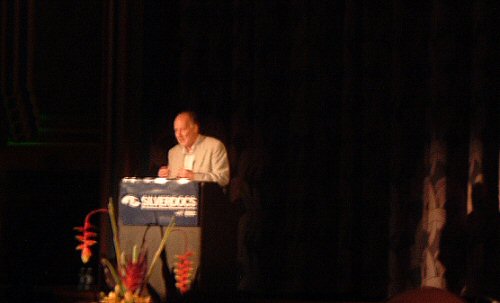
  • Grizzly Man. I have surprisingly little to say about this one. I was very excited to see him in person, but I was not bowled over by the film. Treadwell is clearly insane, but I was a bit irritated with Herzog’s treatment of him. Herzog acted as if he knew the man inside and out, kept comparing him to Klaus Kinski on the set of Aguirre the Wrath of God, claimed Treadwell was related to Aguirre–it was as if Herzog was claiming ownership, or paternity, and lamenting his child’s silly attitude about nature, an attitude that got him killed, and if he only were as smart as Herzog he would have survived. But in reality, Treadwell did survive for 13 years with the Grizzlies. That fact is not felt in the film. And he did know exactly how dangerous it was, he said it many times, he told loved ones that if he never returned, it was what he wanted. He had mental problems and couldn’t handle the world of people, and if he wanted to die with the Grizzlies, who is Herzog to say that’s wrong? Or worse, to claim that he didn’t understand the danger of his situation? Herzog’s pursuit of Treadwell and his claims to understand him better than anyone else (his exact words), to have a special bond with him, are much like Treadwell’s claims to know and understand the Grizzly better than anyone else. And both are equally naive, I think. Both overly romanticize their subjects. Treadwell studies and tracks the Grizzly, Herzog studies and tracks what Tarkovsky called the “holy fool”. The film is more like a letter to Treadwell than a work of art, a bit didactic and over the top, and not the mysterious work of art that Herzog’s older documentaries like Land of Silence and Darkness are. Maybe as artists age they don’t have time any more for subtlety.

That’s all I can muster for now, but I’m sure I’ll have Silverdocs spasms here and there in the near future.

« Previous PageNext Page »