You are viewing a read-only archive of the Blogs.Harvard network. Learn more.

Close-Up

The Kiarostami documentary Close-Up is worth seeing just for the scene where some guys in a car stop to ask directions from a man holding two giant dead turkeys, feathers and all. He gives them directions and before they drive off he holds the birds up to the window and says “You need a turkey?”

These bizarre and mundane moments are typical (and so endearing) of Kiarostami–all of his films are have numerous scenes of people driving in cars. More action takes place driving to destinations than ever happens at the actual destinations. In fact, the camera usually stays behind in the car even after the passengers reach their destination. This happens in Close-Up, in the opening scene when a reporter and some policemen are being driven to a house to arrest a man who has been impersonating the Iranian filmmaker Mohsen Makhmalbaf. They finally find the house (with the help of the turkey-man) and the reporter goes in alone, leaving the driver with the policemen, who make small talk about their families. Then they are re-joined by the reporter, and the police take the man away, and we stay behind with the reporter as he goes house to house looking for a tape recorder. We don’t even get to see the spectacle of the “event” taking place. This scenario happens in several Kiarostami films. It is a very non-Western approach to storytelling, and one might say that Kiarostami is much more interested in “the journey” than the destination, but even that seems like too Western an idea. The journeys he documents are not necessarily life-changing or even dramatic ones. He just seems to think that the important stuff is in these small moments, connections between people, even fleeting or mundane ones, even in the face of larger, more “important” events.

And this goes for more than just driving scenes. In The Wind Will Carry Us, what I remember more than anything is the endless string of scenes of the main character trying to get cell phone service. He climbs up a hill, and back down, and up again, over and over, getting and then losing reception repeatedly. He tries this for days, never really completing his important call. I still remember the sound of the rocks and gravel crunching under his feet as he climbs up and down, up and down. So much screen time is spent on this, an activity that would definitely have been cut out of any Hollywood movie, that it is more memorable to me than any spectacular action sequence in any big-budget film.

It takes some getting used to, but it’s a wonderful way to make movies. And despite the focus on nothingness, Kiarostami’s films are among the most cathartic I’ve ever seen. They all seem to involve characters enduring great emotional and existential suffering, a suffering that is ultimately unburdened in one way or another. In Close-Up, the Makhmalbaf impersonator (Sabzian) confesses his crimes and explains why he ingratiated himself into a family by pretending to be the filmmaker–his own broken family and poverty and failures in life, the acceptance and love and respect they gave him when they thought he was the filmmaker, which he had never experienced before–and Kiarostami’s compassionate questioning of the man comes across as possibly the most caring he has ever experienced in his life. Likewise, at the film’s end (SPOILER AHEAD), when Makhmalbaf himself meets him to pick him up from jail, it is a great catharsis when Sabzian stops in his tracks and bows his head and begins to cry when he sees his hero. “Don’t cry,” Makhmalbaf says, and hugs and kisses him. “Who are you today? You want be me? I’m tired of being me.” He then drives him home–on a motorbike, no less, so he gets to hug his hero for the whole ride. It is an ending that provides great compassion and relief, both for Sabzian and for the audience.

Serpico II Update

I doubt it’s because of my shout-out to Andrew Bujalski, but Serpico II has been successful and Mutual Appreciation and its director are on their way to USC in the near future.

And More Herzog

From the Village Voice:

During a post-screening Q&A at Sundance this year, an audience
member accused Werner Herzog of having ridiculed the title character in
the filmmaker’s
Grizzly Man. Herzog offered to duke it out. “I
was instantly furious,” said the director. “I challenged him to meet me
in the men’s room for a fistfight. Of course, in Bavaria, you meet for
a fistfight in the men’s room, but here it has a different connotation.
I should have said, ‘I’ll meet you in the alley.’ Or the parking lot .
. . “

It Always Comes Back To Herzog

Amen, Caryn, have you been reading my blog?

Every week seems to bring another mediocre documentary, coasting on the strength of its content and its similarity to a better, more artistic film. Even as the genre leaps out of its niche, it is suffering from a tyranny of substance over style.

[…]

“Shake Hands with the Devil: The Journey of Rom�o Dallaire,” follows the former United Nations general back to Rwanda a decade after the genocide he and his peacekeeping force were helpless to prevent. This harrowing film is more effective than last year’s overrated Oscar winner, “Born Into Brothels,” which begins as a heart-wrenching vision of children in Calcutta’s red-light district but turns into a self-aggrandizing account of efforts by the film’s co-director, Zana Briski, to help them. The sight of impoverished children is always touching, but it doesn’t always make a good movie.
Digital technology has made filmmaking so cheap and easy that now almost anyone can point a camera at a difficult father or a wicked stepmother and call it a movie. And more of them are making it into theaters. Nielsen EDI, which tracks box-office data, found that 50 documentaries were released in 2002 and 53 in 2003 – a number that jumped to 80 last year (a rapidly growing chunk of the 500 or so films typically released each year).

[…]

There are still documentaries transformed by an artist’s vision, though.
Werner Herzog’s “Grizzly Man” (opening in August) is built around video shot by Timothy Treadwell during 13 summers spent living among grizzlies, before he was eaten by one. Mr. Treadwell’s own hyperactive commentary would have made for something like a nature film on acid. Mr. Herzog’s editing and narration turn it into a study of Mr. Treadwell’s outsize, self-invented character, and of the motives behind such heroic posturing. In the flood of cheap-and-easy nonfiction films, “Grizzly Man” is something increasingly hard to find: a documentary with imagination.

I’ll let you know about the substance-to-style ratio at Silverdocs next month…

Hey Andrew

I just got off the phone with Serpico II, who was playing a game of
Scrabble with himself when I called. He ran out of crossword puzzles,
he says. It’s so nice when you’re lonely to speak to someone who’s even
more pathetic than you.

He’s trying to get Andrew Bujalski to come to USC with his fantastic film that everyone should see, Mutual Appreciation,
when it opens in LA in a few weeks. But Bujalski is not responding to
his emails. So Andrew, if you’re reading this, and I’m sure you are,
please respond to Serpico’s emails. He’s a good guy and his school will
pay your way. You too good for USC or something?

They Beat Me To It

I started writing a treatment for a screenplay based on a relationship
I had a few years ago and then remembered a film that is pretty much the same story. But mine will be different. It won’t be set in France.

It’s not really the same story though, just a similar dynamic between
the two protagonists. So I put the film at the top of my Netflix queue
so I can watch it again and refresh my memory. I don’t know if that’s a
good idea though. Maybe it’s better to write mine first and then watch
this one later. But who knows when it’ll get written?

Fathers and Sons

Only major film geeks would find “frustrating” a documentary made by the son of Haskell Wexler that is more about their relationship than filmmaking. Come on, how fucking boring would this movie be if it were about cinematography? I can’t wait to see it.

via Greencine

Revisiting Lost In Translation

Someone landed at my blog on a google search for “women portrayal lost in translation” so I checked out what other results were out there, and came across a few that I liked. First this angry Japanese opinion of the film, which I agree with, and then this Texan’s angry opinion of the film, which I also agree with. And if you want to re-read my opinion of the film, see the link in the sidebar about Scarlett’s ass.

My friend Serpico also had an angry reaction to the film, but mainly because he dismisses it as an empty a collection of hipster references. And while I agree somewhat, this movie is no Napoleon Dynamite. It is using all those hipster tropes to try to say something, though what it’s saying may be even more reason to hate the film than its hipster formalism.

Hey Big Sur

I probably won’t make it to Big Sur by Friday but any of you in that area, check it out:

Coming up on Memorial Day Weekend at the Henry
Miller Library in Big Sur
VIDEO DIARY FESTIVAL &
“EGOSHOOTER” WEST COAST PREMIERE
Where: Henry Miller Library lawn – bring a blanket or lawn chair.
When: Friday, May 27 at 8.30 PM.
Continues until past midnight on Saturday, May 28th.

The Festival screens the best of
video diary and personal documentary. This year we are also hosting the west
coast premiere of EGOSHOOTER, a German fiction film about a video diarist,
co-produced by director Wim Wenders.

The festival theme is “Dating the
Camera”
Call 831-667-2574.
All Video Diary info, schedule etc., and tickets here:
http://www.henrymiller.org/videodiaryfestival.html

Please click here
to find out why and how you could help the Henry Miller Library right now:

http://www.henrymiller.org/LatestNews.html

Silverdocs

I’m heading to the AFI’s Silverdocs festival in my lovely hometown of Silver Spring in a few weeks. I’m most excited that Werner Herzog will be in attendance with his new documentary, Grizzly Man. Gee, have I mentioned that I wrote my thesis on Herzog’s docs?

The festival seems to have embraced bloggers–they even have ‘blogger’ listed on their application for press credentials, along with other designations such as “editor”, “photographer”, “freelance journalist”, etc.

Movie Ads

One thing I meant to mention about last night’s movies was the ads, which I am now paying more attention to since this post. We saw the movie at Somerville Theater, where before I only saw one pre-movie ad, but this time there were four. They were brief though, and lasted about 2 minutes altogether, and started after the advertised start time for the film. Are there really theaters where they show 20 minutes of ads? Twenty minutes is a loooong time. I can’t even imagine.

Movie Sadism

A sure-fire way to get things into perspective when depressed is to hang out with a friend whose life is much worse than yours. I did that tonight, and was not disappointed. It helps if the friend also has a sense of humor, so that you both are brought nearly to tears with laughter at the so-horrible-and-unbelievable-it’s-like-a-movie things that happen to her.

Watching depressing movies often helps in the same way. I for one am addicted to Law & Order SVU–only SVU, because it’s the sickest and most depraved crimes–for this reason. There’s always a soothing undercurrent of “at least my life’s not that bad.” So with this in mind her movie choice for the evening was Born Into Brothels. How can you go wrong with a movie about depravity and despair of children living in Calcutta’s red light district? But when we walked out of the theater my friend was very disappointed. “Pfft, my childhood was worse than that!” she said. (And the scary thing is that she’s not kidding.) We become movie sadists, wanting to see pain inflicted so that we can at least commiserate, if not be moved to feel better about our own lives. Shame on us. But it’s more than just that–the film was truly not as upsetting as we assumed it would be, and I think it may be because the filmmaker held back out of some unconscious protective urge. Or it may be because she was there actively helping the children, which is not a luxury most of them are afforded, so they aren’t the worst, or even typical, cases. I’m no expert on Calcutta’s red light district, but having read the Tulasa Letters in an Indian Film class I T/A’d this semester, I went into this movie expecting the worst. But I suppose the film had different aims.

I personally had to cover my eyes while watching, but not because of anything disturbing onscreen. It was the shaky hand-held camera was making me nauseous. Not so good for a film with subtitles, because you have to see the screen to read subtitles, so I missed a good chunk of the last half quarter of the film. I’m really getting tired of seeing films with this kind of camerawork. I think this is a downside of the development of cheap and easy DV equipment–it’s so light and easy to use that filmmakers get careless, or novices brought in by the relatively low barrier to entry aren’t yet well-trained enough to know how to capture images on the fly without causing the audience to lose their lunch. There was plenty of hand-held cinema verite in the 60s and 70s and I never got nauseous watching any of those films. I think it’s because the cameras were heavier and much more expensive so the filmmakers took more care. And in so doing, their films are more artful. I just hope that DV camera operators eventually learn to get a steadier grip on their cameras, otherwise I’ll be skipping a lot of those films.


Also tonight I got a marriage proposal. From a homeless man. Yep, I’m popular with the homeless men.

Specialized Film Festival

How cute, there’s a whole film festival devoted to bikes. I think I might make a documentary about my psychotic bike-messenger brother in law and enter it into the festival.


via Gothamist

Thanks For Making Me Feel Old

Last night a girl in the Harvard Film Archive Library was watching Clueless on one of their monitors, and she was laughing at how “dated” the movie was. “It’s not that old,” someone said to her. “Well, I was in sixth grade when it came out,” she responded.

Ouch.

IM Chat With Rachel Clift of Mutual Appreciation

You may recall I mentioned the pleasant surprise I got when seeing former grad school colleague Rachel Clift onscreen in the fabulous Mutual Appreciation. So I decided to get back in touch and conducted an informal IM interview of sorts, which I have pasted below. There is *so* much more that can be talked about in this film, this is just a taste…and the transcript was already 10 full pages long, so this should be enough for now. But the more I talked about the film the richer it became to me…that’s the best kind of film, the kind that keeps you thinking long after you’ve left the theater.

I could only find three pictures to go with the text, so this is not the prettiest formatting, but I’m working on that. I have kept in much of the extraneous, small-talk bits that are not necessarily pertinent to the film. That’s not completely true, because I did cut a lot. But bits that are pertinent to readers of this blog, such as mentions of Serpico and immature Americans, I kept in. And I guess in the big picture they ultimately do relate to the film (and it’s in keeping with the improvisational/conversational tone of Andrew Bujalski’s films, of course).

One warning–you might say this interview has spoilers. If that can be said about a film with a plot as loose as Mutual Appreciation, that is. But you have been warned, read at your own risk. I’ve marked the spot where spoilers start.
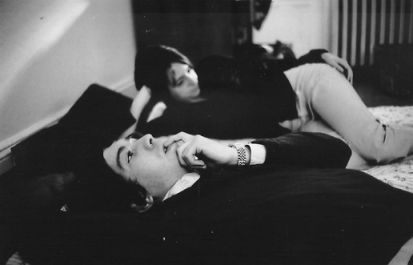
cupcake: hi there
rachel: is that cynthia?
cupcake: that’s me, sorry
rachel: I was like, “oooh, cupcake – that’s intriguing”
cupcake: I tend to have a cupcake fixation
rachel: ah
rachel: well it’s very coy
cupcake: ha–yes it’s my secret IM flirting identity
rachel: I should try that
cupcake: ha
cupcake: so how do you like new york?
rachel: (the guy near me just said “he’s a douche”)
rachel: nice
cupcake: haha
rachel: New York…it’s wonderful and awful all at the same time
cupcake: awful because it’s so expensive?
rachel: no…awful because it’s a constant struggle to craft a good life, which I don’t think is just about the money, although that’s a huge part of it
cupcake: yes that’s hard to avoid
rachel: I suppose the rent does getcha, but it’s also about finding meaningful work in such an image-based, competitive city
rachel: it can take a very long time to find your niche
cupcake: image-based meaning the way people look?
cupcake: would you say boston is less difficult in that way?
rachel: boston…yes, it’s less difficult because boston is a less blatantly capitalist, money-hungry town
rachel: there’s a crunchiness to boston that feels comforting in comparison – when I think of boston these days, I think of walden pond (but I also think of their winters and then I stop thinking about boston)

rachel: mind you, this is my view from mid-town manhattan, at a temp job where i deal with tv salesmen
all day. when i do my own thing, or spend time with friends, new york often feels like paradise
cupcake: that makes sense–I’ve only ever visited nyc, never lived there, so have not felt the full impact I guess
cupcake: I like that–crunchiness
rachel: I hear you
cupcake: do you live in williamsburg? [serpico] lived there for awhile, do you remember him?
rachel: serpico……was he really tall and shy?
rachel: (I live in park slope)
cupcake: yeah
cupcake: he lived there last year, now he’s teaching english in korea
rachel: woah, that’s something different from williamsburg
cupcake: yeah he wasn’t very happy in ny
cupcake: just as you noted, he had a lot of trouble finding a social circle
cupcake: he said he lived among lots of hipsters but didn’t know how to talk to them
rachel: oh geez, i relate to serpico’s experience
rachel: oh my gosh! yes!
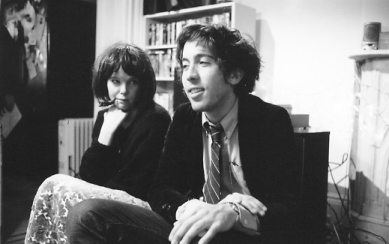
cupcake: I’ll have to tell him someone else shares his misery
rachel: I wonder about your take on andrew’s film(s) given that hipster factor…..
cupcake: actually I almost didn’t want to see it because it seemed so hipsterish
cupcake: but then i heard great things so i went anyway
rachel: you mean “mutual”?
cupcake: yeah
rachel: very interesting
rachel: had you seen funny ha ha?
cupcake: no i still haven’t seen it, but plan to
rachel: ok, well it will be interesting for you to compare the two – i’d like to hear what you think
cupcake: just from the description of the film (mutual apprec.) it sounds very hipsterish, you know, a musician in nyc, slackerish, the jarmush comparisons, etc
cupcake: but i was very pleasantly surprised
rachel: yeah…..so did it surprise you
rachel: ah – we are on the same wavelength
cupcake: yes
rachel: what surprised you about it? (i know you’re supposed to be asking the questions, but i’m tapping into my journalist character now)

SPOILER AHEAD
cupcake: although i probably would have hated the film if your character and justin’s did actually get together
rachel: wow! that’s so cool, what a great thing to point out
rachel: haven’t heard that one yet
cupcake: ha–interesting. i was starting to get a feeling of dread near the end, but was relieved
cupcake: it was actually a surprise ending for me
cupcake: I’m a little bitter about male-female relations at the moment though, so that probably colored my feelings about it
rachel: hey, I totally understand that
rachel: yes – it’s as if the characters, who seem like they’re dangling between adolescence and adulthood, are trying so hard to make the right choices
cupcake: yes, i really loved that the film is about people who act with integrity–so much of film today, especially indie film, seems to be about celebrating human weakness
cupcake: like that’s the only way to be real
cupcake: and it was very refreshing to see people really trying to do the right thing
cupcake: and succeeding
cupcake: I have had a running theme on my blog lately about americans being immature, and i think films that celebrate this kind of weakness contribute to that
rachel: I agree. it’s fascinating to hear this because andrew and i talked a lot during production – and to some extent during post when he was back on the steenbeck day in day out – about whether this would end up being some dark comedy or a warm film…
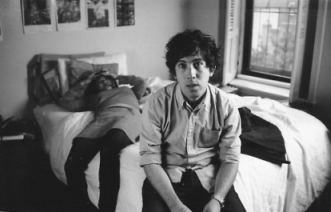
cupcake: so there was a chance that they were going to end up together?
rachel: it was really hard for us to gauge whether the characters were, in fact, doing the right thing

rachel: no – the script never changed a bit, but the energy during scenes certainly did, and andrew’s style is so open to his actors’ interpretations or moods – he allows himself to run with it…which means the sort of emotional realism you get could go in many directions
rachel: the actions never changed, but the emotions were shifting constantly
cupcake: ah you mean whether staying in the relationship really was the right thing or not

cupcake: so it could have seemed to be a tragic ending rather than an uplifting one, depending on the take
rachel: and I believe this is what makes his films so brilliant – his willingness to be open to those subtle shifts. he doesn’t insist on a level of control I imagine a lot of other directors do
cupcake: it is probably an indication of how brainwashed I was during grad school that all of this of course makes me think of carney
rachel: well, you can never escape the ray-nator
rachel: (carney)
rachel: once he gets in your blood, it’s all over
rachel: yes – exactly (what you said about a possible tragic ending)
rachel: like who knows if that was a happy ending or not? or if ellie and alan are total jerks for even letting it happen at all?
cupcake: yeah that’s true, it is ambiguous
cupcake: and it’s still slightly ambiguous about whether anything will happen between them in the future
cupcake: I assume andrew is aware of carney?
rachel: between ellie and alan – yes, absolutely
rachel: I don’t think the group hug is a real resolution
cupcake: yeah definitely–and the ending is rather abrupt
rachel: well – you should see funny ha ha’s ending! this one is far less abrupt….
cupcake: though I did walk out thinking that if she did go for the rockstar guy he’d end up breaking her heart and it would turn into the same old story
cupcake: as it stands, she maintains control, the options are hers
rachel: I have a hunch you’re right about that
cupcake: but if she were to go for the rockstar, it would turn out very differently
rachel: it’s a pretty common pattern with rockstars
cupcake: indeed
rachel: although I’m not sure ellie feels too in control
rachel: did you feel any conflict between her and Lawrence in terms of how their relationship was operating?
cupcake: definitely from her end, not much from his though
cupcake: I was actually a little surprised when she tells him about their little “moment” and then says she still wants to be with him–in some ways I didn’t believe her
cupcake: but I wanted to
rachel: well, yeah, I think that’s why the film doesn’t offer up any real resolution…plus, alan is very sheepish about his encounter with ellie and barely takes any responsibility.
cupcake: yes, typical male
cupcake: ha
rachel: of course
cupcake: I also walked out of the theater thinking that if the roles were reversed–if it were a guy in a relationship and a single woman–they would have slept together
cupcake: a bit bitter, I am!
rachel: my favorite, favorite scene in the movie is when lawrence grabs a beer with alan at the beer garden knowing that something has happened between his girlfriend and his best friend, and his listening to alan go on about his rock star life and the camera stays on lawrence, listening to his friend with that look on his face, that shift – it’s hard to contend with a friend who betrays you and I’m not sure alan and lawrence would get over it with just a hug
cupcake: yes that’s a great scene
rachel: your previous comment – do you think alan would have slept with ellie if she’d let him?
cupcake: and yes a hug probably wouldn’t cut it–though having it all out in the open helps
cupcake: I think so
cupcake: (about alan sleeping with ellie)
rachel: and what makes you think they didn’t? just because her clothes were still on in the morning….
cupcake: yeah I thought about that too
cupcake: it’s ambiguous
rachel: that’s one of andrew’s all-time favorite words
cupcake: ha–I’m not surprised. it definitely allows for many interpretations (that scene)
rachel: he’ll be like, “it’s ambiguous whether or not we are actually meeting at this bar, or the other one, to get a drink tonight”
cupcake: haha. the fact that her clothes are on and they’re in some sort of chair (am I remembering correctly?) are clues, but definitely not definitive evidence
cupcake: too many definites there
rachel: nothing is for sure, but certainly the only thing that is not on her person in the morning is her sweatshirt
cupcake: yes
rachel: although maybe she’s not wearing pants
rachel: but in my heart of hearts, I think she kept them on
cupcake: and when she says hello to the roommate it’s that awkward morning-after moment, even if nothing happened
rachel: absolutely
rachel: always awkward with those roommates, damn them
rachel: like there’s some omniscient presence you will forever have to deal with whenever you do something naughty like almost have sex
rachel: maybe someday I’ll be able to afford my own apt
cupcake: yes it’s a moment we all know
cupcake: even coming home to your own place if you have roommates becomes one of those moments
cupcake: also, even if nothing happened, they both downplayed what happened when they talked to lawrence
cupcake: neither said she actually spent the night, they only acknowledged a ‘moment’
rachel: yeah, “the moment” – they don’t say “we slept in the same bed”
cupcake: right

cupcake: how did you meet andrew, by the way?
rachel: well that’s a good story
rachel: I came home from a movie at the coolidge (Pennebaker’s concert film “Down From the Mountain”) and was parking my car on the street in JP where I used to live…
rachel: ….and as I was walking the rest of the way to my house, I saw this low-budget shoot going on, so of course I had to stop and say hello
cupcake: of course
rachel: turned out it was andrew, shooting an exterior for funny ha ha, and we started chatting (while his crew was working….of course)
cupcake: this says a lot about random connections
cupcake: talking to strangers etc
rachel: yes, I’m a big believer in talking to strangers
cupcake: and he lives in ny now too?
rachel: nope – he’s still a tried and true JP resident – he moved there after funny ha ha was out
cupcake: wow, I assumed he was a new yorker now because the film seemed to live there so authentically
rachel: you felt it was authentically new york?
rachel: authentically brooklyn?
cupcake: yes–though I don’t live there so I suppose I wouldn’t know
cupcake: it seemed to me to be, though
rachel: a bunch of his friends live in brooklyn – most importantly, justin, who he wrote alan’s character for, so it made sense to shoot there and try and work around justin’s real life musician schedule
cupcake: makes sense
cupcake: why does he stay in JP then?
rachel: I ask him that all the time
cupcake: ha well I guess loyalty is good
rachel: I think ultimately it’s cheaper, more nurturing, and more manageable. he gets to visit new york enough for his own taste, I think
cupcake: that makes sense, if you know enough people there and visit often you don’t really need to live there I guess
rachel: I think that’s true
cupcake: have you done much film work since your thesis film?
rachel: not nearly as much as I would have liked
rachel: I shot and edited a film for habitat for humanity, and I’ve started producing a feature doc, sort of personal memoir film
cupcake: is documentary still your main interest?
rachel: absolutely – can’t get enough of it
cupcake: I really liked your thesis film by the way
rachel: oh thank you!
cupcake: I was just complaining the other day about docs that don’t attempt to go beyond their subjects, docs that are just journalism
cupcake: but yours did
rachel: oh…that’s nice to hear
rachel: it’s a fascinating, never-ending conflict in my mind…how to make non-fiction film that’s art, not just “document”
cupcake: yes it’s rare these days
cupcake: it seemed there was a heyday in the 60s-70s for that but not so much any more
rachel: yes
cupcake: now it’s all reality tv, people just trying to get the best/weirdest story, which says nothing about someone’s artistic capabilities
rachel: (ugh, don’t get me started on reality tv)
rachel: have you seen ross mcelwee’s new one?
cupcake: I haven’t yet–bright weeds?
rachel: yes
cupcake: I see him all the time at harvard, I’m a little startstruck
cupcake: I see hal hartley too
rachel: is hal teaching at harvard???
cupcake: yep
cupcake: for the past 2-3 years
rachel: wow
rachel: those harvard kids are lucky
cupcake: I walked into the classsroom where I t/a and was reading, waiting for class to start, and these two guys walk in and put in a tape and start screening it, and the super-tall one comes over and asks if they’re disturbing me
cupcake: and as he walks away I said “oh, that’s hal hartley”
cupcake: and he was looking at a rough cut of his latest film
cupcake: which also screened at iffboston, by the way, but I couldn’t catch it
rachel: amazing – and this is happening quietly in the halls of harvard, in a town which has suffered such a lack of vibrancy in production for a while now
rachel: who woulda thunk it?
cupcake: indeed. well maybe there’ll be a renaissance with hal and andrew
cupcake: and ross
rachel: maybe……

cupcake: anyway do you plan to do more acting?
rachel: I’m not planning on it, but if someone asked me to play a role I liked, I’m not saying I’d turn it down either
cupcake: I hear you–and filmmaking is still your primary goal?
rachel: yes, but I’d like to combine filmmaking with the more general field of communications – from journalism to media relations to pr for the non-profit, NGO world
cupcake: definitely more job options that way
rachel: yes
rachel: the goal being to enjoy my day job, maybe even travel a bit, and earn enough money to buy a nice little editing system of my own
cupcake: ah the american dream…
rachel: yes
rachel: speaking of which, I really need to get the new bruce springsteen album
cupcake: ok one last question–probably a standard one, as everyone talks about the seeming-improvised nature of Mutual Appreciation–was there a full script before shooting started, did the script come out of improvisation, etc?
rachel: there was a full script indeed, and a fair amount of rehearsing
cupcake: so to quote carney, the script wasn’t improvised but the emotions/tone may have been
rachel: yes, and some of the conversations too…
cupcake: so there was a script but andrew was open to changes
cupcake: serendipity, frisson, all that
rachel: yes — I would say he was pretty clear about where he wanted to story or the scene to go; but allowed us the freedom to get to that place in a natural way
cupcake: and do you prefer working that way?
rachel: which was scary at times
cupcake: yeah I was going to say
cupcake: you definitely can’t phone in that kind of performance
rachel: I can’t say that I know what I prefer, since I haven’t done much acting for film. there were definitely scenes where I was yearning for more direction – days when I was hungry or cranky
rachel: (aw, geez, thanks!)
cupcake: well you were great, as was everyone–it all fit together very well
rachel: ….and just wanted andrew to tell me what the hell to say or do, but of course he wouldn’t, and he pushed, gently, to get authenticity every moment, and that wasn’t always easy
cupcake: that does sound scary, and very challenging, but it’s interesting to know he’s actually such a hardass!
rachel: it can be hard for everyone
rachel: yes, he really does know what he wants, when it all comes down to it, and I suppose you must – that’s the difference between wanting to just hang out and make a film versus actually having a vision of some sort about what it is you want film – as a language – to explore or say
cupcake: yes when watching the film it does seem like it’s just a bunch of people hanging out, but when you think about it, random people hanging out is never that interesting so there has to be some hand shaping it
cupcake: btw I really loved the scene with the three girls in wigs
rachel: oh, yeah? it’s pretty classic!
cupcake: so great
rachel: what did you like about it?
cupcake: I think it’s mostly just an emotional reaction–knowing that kind of situation,
cupcake: late night party, few people there, all a bit drunk, and sharing moments with strangers
rachel: yes
cupcake: random connections etc
cupcake: and it is completely extraneous to the “plot”, also the fact that it’s giving the characters life, beyond the plot…I just love it.
rachel: I love pamela in that scene, the one who begs him to put on a dress and then calls him “little lord fauntleroy”
cupcake: yes that’s great
rachel: that’s also the scene where kate dollenmeyer, star of funny ha ha, makes a cameo, which I find extremely comforting in the way that familiar people are
cupcake: which one is kate?
cupcake: is she one of the sirens?
rachel: yes, she’s the one that puts eye make-up on alan
cupcake: ah yes
cupcake: now I see it
cupcake: ok well I have taken up enough of your time
rachel: no worries, have enjoyed it
rachel: really glad you enjoyed the film!
cupcake: yes I loved it–I look forward to more from andrew
rachel: me too
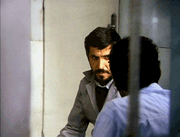
Garden State vs. Bridget Jones

It looks like my speaking out against twentysomething male fantasy movies about depressed jerks and the saintly women who save them may turn into an outreach/intervention. I received this via email:


Sounds exactly like the script my flat mate has been writing for the
last year and a bit. I e-mailed him some excerpts to see if he comes to
his senses 🙂

I’m happy to help. But as I told this person, I don’t want to frustrate anyone’s creative impulses. Perhaps every twentysomething male needs to churn out one of these types of scripts in order to exorcise those demons. Then they can move on to something more interesting.


I’m trying to think of the equivalent female-fantasy movies, but am drawing a blank. That could be because there aren’t so many scripts by women, or it could be my own personal blind spot concerning my own gender. Maybe it’s the woman-who-dares-to-find-herself-and-in-so-doing-finds-Mr.Right? Any help, guys? What are the female fantasy cliches that annoy you in films? Anything with Meg Ryan or Tom Hanks in it? I’d say something like Bridget Jones would be an obvious choice, but it’s actually so old-fashioned that its attitudes seem fresh again. A woman daring to admit she wants a husband! That just isn’t done.

Maybe Not Austin

Looks like my plan to move to Austin wasn’t so original–Andrew
Bujalski (director of the fabulous Mutual Appreciation) had the same
idea and it didn’t go so well:

Bujalski and the leads in his two movies, Kate Dollenmayer (Funny Ha Ha) and Justin Rice (Mutual Appreciation),
moved to Austin as roommates in 1999, after college. “We were young,
and it was that moment in life,” Bujalski told me. “I temped,
volunteering for the Austin Film Society, and wrote the first film
here. Kate was an animator on
Waking Life.” The three expected
to be able to live cheaply in Austin and contemplate their art.
Bujalski lasted a year; Justin Rice left quickly. “It was the high-tech
boom,’ Rice said. “Every Web site in the world was here. We paid more
rent than in Cambridge.”

Poor public transportation + no jobs + no friends there = No Austin for me. Unless I apply to their film PhD program.

via Cinetrix

IFFBoston Awards

Apparently my priorities were very different from the other IFFBoston audience members as well as the Grand Jury for the festival, as I managed to miss every single one of the winners for both Jury and Audience awards. I therefore cannot give you my own commentary on the winners, so I will instead tell you why I missed each and give my own alternate winner:

Grand Jury and Special Jury Award Prizes

Narrative Feature: BLACKBALLED: THE BOBBY DUKES STORY, directed by Brant Sersen. This is a mockumentary and therefore I question its placement in the narrative feature category. And I did plan to see it but I chose instead to see some real documentaries. I was flying high on idealism after seeing Chain and Mutual Appreciation and didn’t want to spoil the ride with silly cynical Comedy-Central comedy about Paintball players. And I want to know who the hell is on this Grand Jury if they picked this as the best film. I did manage to catch Filmic Achievement, another mockumentary, but was not impressed. It takes a very subtle hand to make an effective mockumentary–a little too much of one thing or another and you just look like a bad imitation of Spinal Tap or The Office. And Filmic Achievement, a mockumentary about film students, looked like that. MY SELECTION FOR THE AWARD: Andrew Bujalski’s Mutual Appreciation, natch.

Best documentary: Ellen Perry for THE FALL OF FUJIMORI. I did also plan to see this one but couldn’t due to time conflicts. It is not possible to see all films in a film festival, unfortunately. I could’ve made time, but there are very difficult decisions to be made when you are trying to see as much as you can at a festival. Sigh. Such sacrifices we make. MY SELECTION FOR THE AWARD: I didn’t see enough docs in the festival to really have an authoritative opinion, and of those I did see I wasn’t bowled over by any, so I would have to go with The Future of Food, which I suppose you could say did bowl me over–with horror at our government and corporate greed. But if you allow Chain into the documentary category, that would definitely be my choice. It doesn’t really fit into doc or fiction categories, though.

Audience Awards

Narrative feature: BROTHERS, directed by Susanne Bier. This was a late addition to the schedule and only had one screening, which I learned of too late, and I don’t really understand how a film can get that many votes from a single screening. It’s not something that I probably would’ve wanted to see anyway, though, and I suspect it got its votes because it is a dramatic and timely war film.

Documentary feature: AFTER INNOCENCE, directed by Jessica Sanders. Another that I was only mildly interested in. The docs in the festival seemed very straightforward and while generally I am more interested in documentary, I am not usually in it for the actual subject matter. If that’s all you want in a documentary, it becomes merely a matter of somebody finding the best/weirdest story. It’s then about journalism, not about filmmaking. The docs I did see (Future of Food, Rhythm Is It, Spew, and Inside Out) were all in this vein. Rhythm Is It, which is about a troupe of troubled teenagers who were wrangled together to put on a dance performance in Berlin, was perhaps the only one that tried to say more than its subject matter. But in a fairly didactic way, which to me undermines the artistry. And I didn’t see anything in the doc lineup at the festival that attempted much in the way of artistry. I could be wrong, of course, as there were a dozen or so that I didn’t see. But I don’t think I’m wrong.

In sum, I don’t think much of these award winners, neither the Grand Jury nor Audience Awards. Pfft.

Favorites From IFFBoston

Rain, rain, rain…what great weather for sitting in the theater all weekend. The festival is now over and I saw about a dozen programs (it is not physically possible to see all films in a festival, I have discovered). Not surprisingly for an independent film festival, anti-commercialism was a clear theme in many of the films, one of which was my favorite from the festival–Jem Cohen’s fantastic experimental feature, Chain (other notables being Hal Hartley’s The Girl From Monday and several documentaries such as Deborah Koons Garcia’s highly upsetting The Future of Food). Chain hovers somewhere between documentary and fiction in a Sans Soleil-like essay-film set in the sterile locales of corporate chain hotels, shopping malls, and the interstate. One assumes the film takes place in one specific area, as it follows two characters and their movements throughout this seemingly lifeless space, but in possibly the most powerful intro to a credit sequence ever, Cohen reveals the list of shooting locales – dozens of cities all across the world. You’d never know it by watching the film, where each hotel, shopping mall, and stretch of highway looks identical. The two characters in the film, a Japanese businesswoman on a business trip in America, and a homeless teenager who squats in abandoned housing and spends her days wandering the mall, engage with no one and speak only in monologues to the camera or in voiceover. It’s the loneliest film I’ve ever seen. But also a very exciting one. I advise everyone to see it if you can.

Another of my favorites from the festival is I suppose anti-commercial in form if not explicitly in content. It’s Andrew Bujalski’s Mutual Appreciation. (It turns out that the main actress, Rachel Clift, is someone I know from grad school at BU. That was a surprise. Go Rachel.) This is a wonderful film about pretty much nothing – a bunch of twentysomething creative types do a lot of talking in New York. That’s pretty much the story. I want to compare it to Jarmush, but I daresay the acting is better than pretty much every Jarmusch film out there. It has a similar tone though (and was shot in black and white). I’d also compare it to Cassavetes, though there’s much less drama here than in most Cassavetes films. But these two are clearly influences for Bujalski, though the film is all his own. If I had to classify the film I’d say it’s a beat film. It’s about connections between people, both random and lasting, it’s about creativity, and community, and love and respect. I haven’t seen Bujalski’s first film, Funny Ha-Ha, but I have heard raves about it from all the right people, so I do plan to see it soon. It opens next week at the Coolidge, as a matter of fact, so I’ll definitely be heading over there at some point.

Then there were the obvious anti-conventional selections like the program of freaky Finnish experimental shorts, most if which were actually pretty conventional, I thought. The curator of the program warned us that there were two films that were extremely disturbing and difficult to sit through and said she’d understand if we walked out–I was bracing myself for animal mutilation or diarrhea-inducing low-frequency sonic effects but none of that appeared, and I never figured out which films were supposed to be so disturbing. Methinks she underestimated the tolerance of the Boston crowd. No one walked out.

Much more disturbing was Garcia’s The Future of Food, a straightforward documentary about genetic engineering of food and its effects on farmers, on health, and on the world. Possibly the most upsetting film I’ve ever seen. Monsanto comes across as a truly evil giant corporation which must be stopped, and the government its knowing accomplice.

More to come…

History, Czech-Style

While I continue to digest the many films I’ve seen at IFFBoston (and continue to see today), please enjoy this excerpt from a new Czech book, Europeana: A Brief History of the Twentieth Century, as excerpted in the May issue of Harper’s:


Sex became very important in Europe in the twentieth century, more important than religion and almost as important as money, and everyone wanted to have sexual intercourse in different ways. And after the Second World War, films started to include scenes in which the leading characters had sexual intercourse, which was previously considered improper because lots of people still believed in God and sexual intercourse was generally only hinted at by a shot of a bed or a clock or the sky, or it suddenly went dark. In the fifties film heroes usually had sexual intercourse in cornfields because cornfields were associated with youth and the new life awaiting the young heroes, and wind ruffled the ears of corn as the sun sank on the horizon and women’s bosoms heaved, and in the sixties film heroes had sexual intercourse in the surf on the ocean shore because it was romantic and sand clung to their skin, and their bottoms could be seen, and mist hung over the water. In the sixties pornographic films were made in whch people had sexual intercourse almost nonstop in varous places. And in art films there was more and more sexual intercourse, but the critics said that it was something else, that it was not sexual intercourse as such but its representation, that the film expressed our entomological attitude toward love, which was fine because it enabled us to reflect more effectively on the role of sexual intercourse not only in an anthropological, cultural, or political context but also in human life. In the seventies film heroes mostly had sexual intercourse in motorcars because it was original and the speed of life was increasing all the time, and young people who did not have cars could imagine what was in store for them one day. And men increasingly lay on their backs and women sat on them because they were now emancipated.

And now, off to the theater again…

« Previous PageNext Page »