You are viewing a read-only archive of the Blogs.Harvard network. Learn more.

The Genuine Improvement™ Weekend

ø

The end of last week was a bit of a struggle—the accumulated weeks of struggle combined with watching SJ and John Crowley defend (in the same day) drove the point of my stasis home with a vengeance. It was a bit of a low.

It was doubly pleasant and important, then, that the weekend was a real raiser of spirits. On Saturday Kati and I got away for the day, spent a very relaxing morning talking at Darwin’s, and then a restorative afternoon walking through Maudslay State Park in Newburyport. It gave us the chance to finally spend the sort of quality, pair-bonding, unstructured and carefree time together that I had hoped Copenhagen would provide, but was disappointed that it hadn’t. Perhaps it just needed time, but things feel markedly improved this morning.

On Sunday afternoon we spent some time with Evan and Katie (and Gavi), which was also a surprising source of motivation. Evan has an almost uncannily positive attitude to big tasks and intimidating projects at work. Perhaps it was because I came primed from a weekend of relaxing and connecting, but somehow giving my usual “no, I’m not done yet” pity party spiel this time inspired me to take a more Evan-ish, optimistic, go-gettum view of the task at hand. I am at a point where I can finish up (these first two chapters, at the very least), and what a formidable challenge. So, instead of moping, fearing, and pushing my head far into the sand until the last moment of the weekend, I actually spent Sunday evening quietly looking forward to getting to work and moving forward. I programmed the coffee maker before bed and felt rested and ready to go this morning.

Anyway, this is all a long preamble, but the bottom line is that I am working at Darwin’s today feeling qualitatively different than I have for the past few months—since the big push started petering out in March.

Progress Report Time (This Time, Without Giving a Shit)

ø

Progress report season… for the sixth time! Yay! Well, actually I’m not sure I even had a progress report the first two years, but whatever. I spent yesterday evening reading through the past year’s DSA notes (depressing), comparing them to the goals I set out at this time last year (actually, precisely to the day!). This morning, I sat down and wrote out the progress report and handed it to Andy. I was feeling pretty good about myself, particularly since I managed to convince him not to call a committee meeting (for the first time ever). But then he read over the report and came back to my office to request a change: I had described how, as per his recommendation, I was dropping the diatom diversity project and instead expanding the morphospace project to two chapters, he “reminded” me of the PlanktonTech book chapter we agreed to write and asked that I change the section in my progress report back to include a chapter on diatom diversity.

What?! I thought the diatom diversity chapter was dead. I thought I had explained to Andy that I didn’t think the SQ subsampling method was going to work on the Neptune data. I thought he had suggested I drop the chapter, “with an eye toward finishing sooner rather than later”. Well, that didn’t seem to matter much—I suppose he remembered that there was a book chapter due for the PlanktonTech people, and that it was supposed to be about diatom diversity, and that was it. Just add it to the dissertation, as another chapter.

I could freak out at this point. I could despair about how to goalposts keep shifting. I could sit down and try to realistically plan how I am going to go from two chapters worth of data and analysis and no chapters written to four chapters worth of data and analysis and four chapters written by September 15th (the deadline for dissertation submission for the November graduation date). But I think I’m just too exhausted to do that at this point. Andy wants a chapter on diversity? Fine. So I rewrite the progress report (here it is, by the way) to include a few sentences about how “the diatom diversity project will take on a smaller role and will be represented by a short review chapter for submission to the book resulting from the PlanktonTech research initiative”.

Whatever. I don’t have the energy to engage with stressing out about how long things are going to take, when I am going to be done, what the dissertation is going to look like. The best I can do right now is go from one day to the next. Today, I needed to get a progress report done and signed by my committee members. I did that—I got Andy, Jacques, and Dave to sign off on it (and without requiring a committee meeting!). Whatever happens tomorrow, or next month, or when the thesis is due, happens then. Who cares what the damn report says.

March Shitness Day 27

ø

I have been trying, but every step just seems to be met with a branch in the face. I have been working on code since yesterday to calculate the morphospace volume occupied by individual lists, a sort of “alpha disparity”, but it keeps crashing on me (as in, just quitting R). I can’t figure out what’s wrong. It just makes me seethe. The code is the least, the tiniest of my problems. Yet it alone, at this point of almost complete demoralization, seems capable of defeating me.

Spent HOURS trying to debug this fucking code. Was able to eventually narrow it down to a call to the function that calculates convex hull volume, presumably because it is passing short lists to the function (i.e. it is failing when trying to compute the 3D hull volume of a point set of only 3 points). This is a real arse of course because if I have to reject lists with 4 or fewer taxa in them I’m clearly going to overestimate morphospace occupancy. Fuckity fuckity fuck. God, I hate this shit.

Anyway, that hack seemed to make it work, but the results are neither expected nor really clear.

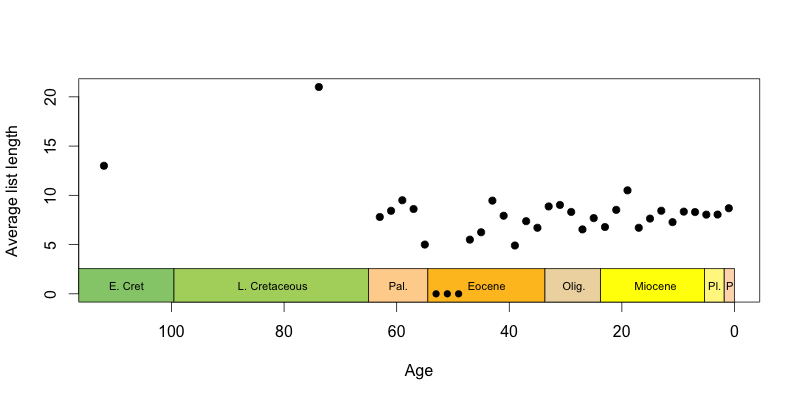
So, actually it looks like this measure of “disparity” at one location is going DOWN with time, if anything. That is not what I would have expected, neither from the overall morphospace pattern, nor from what’s out there about diatoms in the abstract. Things should have evolved to a greater diversity of forms, even in one location, not less.

So does the list length (number of species at a location) go down with time, to explain this? No. Of course not. That would be too fucking easy.

 So it looks like, if anything, list length goes up. Although, really, list length is basically constant. This makes nothing clearer to me, nothing at all.

March Madness: Day 22 is Tufte Day

ø

Took the day off to see Tufte do his thing. It was cool. I liked the idea of making graphics about the content, and putting everything in service of the cognitive task at hand—of making every aspect of the display support the intellectual activity the display is trying to accomplish. At many points along the way I reflected on what this means my morphospace project. In some ways, a helpful reflection. In other ways, reinforcing my crippling stuckness. There’s nothing I can accomplish with a good figure if I don’t know what I’m trying to say with that figure.

The metaphor is the map. Make the graphic as clear and uncluttered and minimal as a map. But, how can you make a map if you don’t know where you’re going?

“The best good design can do is not to get in the way.” I liked that thought. But it scared me a bit, too, because in some ways I feel like well-designed figures is all I have in this project. What I’m lacking is the spine to back it up.

March Madness Day 21: It’s Officially Not Madness Anymore

ø

It’s just March Stuckness. I helped Wil with his project some more. Sure, it felt good. But I felt like crap about the morphospace and didn’t do a single little thing about it. Tried to get Github set up for it. Nothing else.

Not a single word written that I could send Beau. Not a single shred of motivation to do anything about it. What a dire low.

Wasted Weekend

ø

Saturday: Ali and Mike brought Amanda for her college visit. I just couldn’t find it in me to recuse myself given Ali’s condition. Got two phone calls, the latter of which kept me up until past 1am, which were both very emotionally draining.

Sunday: Completely exhausted, spent the morning having a more or less complete meltdown. Spent the afternoon doing taxes. All in all, a completely non-work weekend.

March Madness Day 16: Zoe

ø

Went straight to MIT for my 10:30 meeting with Zoe and Andrew. They were good and active listeners, and had a lot of both nice and constructive things to say, but at the end of the day it still left me dispirited. Firstly because I realized, as I have done oh so many times, over and over again, that I am the only one who can figure this out, and (almost) every time I ask for help, I realize that I have to answer the most difficult questions myself. And secondly because we ended up talking, inevitably, about the future, what I was going to do next, whether I wanted to a postdoc or not, and so on, a conversation that I try to avoid because always leaves me completely unsettled and usually depressed.

One useful piece of the conversation, though also source of my disappointment, was the point Zoe made that I needed to know what I wanted to say before I wrote the papers. What did you find? What are you trying to say? What question is this paper answering? These are the matters about which I’ve been plugging my ears yet Zoe is absolutely correct in asking these as prerequisites—and, sadly, there is probably justification in her incredulous eyebrow-raise when I mentioned that I wanted to get the first paper finished by the time I head to Denmark at the beginning of April. This is so much harder than I thought it would be.

Anyway, she was no help whatsoever on actually answering these questions for me, but she and Andrew did make a lot of other useful and helpful remarks, including these I’ve chosen to highlight as relevant and actionable:

  1. If you divide morphospace occupancy (alpha volume) by the number of species for each time bin, is that a way of standardizing for sampling? [Note: maybe not, but it would give an interesting other measure of per-species morphospace occupancy, a sort of analogue of mean pairwise distance.]
  2. Can you circumvent the sampling problem by plotting the morphospace occupancy of individual lists/sites for each time bin (i.e. alpha morphological diversity through time)? I think this is both interesting and helpful, and allows a discussion of the analogy of alpha and beta and gamma diversity with disparity through time, which I’m not sure has been done before (well, it probably has, but I don’t know about it).
  3. What about plotting the number of realized character states through time? Wouldn’t that be a good measure? [Note: I think this is similar to the metric of ‘realized pairwise character combinations’ or whatever it’s called from the disparity literature.]
  4. Zoe and Andrew both made a bit of a fuss about how my dataset isn’t independent of phylogeny because I used genera, which are defined morphologically, as the basis for my study. I’m not sure I understand why this is a problem, other than that there is sure a lot of intrageneric morphological variation that is not captured by my morphospace. The way around it of course would be to score individuals in samples (without necessarily even naming them or assigning them to a genus), and do this for a large number of samples through time, but of course that’s an utterly unrealistic effort and the mere thought of it makes me want to throw up.
  5. Can you plot mean pairwise molecular distance through time? Using Neptune to time-resolve the pairwise distances from the Sorhannus tree. Would it look different from pairwise morphological distance?
  6. Zoe also suggested what I’ve been wanting to do for a while now, but haven’t yet—i.e. looking directly at particular characters in the data set. When I pressed her to suggest ones that would be interesting to look at, she came up with a list that was (actually  reassuringly) similar to what I’ve had in mind: characters related to chain formation, chain formation characters resolved by silicification (i.e. are they using less silicified structures through time to achieve chain formation?), pore size through time, velum presence/absence through time (this relating to the viral/pathogen defense hypothesis), predation characters, sphericity (SA:V ratio, for both strength, nutrient uptake) and possibly labiate processes/raphes if anything meaningful could be gleaned about their homology from patterns seen in the morphospace through time.
  7. With regard to my difficulty in thinking about the chain formation vs. predation characters, Zoe was encouraging—her take was that this is a real problem and rather than ignoring it I should simply write about how it is difficult to disentangle whether spines are for one or for the other, and just describe what my observations would mean for either hypothesis.
  8. She also suggested going through my list of all characters and brainstorming creatively about what each one could mean functionally, keeping in mind what the main important factors are (which is another difficulty, but never mind—I wrote down “predators, sinking…” in my notes).
  9. In the morphospace occupation density plot, she wanted to know what the morphotypes are that are disproportionately represented—a good question I should answer if I am going to put that plot in the paper.
  10. Finally—what two things can you say about your data? This is the crux, really. I need to figure out what I can say about the data, and then shape my paper based on that.

Altogether a challenging, exhausting day. Some things gained, but much confidence lost. It just feels like there is an eternally long way left to go, and the path ahead just doesn’t seem to get shorter.

To Crawl From a Stall—March Madness Day (Barf) 13

ø

I can’t believe it’s two weeks into the March Madness month. I am trying very hard not to focus on it, but I’m half way to the deadline for my first chapter, and I don’t feel great about the rate of progress in the last week. I think being sick was just a part of it—I’m also pretty capitally stuck, and I’m not sure what how to forge ahead. The past few days haven’t been a complete write-off. I’ve had some good ideas, chief among them plotting the taxa in morphospace with the plot symbol size reflecting the proportion of occurrences that the taxon represents. This would create one more plot for the morphospace-through-time paper, if indeed I go with the division of papers Andy suggested.

This is one of the sticking points. What will go in which of the two papers? One possible layout, suggested by Andy, was to present the results more or less in the order I did them. First paper:

  1. General introduction of both papers
  2. PCO dimensionality reduction and methods for estimating variance captured by axes
  3. What the axes mean, and how hard it is to know that
  4. Comparison to NMDS
  5. Comparing PCO (axes 1-2) to phylogeny
  6. Comparing morphological to molecular distance

The second paper would then look at morphospace through time.

  1. Linking the PCO morphospace to Neptune—stacked 3D plot with convex hulls
  2. Disparity and diversity through time, under range-through
  3. Ditto under sampling in-bin
  4. Ditto under subsampling by unweighted lists
  5. …?

Andy’s suggestion was actually to end the first paper with the PCO through time plot, and the leave the disparity analyses for the second papers. It seems more logical to me to have all of the through-time stuff in the second paper, but maybe I’m wrong in that. Also, if I do put the first PCO-through-time plot in the first paper, what does that leave for the second paper? Just looking at disparities through time in various subsampling regimes? Hmph.

Well. That’s the first sticking point. The second sticking point is the narrative, the biological hook, the meaning of it all. At this point everything I have is sheer analysis, divorced from biological meaning or hypotheses—both at the general evolutionary theory level and at the specific level of diatoms, their ecology, and what has been written about their evolution. The past few days’ reading (half-hearted though it was) has not really helped me find direction in that regard.

The third sticking point, which is closely related to the second, is what to do about the missing characters-through-time plot. I want a plot in my paper that shows some relevant characters changing in their prevalence or occurrence through time. I gave up on the idea of plotting all characters, and instead found the characters responsible for morphospace expansion in each time bin. That didn’t lead to any clear story. So then I was hunting for biological hypotheses in the literature that might be tested by looking for particular characters (see the problems in sticking point #2). So now all that’s left to be done, besides more open-ended reading in the hope of coming across something that makes sense, is to sift through the list of characters in the morphospace and hope that something jumps out at me as relevant. Yech.

Well. So much for the main sticking points. I suppose I have a couple of clear to-dos arising:

  1. Generate the morphospace “density” plot.
  2. Look through the list of characters for ones that might be biologically interesting to plot through time.

These, unfortunately, don’t address the major to-do, which is to get the damn chapters written. Possibilities: since writing isn’t working so well, try talking through what I have, if necessary on tape or to an unsuspecting victim, and hope that some sort of narrative emerges that way. Read more. Try turning my figures into a Keynote presentation and generate a narrative (or narratives) that way. That’s something I’ll have to do sooner or later anyway.

 

The Diversity Chapter Is Dead. Long Live the Thesis!

ø

Had a meeting with Andy this morning—I had wanted to show him my disparity-diversity plots, particularly with the different story told by subsampling, and show him the interesting result from the SQS Good’s U values (being counterintuitively high through time, suggesting a major problem for the approach). The upshot was that Andy now definitely recommended splitting the paper into two parts (“everything you have plotted here should be a figure in a publication, but it’s too much to fit into one paper”), and—more importantly—that as two chapters, together with the radiolarian lineage project, would constitute a thesis.

I had to ask explicitly to confirm, though it was already clear by implication, whether this meant that I didn’t need to do the diversity project to graduate. “Yes, exactly,” he replied. Woot, woot, woot! One less project to do. Not necessarily the one I would have chosen to drop, but whatever. It’s one entire project less to do before I can leave this entire episode behind me. Hallelujah.

I spent a good while bathing in the glory of that news, and checking in with the new iPad being unveiled, then moved on to printing out thumbnails of my figures and pasting them onto index cards so I could work on how they would be arranged in these two new papers. It’s going to be a big challenge for me to figure out what the division between the two should be, and what the two narratives for the papers will be, but at least I now know that’s what I need to do.

Sleep At Last, March Madness Day 6

ø

I’m not sure what it was—the day at Darwin’s and feeling like I’m getting closer with my work, attending the Rem Koolhaas lecture at the Graduate School of Design afterwards and thinking about something utterly different for a change, or going to see some live music with Kati in Brighton in the evening. Or maybe it was starting to run again in the mornings, if only my short loop around the country club. Whatever the reason, I woke up this morning feeling much more rested than I have done for the last couple of weeks, having not tossed and turned with the jolts of anxiety that seem to have been haunting me. How refreshing!

Also got some very exciting news in the morning from my dad, who was offered a very exciting job he had applied for in Berlin. This served to distract from being able to engage in any serious thinking before lunch, so I decided to tackle one of the less exciting but still necessary tasks from my to-do list, namely sorting out the numbering scheme for my characters in the culled vs. unculled matrix.