You are viewing a read-only archive of the Blogs.Harvard network. Learn more.

Another Poor Little Rich Girl

I checked out The Queen the other night after hearing that it does much better than Marie Antoinette at depicting an isolated, oblivious monarch upon whom the real world intrudes. And it’s true, it gets right what Sofia got wrong. It intersperses scenes of her isolated existence in London and on the breathtakingly gorgeous grounds of Balmoral Castle with crowd scenes of the people voicing their growing displeasure. We get to see what all the fuss is about, and at the same time we see how isolated and out of touch the queen is. This is where Sofia fails. We never get to see the crowd or have any idea of what they are so angry about. And I completely understand that that is her intent, to show how isolated she was, but just because the character is isolated and oblivious does not mean the film should be. That is a mistake. To show none of it whatsoever, and to stop the film before we see any of her hardship, means the film sides fully with the Queen and makes the starving peasants’ anger out to be much ado about nothing. You end up with a film that says nothing more than “It’s great fun to be a rich, beautiful teenager!”

The Queen, however, is much more satisfying because we get plenty of evidence that what she is doing is wrong. And we watch her eventually realize this. And the film still remains a compassionate portrayal of an oblivious character who in some ways remains oblivious to the end. She ultimately gives in and acknowledges the real world, but also says in the end “I don’t think I will ever understand what happened this week.” And that’s fine. We don’t hate her for that, we understand.

But while I thoroughly enjoyed The Queen, it’s no work of art. It does not aspire to art. It’s just a very good story, a well-written and wonderfully acted drama. Sofia’s film, I must admit, aspires to art. And for that reason I can’t completely dismiss her. She hasn’t got it quite right in this film, but I do expect that with age and experience she may produce something brilliant one day. Once she acknowledges the real world.

(Note that the links above for each film show approval ratings–98% for The Queen, clearly a crowd- (plebe-?) pleaser, and 52% for the highly polarizing Marie Antoinette. An acquired taste, obviously, like caviar.)

Marie Antoinette

While doing a google search for “sofia coppola racist” I came across the following description at Racialicious of the theory behind all of Sofia’s films:

Life should come easy and it does only until you’re forced to live it (which is so mean and so the fault of patriarchy/foreigners or meanies/POCs/peasants) and when you are it isn’t because a world exists outside of you but simply because the world is intruding on you as you (special white women) are the center of the universe.

That about sums it up. I saw Marie Antoinette and was irritated by her presentation of Madame du Barry, King Louis XV’s mistress, who came from the poorest of the poor and is portrayed as a crude, obnoxious, social-climbing bitch. She burps. She makes out with the king at the dinner table. She wears darkly- and brightly-colored clothing, that period’s version of “trampy.” And, though the real du Barry was blonde and blue-eyed, Coppola has cast the dark and very Italian-looking Asia Argento as the beast. All others at court are fair and light-haired (well, most wear those ridiculous gray wigs so sometimes it’s hard to tell, but no one is in the least ethnic-looking save du Barry). So once again in Coppola’s world, anyone not born rich and anyone who looks different is ridiculed, made a cheap stereotype. I’m not so much offended any more by her obliviousness to her own classism as I am disappointed by the lack of imagination. She so often falls back on cheap over-used jokes and stereotypes that you’d think a Yale graduate could come up with something more subtle and textured than that.

Of course, the real du Barry may not have been the most pleasant person to be around, I don’t know. But in a film that portrays Marie Antoinette sympathetically, and basically as a rich American teenager, Marie’s disgust with du Barry is disturbing because the film then wants us to support this exclusion of the only outsider in the entire film. Her court becomes her own gang of mean girls supporting her and excluding the dark and crude du Barry. Marie is shown to be amazingly accepting of all the ridiculousness of court life–she good-naturedly rolls her eyes but accepts that there are 30 court ladies standing at her bed every morning waiting for her to wake so they can watch her be dressed, she good-naturedly accepts that her husband won’t/can’t have sex with her for 7 years after they are married despite the vicious rumors about the reasons they are still childless, she good-naturedly accepts his weird obsessions and quirks…but du Barry, this she cannot accept. A low-class burping beast in her court? Never. Anything done by the upper-class is amusingly quirky; nothing of the lower class is tolerated (except for well-behaved servants who clean up after your lavish parties). Plus, it’s precisely these peasants/outsiders who later want to lop off poor Marie’s head.

It’s the same issue I had with the portrayal of the lounge singer in Lost in Translation. She is utterly ridiculous, and it’s fine to have characters who are ridiculous, but if Sofia could just include one small gesture, a look, something to give that character a small amount of humanity, it wouldn’t be so irritating. Instead they are completely dismissed as useless human beings. And these people always exist outside the rich main character’s world.

Part of me is hesitant to even bring up the issue of racism/classism because by doing so I become exactly the person her films is trying to vilify–I am one of those peasants with torches and muskets rioting outside Versailles calling for the poor burdened queen’s head. I was also one of those peasants while watching Lost in Translation, and also Virgin Suicides. I am one of those meanies intruding on Sofia’s perfect world and trying to force her to acknowledge reality. And there is something to be said about the way we watch movies, the way we demand to see suffering of the rich and elevation of the poor and downtrodden. I had to acknowledge that part of what irritated me about Lost in Translation is that it was about a couple of rich people who weren’t apologizing for being rich. That’s what we demand of rich characters in films. Should they have to? I don’t know. But it’s not just that. Her characters are rich and they ridicule anyone who isn’t. And they get away with it. That’s the extra step she takes that makes her films unsympathetic to me. I keep thinking (hoping?) that with each of her films she’s trying to remake Rossellini’s Voyage in Italy, where a rich couple travels–yet stays in their isolated bubble–through Italy. These people don’t apologize for being rich but their isolation from reality is highlighted, especially in the final scene, where they grasp for each other among a sea of peasants–giving up their attempt to enter reality and returning to their isolated bubble. This is a whole, complete, subtle, and complex treatment of the issue and I think it’s what Sofia is striving for. But she has missed the mark every time.

-isms aside, the film had other flaws. The acting was horrible throughout, especially Dunst and Jason Schwartzman. But there’s not much they could have done with such bad dialogue. The modern music was not too distracting so long as it was not diegetic, but once it became so it was very irritating–in a party scene the revelers danced to Siouxie and the Banshees. And the film runs so quickly through historic events, touching so slightly on them, that a lot of it probably didn’t make sense to anyone who doesn’t know the story already. Of course a light touch fits with the themes of Marie’s obliviousness, but it’s not handled properly here–bringing them up so quickly only confuses people.

But as I said with Lost in Translation–while I am irritated by the themes in Sofia’s films, I am glad she at least has them. She has a point of view. She has a set of issues she keeps dealing with in each film. She is an auteur.

And besides, those bored rich bitches really need someone to voice their pain.

Laura Palmer’s Father Rides the 3 Train

I sat down on the 3 train and looked up to find this guy sitting across from me:

He is very dramatic-looking in person. I don’t know what else you can do with your life but be in movies when you look that conspicuous just sitting on the subway. Or perhaps the causality is reversed, perhaps a life in movies forms your image. All I know is this guy would stand out in any crowd.

Somerville Invite

Four Eyed Monsters – Thursdays in September

Play Invite | Watch Trailer | See Video Podcast

Festival Blogging

A little birdie told me that the Toronto Film Fest’s doc program has a new blog. Go check it out.

Last Day at Silverdocs…

…I watched the film I was most interested to see, Walking to Werner. It’s about young filmmaker Linas Phillips and his mission to walk 1200 miles from his home in Seattle to Herzog’s home in Los Angeles, an homage to Herzog’s infamous walk from Germany to France to see his dying friend Lotte Eisner. Unfortunately Herzog’s not home, but as they say, it’s all about the journey. He meets a lot of strange persons along the way, as you might imagine, and has his share of hardships and triumphs, freeways and scenic beach roads, ticks and poison oak. It’s an unabashedly sentimental and sweet and inspirational road movie, made by an adorably sweet young man, who is just as adorable and sweet in person. It was very enjoyable to watch, if a bit long, but will certainly inspire you to get off your ass and do something, anything, that you want to do, no matter how ridiculous.

Love Thieves, Hijackers, and Serial Killers

Perhaps it says something about my tastes or my interests that all of the films I’ve seen so far at Silverdocs offer extreme views of womanhood. Last night’s highlight was The Great Happiness Space: Tale of an Osaka Love Thief, a fascinating film about male “Host Clubs” in Japan. There are apparently hundreds of these clubs all over Japan, and the concept is brilliant: men are the product here, women the consumers, and what the men are selling, they say, are “dreams”. Romantic dreams, to be specific. What the women are paying for isn’t sex, but attention. Flirting, touching, snuggling, romantic gestures. The host’s job is to get the girls to fall in love and therefore become repeat customers. They have it down to a science. Women are very “demanding” they say. They need a lot of superficial compliments. But the most fascinating observation they make is that once they reel the women in with compliments, they switch to scolding. And that’s when the women fall in love. We see a host asking a girl why she does such meaningless things, why she lives her life so frivolously, and the girl is completely rapt. And afterward gushes to the camera about how much she loves him. It is a truth that I as a woman was very uncomfortable witnessing. The entire film was uncomfortable to watch, probably moreso for women than for the men in the audience, who seemed to find much of it to be hilarious. I didn’t see many women laughing.

Much easier for women to watch is the story of Leila Khaled: Hijacker. Her world couldn’t have been more different than that of the love-starved women in Osaka. Khaled, who hijacked 3 planes in the 1960s and 70s, had no need for something like a host club, she was too busy being a freedom fighter (terrorist?) for the Palestinian cause and actually altering her beautiful face to avoid capture. And after she was captured, she was insulted when reporters asked her if she had a boyfriend, asked her if she were in love. These things were irrelevant to her. She is now married with children, and encouraged the female director of the film to make babies, but is still every bit the unrepentant soldier. Or terrorist, depending on your view. That’s one of the questions the film poses: what’s the difference between being a terrorist and a freedom fighter? Is the difference simply whether you win or lose?

Meanwhile there’s Only Belle, which is about a female serial killer who emigrated from Sweden in the late 1800s and may have killed more than 50 people (mostly men) in Indiana as part of insurance scams. They found the skeletons of 40 of her victims buried on the grounds of her farm, and eventually just stopped digging–so there may be countless more. She killed several husbands, as well as several of her adopted children, and became a very rich woman after collecting their life insurance policies. And like Khaled, she got away with it all. Like the love theives in Japan’s host clubs, she sold romantic dreams to lonely men, only they paid for it with their lives as well as their money. It was an incredibly creepy film–especially the visit to the site of Belle’s farm, where the family that now lives there keeps finding bones in the ground around the house and the youngest child speaks to several ghosts. The film was a bit heavy-handed with the creepiness, though, which threatened to make it almost cartoonish.

Tonight I’ll be seeing a much more male film–B.I.K.E., about a certain bike subculture in New York City, and tomorrow the film I have been most waiting to see: Walking to Werner. More soon.

Technical Difficulties

My phone has died, it’s very upsetting. It will ring, and take messages, but it won’t let me use the keypad. I can’t figure it out. So if you’re trying to reach me I’m not ignoring you. I guess I’ll have to get it serviced, or get a new phone. But all my numbers are stored there. Depressing.
This afternoon I’ll have a chunk of time to sit in the Cinema Lounge and blog about the films I’ve seen so far — Leila Khaled: Hijacker, Great Happiness Space: Tale of an Osaka Love Theif (best so far, by far), and Only Belle. More soon…

Cutest Silverdocs Swag

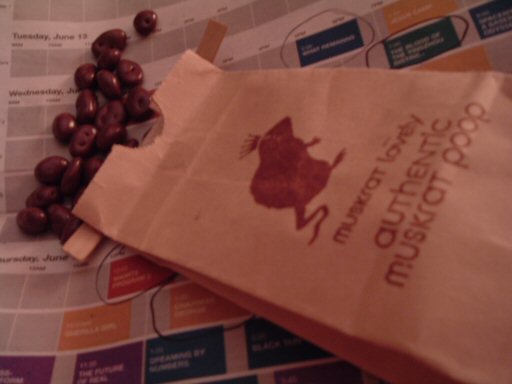
For the film Muskrat Lovely, which is indeed like a real-life Christopher Guest mockumentary:

Silverdocs Day 2

Last year at Silverdocs there was a wireless connection set up in the Cinema Lounge and that’s where I blogged from. This year I’m still blogging from the Cinema Lounge but the connection this time is a citywide free wi-fi for Silver Spring. I didn’t know my hometown had already made that leap. So greetings from the free Silver Spring wi-fi-enabled Silverdocs Cinema Lounge.
I met Chuck at the screening of What Remains, a film that had me near-tears throughout, mostly just for the portrayal of a good fucking life. It’s about photographer Sally Mann, who lives on a farm in Virginia with the love of her life, taking pictures of her gorgeous kids, gorgeous land…oh and dead decaying bodies. But it’s a portrait of a life lived so fulfillingly that all I could think was geez I have done something wrong in life, why don’t we all live like this?
I also caught La Persona de Leo N., a really lovely little film about a transsexual in Venice, Italy, undergoing his sex change operation. Next I’m off to Muskrat Lovely, the film about the Miss Outdoors Pageant in the Chesapeake area of Maryland which is rumored to be like a real-life Best in Show. I’ll let you know…

Oopsie Opening Night

I was unable to extricate myself from supersoaking my nephew on the front lawn long enough to make it to Silverdocs opening night. Or rather, I decided not to go. The movie was Boffo! Tinseltown’s Bombs and Blockbusters, which had little appeal to me because I anticipated it would feel like sitting through one of my intro film classes. Much as last year’s opening night film about the history of midnight movies. Opening night films are rarely the best films in a fest; rather they are usually the one with the broadest possible appeal. There are many films I’m looking forward to here, but this wasn’t one of them.

But here’s my view from when I showed up to pick up my pass an hour after the movie started.

Young American Bodies

I had to find out via Greencine that Joe Swanberg, creator of my favorite IFFBoston film LOL, has been shooting a mini-soap opera for Nerve.com called Young American Bodies. Not sure how I missed this before. At any rate go check it out, it’s interesting. Not safe for work though–lots of graphic sex, lots of penises (including Swanberg’s) and breasts. I like that we are seeing more penises in films these days. Go penises!

Greencine also has an extensive compare/contrast between Swanberg and Andrew Bujalksi, which defends Swanberg against accusations of being “Bujalski-light.” I myself, if you recall, wrote upon seeing LOL that it seemed Bujalski-like, and then when I saw that Bujalski himself makes an appearance in the film, that confirmed it for me. So the compare/contrast/defense is certainly appropriate. I’m not sure that pinning the difference on the fact that Swanberg’s characters lie to each other while Bujalski’s struggle to tell the truth is a big enough distinction to make the case, though. To me that seems more of a socioeconomic distinction. Bujalski’s characters are Harvard kids, well-groomed and well-mannered and overthinking and overanalyzing everything and therefore sidestepping most primal drives. They’re always striving first and foremost to be honorable. But they can be just as cruel to each other, only indirectly or unconsciously. In Funny Ha Ha Bujalski’s character is fucked with by the girl he has a crush on–after turning him down for a date she seems to have forgotten about his feelings for her and actively seeks out his companionship in a way that, to the viewer, and to Bujalski’s character as well, is completely exploitive. He knows what she’s doing to him, yet he is powerless to resist. He’s the beta male and she’s the alpha female. An alpha female who is in exactly the same position with a guy she has a crush on, so she should know better. When Bujalksi one afternoon inexplicably throws a bottle of beer off her porch, shattering it on her neighbor’s porch below, angering her but unable to explain to her why he did it, I understoood. It’s an (inappropriate) outlet for his unspoken frustration, but any rupture of this placid, polite, well-spoken facade is not allowed in this world. He apologizes profusely for his indiscretion, but the viewer is left wishing he’d smash a few more bottles, so weary are we of the characters’ relentless restraint.

Swanberg’s characters, on the other hand, don’t have the burden of this constant restraint. They give in to their impulses. They have personality disorders. They fight and yell and call each other assholes. They lie and cheat and are insensitive pricks. They overanalyze and talk things to death as well, but it doesn’t necessarily stop them from behaving “inappropriately.” A character tossing a beer bottle off a porch in a Swanberg film would not likely cause such a ruckus. Or if it did, someone would call him an asshole. Perhaps it’s overly reductive to attribute it to socioeconomic factors (and possibly wrong, of course, because I don’t have any idea what is the socioeconomic status of Swanberg’s characters, though I know they’re not Harvard kids). It could just as easily be attributed to regional differences–Boston is a very head-oriented city, not a very body-oriented city. There’s not a whole lot of primal going on here. People from other areas come here and find people cold and distant and well-mannered, boring, they find it difficult to socialize outside structured groups. But Harvard’s presence, and the presence of privilege in general, has a lot to do with that. Swanberg’s characters are in Chicago, a city I don’t know much about but as far as I know it doesn’t have the chilly and dowdy reputation that Boston does. A friend from LA came here to attend grad school at MIT and when she went home this summer she had to explain to all her friends why she looks so unkempt since going to MIT. “If it doesn’t make me smarter, I don’t need it in Cambridge,” she said.

Anticipating Silverdocs

I was most disappointed to have to miss Walking to Werner at IFFBoston, but am happy to see it’s on the schedule at Silverdocs, so I’ll get a second chance. There are quite a few docs in the lineup that were also at IFFBoston, which shows how impressive the Boston fest has become. In addition to Werner, American Blackout, Fuck, and The Trials of Darryl Hunt all played at IFFBoston. And somehow I managed to miss every single one. Here are some of the others I’m looking forward to: The Great Happiness Space, about a strange brothel in Japan where the clients are women and the service they pay for from their male prostitutes is attention and “love” behavior, not sex. Also looking forward to Only Belle, a terrifying-sounding film about a female serial killer I never heard of (just look at that frickin’ image via the link..*shudder*), Chairman George, about a Greek-Canadian statistican who sings in perfect Mandarin Chinese and who follows his dream by taking off to China to try to perform at the Olympics, Railroad All-Stars, about a soccer team of prostitutes in Guatemala City, Paper Dolls, about four Philipino transvestites who move to Israel and start a drag show, Blood of the Yingahou District, about HIV-infected children in China, a place not usually associated with the disease, and Muskrat Lovely, about the “Miss Outdoors Pageant” in my beloved home state of Maryland.

Also looking forward to lots of great parties and food, if this year is anything like last year’s festival…

Silverdocs Here I Come…Again

Date: Tue, 06 Jun 2006 18:28:23 -0400
From: Public Relations

Subject: Re: SILVERDOCS 2006 Media Accreditation

You are now accredited as press to attend the SILVERDOCS: AFI/ Discovery
Channel Documentary Festival and can pick up your badge upon registration.
All tickets for special events are subject to availability and you will be
notified ASAP regarding your request.

Best,

Rebekah Welsh
PR Coordinator
SILVERDOCS: AFI/Discovery Channel Documentary Festival
publicrelations@silverdocs.com
301-495-6704

See Me In Greek

Apparently a review of mine has been reprinted in Greek, for a special program for the Thessaloniki Film Festival. Anyone happen to have a copy? I’d love to see myself in Greek. Here’s me in Portuguese. Here’s the original review that was reprinted.


Me me me MEEEEEE!

LOL the Movie Soundtrack

As I said earlier, I really loved the movie LOL, and I got one of the free copies of the soundtrack at the IFFBoston screening. I’m really digging it, though I’m also perplexed by it, does anyone else out there have a copy? It is all written and recorded by Kevin Bewersdorf, who plays a musician in the film and performs much of the music in the film. It’s all electronic and has a sort of Clockwork Orange feel in some places, and I like the sound, but the lyrics in some places are outright ridiculous, and I don’t know if they’re supposed to be that way. How do you take seriously a song that has a lyric like “The chill of winter/is nothing compared/to watching your lover/be murdered in spring”? That has to be intentionally funny, right? It’s so Spinal Tap. I like the sound of the song though. The scene where he performs it in the film reminds me of a scene in Caveh Zahedi’s A Little Stiff, where he’s trying to impress a girl and shows her one of his films–a completely depressing and dour and graphically violent short animated film–and it falls flat, she’s kind of like “Um, great…” It’s totally the wrong film to show in that moment, and shows he’s a little out of touch when it comes to connecting with people. The character in LOL is supposed to have that same character trait–he relies too much on technology and allows it to screw up his real-life connections to other people–so I’m wondering if this is all intentional. Perhaps I will contact the filmmakers and ask.

Marie Antoinette Trailer…

…looks utterly ridiculous. How can you not laugh at Jason Schwartzman as a French fop? Not to mention perky cheerleader Kirsten Dunst as a fucking French queen. Ridiculous. Let’s hope it’s meant to be funny.

IFFBoston Roundup

Well I ended up skipping Walking to Werner last night, figuring it might be brought back at some point while a Jeanne Dielman screening is too rare to pass up. So let’s hope Walking to Werner comes back. And if anyone else out there saw it, please let me know what you thought. It seemed to have the potential to be ridiculously self-indulgent and irritating (and probably full of shakycam) so maybe I didn’t miss much.

As for the rest of the screenings–I’d still say LOL was the best in the festival, and among the others I saw, In Between Days was a runner-up. It did make me a little nauseous with the shakycam, but I loved the simple storyline of a teenage Korean girl’s quasi-unrequited crush on her male best friend, as well as getting a peek into the world of first-generation Korean immigrants moving about in their own subculture in America. Barely a word of English in the film, and it takes some time to even realize where they are.

Another favorite was Arctic Son, a documentary about a man living in tough terrain in the Yukon who brings his teenage son to live with him in an attempt to get him off drugs and alcohol and out of trouble. The boy is also an artist, and he shows us his book of drawings, most of which feature women suffering, he says, “because women go through a lot of pain in their lives. A lot more than men.” One is of his female friend who killed herself, another is of his mother, who raised him by herself after her husband, his father, left. “I’m really angry at him for not being there,” he says. While this issue is never discussed between the two–indeed, nothing intimate is ever discussed, it’s mostly lots of hard work and small talk–over the course of the film a bond develops between this stoic, unaffectionate man and his wayward son.

One of the most hyped films in the festival was Guatemalan Handshake, which sold out most likely on its advanced press comparisons to Napoleon Dynamite (a film I hated). But I went, and while the film has some superficial similarities–rural setting, a cast of weirdos who do inexplicable things, etc–it’s really not very similar. It’s not a comedy first of all. And the storyline doesn’t make a whole lot of sense. I read an interview with the filmmaker who said he was worried it made no sense and people wouldn’t get it, and I think that’s a reasonable concern, because what he says it’s ‘about’ wasn’t really what I got out of it, but I think people will like it anyway. These days your film doesn’t have to make sense for people to like it. In fact that might be a benefit. Quirky and amusing is good enough.

I also caught The Legend of Lucy Keyes which is representative of everything that’s wrong with the term “independent film.” It has stars (Julie Delpy and Justin Theroux) and a completely conventional ghost-story plot, and the director said afterward that the film was just bought by Lifetime. The film is moderately interesting (apparently the people sitting behind me were involved in the making of the film and were pointing out their names in the credits–one a hairstylist, the other a videographer–and when the film was over they said “well, it wasn’t that bad.”) but more interesting is the story of its making. It was shot on high-definition video using one of those cameras that has a hard drive–not a single tape was used in the making of the film. And it looks like film, doesn’t look like video at all. The future is here, baby.

And finally, I went to the podcasting panel, mostly to see the makers of the Four-Eyed Monsters podcasts, which I have been following and I really like. Gerald Peary was in the audience and is apparently a big fan as well. You should check them out if you get a chance–they have six podcasts up, and showed us a sneak preview of episode 7. I was so inspired. Now I want to get a video camera and start podcasting myself.

Overall the festival was a lot of fun–makes me want to be a filmmmaker and just travel around to festivals and party and meet new friends and make connections. I think that is my next goal in life. Better get cracking on that screenplay…

IFFBoston: LOL

How could anyone in our generation not go to see a movie called LOL? If you can, try to see it at IFFBoston Sunday, the last screening of the film. So far it’s the best I’ve seen. It’s an entirely improvised film about relationships–between people, and between people and social technologies–that was made for $3000. That means lots of IM, email, cell phones, etc. The film has little plot other than following the development or degeneration of a few friends and their relationships, and how technology is an integral part of that, both bringing them together and keeping them apart. You might say that the organizing device in the film is a musical project one of the characters is putting together–making short videos of people making random noises with their mouths, which he then edits together to make music out of just their sounds. Watching the film I felt it had a very Andrew Bujalski feel, and then *poof* one of these video heads making noises is Bujalski. Turns out the filmmakers, who live in Chicago, sent out a bunch of emails to people asking for videos of themselves making noises, and Bujalksi sent one in. So did several other indie filmmakers. It’s like a who’s who of indie festival darlings. At the screenings they are giving out free copies of the soundtrack as well, which was actually made by the actor in the film, who is in fact the musician he is playing in the film. So as you can see, like Bujalski, the filmmakers keep their characters close to the actors’ actual performances, which makes for excellent performances, because there’s not much performance going on at all.

Today I’m off to see In Between Days and Guatemalan Handshake, more soon…

A Plea To Filmmakers:

Please stop with the excessively shaky camerawork. It’s unnecessary and vomit-inducing. Please learn to handle your camera more carefully. I’d like to tell you what I thought of Chalk, which I tried to watch at IFFBoston tonight, but I had to leave after about a half hour for fear of vomiting. And I was so nauseous I couldn’t go to any other screenings either. So please stop torturing your audience. Thanks.

« Previous Page — Next Page »