Wave of Saudi Appropriation
Week 6: The Art, Architecture, Symbolism, and Décor of Mosques
From country to country, mosques often serve as not only a center for worshipping Muslims, but also as a canvas that reflects the cultural and stylistic norms of the region. While the string of religion ties all mosques together, these artistic difference are what define a region’s conceptual approach to Islam. By analyzing mosques at a cultural artistic level, they are refined to an art in their own right; they are the reflection of the people that worship there and the Islam that they believe in.
In recent years, the core principle of regional Islamic identity has been pushed aside in efforts to create a common Islamic mosque, and by extension, a common Islamic art. These reformation projects throughout the Islamic world have “destroy[ed] this art and culture and create[ed] a desert in the soul of the Muslim[s]” from nations unlucky enough to need renovation projects done on their mosques (Nasr 199). The major player in these renovations has been the Wahhabi government in Saudi Arabia, which has been scrapping traditional Balkan mosques for their own whitewashed style (Sells, Erasing Culture: Wahhabism, Buddhism, Balkan Mosques 2002).
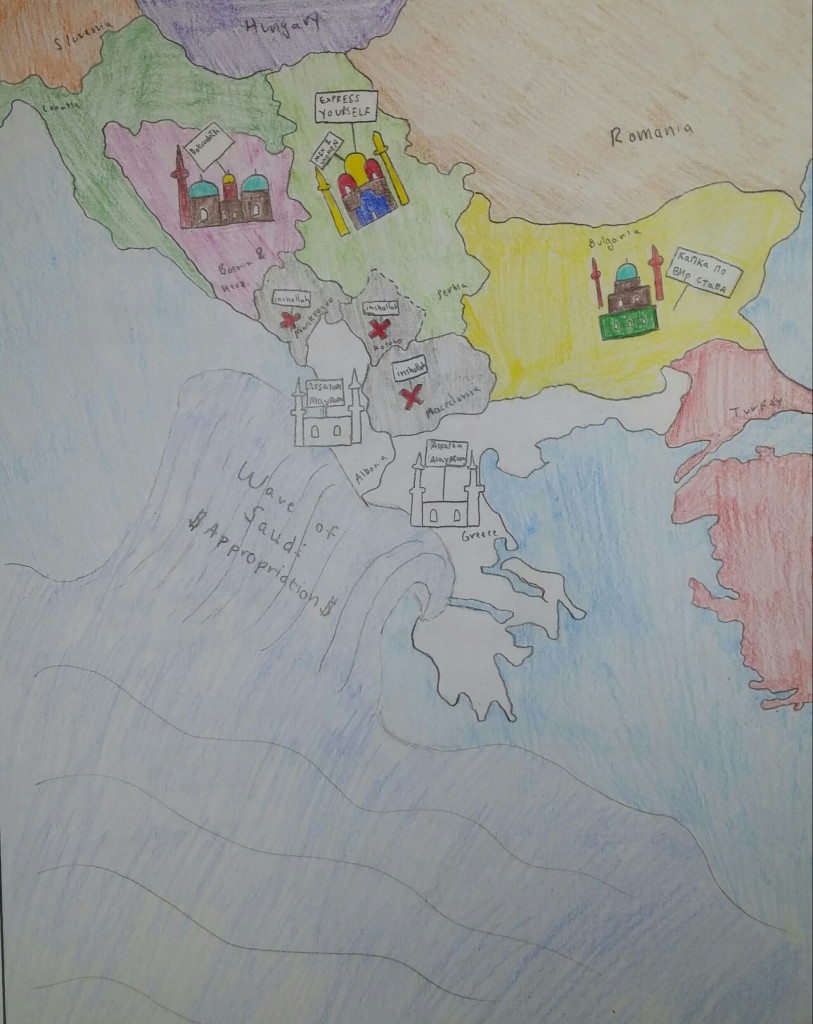
My piece, Wave of Saudi Appropriation (medium: pencil and colored pencil), is a political cartoon that criticizes the Saudis’ efforts to deculturalize the Balkan mosques and erase their artistic and spiritual value to the people that worship in them. The cartoon features a literal wave washing over the Balkan states, turning them from a previously lively color to white. The newly erected mosques in the ‘whitewashed’ countries are white and display a generic Saudi saying, “Alssalam Ealaykum,” meaning “hello”. These lifeless colors and signs contrast with the bright colors and cultural norms in the other Balkan states, indicating that the identity of the renovated states has been lost. Additionally, I included gray countries that were on the cusp of being washed by the Saudi wave with an “X” and a sign saying “inshallah”, meaning “God willing”, indicating that the Saudis plan to move onto that country next.
This Saudi approach to ‘heretical’ mosque renovation has drawn backlash from followers in the Balkans; individuals have scratched out names of the Saudi donors and expressed distaste for the mosques after renovation (Lecture 12). And while the Saudis claim that the Balkan cultural mosque interpretation follows their ancestors and not God, their sentiment is seemingly contradictory. In fact, the earliest Muslims maintained the culturally significant Roman architecture around them (Necipoğlu 67). Now more than ever the Saudis need to maintain the fabrics of Balkan Islamic mosques just as the early Muslims did with the Roman structures.
Thus far, the Saudi contractors have been able to bleach many of the boldly decorated Balkan mosques to try to rid the region of its ‘heretical’ cultural identity. Doing so, though, goes against the “regional, dynastic, and chronological-stylistic” focus of Islam across the world (Necipoğlu 73). While the Islamic core survives within the mosques after Saudi renovation, the artistic and cultural shell is completely removed, diminishing the importance of the mosque to mere worship.
- Comments Off on Wave of Saudi Appropriation
© 2016 by Enlightened Perception
Powered by WordPress | Designed for Cordobo by Cordobo | Huang.