American “versus” Muslim
Week 13: Architecture for Contemporary Muslim Societies; Islamic Hip-hop and Punk Rock
In recent years and especially after 9/11, a sense of opposition has risen among non-Muslim Americans towards their Muslim neighbors, friends, and peers. Many non-Muslims (unrightfully) characterize Islam as having no place in America, as a “religion of war”, and as a group of radicals who “have no hope outside of dying in Jihad”, separating American and Islamic principles as mutually exclusive (Rev. Franklin Graham). As beliefs like these perpetuate, the concept of Islam being a faith of violence has moved to a mainstream audience at the cost of the security and well-being of the Muslims in the United States. Muslim individuals have begun to endure “hostility and structural discrimination” in the face of these unjust criticisms, and, considering the current political climate, there is little chance of improving the perception in the near future (Swedenburg 57). Yet, despite these assumptions that many Islamophobic individuals make, most Muslims in the United States feel no interference between their American and Muslim principles. I would even go as far as to argue that there is no separation of “American” and “Muslim” principles; rather, they spheres that largely overlap, just as any other religion would, with American lifestyle. These are the arguments that need exposure to stop the systemic discrimination and characterization of Muslims as a non-American identity in the United States.
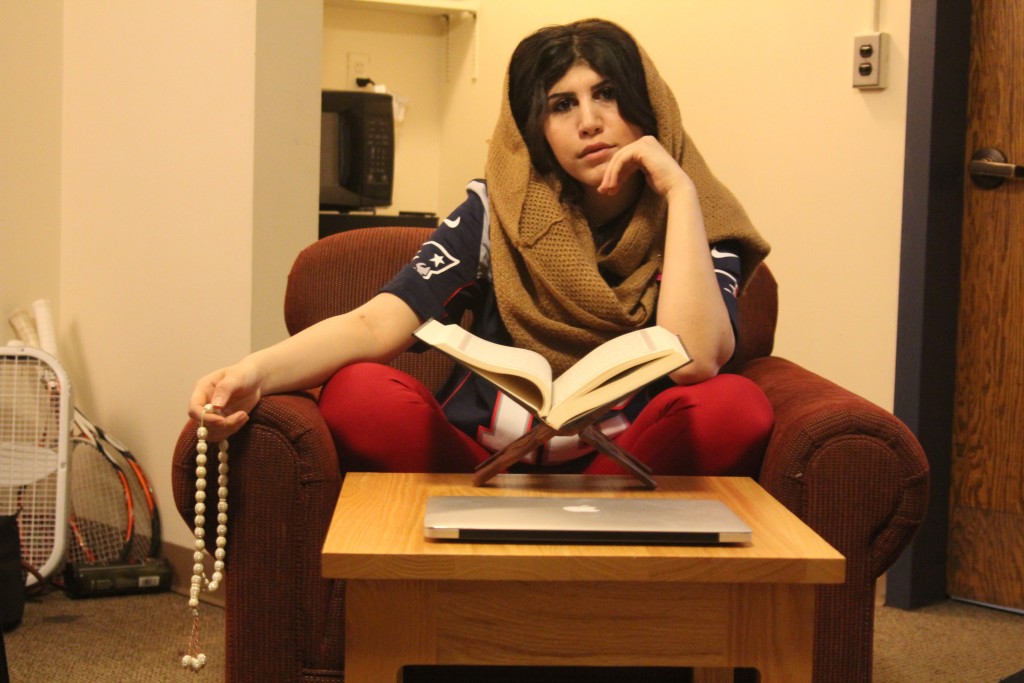
In my photograph American “versus” Muslim, I show the picture of a young Muslim woman who straddles these two lives that are often depicted at odds of one another to break the stereotypical mold I exposed earlier. I intentionally placed the “versus” in the quotes in the photo’s title to signify the perceived difference between the two notions. In the image, the woman is wearing a hijab, holding her prayer beads and heading the Qu’ran, symbolizing the Muslim beliefs that she lives by. On the other hand, she is wearing a jersey from the New England Patriots, an American football team, to symbolize the stereotypical American love of football. Furthermore, a Macbook, the prototypical American product and staple across American college campuses, sits on her desk in front of her red skinny jeans, similar to the clothing worn by the girls in the #MIPSTERZ video, addressing her role as a typical American woman to couple her Muslim identity. In depicting her in this way – incorporating both American and Muslim symbols – I aim to break down the wall that is often cast between the two identities.
Ultimately, the purpose of this photograph goes beyond an isolated attempt to show a single individual who is within both the Muslim and American spheres. I am trying to bring this image to the mainstream, so that the focus on Muslims in America moves away from radicalization and towards a realistic depiction. This very concept is exemplified on the final page of Mohsin Hamid’s The Reluctant Fundamentalist, as Changez urges the interviewer not to imagine all Pakistanis as potential terrorists and to look beyond the stereotypes and into the individual. Moreover, just as Muslim musicians have done in the past with the music they’ve created, I intend to push forward the “multifaceted Islamic identities as weapons in the battles against racist violence and Islamophobic discrimination” where Americans have often seen a single Muslim identity (Swedenburg 76).
- Comments Off on American “versus” Muslim
© 2016 by Enlightened Perception
Powered by WordPress | Designed for Cordobo by Cordobo | Huang.