Khomeini’s Insight
Week 11: Sir Muhammad Iqbal and the Creation of Pakistan; the Iranian Revolution
The Iranian Revolution was a period of unrest from 1977-1979 throughout Iran that was mostly driven by conservative backlash against a westernizing monarch in Muhammad Reza Shah. After taking over the monarchy from his father in 1941, Muhammad Reza Shah began to rapidly secularize and westernize Iran with the help of American dollars and often at the expense and dismay of the Muslim clerics and conservative Muslims of the state (Buchman 86). In order to appeal to the non-Muslims and westernized citizens of the country, the Shah developed a largely westernized appeal in Iran through casinos and locations of luxury on the backs of the same conservative Muslims that he was alienating (Lecture 21). Seeing the unrest in the country come to an apex in 1979, Ruhollah Khomeini, an exiled religious leader, became the face of the movement against the Shah and eventually took over as the religious and political leader of the Iranian Islamic Republic after the Shah’s ousting. Throughout the fall of the Shah and Khomeini’s rise to power, political posters were often used the reach the largely illiterate but pictorially fluent masses in Iran (Chelkowski 128). These posters function as a “second reflection of the revolutionary movement” that intensified the struggle for change among the conservative religious class in Iran during the revolution (Ram 90).
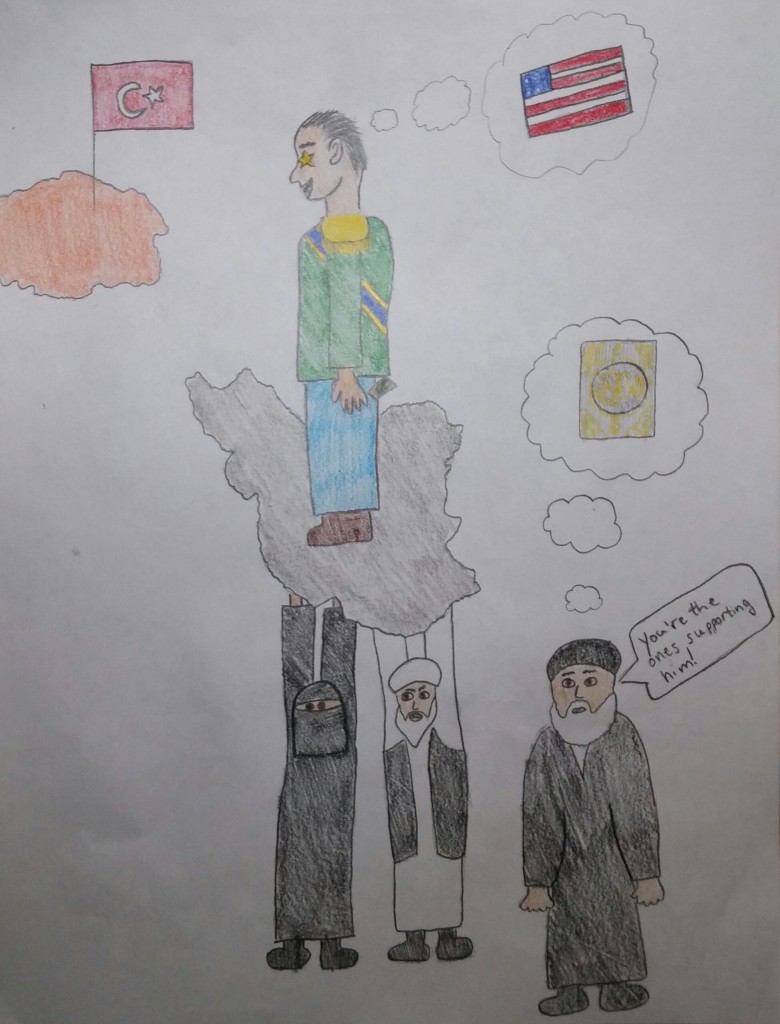
My piece Khomeini’s Insight depicts a typical political cartoon poster from the Iranian Revolution era. The poster depicts Muhammad Reza Shah standing atop Iran, looking west towards Turkey with stars in his eyes, and thinking about the United States with American money in his back pocket. This symbolism shows where the Shah’s alliances are: with the westernized, secular countries, specifically the United States. Furthermore, the money in his back pocket signifies the money that the United States put into reinstalling the Shah after he was overthrown in 1950 (Buchman 86). Underneath Iran are two members of the conservative religious class whom the Shah built his westernized dreams upon; they bear his load without any help from him. Beside these two stands Ayatollah Khomeini with his own insight into the matter: he’s thinking of the Qur’an, saying that the conservative class is supporting the Shah. By incorporating Khomeini into this piece as the bearer of revolution, I stick true to the typical political posters of the time; many works showed Khomeini exiling the Shah from Iran based on his inspiration from the Qur’an. Furthermore, explicitly showing the contrasting parties and ideas (the Shah and westernization versus Khomeini and conservative Islam), I embody the two fronts in Iran at the time. Ultimately, the Shah loses power when the conservative Muslims that he built his empire upon leave him to support Khomeini, resulting in Khomeini’s rise to power and Iran’s transition from an integrative state to the Islamic Republic that we know today.
- Comments Off on Khomeini’s Insight
© 2016 by Enlightened Perception
Powered by WordPress | Designed for Cordobo by Cordobo | Huang.