Friday, May 9th, 2014...3:33 am
An Introduction: Reader’s Guide
Throughout this course, I have been fighting to define every piece of literature and art as my own. This course has been about exploring the meaning of Islam and its many meanings to many peoples around the world. I have discovered what it means to me—and it seems to be something more than a religion. Islam is a belief system, a culture, an art form that is easily relatable, especially for a non-religious person like myself. I have created works of art to match my thoughts and feelings throughout the learning process. This portfolio/blog offers a conclusive example of what can be experienced and achieved when subjected to new and thought-provoking ideas.
Professor Asani and the second chapter of Infidel of Love: Exploring Muslim Understandings of Islam inspired my first portfolio piece (Week 2). This first piece is simple in construction: pencil and paper. I used a four-inch by six-inch piece of paper to reconstruct my own version of a framed poem in the traditional Persian style. Colored-pencils bring the outside border to life and are strategically designed and placed in a symmetrical style—I worked hard to create a border that was complex and reminiscent of nature. The center of the frame is dedicated to a poem by Rumi. I wrote the poem in English in a style reminiscent of calligraphy—it is graceful and beautiful to look at, and perhaps difficult to read. This poem was analyzed in Asani’s second chapter and served as my inspiration. I have never interpreted Rumi and his work through a religious lens before and exposure to this perspective came as a welcome shock. This poem in particular drew my attention because of the fine line it walks between religious love and romantic love. Asani has interpreted the poem as one of religious love, but compared to the poetry included earlier in the chapter (like that of Al-Hallaj) it seems definitively romantic. This is where Asani and I differ in opinion, perhaps only because of the argument Asani uses to defend his opinion. For Asani, Rumi is clearly interpreting God as Love. However, reading this interpretation for the first time, I am not so certain. Asani does not seem to logically defend his point or provide definitive proof of Rumi’s Love-God perspective. This left me in disagreement and eager to share my interpretation. It is because of this controversial position this poem maintains that I dedicated a work of art to it. A simple yet beautiful portrayal of a poem about love; a love that the reader can interpret as their own, whether romantic or otherwise.
Asani and the third chapter of his work inspired my second art piece—a modern day buraq (Week 4). Throughout his third chapter and within class discussion, the mi’raj was discussed as a significant, grounding moment for the Prophet Mohammad. I considered myself to be well informed on Islamic practice before this course, however after reading the Prophet’s ascension story, I was surprised. I have never thought of the prophet in this mythical way before and it immediately brought about a Mohammad-Jesus comparison. I wanted to draw attention to this story through my artistic interpretation of the buraq—a mythical winged creature that flies Mohammad to Jerusalem. The creature has been a great source of artistic interpretation, all of which are fairly dated. With this in mind, I worked to create an updated version of the buraq—less vintage than prior depictions (See Figure 1). I used a standard sheet of paper and a common fashion magazine. From the pages of the magazine, I cut different patterns and textures to build a horse-like body with flying mane and bee-like wings. The collage was finished when I included a background of sorts through the small buildings in the bottom right corner of the image, giving the creature a sense of flight. Although this modern version of a buraq is characteristically wild, I believe it represents an important element of Islamic culture: that is the mystic side. The mythical history of Mohammad is important and was previously unknown to me. By creating my own interpretation of the story, Mohammad’s own ascension became a tangible element of my understanding of Islam and an element that I may question and find fault with. The story may be entertaining however the religious validity of it is questionable. Mohammad in this magical story changes my understanding of him as a normal man—not worshipped like the prophet Jesus—to a super human figure.
The third art piece I created represents the role the Quran plays in Islam and the many interpretations with which it may be understood and utilized (Week 3). To best embody the sentiment I wanted to capture, I staged a photograph. The image is of a woman, holding a book in her lap—the Quran. She is surrounded by black except light emanates from the book on her lap, illuminated her figure and face. This light is meant to represent knowledge and enlightenment to the word of God. The word of God is said to be Light and this image literally captures that idea. Michael Sells book Approaching the Qur’an inspired this image. The discussion that surrounded the book within class emphasized the different role the Quran plays for Muslims around the world. The one idea I found to be universal however, was that o the Quran as Light. No matter the interpretation taken to the holy scripture, whether devote or a source of musical inspiration, the book is illuminating. In the image the light from the Quran mainly affects the face of the woman, symbolizing the direct power of the scripture on the mind and life of humanity.
The Sufi practice of Samā, its mystical nature and controversial practice inspired a piece of artwork that questions what Samā may actually accomplish (Week 8). In reading Leonard Lewisohn’s “The Sacred Music of Islam: Sama’ in the Persian Sufi Tradition,” I learned about the purpose of Sufi practice but also began to question it. At first, Lewisohn expresses the act of Samā as a religious practice, a kind of meditation that brings an individual closer to god. However, even as a spiritual event, the parameters surrounding the act are extremely metered. Lewisohn’s shows that there are four distinct steps that must be followed; this element of the Samā changes how it is understood. I created this digitally manipulated image to depict the many sides of Samā as well as the most fundamental meaning behind the act: oneness with god. The image is a self-portrait with a repeated image of myself digitally altered in a variety of ways. The background is a blend of colors—neither appealing nor unappealing—to signify its relative unimportance in the Samā process. The purpose of the altered images of myself is to symbolize the many things Samā can be, even for the same person. I chose to exhibit the more mystical side of the practice in this way and therefore promote the Samā as meditation rather than as an action.
Conference of the Birds, the epic narrative poem by Farid Attar was the inspiration for my fifth portfolio installment (Week 10) . The meaning of Attar’s poem is clear by the end of the story, however the severity with which one takes their interpretation varies. The poem is often seen as a religious narrative that emphasizes the role of self in finding god. Each of the thirty birds whom take the journey to find the simorgh (the king of birds) holds a deeper meaning as well as a character flaw that must be explored and remedied before the journey itself can begin. In this way, the epic serves as a personal guide to the reader, identifying their flaws and offering the moral solution for it in order to guide one closer to god. It is the conclusion of the story that truly inspired me and I like to interpret the ending in less of a religious light in order to identify with it. The thirty birds accomplish their journey and travel far to reach the lake where the legendary simorgh lives, but when they get there, all there is a lake, and looking upon it they see their own, thirty reflections—a pool of thirty birds, which translates into Persian as sī morgh. Attar plays a trick on the reader and I believe it is what defines the story. From a religious point of view, we may conclude that the King of the Birds—metaphorically humans—is not a living entity but our own selves and the life inside us: God. In looking at our own reflections, we are parts of god and should therefore rule ourselves in the proper and best way possible. The nonreligious side to this theme is the exact same without the emphasis on god. It is an idea that is easily translated into a non-religious context and perhaps, for this reason it truly spoke to me. I created a calligraphy pen drawing to represent what I gained from the epic. I drew the phrase “thirty birds” in Persian in a shape like that of a bird. Within the black outlines of this calligraphy, I used color to rewrite the Persian word for “bird.” The one bird is therefore made up of many, like the point of Attar’s story. The world is made of many and the best ruler this world can have is when all act as one. The poem speaks of the basic nature of humanity and the complexity from which we act.
The last installment in my portfolio was inspired by Marjane Satrapi’s graphic novel Persepolis and speaks for my family’s personal heritage (Week 12). The piece is a digitally altered image of myself: two self-portraits, one with hijab one without, superimposed upon each other. The end result is a complicated, graphic looking self-portrait—the hijab maintains a key focus. Persepolis was an unusual choice for the purposes of this course, however I am lucky to say it was included. It is a novel that examines the significance of Islam in a life as well as the political function a religion can play. For Satrapi, as a young child in revolutionary Iran, religion held little importance until it was imposed. After which, her character poses as an outspoken child, wearing hijab but on her own terms. I found it easy to identify with Satrapi through my own experiences in post-revolution Iran. Her focus on the veil in her book brought out my own thoughts on the matter, and I found they were positive. Unlike Satrapi, although the veil was an imposition, it became a relative positive for me. The hijab as a blessing is not thoroughly analyzed in this portion of Satrapi’s tale but it was a opinion I have recognized. The image I created was my effort to embody and show what the hijab actually is, that is, a piece of cloth. With the two images on top of each other, the distinction between them is hard to define and I meant for it to be that way. A person with or without hijab is the same—in Iran and around the world. In a way, I have used this piece to proclaim my own political message. Women in Iran are not defined by the hijab and neither am I. The image is my proof and my stand. Satrapi’s emphasis on the veil is from the point of view of a child; she is witty and harsh. I built off of what Satrapi offered the reader to form my own opinion and understand my own feelings towards the hijab from my own experiences.
This portfolio offers many ideas on a variety of elements within Islam and Islamic culture. As a nonreligious person, my perspective is very different than those of others and I hope to offer a critical, illuminating eye from this point of view. Islam is beautiful; it is both a religion and an art. And, like others of its kind, it is many things to many Muslims. Exposure to the many facets within Islam brings about new ideas and new questions, and I look forward to continuing my exploration of Islam—more than a faith.
Asani, Ali. “Defining Islamic values and ideals.” Infidel of Love: Exploring Muslim Understandings of Islam. 54-104. Print.
Asani, Ali. “Following God’s Beloved: Prophet Mohammad as the ideal Muslim.” Infidel of Love: Exploring Muslim Understandings of Islam. 105-153. Print.
Attar, Farid. The Conference of the Birds. New York: Penguin Books, 1984. Print.
Lewisohn, Leonard. “The Sacred Music of Islam: Samā’ in the Persian Sufi Tradition.” British Journal of Ethnomusicology Vol. 6 (1997): 1-33. Print.
Satrapi, Marjane. Persepolis: The Story of a Childhood. Paris: Pantheon Books, 2003. Print.
Sells, Michael. Approaching the Qur’an. Ashland, OR: White Cloud Press, 2007. 199- 223. Print.
Appendix
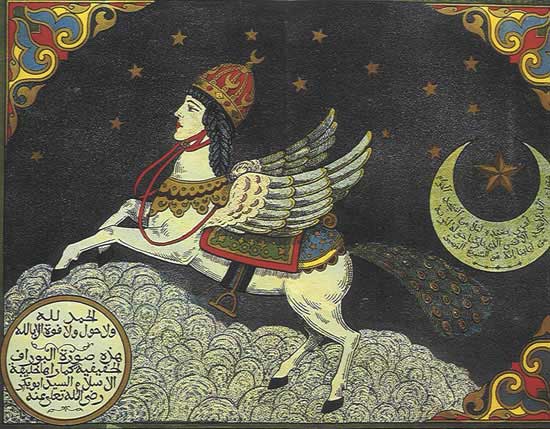
Figure 1: A reproduction of a 17th century buraq depiction. A Buraq seen on a reproduction of a 17th-century Indian Mughal miniature. Digital Image. Wikipedia. Wikipedia, 10 April 2005. Web. 3 May 2014.
Leave a Reply