Wednesday, May 7th, 2014...1:27 am
My Own Persepolis
Rereading Persepolis by Marjane Satrapi brought back all the family stories and heritage I expected. Her story is not too different from my mother’s or countless other Iranians who left Iran prior to and after the Iranian Revolution in 1979. Someone recently called the general movement away from Iran the “Iranian Diaspora,” and I believe that sentiment is a perfect description. After all, Marjane and my mother had to leave their homeland. I know for my family, there was no history outside of Iran, no past homes or future plans for departure. Of course, this was before the revolution and before trouble began.
Instead of using this post to document my family’s history in the Iranian Diaspora, I will use it to describe my own (few) experiences with Iran. Satrapi spends a significant amount of time in her graphic novel critiquing the hijab. And from the view point of a child, I think she offers the reader a more well-rounded view–it can be a fashion statement, something to ridicule, or just a plain imposition. The way she categorizes the accessory in the book is similar to how I would describe it in my experience, although I would be more positive in my experience. In the summer of 2011, I traveled to Iran with my mother for a period of two weeks. That was two weeks of hijab. I did not think much about the imposition before arriving in the country, but as a feminist and someone who has never been told what to wear, was very hostile to the idea… at first. It takes getting used to, but after a few days, it felt normal. Looking back, maybe my fondness for the hijab stems from my desire to belong and my tendency to hold dear all that Iranian culture has to offer. But my family has no Islamic past, Iran to me is not Islam but a culture and identity. Wearing the hijab, I felt right. In fact, I felt beautiful: confident and comfortable, in a way I have never felt before. And when I no longer had to wear the scarf, I found I missed it. Sure, maybe it was a security blanket, or maybe it was just fashion.
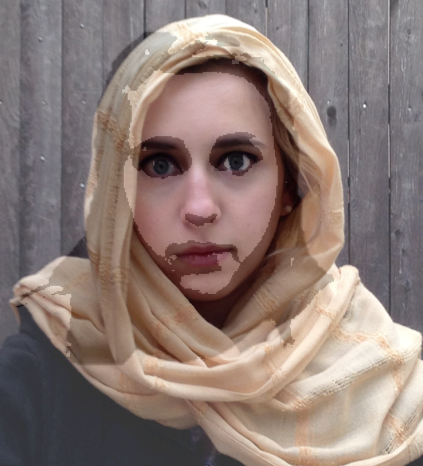
In this piece, I have used a photo editor to blend to images together. Both are self-portraits, one on me in hijab and one of me without. Through the compounded image, I hope to convey the depth and complexity of the hijab issue itself as well as pose several questions. Does a scarf change who I am? Or what I look like? From these questions we should consider not only the social implications of the hijab but also the political.
Leave a Reply