Posts Tagged ‘Copyright’

Does Hope poster infringe copyright?

Friday, February 13th, 2009

(cross-posted on private blog)

Shepard Fairey, artist of the famed red white and blue portrait of Barack Obama for the poster “Hope” is fighting back for his rights. His artwork is based on an AP photo, and AP wanted credit. I don’t know whether they are upset about not being credited in the first place, or because Fairey has profited from the artwork. A photographer myself, I can understand where AP is coming from, but clearly, Fairey’s poster is derived work, not a tweak of the original.

From the LA Times blog (which BTW didnt have credits)

From the LA Times blog (which BTW didn’t have credits)

This case is nothing new, but something we really have to start thinking about. It’s very similar to the case of Richard Prince, although Prince’s derivation of the original photos was, in my opinion, less creative than Fairey’s. I mean, becoming famous because you took a picture of someone else’s picture? Come on!

Warhols Nine Jackies, taken by moi at the Met.

Warhol’s Nine Jackies, taken by moi at the Met.

As I mentioned in a previous post, most contemporary artists are basing their artwork on photographs- think of Andy Warhol, Marlene Dumas… Most of their work is based on publicly-available photos, such as press photos, but with services like Flickr, artists have a huge visual pool to get their inspiration from. Now that the “default” of Creative Commons license is attributing the original author, how does one go about when creating art? It’s not like an academic paper where you can put in a footnote. Should artists write on the back of their canvas if the work was derivitave? Art falls into a weird category, because it is commercial, yet different from what we think when we think of commercial use/purpose.

It’s also very difficult when you’re trying to pin down copyrights because inspiration can come from a number of sources. How can you define which sources of inspiration are more important than others? As an amateur painter, I find traces of Gogh, Klee, Klimt, and perhaps thousands of other artists in my paintings. I am also inspired by people- the particular look in someone’s eye, the specific silhouette of someone’s pose, like Dora Maar was to Picasso. Sometimes I know that I am inspired by a particular image. Most of the time, it comes from a subconscious level, unnoticed by me until someone points it out.

I know that AP may be feeling “cheated” or want to be part of whatever money Fairey made from his poster, but I don’t think this an issue where we have to sort out things with the law. Copyright laws were created to promote the arts, not stifle them. I don’t think artists should have to say where they got their inspiration- that takes out the fun of trying to figure it out. I think every piece of art is a derivation from something that exists, the same as there being no such thing as a new idea. It also doesn’t make sense to have to wait 50 years (or whatever the timeframe is) to be able to freely use an image. Some of the best literature is derivative. Could we have Wicked without the Wizard of Oz? How many volumes of great Harry Potter fan fiction must remain in basements until JK Rowling decides to release her iron hand? Art should be kept open and free.

The beautiful thing that separates humans from animals is that we constantly inspire each other and are able to improvise. Why try to deny something that is the essence of our nature?

Inspired by John White Alexander and an ancient Indian architecture relief. I'm exempt from copyright violations only because these images are very old.

Paintings inspired by John White Alexander and an ancient Indian architecture relief. I’m exempt from copyright violations only because these images are very old.

Laziness, DRM and Freebies

Monday, May 26th, 2008

It’s no surprise that the cable industry is growing despite the availability of allegedly “free” content available on the Web. People want content, but they are also lazy, and sometimes enjoy the being submissive to programming. (Why are we trying to get people to make difficult decisions and choices, when all they want to do is shut their mind and NOT think?) It’s wonderful and scary that my tastes can be categorized so that on channels like Pandora.com I can listen to the type of music I want with only a few “bad apples.”

That’s why I don’t understand why people are so opposed to DRM. I’m not saying that every product should be protected, but why isn’t it fair that people who develop advanced technology be asking a few bucks for the services that they offer? Obviously, from the number of people using TIVOs and iPods, people are willing to pay. It’s not a matter of whether people can use open technology, but a question of whether they have to. I can grow organic vegetables in my backyard, but I’d rather go to Whole Foods and buy something. It is being lazy and productive at the same time. Not everyone appreciates DIY.

It’s interesting that people talk a lot about DRM regarding music or videos, but not about photography. Though somewhat on a different level, how difficult is Sony, Nikon, and Canon making it for camera uses because their lens are not compatible? However, camera users (or at least those who use DSLRs) complain less about that compatibility because they are willing to accept the different quality and characteristics of the different products. The same goes with PS3 and Xbox360 players. They take a certain pride in knowing that their community is somewhat exclusive, compared to those people who can play free online games through the Internet.

In my ideal world, products would be like what they are in Second Life: the original maker of the product is “watermarked” regardless of the owner and people can choose how they products are distributed. Although some of the high-quality products and programs require money, there is an abundance of freebies and the quality of freebies keeps getting higher and higher. This stimulates the people (who charge for their products) to make even better products for those who are willing to pay. There are always people willing to pay.

Is that unfair? Because some people have money and some people don’t? Do people want a socialist society? In a completely ideal world, no one would have to develop anything and things would just grow on trees to pluck for free- where everyone is equal and has equal access to the same technology. Unfortunately, the Garden of Eden does not work in this society, and free riders can only get a free ride when there are alternatives of people who are paying for development and usage of the technology.

(more…)

Design and Copyright in SL

Wednesday, October 11th, 2006

bag.jpg

I was at Dazzle, one of the most famous shops for women’s clothes, and saw a bag that was unquestionably a Louis Vuitton knockoff. Of course, the monogram was entirely different, so I couldn’t say it was counterfeit, but more on the lines of being cute, but it still raised questions in me just where the lines of copyright come in when it comes to cyberspace, especially designing in SL.
Now that I have started making my own clothes, I am undoubtedly inspired by my favorite designers, but as to where I take that inspiration, I’m not sure just what the limit is. The other day, I saw a marvelous Dior couture dress and I saved a photo of the dress because I loved the texture, but then when I thought about it, I suddenly got scared and wondered whether or not I was stealing from John Galliano.
But then, even artists copy from each other and no design is truly original. Why even Gogh copied paintings of Hiroshige.

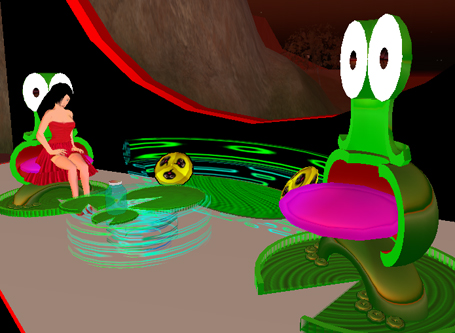
Sometimes I see some very original artwork, furniture, or architecture in SL and I wonder just how original it is. I’ve seen things that seem very original, like this frog chair, for instance. But if you think about it, certainly copying someone else’s work is not something that is overly difficult, if you have the skills. But then, if copyright becomes so unimportant, I believe I would be left with a sense of futility and be discouraged.
But perhaps that is the way of the world. Sometimes I see that articles published in our paper are rewritten with almost no changed under someone else’s byline for some other publication. But being a media in a small country, there are limits to what you can do about it. In the end, it all comes down to ethics, but not everyone has the same standards or sense of what is ethical and what is not. So if you can’t prove your financial or emotional damages- you basically don’t have a case. It’s just a bitter pill you have to swallow.