* Tracy Mitrano, the January guest blogger for the Chronicle of Higher Education’s Wired Campus section, has been writing some good stuff. She doesn’t present us with ground-breaking discoveries, but her posts are soft and personal while managing to deal with some heavy topics. She also has a way of gently flicking questions in one’s direction, which I think is great because the role of a good academic is not only to inform, but also get one to think, and Tracy does just that. Here’s an interview I did with Tracy from last year, in which she talked about building a global university.
* Answering Prof. Charles Nesson’s request for a camera in the courtroom, Judge Nancy Gertner said she will allow Coutroom View Network, a New York-based company that webcasts trials in state courts, into a key hearing this coming Thursday that pits the US recording industry (RIAA) in the suit against BU grad student, Joel Tenenbaum. The court session will be broadcast live on the website of the Berkman Center. Nesson (and his team of students) is defending Tenenbaum for allegedly sharing seven songs illegally from Kazaa, peer-to-peer network.
*”Enhancing Child Safety & Online Technologies ” was released by the Berkman Center two days ago. This final report of the Internet Safety Technical Task Force summarizes a year-long investigation of tools and technologies to create a safer environment on the Internet for youth. It points out that: 1) Sexual predation on minors by adults is still a concern, 2) Bullying and harassment, most often by peers, are the most frequent threats that minors face, 3) The Internet increases the availability of harmful, problematic and illegal content, but does
not always increase minors’ exposure.
As expected, studies showed that these factors were not just problems in cyberspace, but were strongly linked with the offline world. I know people blame the education system (government) and technology (the Internet), but personally, I think so much could be improved by proper education at home, which seems so basic but is overlooked by so many parents. Bringing back the “traditional” values of family, love, and responsibility could solve so many problems…but perhaps my conservative views are not welcome in this era.
(cross-post on arcticpenguin)
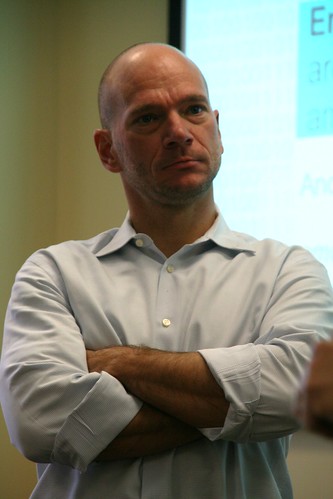 Andrew McAfee of HBS was the speaker at today’s Berkman luncheon series, talking about Enterprise 2.0, which he explains as being the phenomenon in which companies incorporate “community” features into their work. He said that based on connectivity, people’s networks can be categorized into strong ties, weak ties, potential ties, no ties. Citing Mark Granovetter, he said that weak ties may be stronger because people that are strong ties will not provide anything you don’t already know. (Interesting fact: Partners and future jobs are usually found through weak ties!) He said that corporate technologies do lousy jobs of connecting weak/potential ties, which could be done through social networking tools. [One thing that he grazed over was the value of people who convert ties into actual networks, which caught my attention because I fall into that category.]