You are viewing a read-only archive of the Blogs.Harvard network. Learn more.

Category: Uncategorized (Page 3 of 7)

Perma Pops Up on Westlaw, Week of October 1st

Per Westlaw, in the past week Perma.cc Links have showed up in:

  • 9 state and federal court opinions, including opinions by the highest court in
    • Illinois
    • Washington
    • Massachusetts
  • 35 law review articles
  • 5 court filings, and an environmental law forms guide.

Sign up here to use Perma.cc to ensure your own linked sources are safe. We also offer organization-wide accounts and are now offering individual unlimited-use accounts!

New Perma.cc Policy Regarding No-Archive Metatags

We’re excited to announce a change to the way Perma.cc handles our users’ efforts to preserve web pages that have generic no-archive metatags.

In the past, when someone used Perma to preserve a webpage with a generic no-archive metatag (such as a New York Times or NPR article) the resulting Perma record was automatically, unalterably set to “Private.” We’ve found that this practice was unnecessary and often a source of confusion and frustration for our users.

Going forward, when someone uses Perma to preserve a page with a generic no-archive tag, that Perma record will not automatically be set to “Private.” Instead, these records will be public by default, and users will have the option to manually make them private if they or their institutions wish. In addition, existing Perma records with generic no-archive metatags will remain private, but users now can make those records public.

Perma.cc will continue to recognize any Perma-specific “noarchive” metatag or a Perma-specific robots.txt exclusion. Any Perma records of sites implementing those methods will be private.

We’re enthusiastic about the way this change will provide even greater access to links and citations that’ve been protected through Perma. Feel free to reach out to us at info@perma.cc with any questions!

Perma.cc Usage in the Legal World, Week of September 16th

Perma.cc‘s use in the legal realm continues to grow. Per Westlaw, in the past week Perma Links made appearances in:

  • 11 court opinions, including opinions by the highest court in
    • Massachusetts
    • Vermont
    • Maryland
    • Iowa
  • 34 law review articles
  • 6 court filings, including 3 Supreme Court briefs.

Perma.cc use is encouraged by The Bluebook and the Chicago Manual of Style. Sign up here to use Perma.cc to ensure your own linked sources are safe. We also offer organization-wide accounts and are now offering individual unlimited-use accounts!

Designing with Our Users: batch link creation

“Is there a way to create more than one Perma.cc link at a time?”  

This was a common question from our users and while it was a feature that was in the backlog, it was pushed into development when Leonid Grinberg, one of our own LIL alumni, now using Perma.cc as a law review editor, inquired about batch creation and offered to help build it!

We decided to invite the alumnus and additional law review editors to participate in a design session with our developers to sketch out how this feature might look and behave*.  Before we started designing, the editors spoke about their journals’ processes when it comes to creating perma.cc links for articles, so the perma team had a better understanding of user workflows. Next, participants did 2 rounds of sketching and sharing their ideas, and then it was time for some prototyping and development over the next 6 months.

This has culminated in the release of our batch link creation tool – launched in time for law review subcites. Click that link to read all about it, then log on to Perma.cc to try it out yourself!

*Full participant list:

Leonid Grinberg – NYU Law Student/former LIL team member, and initial developer for the project

Nick Szydlowski- BC Law’s Digital Initiatives & Scholarly Communication Librarian

Lydia Lichlyter and Frederick Ding- HLR Editors

LIL Perma team: Anastasia Aizman, Becky Cremona, Ben Steinberg,  Adam Ziegler

Brett Johnson- LIL Outreach and Support Lead

Jess Rios- HLS Service Design and Assessment Librarian, co-creation activity facilitator

AALL 2018: LIL goes to Baltimore

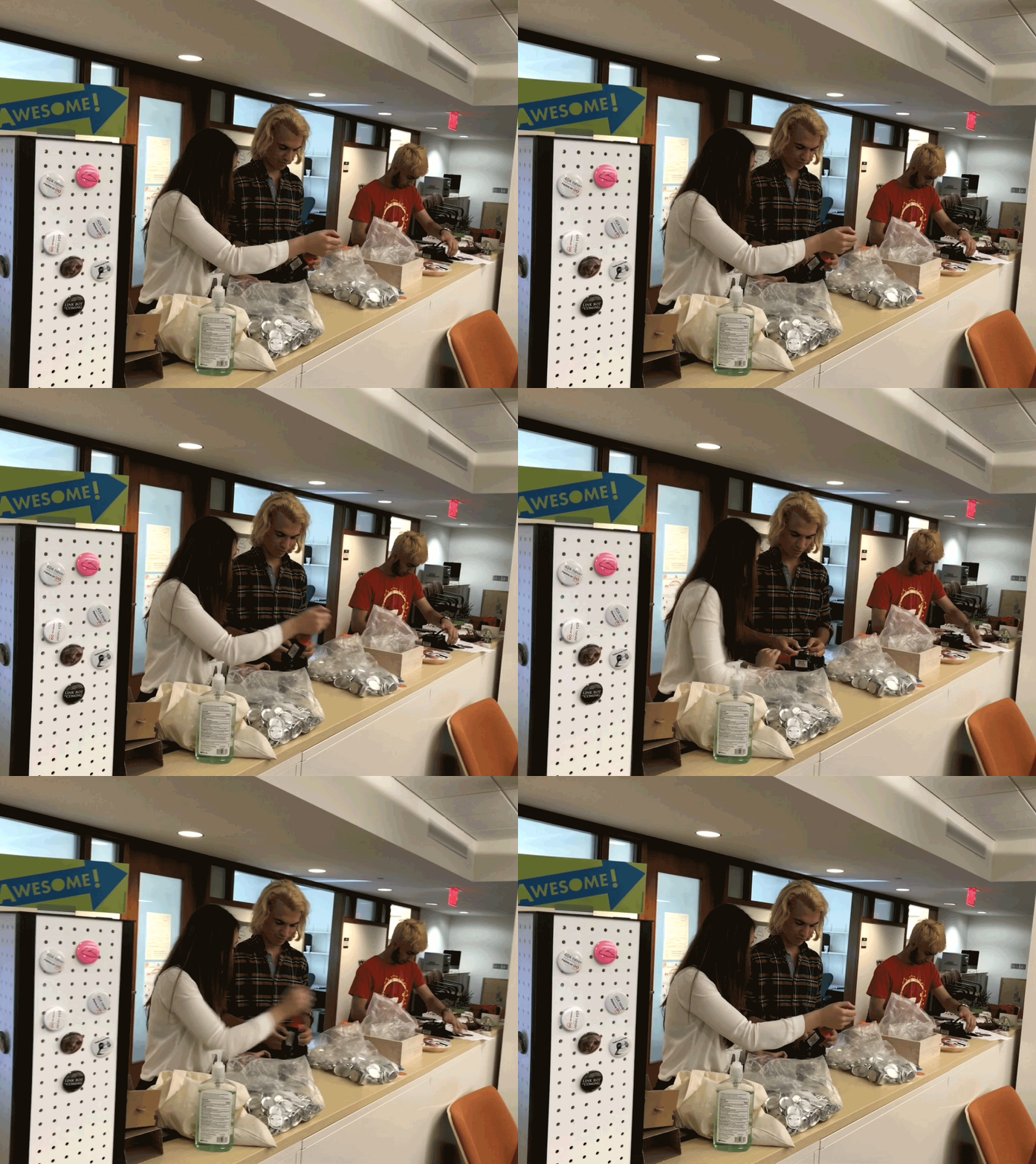
Last weekend members of the LIL team traveled to Baltimore for the annual gathering of the American Association of Law Libraries (AALL). Armed with our new business cards (thanks Anastasia) and freshly pressed buttons (thanks LILterns) Brett, Adam and I were ready to attend sessions, catch up with colleagues and hit the exhibit hall.

We kicked the weekend off with a keynote speech from Baltimore’s own John Waters, author and director of boundary-pushing cult films such as “Hairspray” and “Pink Flamingos”. Beyond his connection to the conference’s host city, his appearance seemed at first to be an odd fit. However, as he pointed out, “librarians are brave, smart and sometimes pissed off…and they stand up for people who get overlooked” – all qualities he tries to get at in his movies. His thoughts on access to books for prisoners, the risks of censorship, and equality got everyone ready for the next couple of days.

Our friends at LIPA once again generously shared their exhibit hall table with the LIL team, for which we’re exceedingly grateful. It was great to work alongside Margie Maes, champion of LIL and Executive Director of LIPA who will be retiring this month. Congratulations, Margie! We will miss her, but were also thrilled to meet her successor, Michelle as well. Here’s to future collaborations! 


A big goal of ours during AALL (in addition to spreading the word about new-and-improved H20, progress on the Caselaw Access Project, and new batch link creation for Perma) was to seek feedback and thoughts from colleagues about link and citation rot in the broader context. We’ve been rooted in our home of an academic law library – but we are seeking input and thoughts about linkrot in other industries and contexts.

We want to know: Who thinks linkrot is a problem for the flow of information and citation? What is their job? What kind of content is especially susceptible to the dreaded 404 error? At what points in the creation of the content are citations and links added? Whose responsibility is that? Are you seeing solutions to this problem? Email us! We’d love to talk.

Stay tuned for some of the answers we got during conversations at AALL!

Web archiving and CNN – frenemies?

As you may have read elsewhere, CNN pages are notoriously difficult to archive. Our developers will attest to the complexity of CNN web pages and the impact that can have on speed and fidelity of capture. Often, whenever folks using Perma.cc report trouble preserving a page, one of our first questions is “Is it CNN?”

But CNN’s not all trouble, it turns out. Recently we discovered a Perma.cc link embedded in — of all places – a CNN.com article that cites an American Medical Association press release: https://perma.cc/CNE4-FEQ9.

Great to see that CNN appreciates a good web archive!


Using Perma.cc in Court Filings: Two Quick Examples

In recent months we’ve been asking this question more and more: does link rot matter to lawyers?

One context where it matters – or should matter – is in court, when lawyers routinely cite web pages in their briefs, complaints or other filings.

Here’s one example: a Complaint filed by lawyers for the Freedom of the Press Foundation against DOJ, CIA, NSA and other federal agencies for access to records concerning government surveillance of members of the news media. This Complaint cites several web pages that could disappear, change or break while the case is pending or at any time in the future. Fortunately the lawyers included Perma.cc links for each of the cited web sources, such as this one, a DOJ press release: https://perma.cc/NQQ8-82F2.

Here’s another example: a brief filed two weeks ago with the U.S. Supreme Court in Weyerhauser Co. v. U.S. Fish & Wildlife Service. This document also cites to several ephemeral online sources. These lawyers also included Perma.cc links pointing to preserved versions of the cited source. No matter what happens to the original source, the Perma.cc links will point future readers – such as Supreme Court justices and their clerks – to a stable record.

Lawyers no doubt want their citations to be accurate, reliable and helpful.  When citing web pages, that means using web archiving tools to prevent link rot.

Perma.cc  currently is free for lawyers to use to preserve up to 10 links per month. We offer paid subscriptions for higher volume use. You can sign up at https://perma.cc or reach out to us at info@perma.cc to learn more.

AALL partners with Perma.cc

We’re excited to announce a new partnership with AALL, who be using Perma.cc to preserve the links used in their Law Library Journal and other publications. See their press release, below!

March 27, 2018 The American Association of Law Libraries’ (AALL) today announces the organization is partnering with Perma.cc to ensure AALL publications will remain complete and maintain their longevity for the benefit of its more than 4,500 members and those served by their legal information expertise. Perma.cc is a service that helps scholars, courts, and others create citation links that will never break by making a copy of the referenced content and generating a permanent link to an archived record of the page.

“Our primary goal as law librarians is providing access to legal information,” noted AALL President Greg Lambert. “It is critical that the resources we create are produced with strong preservation principles to ensure they are accessible to members, the public, and institutions that rely on them. Our partnership with Perma.cc will help us uphold this important responsibility.”

The partnership with Perma.cc will ensure the reliability of the links used in AALL’s Law Library Journal and other association publications, reinforcing AALL’s commitment to preserving legal information.

Perma.cc was developed at the Harvard Law School Library as a tool to fight link rot and content drift. Research has demonstrated the extent that citations have been affected across the web. For example, a study detailed in the Harvard Law Review revealed that over 50 percent of cited links in Supreme Court opinions and 70 percent of URLs from legal journals cited a reference that was inaccessible.

“We’re particularly proud of our members’ dedication and knowledge in launching Perma.cc, among them member Adam Ziegler, who serves as Perma.cc’s managing director as well as former Harvard Law School Library Innovation Lab Director Kim Dulin,” noted Lambert.

Perma.cc is free to use for those at academic institutions, courts, libraries, and other non-profit institutions and boasts over 20,000 users. Additionally, Perma.cc is now offering its services to law firms and other commercial organizations.

About AALL

The American Association of Law Libraries (AALL) is the only national association dedicated to the legal information profession and its professionals. Founded in 1906 on the belief that people—lawyers, judges, students, and the public—need timely access to relevant legal information to make sound legal arguments and wise legal decisions, its nearly 4,500 members are problem solvers of the highest order. AALL fosters the profession by offering its members knowledge, leadership, and community that make the whole legal system stronger. For more information, visit www.aallnet.org.

About Perma.cc

When a user creates a Perma.cc link, Perma.cc archives the referenced content and generates a link to an archived record of the page. Regardless of what may happen to the original source, the archived record will always be available through the Perma.cc link. Perma.cc is developed and maintained by the Harvard Law School Library in conjunction with university law libraries across the country and other organizations in the “forever” business.

How the Harvard National Security Journal Uses the Perma.cc API

Guest post from Harvard Law J.D. student Aaron Marks:

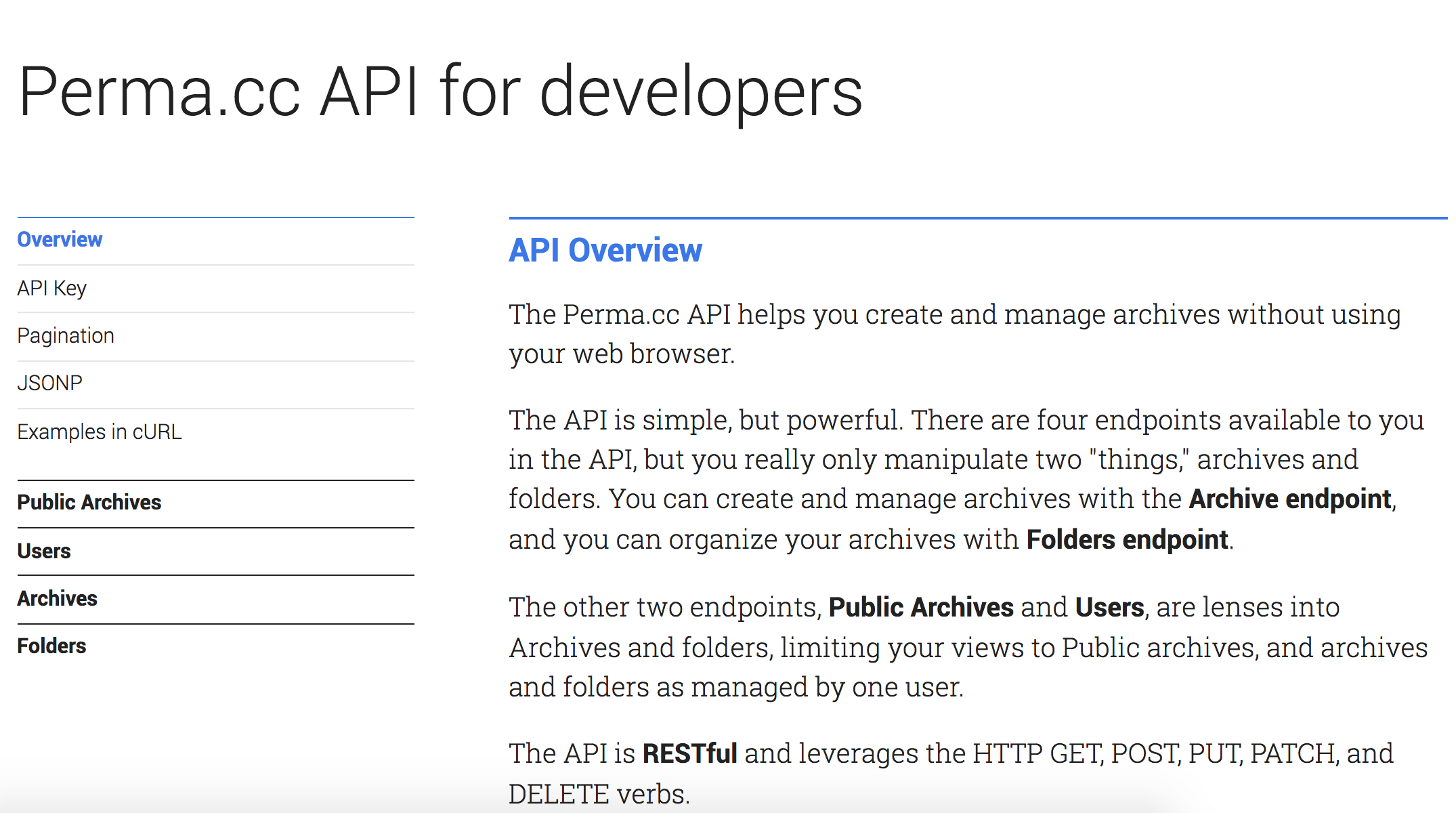
As the Online Editor for the Harvard National Security Journal, I am the go-to person for many of the Journal’s technical questions.  This semester I was able to put my technical skills to use by implementing a new tool that uses the Perma API.  The National Security Journal’s fall issue (out now!) contains several hundred weblinks.  We wanted to use Perma so that the content at those links would be permanently accessible.  But we did not want to manually create Perma archives for hundreds of URLs, which could take some time.

On a hunch, I suspected that Perma might have an API that would enable us to programmatically generate these links.  It turned out that not only did Perma have an API, but it was surprisingly simple to setup and use.  In just a few hours, I wrote a Ruby application that could import a spreadsheet of URLs, generate Perma archives for those URLs, and output a new spreadsheet that includes the URLs for each new Perma archive. 

In addition to programming with the Perma API, the experience let me interact with the Perma support team.  This happened when I discovered a bug: on creating a new Perma archive, our custom archive title would revert, after a few seconds, back to the default title that Perma generates when a custom title is not submitted.  Luckily the Perma support team was quite responsive after I reported the bug.  In fact, they resolved the problem before the Journal published our latest issue.

Although I was a software engineer before coming to law school, I have not coded much in the past three years and so my programming skills were somewhat rusty.  Happily, the API was very user-friendly and easily enabled our Journal to programmatically generate Perma archives.  I would recommend trying the Perma API to integrate Perma archives into your publication, website, software application, or anything else that links to web-content that you want to be preserved.

PS – Special thanks to Brett and Rebecca from Perma who helped fix the bug that I discovered!

Aaron Marks is a third-year J.D. student at Harvard Law School.  He is currently the Online Editor of the Harvard National Security Journal.


Perma in the News: American Libraries Magazine

Perma.cc got a recent shout-out in a December article for American Libraries Magazine about the importance of libraries in the Internet Age.

We  highly value our relationships with libraries across the country as they are key partners in our work because, as the author points out, “Libraries respect history. Web pages are ephemeral, and link rot is a real problem. The content of library collections is much more stable.”

To get started using Perma.cc yourself, sign up here!

« Older posts Newer posts »

© 2026 Perma.cc Blog

Theme by Anders NorenUp ↑