Archive for April, 2018

Week 12: On the Power of the Pen

Wednesday, April 25th, 2018

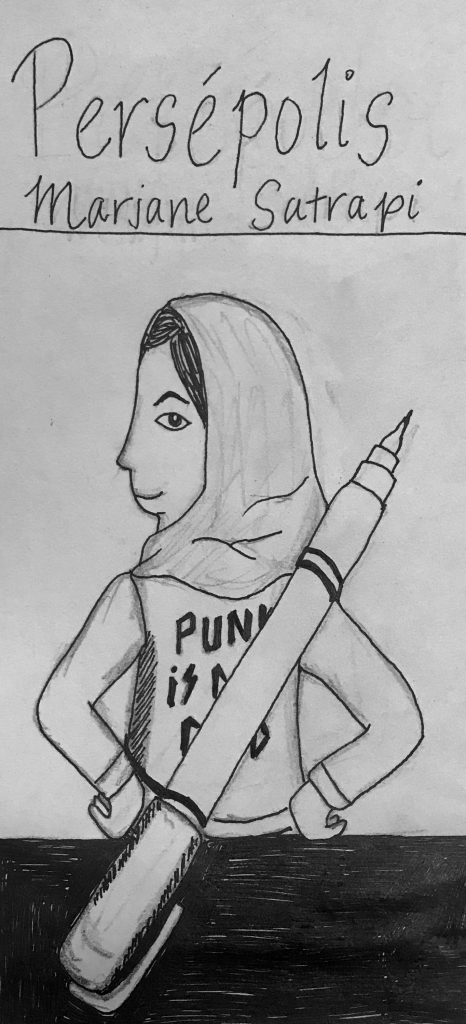
This is a pen and ink piece that was inspired by Persepolis, by Marjane Satrapi. Specifically, the idea behind this is that it is an alternative cover to the graphic novel than the original, focusing on the importance of the medium that Satrapi used as a form of empowerment in telling her story. The original novel cover features a young Satrapi staring point blank at the camera from across the table. Her body language, with her crossed arms and frowning expression, express feelings of distress and discomfort, which are representative of her experience growing up during the Iranian Islamic Revolution. During the section in which Satrapi struggled to smoke a cigarette for the first time, she reflects on how she felt that this was her turning point into adulthood – which I’m sure, to a kid smoking a cigarette for the first time, is a total symbolic moment, but I would like to argue that Satrapi was slowly losing the innocence of childhood much earlier: through the bombings, killings, and various horrifying events that she and her family witnessed; through the difficult questions she constantly asked her parents and friends; through her insistence to protest alongside her mother and father, and many more. As a result, due to the Revolution, Satrapi was forced to grow up much sooner than a normal child her age, a juxtaposition that I was constantly aware of due to Satrapi’s usage of the graphic novel: you could see that Satrapi was still a child, as illustrated, but the questions and thoughts she was expressing were so beyond her age. As a result, this illustration shows the agency that Satrapi was able to have after a situation in which many of the decisions about her life growing up were out of her hands – she was forced to wear a hijab, forced to leave her family, and so on. The telling of her childhood through a medium that is able to contrast the innocence of childhood with her intense emotional backstory was immensely effective, and so this cover represents that: her facial expressions and upright body posture are exuding confidence, and her “weapon of choice” against the trauma of her childhood is her micron pen.
Week 10: On Reclaiming the Hijab

Wednesday, April 25th, 2018

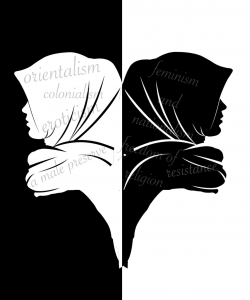
This digital media piece was inspired by the piece Unveiling Scheherezade: Feminist Orientalism in the International Alliance of Women by Charlotte Weber.  This piece, to me, was an extension of a point made in lecture this week that really struck me and stuck to me: that the role of the hijab as a form of oppression is a product of the male-dominated Muslim societies impacted by imperialism, in which such measures for women are mandated. Weber goes into this, as represented by the left half of the piece: in her argument, she discusses how males of these Muslim societies both are able to oppress women and fetishize women through such a measure, shown through the trope present in literature of women in harems wearing veils, secluded from society due to qualities they associate with women – sensuality, eroticism, and exoticism, which are represented by the some of the phrases found on the left side. Orientalism is also included as a term on this side, in response to an important point Weber made emphasizing the complicity of Western women in this fetishization of Eastern Muslim women through the perpetuation of such tropes, contributing to their oppression by these terms. This is important, as it directly addresses the Western perception that is often perpetuated that the veil itself is oppressing the women who wear it, when the more nuanced point is that it is the societal views of women in these particular societies as a result of misogyny and colonialism that causes this oppression. The right side of this piece, as a result, seeks to reclaim the hijab, allowing women who wear one to define their rationale on their own terms: as a form of resistance against global Eurocentric tendencies, as a form of religious expression and freedom, as a form of nationalism, and through reclaiming these definitions for themselves, as an expression of feminism. This is also particularly important, as it shows that Islam and feminism are not mutually exclusive.

Week 9: On the Mathnawi Style

Wednesday, April 25th, 2018

This digital collage was created as a reflection on The Conference of the Birds, a Sufi epic poem consisting of 4500 lines written in the Mathnawi style, of rhyming couplets. The overall purpose of this epic is to present through a large allegory the Sufi interpretation of the Qur’an. This is especially notable, as the artistic interpretations of the Qur’an – directly through the poeticism of The Conference of the Birds, the further exploration of this piece through other art forms such as dance – are able to encapsulate the physical and spiritual struggles of being human in a way that connects to a person’s soul. This digital piece was inspired by a couple of lines in the epic that really stood out to me:


“We are a wretched, flimsy crew at best,

And lack the bare essentials for this quest.

Our feathers and our wings, our bodies’ strength

Are quite unequal to the journey’s length;”


Followed soon after by:


“No one can bear His beauty face to face,

And for this reason, of His perfect grace,

He makes a mirror in our hearts – look there

To see Him, search your hearts with anxious care.” 


This piece highlights the individual struggles that each of the birds encapsulated, represented by the black and white, rough sketch in the middle of a worn-down bird – each of the birds in The Conference of the Birds has their own individual vices, making them wretched and flimsy. However, the community of religion, as represented by the collection of smaller birds surrounding the larger bird, allows people to explore within and seek elements of spirituality and God within themselves, as is expressed in the second paragraph – which also aligns with the overall Sufi tradition of letting go of materialism and looking within for spiritual enlightenment and a path to God.