Archive for March, 2018

Week 1: On Resistance and Social Responsibility

Tuesday, March 20th, 2018

This digital media collage was created with the idea of social responsibility as a core tenet of being Muslim in mind. This was an idea explored from the beginning of this semester, starting from Professor Asani’s interpretation of Qur’an 2:177, which calls those righteous who give away money to kin and the needy, who free their slaves, amongst other qualities. This verse emphasizes the various elements of the path to righteousness for a Muslim: faith, having a god character and participating in salat and zakat, and taking action to better society. John Renard in his work Seven Doors to Islam discusses this verse and comes to the same conclusion, highlighting the emphasis on social responsibility (pg. 12). The cultural context of any given moment in history may emphasize particular types of social engagement, so I decided to collage the symbolic raised fist of resistance with a focus on some prominent social movements of the present day: marches against the current United States political administration, especially pertaining to banning and limiting of immigration into the United States, the march for women’s rights, and the Black Lives Matter movements. All of these movements had Muslim presences in some way or another, whether it was Linda Sarsour, one of the co-chairs of the Women’s March on Washington, or Munira Ahmed, the face of resistance on posters to show that a Bangladeshi Muslim from Queens, NY is just as American as anyone else. A lot of the present day’s movements of resistance highlight the intersectionality of current social issues, intertwining issues of racism, sexism, Islamophobia and many other issues, thus highlighting the relevance of social engagement and visibility in today’s society, in order to help various marginalized populations.
Week 2: The Light and the Qur’an

Tuesday, March 20th, 2018

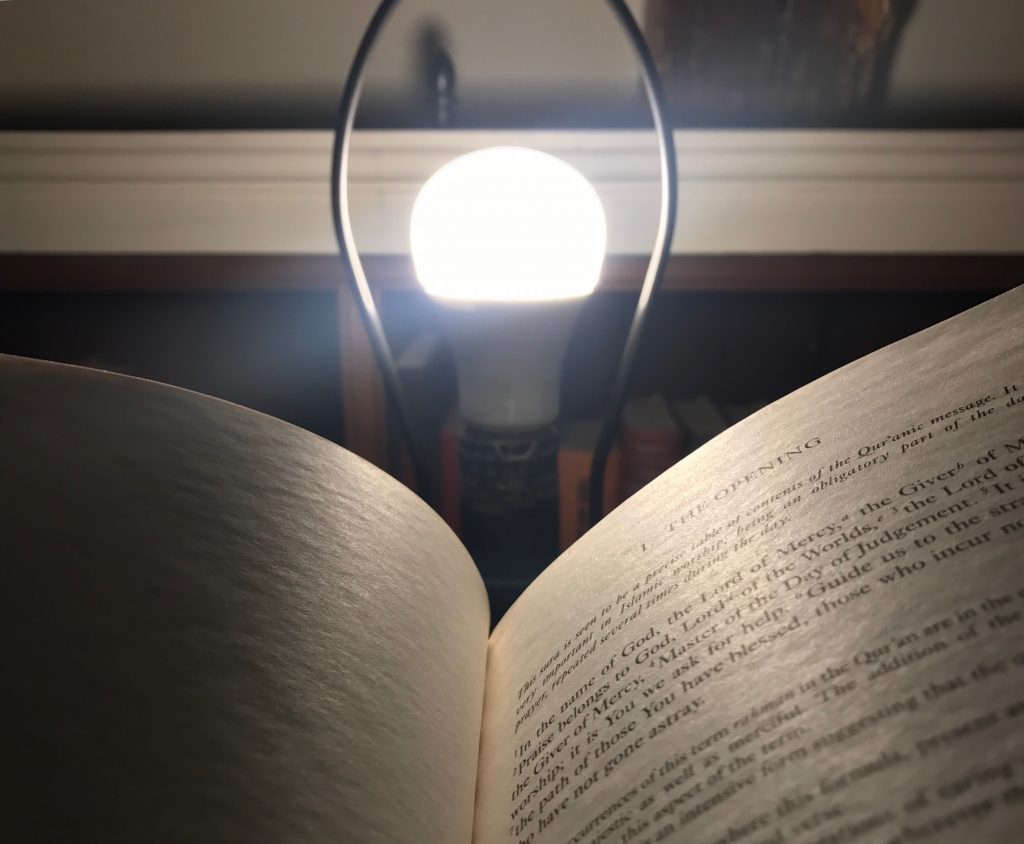
There are multiple layers of meaning to this digital photography piece, but the main idea that inspired this piece was the verse regarding light in the Qur’an: “God is the Light of the heavens and the earth; the likeness of His Light is as a niche wherein is a lamp – the lamp in a glass, the glass as if it were a glittering star –kindled from a Blessed Tree, an olive tree that is neither of the East nor of the West, whose oil well-nigh would shine even if no fire touched it; Light upon Light; God guides to His Light whom He wills. And God strikes similitudes for man, and God has knowledge of everything” (24:35).

The light in this photo is the focal point illuminating everything in the darkness surrounding it, representing the idea of the ubiquity of God in Islam as discussed in lecture. The light shines upon the other central part of the photo – a written copy of the Qur’an, which is specifically turned to the opening, Surah Al-Fatiha. This is important, as God having knowledge of everything and guiding His Light to whom He wills is represented in the revelation of this sacred scripture to Prophet Muhammad, thus connecting the idea of light and the Qur’an as it was illuminated piece by piece to the Prophet during his lifetime.

Another layer that this photo uncovers is the idea of access to the scripture and how that is illuminating – as we’ve discussed, the Qur’an was initially an oral/aural transmission in Arabic, which was how it was initially passed from person to person. Although it continues to be recited, the Qur’an’s transition to written text both created stratifications of access to the sacred text based on one’s literacy, but also increased accessibility of God’s word to people of various cultures across the world, thus introducing more people to Islam (guiding individuals to His Light through reading the text).

Week 3: On Recitations and Tears

Tuesday, March 20th, 2018

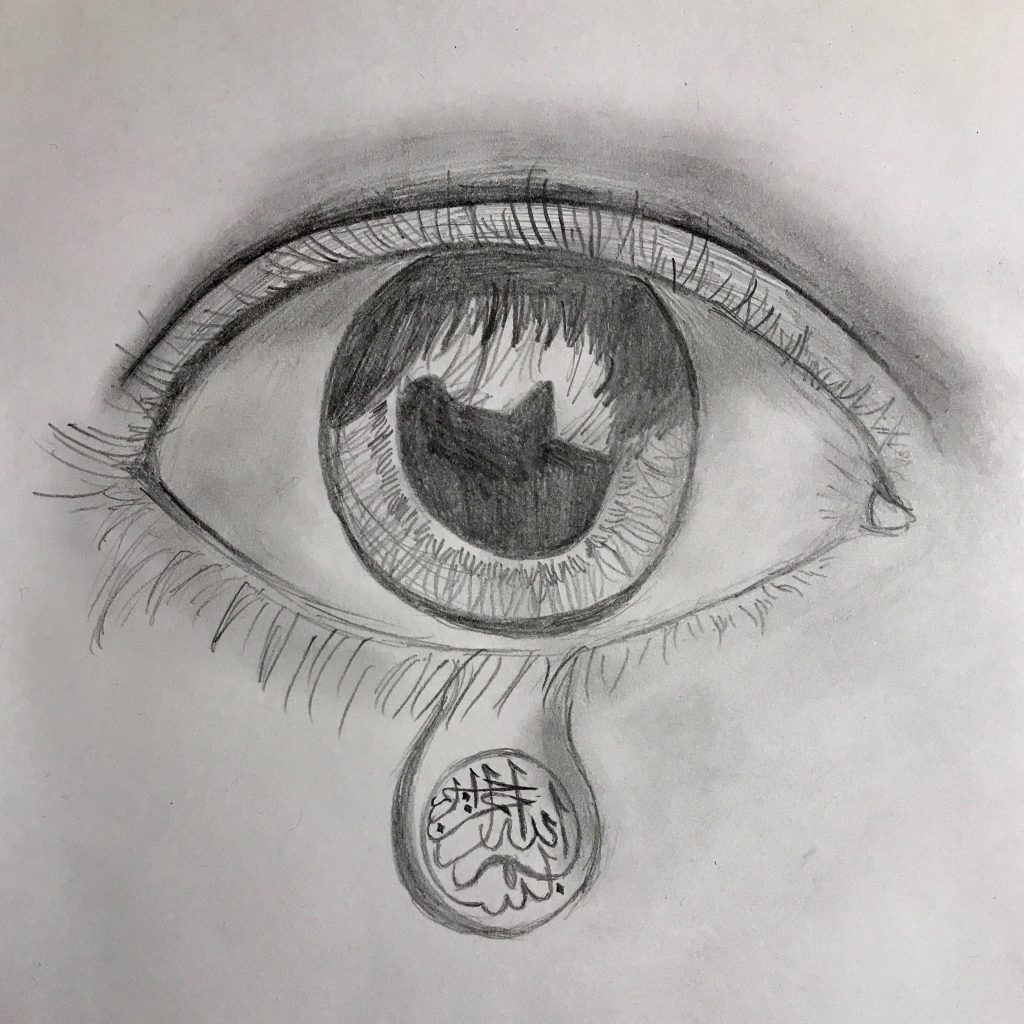
This piece was primarily inspired by Al-Ghazali’s The Recitation and Interpretation of the Qur’an, specifically the chapter that we read on the external rules of Quranic recitation. In this piece, Al-Ghazali discusses the role of weeping, even intentionally forcing oneself to weep, while reading the Qur’an as being praiseworthy, as it brings the idea of grief to the mind and makes the individual weeping consider “the threats, warnings, covenants, and promises which are contained in the Qur’an,” thus making an individual consider their own shortcomings in front of God (44). During section that week, we continued to talk about the intertwining of practicing such a ritual and organically feeling the emotions prescribed to that ritual – who says that one needs to come before the other? Perhaps a ritual can be practiced in order to forge the emotional bond between a sacred text and one individual, whereas for another, the emotional response is embodied as a physical response, thus creating the ritual. This grey zone of which aspect of a spiritual connection comes first shows how interrelated the body and the mind are in the context of religion – and that interconnectedness especially comes out in a spiritual act that is as physical of an experience as recitation. This concept is what I sought to bring out in my charcoal visual art piece – I depicted an eye with a single tear, within which is the Bismillah, the phrase recited before each surah of the Qur’an (except for the ninth). This piece connects the repetition of this phrase with the idea of weeping, thus showing the connection that can form between a spiritual idea and a physical ritual.

Hello world!

Tuesday, March 20th, 2018

Welcome to Weblogs at Harvard. This is your first post. Edit or delete it, then start blogging!