You are viewing a read-only archive of the Blogs.Harvard network. Learn more.
  • Home
  • About MESH
  • Members
  • Papers
  • Contact

Middle East Strategy at Harvard

John M. Olin Institute for Strategic Studies :: Harvard University

Feed on
Posts
Comments

‘Arab Economies in the Twenty-First Century’

Mar 16th, 2009 by MESH

MESH invites selected authors to offer original first-person statements on their new books—why and how they wrote them, and what impact they hope and expect to achieve. Paul Rivlin is senior fellow at the Moshe Dayan Center for Middle East and African Studies of Tel Aviv University. His new book is Arab Economies in the Twenty-First Century.

From Paul Rivlin
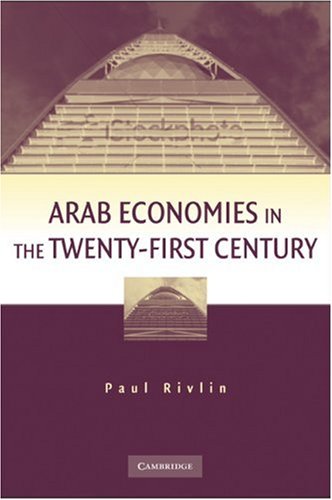
My book brings together two areas of research.

The first is an investigation into the balance between resources and needs in the Arab world. Resources can be thought of as the economy that provides the goods and services that a country requires; needs can be interpreted as the population, its age structure and growth. The reality is more complex because one of the factors of production is labor, which means that population is therefore part of supply as well as the source of demand.

The balance between supply and demand is crucially affected by changes in the age structure of the population. The proportion of those of working-age to the young and old (who do not work) in the Arab world is favorable at present and offers these countries the opportunity to develop with lower costs in terms of investment in education, health and other welfare expenditures. The working-age population is still growing more rapidly than the population as a whole, and this will continue for at least another decade. There is an increasing need for jobs, but if they are available, then more workers will be able to support relatively fewer dependents.

But over time this will change as the share of the elderly population increases, something that already presents serious challenges in Europe and Japan. Indeed, Arab population growth already has slowed in the last decade. That will push up costs and reduce the share of the population that can carry the burden.

So far, Arab countries have not taken advantage of this “demographic transition” or “demographic gift” in the way that East and Southeast Asian countries did in the 1970s and 1980s. Research has emphasized the major contribution that demographic transition made to rapid economic development in those regions. The danger is that in the Arab world, this temporary phase will pass and demographic trends will become more burdensome again.

The second area of research is part of what might be called the new economic history of the Middle East. In recent years, a number of economists and economic historians have attempted to provide new explanations for the poor economic performance of the region. They have examined religion, culture, institutions, geography, law, international relations and internal politics in ways that once were a taboo and, for some, remain so. This literature helps to provide answers to the questions that my first research area posed: why are such deep and prolonged imbalances permitted? These imbalances manifest themselves in high poverty rates, growing inequalities in income and wealth distribution, malnutrition and rates of illiteracy. Given the threats to stability that they pose, why have governments not been more effective? This book offers an explanation.

Order from Publisher | Amazon | Excerpt

Posted in Books, Demography, Economics | No Comments

Comments are closed.

  • This Site

    Middle East Strategy at Harvard (MESH) is a project of the John M. Olin Institute for Strategic Studies at Harvard University.
    • Read about MESH
    • MESH blog
    • Download entire blog (pdf)
  • Last Post

    • MESH in hibernation
  • Subscribe

    Subscribe to MESH by email Posts+Comments
    Feed Posts+Comments
    Twitter Posts+Comments
    Posts+Comments
    AddThis Feed Button
  • Search MESH

  • Posts by Category

    • Administration (5)
    • Announcements (24)
    • Countries (248)
      • Afghanistan (11)
      • Arab Gulf (11)
      • Bahrain (1)
      • Caucasus (5)
      • Central Asia (2)
      • China (3)
      • Egypt (25)
      • France (2)
      • India (1)
      • Iran (79)
      • Iraq (36)
      • Israel (95)
      • Jordan (9)
      • Lebanon (28)
      • Pakistan (8)
      • Palestinians (52)
      • Qatar (1)
      • Russia (13)
      • Saudi Arabia (14)
      • Syria (18)
      • Turkey (15)
      • United Kingdom (3)
      • Yemen (5)
    • Members (270)
      • Adam Garfinkle (22)
      • Alan Dowty (19)
      • Andrew Exum (11)
      • Barry Rubin (14)
      • Bernard Haykel (9)
      • Bruce Jentleson (6)
      • Charles Hill (3)
      • Chuck Freilich (15)
      • Daniel Byman (17)
      • David Schenker (16)
      • Gal Luft (9)
      • Harvey Sicherman (11)
      • Hillel Fradkin (8)
      • J. Scott Carpenter (15)
      • Jacqueline Newmyer (6)
      • Jon Alterman (13)
      • Josef Joffe (17)
      • Joshua Muravchik (10)
      • Mark N. Katz (22)
      • Mark T. Clark (15)
      • Mark T. Kimmitt (6)
      • Martin Kramer (25)
      • Matthew Levitt (15)
      • Michael Doran (4)
      • Michael Horowitz (9)
      • Michael Mandelbaum (12)
      • Michael Reynolds (14)
      • Michael Rubin (8)
      • Michael Young (16)
      • Michele Dunne (16)
      • Philip Carl Salzman (32)
      • Raymond Tanter (17)
      • Robert O. Freedman (20)
      • Robert Satloff (17)
      • Soner Cagaptay (4)
      • Stephen Peter Rosen (13)
      • Steven A. Cook (14)
      • Tamara Cofman Wittes (18)
      • Walter Laqueur (21)
      • Walter Reich (11)
    • Subjects (274)
      • Academe (4)
      • Books (40)
      • Counterinsurgency (14)
      • Culture (21)
      • Democracy (16)
      • Demography (5)
      • Diplomacy (20)
      • Economics (1)
      • European Union (3)
      • Geopolitics (42)
      • Hamas (21)
      • Hezbollah (25)
      • Intelligence (10)
      • Islam in West (5)
      • Islamism (16)
      • Maps (27)
      • Media (5)
      • Military (19)
      • Nuclear (27)
      • Oil and Gas (14)
      • Public Diplomacy (10)
      • Qaeda (23)
      • Sanctions (8)
      • Taliban (3)
      • Technology (2)
      • Terminology (9)
      • Terrorism (30)
      • United Nations (7)
  • Archives

    • December 2009 (5)
    • November 2009 (13)
    • October 2009 (8)
    • September 2009 (9)
    • August 2009 (9)
    • July 2009 (9)
    • June 2009 (12)
    • May 2009 (16)
    • April 2009 (11)
    • March 2009 (16)
    • February 2009 (11)
    • January 2009 (10)
    • December 2008 (12)
    • November 2008 (11)
    • October 2008 (19)
    • September 2008 (15)
    • August 2008 (17)
    • July 2008 (18)
    • June 2008 (12)
    • May 2008 (17)
    • April 2008 (20)
    • March 2008 (27)
    • February 2008 (19)
    • January 2008 (18)
    • December 2007 (19)
  • Harvard Events

    Check upcoming events from the calendars of...
    • Weatherhead Center for International Affairs
    • Center for Middle Eastern Studies (CMES)
    • Belfer Center for Science and International Affairs
  • Rights

    Copyright © 2007-2009 President and Fellows of Harvard College
    Site Meter

Theme: MistyLook by Sadish