‘The Rise of Israel’
May 12th, 2008 by MESH
MESH invites selected authors to offer original first-person statements on their new books—why and how they wrote them, and what impact they hope and expect to achieve. Jonathan Adelman is professor at the Graduate School of International Studies of the University of Denver. His new book is The Rise of Israel: A History of a Revolutionary State.
From Jonathan Adelman
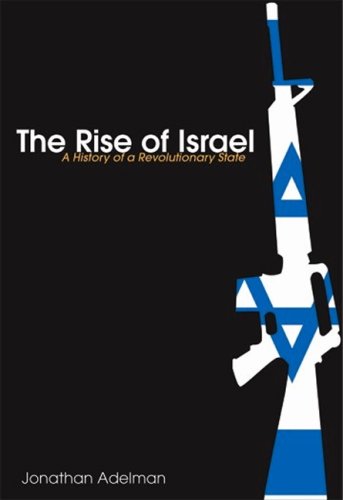 The Rise of Israel: A History of a Revolutionary State had a slightly unusual genesis. As a specialist in Russian and Chinese politics with little background in the Middle East, I never expected to write a book on the Middle East or Israel. But, after teaching at Hebrew University in 1986 and the University of Haifa in 1990, I became fascinated by Israel, how it came to exist and how it survived and flourished despite enormous obstacles.
In 1988 I was in Moscow to give a paper on the Russian civil war at the Soviet Academy of Sciences. While there I asked its deputy director, Yuri Osipyan, if there was a research unit on Israel, with which the Soviet Union did not have diplomatic relations at the time. Soon I found myself in front of a group of fifteen researchers in the Laboratory for the Study of Israel, who insistently requested I give a talk on Israel. I found myself giving an overly long talk on how Israel represented a new Russia with deep roots in its narodniki, Menshevik and even Bolshevik revolutionary traditions.
After the second intifada broke out in 2000, I became deeply involved in giving talks on Israel for various Jewish organizations across the country. As an academic who also teaches a graduate seminar in comparative revolutions, I remembered my time in Moscow and soon again saw the deep revolutionary origins of Israel. I spent several years working out a different way to view the state. Those visits to Israel and the Soviet Union in the late 1980s ultimately led to The Rise of Israel: A History of a Revolutionary State. And now, I am hard at work already on a sequel to this volume.
When I started reading the literature on Israel’s origins and causes for its successes against great obstacles, I was surprised that none of the three main camps—Arabist, post-Zionist, or (for lack of a better word) mainstream Zionist—really dealt with this question. The Arabists largely dismissed its relevance, for they saw Israel as a lackey and running dog of powerful Western imperialism. They focused on the West, not Israel, as the source of Israel’s victories and successes. The revisionist post-Zionists, focusing on Israel’s numerous (and sometimes real) sins of omission and commission, were not interested in looking at the questions that would put Israel in a positive light. The mainstream Zionists (especially of the previous generation), whom one would have expected to be interested in the question, largely saw the rise of Israel as inevitable or as a product of the reaction to the Holocaust.
I hope the book has several impacts. First, it serves to remind the reader of how Israel, with few resources, had to overcome enormous obstacles—Tsarist Russia, the Ottoman Empire, the British Empire from 1939-1949, the Soviet Union, much of the Arab world, international religious and political organizations—that none of over 130 other new states after World War Two had to face. Second, it shows how so many of the labels put on Israel, such a racist, colonialist, imperialist, Nazi-like, have little academic relevance to the topic. Third, it shows that Israel, far from being a running dog of Western imperialism or born in original sin, came into being and flourished because of its ability to originate and carry through two revolutions—first, a nationalist, democratic socialist revolution (1882-1977) and a second, incomplete semi-capitalist, globalist revolution (1977-present).
I hope thus to move the debate on Israel away from its perceived sins to one that seeks to understand the revolutionary origins of Israel. I also seek to show how the application of neo-realist theories can be used to explain Israel’s actions in a world of menacing threats, today most strongly from the Islamic Republic of Iran and its fundamentalist allies in the region.
There are over 400 books on the Israel-Palestinian dispute but very few on the nature of Israel’s rise and cause of its successes. Just as India cannot be understood solely through a focus on its dispute with Pakistan, so too Israel cannot be understood solely by a mono-focus on its dispute with the Palestinians and Islamic fundamentalism. This book, rooted in theories of comparative revolution and comparative politics, seeks to help readers to see a different Israel and gain a new perspective on a critical player in the turbulent Middle East.
 Posts+Comments
 Posts+Comments
 Posts+Comments
 Posts+Comments