Illicit money trail leads to Central Bank of Iran
May 9th, 2008 by MESH
From Raymond Tanter
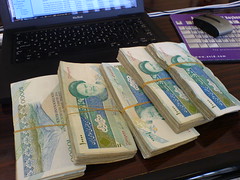 When asked why he robbed banks, Willie Sutton declared, “That’s where the money is.” Following the money trail has led to U.S. and UN sanctions on Iranian banks involved in the financing of terrorism and WMD technology purchases.
In January 2008, as I approached Hotel Parc Hyatt Paris Vendôme at 5 Rue de la Paix to hold a press conference on Tehran’s evasion of UN sanctions, I noticed that just down the street stood a Paris branch of Iran’s Bank Saderat, which has transferred millions of Euros to Hezbollah. Farther down the street is Bank Sepah, whose proliferation activities have been curtailed by UN sanctions. Indeed, Under Secretary of Treasury for Terrorism and Financial Intelligence Stuart Levey visited France in July 2007 to build consensus in Europe for removing Iranian banks from the international financial system.
Despite sanctions on banks Saderat and Sepah, Treasury has yet to sanction Iran’s Central Bank. According to Deputy Assistant Secretary for Terrorist Financing and Financial Crimes Daniel Glaser, “Another method Iranian banks use to evade controls is to ask other financial institutions to remove their names when processing transactions through the international financial system…This practice is even used by the Central Bank of Iran to facilitate transactions for sanctioned Iranian banks.” Furthermore, Glaser has said that the “From 2001 to 2006, Bank Saderat transferred $50 million from the Central Bank of Iran through its subsidiary in London to its branch in Beirut for the benefit of Hezbollah fronts in Lebanon that support acts of violence.”
Consistent with Glaser’s testimony, information obtained during Iran Policy Committee research on Iran’s opposition parliament-in-exile—the National Council of Resistance of Iran—indicates that Ebrahim Sheibani, a former head of Iran’s Central Bank, is a senior member of Tehran’s task force to evade sanctions. Also, the IPC has learned that Iran’s Central Bank pays Bank Keshavarzi (Agriculture Bank) and Bank Refah to set up banks abroad as middlemen for Bank Sepah to make illicit financial transactions for Iran’s Ministry of Defense.
Because of such illicit activities, Treasury’s Financial Crimes Enforcement Network has advised U.S. banks to be cautious of the Central Bank of Iran, which is using deception to mask involvement in nuclear proliferation and terrorism. But, the governor of the Central Bank has said he is “proud” the Central Bank has helped other Iranian banks with financial commitments, “regardless of the pressures on them.”
At issue is whether such pressures are enough. Treasury has been incrementally ratcheting up sanctions against Iranian financial institutions. So far, sanctions have made the international financial system an increasingly difficult environment for Iran to conduct illicit transactions in support of terrorism and pursuit of nuclear weapons. But the Central Bank governor’s comments suggest that such pressures are insufficient, given the role the Central Bank is playing in evading sanctions.
When asked why the Central Bank of Iran has not been sanctioned, Glaser told the U.S. House of Representatives Foreign Affairs Committee, “Taking action against the Central Bank of Iran is an extraordinary step. It is certainly something that is within our toolbox.” In response to Glaser’s testimony, California Democrat Brad Sherman, chairman of the Foreign Affairs Subcommittee on Terrorism, Nonproliferation, and Trade, said, “In effect, he’s [Central Bank of Iran governor] announced that his Central Bank is helping other banks evade the various sanctions that you’ve [Glaser] applied.”
The words of Iran’s Central Bank governor and Treasury’s own warning to U.S. banks strongly suggest that the Central Bank of Iran should be next on Treasury’s list for sanction. To be sure, as much as Banks Saderat and Sepah, the Central Bank “is where the money is” when it comes to terrorist financing and purchasing nuclear weapons technology.
 Posts+Comments
 Posts+Comments
 Posts+Comments
 Posts+Comments