Harvard Extension School ALM in Management vs. full-time MBA

(Updated) I received an email from a prospective student asking about the Harvard Extension School’s ALM in Management program. He wanted me to compare the ALM in Management vs. a full-time MBA.

In my reply, I noted that I have never taken any ALM in Management classes. My ALM concentration was history. But I have followed the Management program since it was introduced and have a full-time MBA under my belt, and feel qualified to make some comparisons.

Harvard Extension School ALM in Management vs. MBA: Where the programs differ

From my point of view, while the ALM in Management has a price that’s hard to beat, it does not compare with a full-time MBA. Here’s where I think the ALM in Management program comes up short:

  1. There is no cohort experience, vital for building a network that can serve you long after after the program concludes. The Extension School has made some moves to boost the sense of community and establish limited cohorts, a positive step.
  2. Even though many of the classes are similar to those you would find in a business school, the ALM in Management degree is technically not an MBA. It’s a liberal arts degree in management (!). This fact may cause skepticism among some potential employers.
  3. Many instructors are not Harvard faculty, and there is no affiliation with the world-famous Harvard Business School (however, HBS faculty are now apparently allowed to teach HES courses, see below).
  4. While online classes are a lot of work for students, they are not a substitute for in-person learning experiences. Extension School students have complained about some of the deficiencies in the past.
  5. Some recruiters view any part-time business degree with skepticism.
  6. Among recruiters, the reputation of the school has been damaged by HES graduates who have omitted their Extension School background on their resumes. In some cases graduates have innocently followed the Harvard Extension School resume guidelines, but in many cases there have been deliberate attempts to portray themselves as graduates with a Harvard MBA or Harvard College degree.

In other words, it’s a mistake to assume the ALMM is like a Harvard MBA lite. That said, I think there is real value in some of the on-campus classes that expose students to important business concepts. There are takeaways that can be brought back to the workplace, or help students shift their careers in a new direction. For students who cannot enroll in a full-time MBA program, ALM in Management classes are an attractive alternative.

2020 Update: At one time the ALM Management faculty list did not have any faculty with Harvard Business School affiliations, but that has now changed, as the example below demonstrates. It’s a great development, and an opportunity for ALM Management students to study under HBS faculty.

V.G. Narayanan is the Thomas D. Casserly, Jr., Professor of Business Administration and has been teaching accounting at Harvard Business School

See also: Harvard Extension School success stories from the past year


The Startup Roller Coaster

In 2010, I heard a talk by angel investor and entrepreneur Howard Anderson about the emotional roller coaster that comes comes with launching a new technology venture. He explained how the highs are so high, while the lows feel really low.

For those of us in the room who had never been in the position of launching a company, it didn’t sound surprising. Of course the pressure will be intense, and incredibly risky. But how extreme could the highs and lows be?

Extremely extreme, as it turns out.

I worked in large organizations for more than a decade. A bad day at an established company might entail sharp-elbowed office politics, hurt feelings, and worry about career advancement or a raise. Worst cases involved the loss of a job. But in most situations at a large company, problems will eventually be worked out. Everyone knows the organization will endure.

Startup Roller CoasterNot so at a startup. Before you’re funded or generate revenue, the venture is fragile. Things move fast, there is too much to do, and the sense of responsibility is huge. Even minor problems feel big, and failure of the business can take many forms.

Conversely, the accomplishments feel huge. Hard work, a new product out the door, positive feedback from customers (or, in the case of my company, readers), and lucky breaks can really boost your spirits. When a bunch of things are working well at the same time, the feeling is spectacular.

Then the crash: reality checks, unforeseen problems, pushback, lack of alignment, and the flat-out “no” when you were hoping for a “yes.” These and other issues can really throw a wrench in the works.

There are ways out of the funk, though. Keep on executing. Work through or around the problems. Reach out to your partners or customers or mentors or anyone who might be able to help with a new approach or pivot. The wins begin to trickle back, and the cycle starts again.

A few years ago, I met an experienced startup founder at the Cambridge Innovation Center. She was very familiar with the entrepreneurial roller coaster, and offered some advice on how to handle it.

Highs and lows on the startup roller coaster

“For the highs and lows, be careful of what you do on those days,” she said. For instance, on a good day when you get a big win like recruiting a customer, call your investors and tell them about it.

She also alluded to things founders should not do on the bad days. She didn’t have enough time to explain what they were (it was at the end of a late-night meeting) but one of them I have been able to deduce from multiple sources (including Y Combinator founder Paul Graham), as well as Howard Anderson’s reminder at the end of his talk: “It’s always darkest before the dawn,” he said.

In other words, keep pressing ahead, even when the world seems to be working against you. And don’t give up.

The above image is a creative commons licensed image from Tanki on Flickr.

Brazil’s SEED startup accelerator, and an opportunity for foreign startups

If I were 20 years younger, and not already dedicated to my publishing company, I would be all over this. The Minas Gerais State Government in Brazil (home of the local startup hub known as San Pedro Valley) has set up an accelerator program that is open to local or foreign startups. For teams that are accepted to SEED, the program provides living expenses, co-working space, startup capital (equity free!), and support for staying in Brazil (the announcement doesn’t state what the support is, but hopefully it involves helping with visas and other bureaucracy).

There is a deadline coming up October 17 for the next program, but there is also a late December deadline for the following session. Details are located on the official SEED website, but here are the most important elements from the announcement (I’ve also added the official infographic to the bottom of this post):

Seed capital, equity free, for each startup varies, approximately, between US$ 35,000.00 (for projects with two participants) and US$ 40,000.00 (for projects with three participants). Part will be transferred as monthly scholarships of US$ 1,000.00 for each project participant, to cover living expenses and guarantee exclusive dedication to their business while participating in the program. The remainder US$ 22,000.00 will be transferred to fund a high-potential prototype or a releasable version of a product or service.
SEED offers too exclusive mentoring program; an inspiring co-working space and connection to a global community of entrepreneurs.

Who can apply?
Participants must be 18 years or older, Brazilian or foreigners in condition to stay in Brazil for duration of the program (SEED will assist all foreign participants in meeting this condition). During their participation in the program, entrepreneurs must be willing to live in Belo Horizonte, contributing to develop the local startup ecosystem.

Startups can be from anywhere in the world and must be in an early stage, that is, planning or developing a high-potential prototype or a releasable version of a product or service

As I stated at the beginning of this post, if I were 20 years younger, I would apply in a heartbeat — and not just because Brazil and Brazilian people are so special. The financial support (no equity!) is important, as is the “cohort” experience of being with other like-minded startups from all over the world. But there’s something else: Living in a foreign country is not only a rewarding personal experience, it allows you to focus on activities and goals without the distractions and expectations of one’s home country. I spent most of my 20s living abroad, and was able to make connections and accomplish projects that never would have been possible if I had remained in Boston.

As it is, I am older now, and have a wife and school-aged kids and other obligations that prevent me from relocating to Brazil. In addition, while my In 30 Minutes venture leverages a number of e-publishing technologies to produce a Dropbox guide, a book that explains what Google Drive is used for, and the most recent release Twitter In 30 Minutes, it is not a pure tech startup, which is what SEED appears to be looking for.

SEED startup accelerator: Basic facts

The official SEED infographic contains more details:

Brazil SEED accelerator

Why it took so long to release Twitter In 30 Minutes

At the beginning of this month, I released a new In 30 Minutes guide that explains what is Twitter and how to use it. Some people who have been following my story over the past year may wonder why it took so long to release Twitter In 30 Minutes — after all, the series has covered popular Web and mobile services since the beginning, and Twitter is one of the most popular services of all. Why not write it sooner? But I have my reasons, and this post explains some of the thinking behind the timing for this particular title.

Twitter In 30 MinutesI have considered the idea of doing Twitter In 30 Minutes since the early success of the In 30 Minutes guide for Dropbox in the summer of 2012. It was clear there was a marketplace need for titles that quickly and clearly explained consumer-oriented online software. In addition, a guide to Twitter would not be hard for me to write — I have been using the social network since the early days (2007, to be precise) and have a solid level of domain knowledge.

Learning from an earlier In 30 Minutes book

But a few other factors held me back. The first was the lackluster release of Excel Basics In 30 Minutes in late 2012. It was a hard title to write, and it flopped upon release.

I did a lot of experimentation with pricing and positioning of the guide, but it took a long time before I was able to get much sales traction. Why? It seemed like a perfect candidate — the software is complicated, and there are millions of people who need to learn how to use it. But on Amazon there are about 100 other titles that explain how to use Excel, and many of them target specific versions. It was therefore very hard to stand out in the crowd with Excel Basics In 30 Minutes. I foresaw a similar problem with a guide to Twitter. In the Kindle store in particular, there are dozens of “how to use Twitter” guides, which makes it much harder to stand out.

Another issue that crossed my mind: Was Twitter so easy to figure out, that few people would actually need a guide? Compared to Dropbox and Google Drive, Twitter is a cinch to start using. But I also knew that many people who started using Twitter stopped shortly after for a variety of reasons. One Harvard Business School case I read claimed Twitter’s retention rate in the late 2000s was just about 25% after the first month. The rest gave up, many never to return. That meant lots of people could be coached on techniques that would keep them interested and engaged.

A couple of other factors pushed me to consider bringing Twitter In 30 Minutes to market.

  • Readers of other In 30 Minutes titles began asking me for a guide to Twitter.
  • LinkedIn In 30 Minutes, released in May 2013, was a breakout success

LinkedIn In 30 Minutes was an interesting case. Even though it was entering a crowded market (there are dozens of LinkedIn guides on Amazon), it did manage to have strong sales right out of the gate. This was in large part because of creative and sustained marketing efforts on the part of author Melanie Pinola and myself. In addition, it was written by someone who I knew was a strong writer and more of expert on LinkedIn than I.

Based on the success of the LinkedIn title, I began asking contacts, bloggers, and other writers to see if any were interested in taking on Twitter In 30 Minutes. When that did not work, I considered just hiring someone out. But I was worried about quality issues and costs. Eventually, I decided to do it my own. Now I am asking myself if it’s time to create Facebook In 30 Minutes.

If you’re interested in learning more about Twitter In 30 Minutes, check out the table of contents and the options to buy the guide for paperback, Kindle, iPad, PDF, and other formats.

CIC Cambridge: A review of the local startup hive that most locals have never heard of

The Cambridge Innovation Center is a startup office space located at One Broadway, just around the corner from the Kendall Square T station and across the street from MIT Sloan. Few people in Cambridge and Boston have ever heard of CIC Cambridge, but it plays a very important role in the local startup ecosystem, as I will discuss in this post.

I spent a fair amount of time in the CIC from 2011 to 2012, and still go back on a regular basis to meet people or take part in seminars that help me run my business. I am not an insider or expert on the CIC, but as a participant in the local startup scene, I have written a CIC Cambridge review which others may find useful.

Famous CIC Cambridge alumni include Carbonite and Hubspot. But most of the hundreds of CIC startups are still in the relatively early stages of their existence. Almost all have some sort of technology focus or angle, although there are many companies that provide services (such as law firms) as well as investors with offices in the building.

CIC Cambridge review - the C3 area
CIC Cambridge

Some startups are no more than a cubby and red belongings bag in the Cambridge Co-working Center (C3), the CIC’s low-cost co-working space. In 2011, C3 cost $250/month, which included random desk space, wifi, access to conference rooms and printers, free coffee and snacks, etc. I’ve heard it’s gone up. Regardless, this is an attractive option for companies with little funding or revenue. It’s not uncommon to see practically every seat in the C3 areas occupied on a typical afternoon, and the work continues there well into the morning hours.

Established companies with funding, customers and revenue have their own offices in the building. Some are quite small. I’ve been in a CIC office that is no more than a tiny, 30-foot-square room with a desk and some shelves. Others have larger spaces with lobbies and their own conference rooms.

There is a fair amount of churn at CIC Cambridge. Walking around the lower floors, it seems that there’s always someone moving in or out. That’s to be expected. Startups are inherently risky, and many of the C3 companies may not make it past the idea or early prototype stage. For those that do, they will eventually outgrow C3. Upgrading to a larger CIC office is an option, but if they grow big enough they will eventually have to find larger (or cheaper) office space elsewhere.

Events at CIC Cambridge

CIC events are worth mentioning. Venture Cafe is well-known in the local entrepreneurial community. It’s held on the 4th-floor of the CIC on a regular basis (usually on a Thursday afternoon). It’s a great place to network as well as access expertise and investors.

Besides the Venture Cafe, there are many other events held in the CIC for founders and people interested in starting their own companies. I’ve derived a ton of value from the free seminars organized by McCarter & English, a law firm that serves the startup and investment communities and has an office in the CIC. The speakers are all pros. I’ve attended talks on seed-stage funding, accounting for startups, and a great session on startup marketing featuring Bobbie Carlton, the founder of Mass Innovation Nights.

While the CIC is just part of the startup ecosystem in Cambridge, it’s an important part. We’ve found it to be an excellent place to start entrepreneurial efforts and make connections that will help sustain new enterprises. The CIC blog gives a feel for the character of the organization, activities, and some of the startups and founders that are based there. You can find out more about the CIC at its website and learn more about the history of the CIC on Xconomy.

Harvard Extension School résumé guidelines are bogus

If you are a graduate of the Harvard Extension School, how should you list this accomplishment on your résumé, or on LinkedIn?

That’s easy. You type “Harvard Extension School” in the place where the university name is supposed to go. For the degree name, write out “Bachelor of Liberal Arts” or “Master of Liberal Arts”, or type the official designation, ALB or ALM. Then add “Museum Studies”, “History”, “Biology”, “Information Technology”, “Management”, or other concentration in the place where the field of study is listed.

Simple, right? It clearly identifies the school you attended, the degree you received, and what you studied.

However, for some Harvard Extension School graduates, it is not so simple. For evidence of this, take a look at this comment on a recent Atlantic essay about the Extension School:

I have a master’s degree from Harvard obtained through the HES. My diploma says Harvard University (in latin no less). I have had headhunters and recruiters question me on it and state that it was misleading for me to list Harvard University as my school. My diploma says Harvard University, my classes were all taken on campus at Harvard (before online classes were popular), so many had to be taught by Harvard professors and not instructors, I completed all the degree requirements. I don’t see anything misleading and I don’t know how else to list it on my resume.

The headhunters are right. It is misleading. Every student and alumnus at Harvard identifies with the school he or she is affiliated with. Harvard Medical School students will tell people they go to the Harvard Medical School, or “the Med school.” Harvard Business School students identify with the “B-school” or HBS. Law School. Divinity. Ed school. Kennedy school. And so on.

To outsiders, things are a bit different. “Harvard” or “Harvard University” is synonymous with “Harvard College” in the eyes of the public, and many people in the corporate world. At the graduate level, “Harvard University” is associated with the Graduate School of Arts & Sciences programs that lead to MAs and PhDs. The Extension School is very different than the College or the advanced programs in GSAS.

As for the comment that she doesn’t know how to list the name of her school on her resume, why not list “Harvard Extension School”?

This question gets to the heart of the identity issue. Some graduates don’t want to admit they attended the Harvard Extension School – even though Harvard Extension School transcripts enable some graduates to take up advanced study at Harvard, Oxford, and elsewhere, other Extension School graduates deliberately take advantage of the “Harvard University” umbrella to mislead people into thinking they attended highly selective College or GSAS programs. Indeed, every few years in The Crimson there are reports of Extension School students (matriculated or not) insinuating or outright claiming to be College students to other people at Harvard. It happens all the time.

But there’s another possibility: The Extension School tells its graduates that it’s actually OK to use “Harvard University” as long as graduates also include the bogus “in Extension Studies” designation when spelling out the name of the degree (NOTE: The guidelines changed in 2014; please see the update at the bottom of this post):
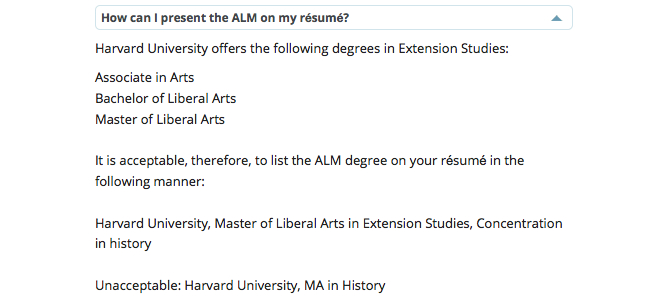
Harvard Extension School Resume Guidelines

No one at the Harvard Extension School majors in “Extension Studies”, so why do we have to state this on our résumés? The only reason I can think of is to compensate for the misleading use of “Harvard University”. But if you are clearly stating the name of the school (e.g., Harvard Extension School) instead of “Harvard University” there is no need to add this inaccurate and demeaning qualifier to the name of the degree.

The requirement to use “in Extension Studies” can cause real problems, as one ALB graduate found out a few years ago and described on a now defunct online Extension School forum:

Want to add my 5 cents to the problem. I graduate with ALB in 2014; currently enrolled in ALM, Software Engineering.

For the last 6 months I’ve been looking for jobs in the US (I’m a remote foreign student). HES doesn’t provide student visas for foreign students, so it was already a challenge to find companies that would even consider interviewing someone with a US degree, but without a temporary permit to work after graduation (so called OPT). I was aware of that from the very beginning, but didn’t expect to that so few companies actually work with foreigners without experience. In case you’re interested, I didn’t get a single offer in Boston even though I tried really hard to move there. Luckily NYC and San Francisco were much more visa-friendly cities.

After I found a couple of companies who were ready to interview despite the required visa sponsorship and almost lack of experience, I had to explain “liberal” part of the degree name (nobody actually paid attention to “Extension School” words). It wasn’t too bad since most HRs and engineers I talked to were more interested in my actual knowledge and whether I can confirm that I know the things I listed in my resume. Liberal/extension “flaw” wasn’t much of a concern for them (including big companies, e.x. Google, Microsoft). And I personally felt fine about that since my program of study really wasn’t that rigorous compared to the college one (I skipped a couple of math classes that I wasn’t interested in).

However, after I got a job offer and started to work with the lawyers the real troubles came into play. The degree officially says “in extension studies” rather than “in Computer Science” whereas the transcripts specify concentration (sciences), field of study (computer science) and a minor (thesis/research). The lawyers immediately saw an inconsistency between transcripts and the diploma. For a couple of days I was explaining to them how HES works, provided links to the web site and even contacts of HES admission office for further inquiries. In the end, my attorney said that they’ll have to send my degree for special evaluation to confirm Computer Science concentration because the transcripts specify one thing and the diploma a different one.

I’m sure it will all work out and I’ll get an additional paper from some evaluation service that will confirm that my degree is a real computer science degree, but Harvard should feel embarrasses that lawyers have to send a degree from Harvard with transcripts to verify the field of study mentioned in the transcripts.

In short, I don’t complain about “liberal” arts or requirement to specify Extension School in my resume and about frankly explaining to employers what school I attended and why. I slightly object the lack of F1 support because that wasn’t the case before 2009. However, I strongly feel that the degree conferred in Harvard Yard in Tercentenary Theatre with all other Harvard diplomas should not be a subject for any additional verification or legal doubts.

This young student is absolutely right. There should not be any doubt or questioning about the degree he received, yet he was subjected to something that graduates from other Harvard schools would never experience. Three stupid words — “In Extension Studies” — threatened his ability to work at a job that he was otherwise qualified to do. (Note, however, that some Harvard Extension School grads have been able to get jobs at major tech companies, such as this ALB grad who got hired by Google).

A convenient excuse

Of the Extension School graduates who do state “Harvard University” on their resumes and LinkedIn profiles, most leave out the required “In Extension Studies” label that the Extension School demands. Their argument: “Harvard Extension School is one of the 13 degree-granting schools, therefore I have the right to use ‘Harvard University’.” It’s a convenient excuse that lets them sidestep the stigma and questions from colleagues and recruiters. The comment above as well as many of the responses to this blog post reflect this attitude.

There is an exception to the official Harvard Extension School résumé guidelines: People who have completed the ALM in Management (ALMM) program are supposed to use “Harvard University” and “Extension School”, but not “In Extension Studies”. Here’s the screen shot from the current Extension School website (NOTE: this is no longer accurate, see 2020 note at the bottom of this post):

Harvard Extension School ALM Management resume guidelines

Why this exception? My guess is the Harvard Business School got tired of fakers running around suggesting that they had completed the Harvard MBA program …. or the Extension School wanted to avoid friction with the B-School.

The Old Guidelines Were Bogus, Too

It should be noted that the guidelines have changed several times since I started the original Harvard Extension blog. For instance, the 2008 website’s official resume guidelines did not require “Extension Studies” or “Extension School” anywhere:
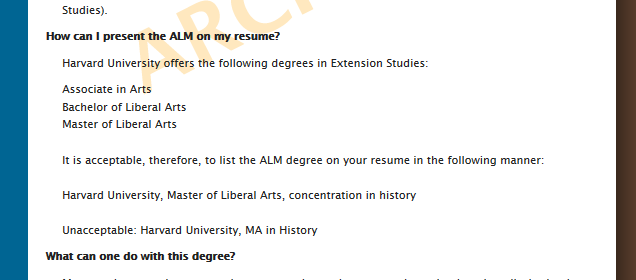
old Harvard Extension School resume guidelines

I never followed those guidelines, either. I felt “Harvard University, Master of Liberal Arts, Concentration In History” was misleading and not representative of the degree that I earned through the Extension School. It could easily be confused with a Harvard GSAS degree. I have always used “Harvard Extension School” on my LinkedIn profile and paper versions of my resume, and clearly state this fact on this blog and elsewhere.

Bottom line:

  1. Be proud of your school. As anyone who has completed the ALB or ALM programs know, it requires years of dedicated study and some extremely challenging academic requirements, from the Harvard Extension School admissions requirements to the ALM graduate thesis. People who take online classes have it even harder, as there are no nearby students to turn to for support and it’s often impossible to ask questions during class or interact with faculty.
  2. The Extension School’s official guidelines obfuscate the degree and serve no one except for those graduates who want to claim “Harvard” on their resumes while avoiding the actual name of the school (no longer true since the Extension School updated its guidelines to allow “Harvard University Extension School” while dropping “in Extension Studies”).
  3. If you insist on using “Harvard University” on your resume while knowing that most people reading it will assume it refers to Harvard College or GSAS, you’re either fooling yourself or are deliberately misleading people. When people find out, it not only makes you look bad, it reflects badly on all of us.
  4. Be clear about where you attended school at Harvard, and be clear about what you studied. People expect it, and it’s the right thing to do.

2014 Update: A comment on this post in October 2014 alerted me to the change in the official guidelines. The school now allows two methods of listing your Extension School degree on your resume:

  1. Bachelor [or Master] of Liberal Arts, Harvard University Extension School. Include concentration or field of study, minor, and degree honors when applicable.

  2. Bachelor [or Master] of Liberal Arts, Extension Studies, Harvard University

Clearly the school wants alumni to include “Extension” somewhere in the listing.

2019 Update 1: Another comment on this post notes that the guidelines have changed yet again. Now, the concentration is removed:

On your résumé, the degree name may be listed as either:

Bachelor [or Master] of Liberal Arts, Harvard University Extension School.
Bachelor [or Master] of Liberal Arts, Extension Studies, Harvard University.

But “Extension” is clearly stated in both cases.

2019 Update 2: An Extension School fan/follower says he received via email the following clarification from the Extension School regarding how to list degrees on resumes/CVs, which follows the 2014 guidelines:
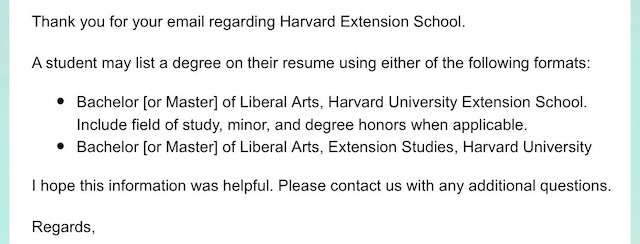
Harvard Extension degree listing via Jay Waters 052219

However, as of May 22, 2019, the Extension School website still shows this:
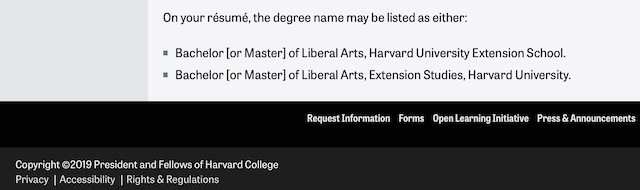
Harvard Extension School resume listing May 2019

Meaning anyone who reviews the official Harvard Extension School guidelines on the Extension School website will still think it’s not OK to list the concentration. That is, it’s either “in Extension Studies,” or nothing.

As someone noted on Twitter, “It’s absurd to think it’s unethical to mention your concentration or field of study on your resume.”

2019 Update #3: The Harvard Extension School has reverted the language back to 2014, thanks to a persistent supporter and (I suspect) Dean Huntington Lambert being tagged in a Twitter thread about the issue. First, what the site now says:
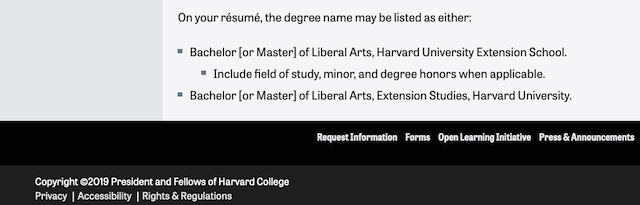
Harvard Extension School diploma listing

Second, the context as explained in an email to a Harvard Extension supporter:
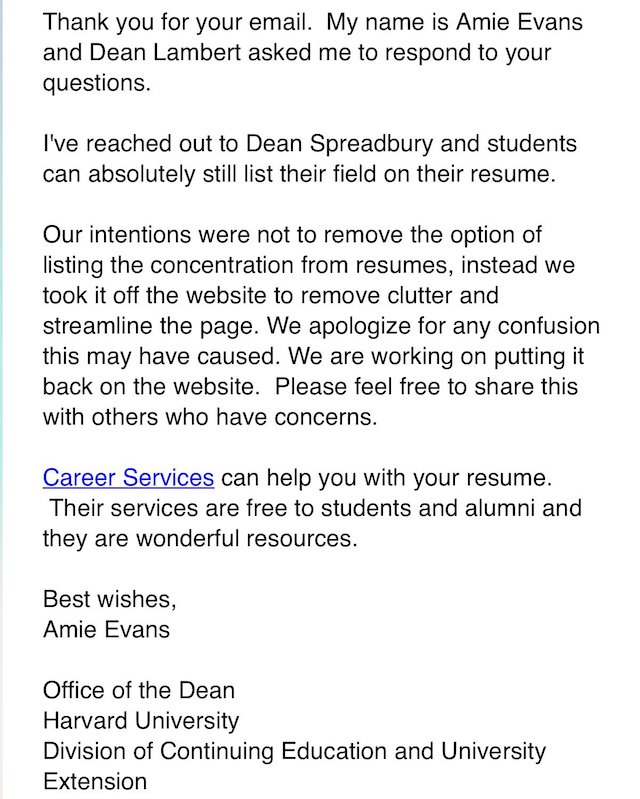
Resumes are important to HES alums and new grads, and it seem amazing that the web page explaining the official resume guidelines would be treated so cavalierly. I give credit to Lambert and his staff for quickly correcting this oversight, but it also makes me wonder what else has been stripped away from the official Extension School website in order to “reduce clutter.”

2020 Update: A comment by Laura alerted me to the fact that the official resume guidelines for ALM Management degrees are now grouped with the guidelines for other Harvard Extension School degrees.

See also:


MDP: Minimum Delightful Product

Minimum Viable Product, or “MVP”, is a startup buzzword that is actually a powerful concept for product development. It basically means creating a product that has just enough functionality for early customers to use, and helps guide future development. It greatly shortens feedback loops and can help companies avoid investing huge amounts of resources designing more complex products or features that customers don’t want. Building an MVP is a central part of the “lean startup” approach espoused by Eric Ries and others, and is used by startups and even larger companies to build Web, mobile, PC, and enterprise software. This post is about a variation known as MDP, or Minimum Delightful Product.

I first heard about this interesting twist on MVP from startup veteran and marketing guru Adam Berrey. In a 2011 email about a consumer app my company was developing, I mentioned MVP. He noted the importance of design and user experience (UX):

“For consumer apps, I like to think about ‘minimally delightful product (MDP)’ instead of MVP. The reason for this is that in the consumer world ‘viable’ isn’t really compelling. It’s like someone in the ICU. They are alive, but not really fun to hang out with. Create a product with just enough features (lean) and the right UX to be delightful, and you’ll capture the passion of consumer users.”

Taking a prototype from MVP to MDP

Adam’s idea resonated with me — imagine taking the UX to the next level in an MDP. It might take extra time, but there would be a payoff in terms of better adoption rates for the new product, which translates to more plentiful and more accurate feedback and usage data. MDP lets people get past potential qualms about simple UX or amateur design elements, and spend more time on the products features. These experiences can help founders identify what needs to be improved or jettisoned for the next version.

MDP can also result in better word-of-mouth loops, both online and off. I once heard Mint founder Aaron Patzer talk about the launch of the personal finance tracking website, and how paying attention early on to UX and design elements like fonts, the number of screens and even the name of the service led to viral growth as users told their friends about the service. Marc Hedlund, the CEO of Mint competitor Wesabe, acknowledged that this factor contributed to Mint’s success … and Wesabe’s eventual demise:

“Mint focused on making the user do almost no work at all, by automatically editing and categorizing their data, reducing the number of fields in their signup form, and giving them immediate gratification as soon as they possibly could; we completely sucked at all of that. … It was far easier to have a good experience on Mint, and that good experience came far more quickly.”

Naturally, getting to “delightful” may be a challenge. Design and UX choices can be complicated. They can also be very subjective — what appeals to one group of users may not work with others.

MDP examples: Bikes to books

MDP Minimum Delightful Product example for a mobile app
MDP example

For my old company, we employed MDP in early versions of our product, which was a classified app. People loved it. It looked better in the app store, which resulted in more downloads. The app also had engagement rates that were well above the norm — something like 20% of users were still using the app a month or two after downloading it, and average session times were several minutes long.
<!–
Dropbox Guide
–>
I also used the MDP concept for my second startup, In 30 Minutes guides. While I employed an “MVP” to test the idea (a Dropbox book in ebook and paperback formats) I quickly swapped out my amateur cover for a professionally designed cover, which resulted in more sales and a brand identity that I am still using today.

Update: Adam Berrey, the marketing expert who coined the phrase “Minimum Delightful Product”, has since written his own blog post elaborating on the MDP concept.

Positioning: A powerful marketing concept (with some limitations)

A few years ago, I picked up Positioning: The Battle for Your Mind, by Al Ries (with Jack Trout). It’s a quick read, and an old book (it was written in the 1980s, and based on a series of articles for Advertising Age that date from the early ’70s) but it was recommended by Lean Startup practitioner Ash Maurya, author of Running Lean. When I began writing books, I used some of the ideas in Positioning to position Dropbox In 30 Minutes as well as a second guide that is like a Google Docs for Dummies alternative. But it wasn’t just the technical topics that appealed to people — I actually created a series of guidebooks that can be read in 30 minutes. I learned from customers that this “positioning” is very compelling. It’s worth digging into the concept to learn how it can be applied elsewhere, while keeping in mind that there are some limitations.

Positioning, by Jack Ries with Al Trout

Summary of Positioning by Ries and Trout

Positioning starts with several compelling premises. First, we are constantly bombarded with marketing messages. “We have become the world’s first overcommunicated society,” Ries writes. “Each year, we send more and receive less.” As a result of the huge volume of marketing messages, advertising is like a “very light fog that envelops your prospects.” Note this was written long before the advent of the World Wide Web and mobile phones!Beyond the challenge of getting noticed, is the issue of convincing people to believe in the messaging. According to Ries, this is where many companies make a big mistake — trying to change audiences’ minds that their products are better than the market leaders.

“Were the average consumer rational instead of emotional, there would be no need for advertising,” Ries says. The reasoning here: Customers would gravitate toward better-quality products, regardless of who produced them or how they were marketed.

Of course, that’s not what happens — people tend to gravitate toward the familiar brands and products at the “top of the ladder” for each product category. And knocking the market leader off that ladder with claims about quality is nearly impossible.

Therefore, according to Ries, it makes sense to work with what customers already know. Strategy should be built from the perspective of the “prospect”, rather than the perspective of the company (and the ego of company executives). Often, this involves finding the hole that the market leaders have neglected or don’t serve well.

These are the concepts that lie at the heart of Ries’ and Trout’s thesis, and they use many case studies and examples to illustrate the companies, brands, and products that have successfully positioned themselves in the mind of the consumer. Consider these examples from decades past, and the holes that they filled:

  • 7-Up: “Uncola”
  • VW Bug: “Think Small”

In the first example, 7-Up was introduced to a market which associated “soda” with “cola”. It filled a hole for people who wanted something other than cola, which was at the top of the sweetened carbonated beverage ladder. The original VW Bug couldn’t compete with what drivers saw in the size and power of cars from Detroit, so its marketers sidestepped those issues and concentrated on the hole that Detroit had neglected — small vehicles, which have their own advantages in the minds of the prospect: price, parking, fuel use, etc.

Other marketing strategies in Positioning

There are other strategies Ries mentions in Positioning. One involves invoking other successful products. One clever example involved positioning Jamaica as “The Hawaii of the Caribbean.” It’s a great line, but it apparently fell victim to micromanagement at the highest levels of Jamaica’s government.

However, I had to question other parts of Positioning. For instance, Ries spent a lot of time discussing the importance of of having the right name. Some of this makes sense, such as the example he used of “Hog Island” being a poor choice for a tropical resort until it was renamed “Paradise Island.”

But should companies completely avoid “coined names” like Coca-Cola? I think the jury is still out on this one. Ries states that it’s “dangerous” to have “mean-nothing” names, and it only seems to work when the product is first-to-market, like Xerox. But in the digital age, we have seen a slew of successful companies and products that have obscure or semi-relevant names (Google and Google Docs, Apple and the iPod, Nintendo and the Wii, etc.) None were first-to-market in their respective categories, yet all have been runaway successes.

On the other hand, some people in the digital realm are still firm believers in using easy-to-remember and easy-to-spell names. At a conference a few years ago, I heard Mint cofounder Aaron Patzer talk about spending a lot of time on finding (and paying for) the right name. The personal finance tracking site had to be easy to understand, spell, and enter into a browser address bar. He also thought his competitors were crazy for choosing names that were hard to spell or pronounce — he specifically mentioned Geezeo.com and Wesabe.com.

Ries also struggles with disentangling positioning problems from other business problems. For instance, he suggests that Eastern Airlines was failing at the time of the book’s writing because of its name (“when prospects are given the choice, they are going to prefer the national airline”). No mention was made of deregulation, new competition, Eastern’s fleet, or the titanic management/labor struggles Eastern was dealing with at the time.

Positioning a big company vs. positioning a startup

It must be noted that the ideas in Positioning are often best suited to major national brands and multinational corporations. Startups may find some lessons here — I certainly derived value in the hole and ladder concepts described above. But other theory and examples will resonate best with people who work for Google, G&E, and other giants of the corporate world, in which big-budget advertising campaigns and months-long market research studies are possible. Ries is clear that it takes time and money to follow his advice (e.g., “If you don’t spend enough to get above the noise level, you allow the Procters & Gambles of this world to take your concept away from you”). Of course, time and money are two things that most startups don’t have.

Lastly, Positioning is a book from another era — the golden age of one-way mass media. It was written long before the Web, social networks, and mobility had a chance to impact the way people communicated and formed opinions. Technology-driven trends such as the Web or mobile phones as well as game-changers such as Google search results must be considered in any discussion about marketing, but these developments came too late for Positioning. On the other hand, it leaves a few holes that I am hoping other authors, bloggers, or experts will try to fill.

Releasing a C. diff guide

Last month, my publishing company released its first title about a health-related topic: C. Diff In 30 Minutes: A Guide To Clostridium Difficile For Patients & Families. C. diff is an obscure term, but it refers to a common bacterial infection that affects the lower intestine. C. diff in hospitals is a serious problem, and the incidence of C. diff has nearly quadrupled in the past 20 years in the United States, as the following chart shows:

C Diff Hospitals: 1993-2009

Even though C. difficile is a relatively common infectious disease (see What Is C. Diff?) there are limited online resources for patients and families. As of this writing, there is only one other book about the topic available on Amazon.

C. difficile book about C. diff

The importance of a C. diff expert

The author of C. Diff In 30 Minutes is my father Thomas Lamont, a gastroenterologist and Harvard researcher who has seen thousands of patients suffering from the ailment. Last year, as I was getting In 30 Minutes guides off the ground, he offered to write this title. I gladly accepted — I’ve been interested in expanding beyond pure software and technology topics, and this would allow me to evaluate how niche topics fare in the health field. Because of his busy schedule, it took some time to release C. Diff In 30 Minutes, but both of us are proud of the result. You can order the C. Diff book here, either as a paperback or as an ebook that can be read on a Kindle, iPad, Nook, or other e-reader.

In addition, I am working on another health-related In 30 Minutes guide. It is also oriented toward patients and families, but does not get into treatments or causes of the disease (sadly, this other ailment cannot be treated). The author is someone who spent more than a decade caring for a sick parent, and not only has expert insights into care-related issues, but will also talk about the impact on families. I’ll reveal more information about the title when it’s released later this summer.

How to downgrade Hootsuite Pro accounts

If you’re frustrated with Hootsuite Pro, or no longer need to use the extra Hootsuite Pro features such as managing more than 5 social media accounts, you may be wondering how to downgrade Hootsuite Pro. This post explains how to do it.

Why I downgraded my Hootsuite pro account

A little backstory: I’ve used Hootsuite for more than three years, and signed up for Hootsuite Pro earlier this year when my business reached the stage where the free Hootsuite account was no longer enough. The In 30 Minutes series was exploding, and with new titles such as this book about LinkedIn, I had too many social media accounts to look after. They included about five or six Twitter accounts, plus my LinkedIn profile and company page, Facebook profile, and several Facebook pages for the LinkedIn title and other In 30 Minutes guides. The $9.99 monthly price for Hootsuite Pro was worth it.

That is, until Hootsuite changed a critical feature for me and other Pro users: The social network selector. I won’t get into how it worked here, but you can read my “Hootsuite sucks” post and the follow up (“Hootsuite takes the low road, blames complaints on ‘fear of change’“).

After a week of struggling with the new user interface, I decided Hootsuite Pro was no longer worth it, and switched back to the free version of Hootsuite. Here’s how to downgrade Hootsuite Pro:

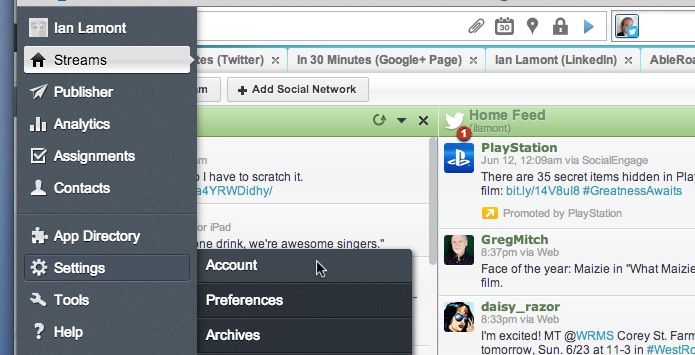
1. Click on the Settings icon in Hootsuite (which looks like a gear on the left side of the browser window) and click Accounts:

Hootsuite Pro account settings
The Hootsuite Pro interface

2. The Settings window will appear. You will see your profile information. On the right side of the pop-up, is a button that says “Downgrade”. Press it.

3. You will see your billing summary. At the bottom of the page is a tiny link that says “Downgrade to Free” (see screenshot below). Click it.

Downgrade Hootsuite Pro

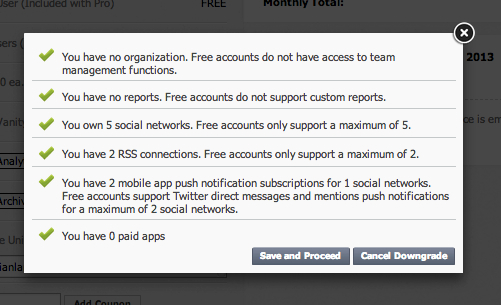
4. You will be warned about the Pro features that you no longer have access to, such as 6 or more social media accounts or extra RSS feeds. Click the buttons to manage them, or go back to Hootsuite’s settings to unlink social media accounts, get rid of reports, and decouple RSS feeds.

5. You’ll have to start again at step 1. Follow the steps, and then click through the prompts that basically ask you to confirm that you want to do this:

Hootsuite Prompt

6. Click “Save And Proceed” and you’ll eventually get a confirmation that you are done … and one final prompt to give your feedback. The confirmation says that you will be pro-rated for time not used during the current billing period.

If you have problems with downgrading, or you still get billed, I suggest using Twitter to contact @hootsuite_help.