I found the pedagogical emphasis on a cultural studies approach to religion to be the most fascinating part of this course. Because of our thorough introduction to the theory behind the approach, I feel equipped to bring this perspective to future coursework and to future research in areas outside of religious studies. I think that, already, my exposure to this a cultural studies approach has shifted the way I perceive the world even in situations that are informal and entirely non-academic. I find myself more likely to analyze carefully my views on both specific and abstract topics, and more likely to attempt to identify which experiences of mine have contributed most to the development of my views on each topic.
I have enjoyed conceptualizing the cultural studies approach as a process similar to building a mathematical model to represent some system. I will first explain the principles of a mathematical model in order to convey how I found this analogy helpful when synthesizing the material of the class and when designing my creative responses for this portfolio. Building a mathematical model means attempting to recreate an approximation of a qualitative phenomenon in mathematical terms. For example, if we wanted to calculate the volume of the earth, it would be sufficient in some contexts to model the earth as a sphere and use the formula for volume of a sphere. But the earth is irregularly shaped, so this formula is not completely accurate. If we wanted to be more precise, we could model the earth as an ellipsoid (which is a sphere that is stretched along one axis). We could do this by starting with our first model, where we assumed the earth is a sphere, and then adding in a corrective term to that would calculate the volume of an ellipsoid earth. But the earth is not really an ellipsoid, either; it bulges around the equator. So to be even more accurate, we could add another corrective term to the model so that we would end up calculating the volume of a bulging ellipsoid. Let’s say that we then learned that the measurement we are given for the radius of the earth is systematically faulty. We could add to our model of the volume of the earth a term that would correct for systematic mistakes in calculation of the radius. This corrective term, too, would make our final calculation of volume even more precise. Clearly, if we learned more about the shape of the earth or about the limitations of assumptions we have made, we could continue to add corrective terms to our model in order for us to ultimately attain a better calculation of the volume of the earth. However, in order for us to add a new term to the model, we need to learn something new about the system or take a new perspective on the system.
I like to think about a monolithic view of religion as a mathematical model with only one term. In some cases it is fitting to model the earth as a sphere when calculating its volume because it is accurate enough for what we need. Similarly, in some contexts, it is not strictly necessary to conceptualize a religion beyond one or two fundamental aspects. A person can theoretically create a model of Islam that is alarmingly simple, like “Islam = headscarves” or “Islam = scary religion with headscarves.” And perhaps in some environments (i.e. Islamophobic environments), a person with this idea—who we will call the modeler—might never receive any information contradicting their model. If a modeler is never exposed to a person who identifies as a Muslim, or even a person who has a different perspective of Islam, then that modeler will never be forced to—and might never be given the opportunity to—acquire the information necessary to add more terms to their metaphorical model of Islam.
Even when it isn’t strictly necessary, adding more terms to a mathematical model will create a model that is both more accurate and more robust (i.e. it will remain accurate under varied conditions). Each new term corrects the previous ones. I see adherence to the cultural studies approach as an attempt to learn as much as possible to recreate a certain context or situation; in other words, an attempt to add as many terms to the model of a religion as possible in order to create a better representation of the religion. In this way, I have journeyed through this class with the perspective that every new viewpoint I am exposed to, every experience that I take the time to analyze and unpack, every lecture, every reading, and every discussion I participate in allows me to create a new term in the model. In one of our first lectures, Professor Asani introduced the cultural studies approach as “consider[ing] religion as a phenomenon that is deeply embedded in all dimensions and contexts of human experience.” Scholars who align themselves with this approach not only acknowledge but pursue actively the manifestations of religion in virtually every imaginable cross-section of context: political, historical, economic, social, artistic, etc. Each context provides the opportunity for essentially infinite different new perspectives; in this analogy, each new perspective becomes a new term in the model.
As in any mathematical model, an additional term—even if it is optimistically called a corrective term—is only truly corrective if it is accurate. When modeling something as intensely complicated as an entire religion there is absolutely no way to investigate to what extent the model is correct. We cannot run a computer simulation to confirm that our model produces results that mimic the system in question. We cannot formally identify which parts of the model are more or less accurate than others. We cannot realistically determine which parts of the model should be weighted to contribute to the final result more or less than others. This means that within our quest to learn as much as possible, we must also remember to be critical of the new information we acquire. Further, since introducing a bias to our search for context effectively contradicts our initial purpose, we must be intensely critical and analytical of every new piece of information that is introduced in our studies.
Another analogy for the cultural studies approach is that of a telescope. Each new piece of information or perspective acts as a new lens for a telescope through which to view some religion. Stacking every lens would lead to a perfect image, but it is, of course, impossible to attain and correctly focus every lens. Further, some lenses might be warped or might fit a different model. And each lens must be cleaned before it is used, just like each new perspective must be critically analyzed before it can be used as background information.
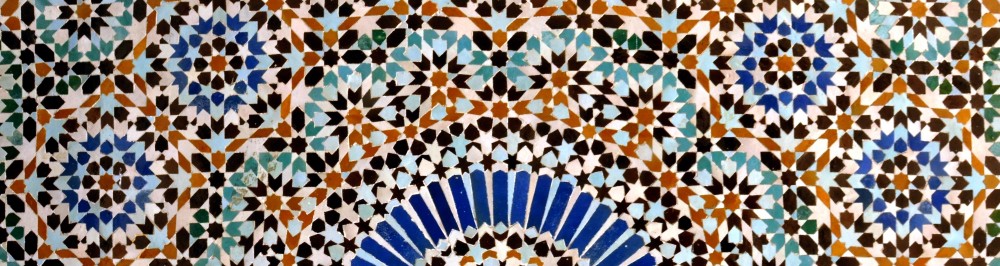
I created each of my art projects keeping in mind my analogy of a mathematical model or a multi-lensed telescope. The major theme I have hoped to convey is a sense of many pieces each contributing to comprise a larger whole—even if that larger whole may be too complicated or too hidden to ever be seen alone.
Understanding the multi-faceted concept of Islam means understanding that it looks very different in different contexts. It looks different even in the minds of different people in the same context. But studying Islam, even under a cultural studies approach, does not mean studying every point in time and space; some things are relevant to the study of Islam and some things are not. This means that there are some fundamental similarities that bind together the contexts that scholars include in their study of Islam. This means that the similarities in manifestation or perception of Islam are just as important to identify and analyze as are the differences. I think that my week 2 response (“View from the Madrasa”) and my week 11 response (“Complaint, Answered”) best represent the idea of loose unification of Islam. In the week 2 response, I depicted the view outside the madrasa in order to highlight that a lot of the sentiments within different madrasas likely have similarities. In my week 11 response, I depicted planets conferencing on earth about the earth’s Muslims; this shows that from their view, there is some broad unification between all Muslims that allows them to categorize the population. I think this view can be extremely dangerous and problematic if weighted too heavily in one’s model of Islam, but I do think it is a very valuable view. In order to study Islam, one must determine what is and is not Islam. This course has not begun to approach the many ways to answer that question, but I think that acknowledging the existence of that question allows us to better understand the importance of seeking out the differences between Islam in every different cross-section.
The idea of a model, or a collage, is present throughout the portfolio: each response revolves around many pieces coming together to make a whole. Week 2 (“View from the Madrasa”) shows several views representing one idea of the madrasa; Week 3 (“Qur’anic Reciter”) shows several different aspects of an identity creating either/both the image of an established reciter and/or of a mainstream pop star; Week 6 (“Mosque Diversity”) shows the incredibly large variation in what is considered Islamic architecture but allows these varied structures to piece together to become one aesthetically unified collage; Week 10 (“A Conference in Cambridge”) shows three different aspects of Harvard campus life that could be all-consuming, but in truth each of these exists to some extent in each student at Harvard; Week 11 (“Complaint, Answered”) shows that if one adopts an outsider’s perspective, each different manifestation of Islam comes together to form one loose concept of Islam; Week 13 (“Identities”) shows that each experience someone has contributes in some part, however small, to their identity, which in turn contributes to the way a person will respond to an outside stimulus.
I also liked the idea that the metaphorical mathematical model of Islam is non-predictive; in other words, given some information about a specific spatial and temporal cross-section of the Islamic world, one may or may not be able to predict the other coordinates of the cross-section. For example, in Week 2 (“View from the Madrasa”) if someone is given information about the madrasa, one may or may not be able to accurately choose the madrasa. Or, in Week 10 (“A Conference in Cambridge”), someone given information about a person’s faults could not necessarily predict the time and place and culture that person belonged to; the faults of the Cambridge birds in the Harvard context were the same in all but the specifics as the faults of the birds in the epic poem the Conference of the Birds. This is abundantly clear when learning about the many different formal schools of interpretation of the Qur’an, not to mention the infinitely different perspectives within each school.
The major themes I wished to explore through my creative responses all related to large concepts being comprised of smaller ones. I wished to emphasize context, identity, and recreation of motivation for action. I used natural images whenever possible to highlight the connection between faith and the natural world. I used visual art for the entire portfolio because I felt it best allowed me to express my thoughts, and because I particularly benefitted from being able to look at responses from different weeks in the same physics space, right next to each other on the table. I enjoyed very much the opportunity to explore the course’s themes in many different media.
