Archive for November, 2017

Maybe Not Bitcoin…

Tuesday, November 28th, 2017

Most of our conversation today centered around the uncertainty of Bitcoin. We talked about the issues related to having a currency system that relies on consensus and how that can lead to forking which can complicate or nullify transactions. We also discussed the hacking of DAO that resulted in tens of millions of dollars of ether, another cryptocurrency, being stolen. It didn’t seem like there were many positive takeaways from our discussion related to Bitcoin and other cryptocurrencies.

And yet, Bitcoin’s value is soaring close to $10,000 while cryptocurrencies everywhere continue to pop up. How do we explain this?

The biggest problem with Bitcoin is that it may be traded like a currency, but in reality it is as volatile as a commodity. However, this “problem” is also the source of Bitcoin’s popularity and success. Bitcoin miners and buyers alike are gambling on the price of an incredibly volatile asset, betting that the price will continue to rise.

This volatility is the opposite of traditional centralized currencies issued by governments. These currencies are based around being relatively stable. There are fluctuations of the value of currencies, but you would never expect the U.S. dollar to experience a 100% increase in value, let alone the 10,000%+ increases seen in the value of Bitcoin.

I cannot see future governments adopting cryptocurrency because of its decentralized nature. It would make absolutely no sense for a government to cede control over its currency to the citizens. Governments don’t usually like to give away power.

I do, however, see a future with cryptocurrencies which are more currency than commodity. It probably wont be Bitcoin, but there is a need and market for a stable cryptocurrency which can be used for anonymous online transactions. On the timeline of money systems, I view Bitcoin as the gold coin, while a future cryptocurrency will move beyond this to the fiat currency analog (don’t ask me how).

Perhaps this wont happen. Perhaps cryptocurrencies are destined for commodification. But, I am optimistic about the future of cryptocurrency.

As this is my last blog post, I’d like to thank Professor Smith and Professor Waldo for running such an enriching course. Feel free to use the content of my blog for your book (whose future is uncertain).

The Necessity of Self-Awareness: Taking a Step Back

Monday, November 20th, 2017

One of my biggest take aways from our discussion with Latanya Sweeney, former CTO of the FTC, was that we humans tend to get caught up in things. There is a basic human tendency that exists to take a myopic view of situations. In prehistoric times, this was vital for survival—we needed to forage and hunt for food, find shelter, etc.

Fast forward to 2017 and this tendency still exists, but it is magnified. Instead of worrying about finding food or other basic human needs, we focus on technology. More specifically, we get caught up in the minutia of social media, sucked in by the endorphin rush of a notification.

As social media platforms and our digital personas have grown with the advent and expansion of new platforms—Facebook, Instagram (“rinstas” and “finstas”), Snapchat, LinkedIn, Tumblr, Reddit, etc.—our emotional investment in these platforms has grown as well. A perfect example of this was brought up in class with Snapchat streaks. When you send and receive a Snapchat from a friend for multiple days in a row, a number appears next to their name, indicating that you have a streak. Yet, this has translated into superficial conversations—if you can even call a selfie with a dog filter a conversation—with the sole purpose of keeping these streaks alive. Often, you will see a Snapchat user who maintains more than a dozen streaks. These connections are empty.

But if these connections are meaningless, why do we keep these streaks alive? What is the point? It is because we have become too invested in maintaining our digital personas and superficial digital connections. It’s a building avalanche of sunk cost.

I am not saying that I am not guilty of this. At times, I, too, find myself caught up in social media.

However, the key is to step back and reflect on our behaviors on the Internet. I think that reflection, like the discussion that we had today, is essential to remaining grounded in this digital age. We need to recognize that sometimes we need to turn the screens off and allow ourselves to be bored, or uncomfortable, or lonely. These feelings are essential elements of the human condition and essential elements of our sanity.

Through reflection, we can realize that one tweet, or post, or picture is not the most important thing in the world. Maybe this can make us all happier, too.

Cyber Conflict and the Perils of Technological Illiteracy

Monday, November 13th, 2017

One of the points that was touched on by our guest speaker, Michale Sulmeyer, was in regard to current politicians’ lack of understanding of cyber conflict. I don’t think that this issue can be understated. Right now, we have a president who barely knows how to use Twitter, let alone address the intricacies of cyberspace.

Beyond the White House, Congress and other policy-forming institutions are filled with representatives and officials who fundamentally lack an understanding of cyberspace. This is understandable — many representatives are older and may lack technological literacy — but it is unacceptable. Representatives must gain education on these issues so that policy is not based on Cold War tactics which don’t necessarily apply in cyberspace.

Obviously, there are some very smart people in the Pentagon working on issues relating to cybersecurity and cyber warfare, but I think that beyond the covert, there needs to be more of a public effort to educate our representatives. At the very least, representatives need to understand the importance of cyber issues and allow experts on the subject to advise policy decisions.

One of the big problems comes down to the idea of abstraction. I feel that the ambiguity relating to issues of cybersecurity can be drawn back to the term “cyber.” Each representative most likely has a very different view on what cyberspace is, and this is problematic. To make informed decisions regarding the Internet and cybersecurity, we need a technologically literate government. When representatives attempt to form policy without basic understanding, inevitably the wrong decisions are made.

If the United States is going to survive and thrive in the age of cyber, the government must evolve.

The Internet of Governance or the Internet of Google?

Monday, November 6th, 2017

When John Perry Barlow wrote A Declaration of the Independence of Cyberspace more than twenty years ago, I don’t think that he could have imagined the Internet as it exists today—the constant connection and never-ending stream of information. In his declaration, Barlow outlined the idea that the government has no power in the sphere of the Internet. It can try to govern the Internet, but it will ultimately be unsuccessful.

I think he makes the accurate point that on the Internet, people will always find a way around government regulation. This is not to say that all users will be capable of getting past firewalls or other restrictions, only that it is especially difficult to completely govern behavior on the open forum that is the Internet. This is due in part to the original design of the Internet, which did not have profits in mind, resulting in a distributed, “collective hallucination,” which our guest speaker Jonathan Zittrain discussed.

I’m not so worried about governments controlling the Internet. I’m more worried about the Internet leviathans—Google, Facebook, Apple, Twitter—governing the Internet through stringent regulation to increase their profits.

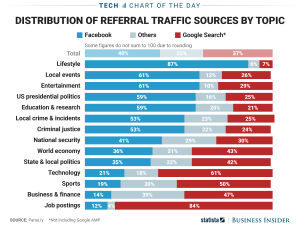
If you were to take away Google and Facebook, many would be lost puppies on the Internet. According to Business Insider, Google and Facebook account for 87% of the total referral traffic on the web. In other words, 87% of the links that people click to bring them to an article or other page come from either Facebook or Google. That is a lot of power.

These companies may be benevolent for now, but I fear a future where Google and Facebook decide what belongs on the Internet and what does not. We are already seeing the beginnings of this content censorship with “fake news” and ISIL postings being taken down, but will it stop here? Are anti-Google and anti-Facebook postings next? What about content involving competing products? It seems that we need to regulate these Internet giants.

The real (and unanswered) question is who decides these regulations. The United States? The United Nations? Jon Postel’s ghost? Can we really regulate the Internet?

I think that the only true way to regulate the Internet is through competition. We need more companies offering competing products and platforms so that users have a sense of choice. The forums with positive regulations will be selected by users. This seems less and less likely, however, in the age of Google, but one can hope.