Archive for September, 2017

Musicians, Opera, and The Internet

Monday, September 25th, 2017

One of the most interesting implications of the long tail model for me comes in the form of the effects that it has had on the music industry. Both of my parents are musicians—my mom is a violinist in the Metropolitan Opera and my dad used to be a trumpet player in the MET Opera as well and is now a professor of music. It has been interesting growing up hearing their side of the story and what their perspective is on the revolution that has occurred in the music industry.

As I mentioned in class, occasionally my dad gets royalty checks from music streaming services for a few cents or maybe a dollar or two. Many of his friends, who are also musicians, have similar experiences when it comes to these music streaming services. Though the long tail model allows access to a broader variety of music, it is not profitable for the producers of that music that are getting a couple plays at the end of the long tail. At the same time, the Internet allows certain artists to be discovered and shoot up in popularity and make a great deal of money.

That being said, my parents are not opposed to music streaming, and both use music streaming services. What my dad tells his music students is that there are essentially no jobs in music (especially classical music)—you have to create your own job or hustle to get by. In the past, a musician could get an orchestra job, but now the industry has changed such that you have to do something more niche to be profitable. For example, one of my mom’s former colleagues now produces jingles for companies. The music industry has evolved such that there are more niche markets for music and musicians, yet some jobs are being completely eliminated.

Another interesting phenomenon is that the Internet has forced the opera to evolve as well. Now, a select number of the productions at the MET Opera are live streamed to movie theaters, allowing for broader access. People apparently get dressed up to go to the movie theater and watch the opera, just as they would if they were going to the actual opera.

This evolution of art and the economy of art was not necessarily natural, but forced out of the competition brought on by the Internet. There will always be purists and luddites who will oppose this evolution of the art form, but I think that any time art and music can be exposed to a broader group of people, it is a positive.


A Network By The People, For The people

Tuesday, September 19th, 2017

In the history of the networks, change happens rapidly. From the ARPAnet, to the proliferation of international networks, to the network of networks—the Internet—growth, as well as the expansion of the user base, has been exponential. With this growth comes the issue of scaling that we discussed in class.

What I found particularly interesting was the truly democratic basis of Internet standards, especially TCP/IP, that formed the basis of scaling the interconnected networks. Despite the push by governments and some companies to switch to the more complex, bureaucratically developed OSI standard, it was ultimately the users that decided which standard was to be used. The government had birthed the ARPAnet and networking, but they no longer controlled it. A computer scientist who supported the TCP/IP standard stated, “Standards should be discovered, not decreed.” Lowly graduate students had created the Internet, geeks had used email mailing lists to discuss science fiction, and now these Internet warriors decided its fate.

If one looks at the issue of Net Neutrality, the idea that all data/bits must be charged at the same rate and treated equally, it is also a central component of our democratic Internet. If Net Neutrality were to be breached, beyond even the idea of the exploitation of the consumer with overcharging, it would take away the element of the Internet being a space for everyone to enjoy equally. It seems like it is again an attempt to put the Internet in the hands of companies or the government, when the Internet, at its heart, has always been the people’s.

There is also a beauty to the simplicity of the network described by the End-to-End Argument, and currently in place with the Internet. The very fact that the network is dumb and unreliable is what makes it so adaptable and easy to expand. It is a true case of function over form. The network is a big, expansive idiot, but it’s our idiot.


Communication & Creativity

Tuesday, September 12th, 2017

“Where there’s a will there’s a way” seems to be the theme when it comes to software development on the ARPAnet. There were definitely strong wills and a lot of stubbornness at play in the software community (e.g. the Big Indian vs. Little Indian bit processing debate that was discussed in class). Perhaps the most important program in the network’s history, email was developed through humans simply playing around. It is basic human nature to want to communicate and the grad students and other programmers found a way to do it even though the network was not explicitly designed for this task.

It seems to me that the history of technology has been clearly linked with a history of communication. In ancient times, technology enabled the creation of road systems to allow for better communication and a very physical manifestation of a network. Similarly, ship technology was improved to allow for intercontinental communication, among other things. Next came steam engines, cars, airplanes, the telephone and other technologies that allowed for the movement of human “packets” of information.

The most primal of human desires is connection. Communication systems make us feel connected (though they may seem impersonal today). The jump from physical mail, or even systems of communication like the telephone or telegram, to email and file transfer systems is monumental. It represents communication on an entirely new level, opening up new modes of communication that are still being explored. It’s amazing to think that this was created almost illicitly, outside of the parameters for which the network was created.

Today we take for granted the constant connection to the rest of world and our ability to access information. We have Snapchat, texting, FaceTime, and so many other forms of communication based around the network created by a group of determined individuals less than fifty years ago. In this short time, communication has transformed exponentially, and it makes one think about what might be next.

Funding and Fusion

Monday, September 4th, 2017

The thing that struck me while completing the readings and during our class discussion was that much of the innovation that came out of ARPA was the result of giving scientists and engineers free reign over what they wished to pursue. The ARPA directors, including Ruina and Herzfeld, operated under the principle of bringing in the brightest individuals that they could find and allowing them to steer the ship for the most part. The readings even reference an instance where Taylor was able to acquire one million dollars in funding from Herzfeld in a matter of twenty minutes.

This model of organization made me think about the current attitude towards science in the United States and among the U.S. government. Obviously, it is important to note the pressures created by the Cold War at the time of ARPA’s free-flowing funding methods, yet I feel that the government has strayed from placing the proper emphasis on research and development, and funding for the sciences in general. Investment in the science and technology sector has had a history of paying dividends and driving the economy forward by providing new jobs and new industries.

In particular, I feel that if ARPA’s “modus operandi,” as it is described in the reading, along with an appropriate level of funding, were applied to the energy crisis, a solution would be inevitable. Simply assemble the field’s top scientists in an incubator with enough funding, and allow them to decide the best course of action.

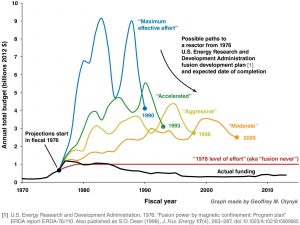
The chart below looks at the levels of funding for nuclear fusion technology, which many believe to be the key to solving the current energy crisis and over-dependence on fossil fuels. From the chart, it is clear that the current level of funding is inadequate. Even if nuclear fusion is infeasible, or not the appropriate solution to the energy problem, providing funding more generally for the research of alternative energy sources should be a top priority.

Many will point to the growth of the private sector as the main source of technological growth today, failing to note the importance of government funding in technological and scientific endeavors. Companies like Google, Spacex, Apple, Microsoft, Amazon, and many others produce technological growth and innovation, as we discussed in class with the partnership of Amazon’s Alexa and Microsoft’s Cortana to produce a better A.I., yet cooperation between the private and public sector is important.

Maximum innovation is achieved when there is a symbiosis between government and private companies, as demonstrated by the creation of ARPAnet, where ARPA, BBN, Honeywell, and universities worked together to make the network possible. The importance of this cooperation should not be forgotten.