Archive for May, 2016

Comic

Sunday, May 8th, 2016

IMG_2186

My inspiration came from our week 12 reading of Persepolis by Marjane Satrapi. The contrast between Marjane’s childhood experiences and the turmoil occurring in Iran at the time was profound. It is important not to forget history and to apply past experiences to modern struggles. After reading about the discrimination against Muslims occurring in Europe (particularly France) and reading The Reluctant Fundamentalist, I was thinking about how modern governments and societies inflict harsh rules and arbitrary punishments upon cultures different from their own. While these current problems are different than the Iranian Revolution, the effects they have on young children may be equally confusing and upending.

So, I created a cartoon in a style similar to that of Satrapi (except with dramatically less artistic talent), showing a possible experience of a young Muslim girl going to school in the United States. For children, life is simple, which makes them good candidates for studying the biases that family and media teach them. For the children who are taught to be biased, there is no reason, that is just what they believe. They parrot family and media. For children who are not taught to be biased, being discriminated against is incomprehensible. If nothing else, we should strive to create a world that does not harm and confuse children for reasons that have no bearing on who they are and who they will become. Marjane’s parents are a good example of how to teach acceptance and understanding to children. They do not assume she will not be able to grasp the concepts, instead they are honest and genuine about what is happening and why. Forcing parents (and other adults) to explain their biases may even help them reflect and revise their opinions.
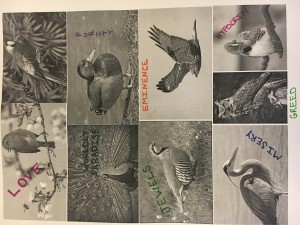
Collage

Sunday, May 8th, 2016

IMG_2185

My inspiration came from our Week 10 reading of The Conference of the Birds by Farid al-Din Attar. The characterization of each bird with a particular vice is a beautiful analogy to the the sinful desires that attract men and women away from living a holy or fulfilling life. In my collage, I include photos of all the birds in the story with their vice written across their picture. Some vices were more easy to concisely name than others. Some of the vices were more like descriptions of how the bird strayed from the worship of God. For instance, the Nightingale was easily characterized because it worshipped Love rather than God. The Peacock, on the other hand, was more difficult to characterize because it sought to return to a worldly paradise rather than pursue the eternity of spiritual connection to God. Or, the Finch, who thought it could take the place of a figure as virtuous as Joseph, but could not stand before Simorgh (God). The Finch strays from the worship of God by using hypocrisy and meekness to avoid the struggle and hard work necessary to achieve the spiritual connection.

The Conference of the Birds was my favorite of our readings this semester. The story is unusual and incredibly effective at communicating some of the most important parts of Muslim life. The temptations that exist are difficult to avoid as they may seem trivial when considered in the small doses seen in everyday life. However, in order to live a fulfilling and spiritual life, it is important to analyze even the minute vices that distract from worshipping God and following the life of the Prophet. For instances, the Duck’s vice is Purity. Purity does not seem sinful, however, when an obsession with cleanliness starts to get in the way of forming a connection with God or takes up time that could be used to aid others it becomes a vice. Al-Din Attar does an impressive job describing how small temptations can confuse one’s understanding of their unimportant actions in relation to the everlasting nature of God.

While I labeled each of the birds in my collage, they were eventually able to overcome their vices and work together to reach Simorgh. This reveals how Muslims can overcome temptations by coming together and the importance of providing and accepting help from other members of their community. In this way, the collage represents the stage in which the birds have come together, but have not yet fully overcome their worldly desires.

Photography

Sunday, May 8th, 2016

IMG_2184

My inspiration came from our Week 8 reading of A Saint in the City: Sufi Arts of Senegal by Allen and Mary Roberts. The discussion of the photo and representations of Sheikh Amadou Bamba was intriguing. Throughout the course, the readings that included descriptions of different talismans in parts of the Muslim World caught my attention. For Mourides, not only the singular photo of Bamba is believed to have talismanic properties, but paintings and recreations of the photo also have protective powers. While many portrayals of important religious figures are artistic and luxurious, Bamba appears ascetic and is barely recognizable. This highlights how little importance is given to material possessions in Muslim cultures like that of Senegal as well as the democratic aspects of the religion. Bamba is considered a saint, yet he is not put on a pedestal or draped in jewels. He is praised for his ascetic lifestyle.

While thinking about the representations of Sheikh Bamba, I came across an old polaroid photo of my friend who passed away last year. Our friendship was simple, thoughtful, and he protected me like a younger sister. As I thought more about the photo, I realized it had talismanic properties in a way. It encouraged me to pursue my passions, care for others, and it made me feel safe. Plus, it was such a good representation of Raul. Sitting on the floor of the store where he worked day in and day out, holding a puppy that had come in out of the rain, and wearing his typical raggedy T-shirt and jeans. Hard working, incredibly kind, and with little care for material possessions; while I am not a particularly religious person I do believe he still protects me. Raul was to me what Sheikh Bamba was to Senegalese Muslims.