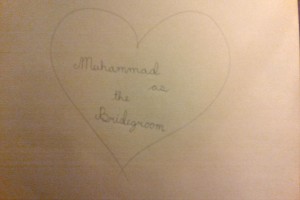
My inspiration came from our Week 4 reading of compilations of famous Sindhi poetry. Much of the Sindhi poetry exalts Muhammad as a missing or lost lover. Some even allude to him as the “bridegroom” in a mystical, missing, or foregone relationship. While I am not very artistic, when reading the poetry I imagined a romantic play. My drawing represents the front of the playbook for a romantic drama about this mystical love story between Muslims and their Prophet. They admire him enormously and wish to become more like their lost lover. They work hard to earn enough money to support their own families as well as give alms and pray every day, fast on Ramadan, and make the hajj. One day they finally win the ultimate approval, and the Prophet appears to them in a dream in which their wedding is occurring.
The cover of the playbook strives to exalt Muhammad as a famous actor who plays the leading role. Intended to lure audiences with promises of this famous, desirable figure. The simplicity is meant to look like what you would see in a teenage girl’s diary. Where she had written over and over again about her love, daydreaming in class about their wedding. Despite the fact that he was completely out of reach. I imagine the play in the style of Ta’ziyah, with lots of movement, ups and downs, and audience participation.
One of my favorite aspects of the poetry I used as inspiration for this post, is the unimportance of gender in the spiritual romantic scheme. This quality allows the poetry to rise above normative worldly relationships and create a more holy form of love. Love that is eternal, above human squabbles, and blind to gender and sexuality.