Harvard Workers Let the Light In
ø
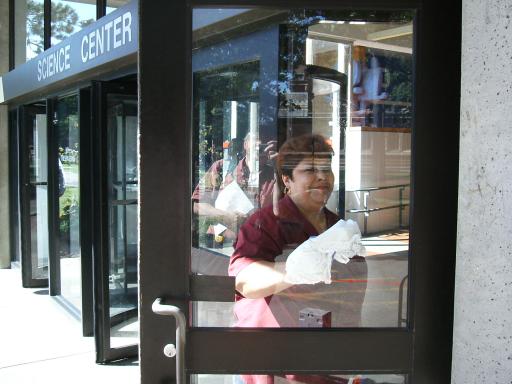 “>
[cleanliness with the best regards of S.E.I.U]
and keep you fed.
 “>
[nourishment with the best regards of Unite-HERE!]
… who looks after things.
ø
“>
[cleanliness with the best regards of S.E.I.U]
and keep you fed.
“>
[nourishment with the best regards of Unite-HERE!]
ø
 “>
Would you like to learn some labor related Spanish with me? Unidos sindicales United Union.
More later.
ø
 “>
Harvard University Graduation Day Spring 2005 – A grand occasion for many. Yet some not so grand activities must also take place. I speak only a few words of Spanish, ” Si! Se puede!”*. That’s about it. My conversation with this gentleman was a bit strained. He is Mr. Aguilar. I remember because I know an Aguilera. His first name is Jaime like in “Stand and Deliver”. I believe her first name is Christina … I’m kidding.
Jaime and Harvard’s other custodial workers are represented by the Service Employees International Union through it’s Local 615 which has had a Justice for Janitors campaign for 20 years. S.E.I.U has also begun organizing security guards and has made some recent progress. Harvard’s security guards are currently not represented by any Union. [HUSMPGU still represents museum and parking guards. The security guards were outsourced two years ago.]
The Harvard’s contract with S.E.I.U. expires on Noverber 15, 2005 – at least according to the copy on the Harvard University website. [The locals have reorganized since the contract started.] This contract was renogtiated to good effect as a result of the Mass Hall sit-in coming out of the Living Wage Campaign
of the Progressive Student Labor Movement. In any case, this word from a soon to be named student worker group on behalf of S.E.I.U.
It begins with hello. And you can continue with hello between structured activities. You don’t need a grand strategy to do that, and it will certainly help with whatever else you decide to do. It is, afterall, at least in part, about the workers.
*Yes! We can!
ø
 “>
Desiree Goodwin and Geoff Carens, her Union Representative leaving Federal Court [the House that Joe Moakley’s bricklayers built. Both are more handsome irl. :(]
Librarian and Information Science News reports:
“Talk about adding insult to injury, Desiree Goodwin , who lost her case for promotion against Harvard University and still retains the same low-paying job, has been told by her attorney, Richard Clarey, that Harvard has sent her a bill for $3,319; the legal expenses incurred during her civil rights trial against them.”
The full article includes a link to a May 24 interview with Desiree and a March 21 article from MSNBC.
The Boston Herald quotes Desiree’s lawyer Richard Clarey:
“I’ve seen it done in very big cases involving very big corporations,” said Clarey, vowing to oppose the motion. “But I’ve never seen it done in the case of a corporation whose assets (are) in excess of $23 billion. I’ve never seen it done against a plaintiff who has nothing.”
The guy by the door commentary: There were five lawyers retained by Harvard in the courtroom for the 10 days of the trial – Judith Malone of Palmer and Dodge, Richard Riley and John Coakley from Murphy and Riley, Eileen Finan from the Harvard Office of the General Counsel, and a jury consultant who declined to identify himself to me. A crude estimate of Harvard’s expenditure in the face to face portion of the trial;
5 lawyers x 10 days x 6.5 hours x $200 [low for Ms. Malone] = $ 65,000
[There must be an industry standard multilplier to get the real cost. Anybody?] So what is the significance of $3,319? It may be all that they can hope to win legally. How does it compare to the cost of the meetings and research to make the decision and file the court papers? I will complete my account of the trial posted at OpenHUCTW and keep you aprised of further developments here.
ø
From the Cape, Eric Schwaab reports firsthand accounts of nstar linemen in his blog and blog community.
Pix from a guy on the picket line. No addresses 🙁 . Naysayers might ? their “probative value.” Lets look around and report to local government.- inspectional services and legislative [e.g. City Council] and, of course, the BLOGosphere. Exact address is essential, picture is good but optional.
Cambridge and Boston both support Local 369. I’m going to Boston CC tomorrow.
If you don’t do electoral politics, Mass Jobs with Justice offers action links.
Birobidzhaner, blogging from the left, reports on the Monday rally.
 “>
Power to the strikers or power to the customers?
1/3 of a second before he was showing the thumbs up.
Answer: (c) All of the above.
“One to One”
Organizing ultimately comes down to this – one on one – in the blogosphere
and in the street. The round part of the building behind her head is
the control room for all of Metro-Boston. Power to the people.
 “>
Sunday morning, the bus driver went a just a little slower past the strike.
He’s in the Carmen’s Union. I think he said Local 569.
This is mostly a tease to be edited in due course. But while we work out what is and is not “on the record”. I leave y’all with just this one.
Outsourcing is only “importing service”, if the workers are somewhere else.
Example 1: Hypothetical
So, if you fire your Boston customer service representatives and hire people in Omaha or Bangalore, that is arguably “importing service”. If, on the other hand you fire your “direct employees” from Dorchester and Jamaica Plain and hire contingent workers from Dorchester and Jamaica Plain, it’s not “importing service”. It’s just lowering people’s standard of living. “Importing service” is sometimes a creative euphemism and sometimes totally unconnected to Veritas.
Example 2: NStar Substation Crew
 “>
These are some of the guys that go into the manholes and replace fuses and blown up cables and stuff. Sometimes they have 14,000 volts in their hands. Well that’s what they say and rather than have a discussion about relative sexual endowment, I’ll believe them. But power only gets to your house, if the cables and wires do. [Some renewables would, but Big Capital doesn’t like this idea any better.] If a connection breaks they have to go to it to fix it. They can’t phone it in from Bangalore. Replacing them with contract workers should not be called “importing service”. I’m not sure I want to tell you what they call it.
Example 3: Harvard cooks, janitors, and security guards.
Curiously, in this one case at least, Harvard Administration is more up on econonmics than Harvard Economics. Administration simply uses neither term. Problem solved. However, HCECP, aka the Katz Committee, determined that outsourcing did happen to the tune of 1000 workers up from the original “only seven” claim during the sit-in on Mass Hall in Spring 2001. HCECP had a website chronicling the adjustments that were made. H.E.R.E. and S.E.I.U. did get some improvement in their contracts. H.U.S.P.M.G.U. got a tiny bit, but they have since had 20 or 30 jobs outsourced.
Officialdom of H.U.C.T.W. said, “We’re just fine thank you very much.” My unit was about half contingent workers.
What has happened to “H.E.R.E. and S.E.I.U. since? The HCECP website declared “problem solved” and disappeared. Folks in the Unions tell me that outsourcing, has started moving in again. There have been new “direct’ hires in my unit, but it seems like even more new contingent workers. Administration’s response is to give the new VP woman for Human Resources an “HCECP Fellow.” I’m not holding my breath.
This discussion, by the way, is “on the record.”
Nstar, Mass Ave, Dorchester – Members of UWUA Local 369 walk the picket line.
Alerted by mailing lists of the Harvard Social Forum and the Progressive Student Labor Movement, students and workers from Harvard joined members of the Utility Workers Union of America Local 369 on the picket lines at local NStar installations. Students mostly went to the nearest installation in Somerville. Many Harvard workers, however, cannot afford to live near campus since the end of rent control. Most live in communities like Jamaica Plain and Dorchester:
 “>
The two largest issues are:
1. Compromised safety due to understaffing.
2. Attack on pension benefits.
The union members have community support.
 “>

The guy by the door representing Harvard Union Labor, Harvard Social Forum,
and Progressive Student Labor Movement and friends.
 “>
And it goes on into the night.
ø
In May of 2001, about 50 students occupied Massachusetts Hall. Many more gathered outside.

It was the high point of the Harvard Living Wage Campaign. As I’ve mentioned elsewhere, spokesman for the administration, Joe Wrinn claimed that there were “only seven” workers at Harvard who made less a living wage. One of the cooks turned to me and asked, “They’d let all this happen to avoid paying 7 people?”
The sit-in led to a temporary slowing down of what was then a 30 year long campaign to outsource labor. [It started with the painters in the early seventies.] N. Gregory Mankiw has been heard to characterize outsourcing of jobs as “importing service”. This is clearly not the case when Harvard outsources jobs like painters, janitors, cooks, and security guards. These jobs cannot be phoned in from Bangelore. I suppose you could clean a toilet with a remote controlled robotic arm, but I guess that’s not ready for market yet. Administration’s outsourcing is replacing employees with a living wage and benefits with contract workers who are paid less and have little if any benefits.
Also resulting from the sit-in was the formation of what was informally known as the Katz Committee to study low wage workers on the Harvard Campus. There were public hearings and meetings for a full year. The Committee was curiously able to find about 993 workers making less than the living wage that Joe Wrinn didn’t know about. That’s an error of … oh … about 14185%, but who’s counting.
In March of 2003, the chair of the committee, Professor Lawrence Katz gave a talk with slides [graphs] at the Malcolm Weiner Center for Social Policy in which he reviewed the results obtained by the Harvard Committee on Employment and Contracting Policies. Dean David Ellwood pointed out that, “administration was totally transparent about labor practices.” I objected that Joe Wrinn had said “only seven” workers below the living wage and HCECP found 1000. Somewhat testily, Dean Ellwood corrected me. I said, “administration was totally transparent DURING THE WORK OF HCECP.” It is well he take no responsibility for the “transparency” of administration during the “casual” era. This was an era almost as long as the history of HUCTW culminating in there being 2000 unbenefitted, untenured casuals filling 1000 FTE positions. There were 3000 union members at the time. One fourth of the bargaining unit jobs were filled by contingent workers. And as of the time of Dean Ellwood’s remarks, Sally Zeckhauser had caused the HCECP website to be removed after an appropriate “problem solved” posting. When I asked Professor Katz for a copy of his paper [and the graphs], he informed me that it was, “A talk, not a paper.”. It seems that the laws of economics [and supporting evidence for them] are eternal except when the application is what Harvard actually does.
The late Polly Price once remarked at the Arco Forum that Harvard is the largest [by quite a bit] employer in Cambridge and the fifth largest employer in the state. It is reasonable to ask if Harvard can reasonably be assumed to be a price taker in the local labor market. LWC presented evidence that Harvard is clearly not. Yet administration continues to justify it’s policies on the claim that it is. The HCECP claim of the necessity of retaining “market discipline” is a subtler, but equivalent claim. That was true from the moment its recommendations appeared. A separate question is the adherence to or erosion from the recommendations since then.
Jack Trumpbour writes so beautifully that it would make Hemingway cry. Hemingway once said, “I’ve never yet known a good writer that was also a good talker.” That’s Jack. But if you read his book,
“How Harvard Rules: Reason in the Service of Empire,” you’ll probably want to talk to him. Only once has he disappointed me and I think it’s repairable. He said something like every time we get a victory they take it back later. You’re surprised by this? Administrators spend all their time excercising and trying to extend their power. The rest of us have better things to do. We express our power when we feel we have no other choice. As long as administration and the Fellows operate like a black hole for information, there will be constant recidivism. We must recharter the University.
So what is the status now of low wage workers at Harvard?
It’s a nice day out. Why don’t y’all go for a walk in the yard late afternoon.
-r
ø


ø
Boston. Jackie Benson Jones, Special Assistant to President Lawrence H. Summers, testified that she was told to stop working on an internal probe of Ms. Goodwin’s afirmative action complaint because the case had gone to the General Counsel’s Office. This confirmed allegations made by attorneys for Ms. Desiree Goodwin, that Harvard Assistant General Counsel Eileen Finan had compromised the integrity of proceedings before the Equal Employment Opportunity Commission by having secret talks with the Commission even before Ms Goodwin approached them. This followed a surprise motion on Monday, which excluded about half of the witnesses for Ms. Goodwin. In the second week of trial, outside counsel for Harvard administration, supervised by Ms. Finan, filed a motion to exclude witnesses that had been on the witness list well before the beginning of trial. “This is unfair surprise!” exclaimed Attorney Jon Margolis, of Rodgers, Powers, and Schwartz. “In thirty years of practice, I’ve never seen anything like this!” The usual practice is for the witness lists for both sides to be frozen before the trial begins.
ø
Harvard’s Union of Clerical and Technical Workers refuses to use the web to keep it’s membership updated about what’s going on. They have had a domain registered [http://www.huctw.org] for several years, but it has been either dark or parked all that time. Union leadership argues that they get anything they want posted by “Harvard”. In this case, “Harvard” actually means administration. Kris Rondeau says that “Harvard” is good about learning to everyone except us [HUCTW]. Well, when it is routinized and controlled by administration what can you expect? On the other hand, workers who have direct relationships with faculty can have a much better time of it. Take for example our own Berkoblog facilitator Wendy. In this case, “Harvard” is Berkmeister John Palfrey. Wendy seems to have learned quite a lot. [Thank you sir.] Kris Rondeau made her career on her relationship with Ann Taylor. Ann was an administrator, so Kris’s relationship was with administration. Also, Ann’s gone. In addition to years of no progress on the learning front, living in the past cost us $2 million in wages. HUCTW should not forfeit learning issues to administration. In many cases, learning issues means technology. Our presence on the web – leadership and rank-and-file – is the quickest way to make clear to all that we are capable of learning the important new tools. The administration will continue to claim being “progressive”. Their program of deskilling jobs for the purpose of outsourcing and turning over older workers for younger – to cut salary costs – will continue. Unless, that is, we make the cognitive dissonance so apparent that it cannot be ignored.
A more developed and polished argument will eventually appear at: http://www.openhuctw.org .
-r


 “>
 “>