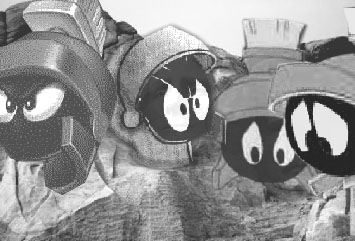
Editor’s Note: “We’ve turned this post over to a celebrity
interplanetary weblogger — Marvin T. Martian.
The Alito Confirmation Hearings are over and I need to sum up quickly,
because my Flying Saucer is about to take off, and there aren’t enough
hot spots in this part of the galaxy.
The Constitution Drafting Committee of the Martian Transitional “MarsR”
Government sent me here, to see how our Liberator, the United States,
all week, the elected Transitional Coalition back home wasn’t impressed,
and has already sent me on a new assignment. They told me, quoting one
of my own favorite phrases: “back to the old drawing board.”
Frankly, there were times during this Hearing when I wanted to use my
Acme Time-Space Gun on Senators from both sides of the aisle. Still,
I learned a lot about the American judicial nomination process and might
as well “blog it” (such a euphonic phrase!).
It might shock Earth Bloggers, but
their Martian colleagues — not being used to Free
Speech — merely report facts. Commentary and
opinion are risky things, until we get a final Bill
of Rights installed. Also, we never get snide nor
use irony.
After this hearing, I can say with some certainty,that the following factors
are important in the Senate confirmation process for a Supreme Court
justice:
In the United States of America:
stones (and live under bridges, I think).
– even “very troubled” persons get to vote on Supreme Court violations
[ed. note: Dr. Freud apparently got to Mars; Marvin meant “nominations”]
– even ardent people of Faith are tolerant of the little white lies used when
applying for a job
“specterLeahy”
– even really smart intellectuals say stuff like “super-duper“
– even friendly witnessses can be asked detailed, leading questions
all day long (and no stick-in-the-mud gets to say “ask and answered”)
– even appellate judges get to give fuzzy, circular, non-responsive answers
they would never accept from counsel in oral argument
From the Mean Stream Media and weblogs, I also learned some other
surprising things:
It takes three to four times as many words (thousands of ’em)
to ask a question than to answer it
orig.
about Samuel Alito
as personal vendettas (according to one Public Intellectual).
Supreme Court.
Okay, I admit this list doesn’t help the Drafting Committee back home very
much. But is that my fault? My weblogging career is being disintegrated as
I type — and all I did was tell it like I saw it. As I recently said to my former Earth
foe, Bugs Bunny: “Being disintegrated makes me very angry. Very angry indeed.”
In an Instant Message this afternoon, the Committee Chair back in Marsilia wrote:
“This couldn’t possibly be how a Great Nation picks a member of its Highest Court.
You might as well have gone to Uranus!”
That’s when he got the bright idea to actually send me to Uranus to cover their
congressional elections. I should be back in time to see how you choose a President.
yours truly,
Marvin T. Martian
alito [means breath]!
puffs from the right
huffs from the left
feminists
shudder —
alito
federalists
sigh —
alito
Study windows frosted–
coffee dregs dried
in a chipped ceramic mug
The long drive home–
stumps in the roadside forest
mounded with old snow
“PokerDogs”
A grey dawn–
last night’s poker cards
facedown on the table
from Shadwell Hills (Birch Brook Press, 2002)
Marvin images thanks to gargaro!
“MarsG”
January 13, 2006
marvin blogs alito hearings for mars audience

 even
even 



Comments Off on marvin blogs alito hearings for mars audience
triskaidekamania
friday the 13th
the clang of the farrier’s
rounding hammer
thirteen bagels —
we eschew
triskaidekaphobia

the panhandler
more persistent than ever —
Friday the 13th

Comments Off on triskaidekamania
January 12, 2006
too dam personal
The Gilboa Dam, at the Schoharie Reservoir in Schoharie County NY, is
about 60 miles west of my home in Schenectady. The dam is owned by
the distant City of New York, and supplies about 16% of the NYC’s water.
For the past few months, I’ve been vaguely aware that a lot of people are
worried the 1927 Dam might fail, causing massive damage along its down-
stream watershed on the Schoharie Creek. In December, Sen. Chuck
Schumer urged NYC to speed up its repairs to the dam, and local Cong.
Mike McNulty joined Sens. Clinton and Schumer in asking the Army Corps
of Engineers to help get the job done quickly and right.
None of this focused my attention on that Dam. It’s on the Schoarie Creek,
and my backyard in the Schenectady Stockade is on the Mohawk River.
However, yesterday, a local tv news show made a report that did get me
focused (WRGB/CBS-Ch6 “Emergency plans for Gilboa dam,” Jan. 12,
2006):
Schenectady’s Stockade is about 60 miles from the Gilboa Dam
but if it were to fail it is not just the people in Schoharie County
who would be affected. Emergency officials in Schenectady
County are keeping a close eye on the aging Dam. If something
were to happen residents of the Stockade would only have 10 hours
to get out. County Emergency Management Coordinator, Bill Van
Hoesen . . . says the consequences if it did happen are serious.
It was recently revealed that the 80 year old Gilboa Dam was not up
to current safety standards. Water from the dam flows north from the
Schoharie Creek into the Mohawk River which along with spring thaws
and ice jams, makes the Stockade prone to flooding. Experts say that
if the Gilboa Dam does burst, [20] billions of gallons of water would head
straight for Schenectady flooding the streets of Front, Erie, and Broadway.
The water could even rise to nearly 240 feet above sea level, where it was
in 1914 [the highest on record; flood stage is about 212 feet]. Under the
emergency plan, though, Assistant Fire Chief Mike Dellarocco would go
door to door evacuate residents.
Okay, now I’m interested. I’m leaving in a few minutes for a Stockade Association
Meeting, where I hope to learn more. The tv reporters said that parts of the
Stockade — a Historic District of ancient homes — might be irretrievably lost. My
home is on the block that borders the River. Sometimes, one’s perspective can
change with just a tiny little fact or two. (Something a good judge and lawyer
should always keep in mind.)
river flood
a “For Sale” sign
on a cottage roof
George Swede from Almost Unseen
the flood’s wake—
driftwood bison
and dinosaurs
Barry George from Haiku Harvest (Jan-Feb 2003)
flood damage —
strolling
our new riparian beach
dinner party
glancing up from grace
to the flood mark on the wall
wind and rain
the hand I reach for
in the dark
shimmering pines
a taste of the mountain
from your cupped hands
bitter wind …
the hand that cups the flame
aglow
snowed in
the wedding-ring quilt
lumpy with childrenWinter night:
a spark between the tweeds
of strangers
mops and pails–
the wren goes on singing
with straw in its beak
Peggy Lyles – To Hear the Rain (2002)
“mops and pails–” – Frogpond XXVIII:2 (2005)


Comments Off on too dam personal
January 11, 2006
annoy-nymous blogging
discussion and debate regarding the new “Preventing Cyberstalking”
provision of the federal telecommunications act. It was signed into law
last week and, on its face, makes it a crime for an anonymous person
to utilize
“any device or software that can be used to originate …
communications that are transmitted, in whole or in part,
by the Internet . . with intent to annoy, abuse, threaten,
or harass any person … who receives the communications.”
[section 113 of the new statute, amending 47 U.S.C. 223]
In brief, the new law appears to make anonymous, intentional annoyance
of any person a crime, if done through the covered Internet devices. As
was predictable, there has been much squawking all around the blogiverse.
On Jan. 9, CNET’s Declan McCullagh shrieked: “Create an e-noyance, go
to jail.” Although annoyed by the provision, Kurt at the EFF’s Deep Links
has a less stressful reaction (EFF strongly supports the right to post anony-
mously on weblogs).. Prof. Orin Kerr at Volokh Conspiracy wants the blogi-
shpere to stop catastrophyzing; he points out that the provision cannot be
used against speech that is protected by the First Amendment. His co-
Conspirator Eugene Volokh doesn’t think Kerr’s apporoach offers much
guidance to the public or to prosecutors, but is especially concerned over
taking a concept that was already shaky — banning annoying anonymous
communications that were one -to- one — and applying it to one -to- many
communications, such as websites.
Prof. Volokh summarizes:
“The bottom line is that, even if it’s OK to punish speech that’s
likely to be annoying and offensive to its sole listener — on the
theory that such speech is unlikely to enlighten or edify, and likely
only to annoy — such restrictions shouldn’t be extended to speech
that has many listeners, many of whom might find the speech
valuable even though it’s annoying (perhaps deliberately so) to
some other listeners.”
There are a lot of open questions presented by this poorly-worded
and poorly-thought-through statute. McCullagh gives a much more balanced
account of the issues in his “FAQ: the new ‘annoy’ law explained.” Many
worry that, until issues such as applicability to weblogs and to merely
irritating rather than abusive speech are settled, there will be great poten-
tial for prosecutors to use subpoenas to unmask anonymous internet
voices. (see Deep Links)
We at f/k/a don’t think it is very mature or courageous to attack or harass
someone anonymously. Your Editor understands Prof. Volokh’s distinction
between one-on-one and one-to-many communications, but one-to-many
communication (which is public and available to all, especially Googlers)
certainly has a far greater capacity to annoy/embarrass and, if truly intended
to “annoy” a particular person or persons, may offer very little valuable
content.
Bottomline, though, we don’t believe a court would find criminal liability
for communication that is merely annoying (even though done in a
cowardly no-name fashion). Of course, going through a trial and
appeal to learn that result would be quite troublesome for the defen-
dant. It is ironic that a congress filled with so many “textualists” and
“literalists” — not to mention proponents of individual freedom and liberty —
would come up with such bad policy that is so poorly drafted. (Doesn’t
congress have any lawyers experienced in writing a statute?)
no Comment posted —
she won’t stop
leaving me alone
something I said?
the cricket’s
gone, too
after her letter
no heart to open
a bill
we bicker
all through the house
… cleaning
to the cat:
“that’s complete and
utter nonsense”
she’s waited up …
to have some last words
with me
all through
his temper tantrum
her calm
from Homework (2000)
Thanksgiving Day
the emails come
with tunes
home alone
my own
silences
construction crew
the blackbird
relocates
party couple –
she doesn’t want me to say this,
he says
“T-Day” & “home alone” – (2004/I)
“construction crew” & “party couple” – (2002/II)


January 10, 2006
tankas a lot, george
Two days ago, we featured more than a dozen one-breath poems
from our Honored Guest George Swede, along with his five “essential”
rules for defining/writing haiku.

Last night, we learned that Prof. Swede’s collection of tanka poetry,
First Light, First Shadows, is the winner of the Snapshot Press
Tanka Collection Competition 2005. In addition to a cash prize for
the author, the collection will be published later this year as an
8″ x 5″ perfect bound book. Congratulations, George!
poetry, and for more links on the subject.
Please enjoy three tanka from the winning collection.
Our clothes
where they fell
on the floor
gather first light
first shadows
Burial of a friend—
in spite of myself
I marvel at
the yellow butterfly
against the blue sky
With the promotion
a corner office—
two window reflections
now vie for
my attention
george swede – First Light, First Shadows (pub. pending,
Snapshot Press 2006)
potluck
has failed to post in 2006. But, we’re glad to see that his winning
a major Blawg Review Award has not pressured him to start posting
prolifically, as it did with us. Wish we were so non chalant.
“spotlightS” Do you mean Your Editor could have sued all those legal
employers who hired him for his looks? (Law.com/AP, “$1.4
Billion Suit Claims Bank Hired Women as ‘Eye Candy,'”
Jan. 10, 2006). Who knew?
as a single-author legal webloggist. For example, see Roger Alford’s list.

Comments Off on tankas a lot, george
LexBlog Kev v. Blawg Review Ed
“Ed” the mysterious Editor of Blawg Review and Kevin O’ Keefe, founder
of LexBlog, are having a public Blog Fight. The tiff started when Ed asked
Kev how The Law List (which O’Keefe edits) works, but Kev wanted to know
who Ed was and wrote a piece decrying anonymous lawyer webloggers and
objecting to the word “blawg.” Ed then posted about their Fight [and got
some moral support from his BR co-editor Kevin J. Heller], Kev O. wrote
again, and Ed both defended using “blawg” and announced that several
weblogging personalities [including yours truly] are not Ed.

As we enter the era of 39-cent stamps, today, I’d like to put in
my two cents on each issue. First, I should mention that Ed
and I have had a congenial correspondence over the past half-
year, and he’s never been disagreeable, even when we disagree.
It’s been quite a while since Kevin O’Keefe and I have correspon-
ded; we have often disagreed, and it was not always pleasant.update: In an Open Letter to Giacalone, this morning, Ed
says “There was never a fight in my mind.,” and that Giacalone
got the timeline and background facts wrong. The Open Letter
left me unclear of the circumstances, facts and motives. How-
ever, I’m pretty sure that — whether there is a fight or just a debate
or a misunderstanding — the primary issues (weblog anonymity
and use of the word “blawg”) still separate Kevin and Ed and
are appropriate for my commentary. They both used the words
“Blog Fight” in their headlines but, as I conclude below, they
aren’t really all that far apart. Unless, of course, they are.
5 PM update: “Ed” has helped clarify the tone of his Open Letter,
by adding an appropriately lighthearted emoticon, with a link to
“tongue-in-cheek“. Thanks, Ednonymous One.

David Giacalone. I shall add for emphasis, that he is not David’s twin,
Arthur, nor any of his f/k/a alter egoes (Prof. Yabut, ethical Esq, dagosan,
haikuEsq, Joe Cliente, etc.). David Giacalone barely has the energy to
keep this site going; you would not for a moment find him taking on a
job like Editor of Blawg Review — and, certainly, not without getting the
glory that comes with it.
knowing the identity of the human being behind a weblog is very important
for the weblog’s integrity and the value of its information and opinion (see, e.g.,
Selling the Perception of Expertise & Ghosts Will Kill the Weblog Community).“MirrorG” However, I do not find it disconcerting that Ed wishes to stay anonymous —
especially after being reassured that he is not a cover for Evan, Mike or Kevin H.,
the Blawg Review co-editors. It’s not very difficult to imagine perfectly good
business, professional or personal reasons that the Editor of Blawg Review
might want to remain anonymous.
of Blawg Review, or its Awards, in the content of
Ed‘s anonymity. I’m sure he’s taken that reaction
into account in choosing to remain unnamed.

the “information” available at PubSub’s The Law List. I learned about The Law
List from “Ed” — who apparently recommend it to many fellow law webloggers.
Therefore, it’s ironic that an attempt by Ed to find out more information about the
service, after people such as myself told him it was confusing, annoyed Kevin so
much. Makes me wonder (as in some of our prior dealings) why Kevin is so darn
defensive.
final topic — use of the word “blawg.” Despite its origin from the punning and
cunning mind of Denise Howell, I have long believed that we all would have been
better off without the creation and spread of this confusing, odd-sounding mutation
on the ugly little word “blog”. This is a topic that deserves its own post, but I want
to make two quick points: First, I wish I had lived up to my public promise, made
Sept. 30, 2003, in a piece for BloggerCon2003, called “Jargon Builds Walls Not
Bridges:”“Blawg” is, as of today, purged from my dictionary,
glossary and ken.“BoxerSignN” Second, lawyer weblog owners and editors who are using the term “weblawg”
shouldn’t take personally Kevin’s statement that it is “just plain stupid” to do so (Real
Lawyers Have Blogs, Oct. 25, 2005). You see, on January, 5, 2004, at the very start
of his Real Lawyers Have Blogs weblog, Kevin placed this description of himself in his
template, at the foot of each page:“Kevin has now founded a company providing a turnkey
blawgs solution, by LexBlog, Inc., the leading provider of
law blogs, blawgs or weblogs for lawyers and attorneys
desiring to use a legal blog, blawg or weblog for effective
lawyer and attorney Internet Web site marketing and started
a new Real Lawyers :: Have Blogs blog.” [emphases added]If Kevin can come this far, there’s clearly hope for all of us. The mediator in me wants
to point out that Ed and Kev aren’t really very far apart — if they truly want to end their
feudin’ and get back to respective productive lives.
dinner bell
the boy keeps on
shadow boxing
after hours gym –
a heavy bag sways slowly
in the windowBarry George – Haiku Harvest (Jan-Feb 2003)
p.s. Speaking of Blawg Review, this week’s version (#39) is ably
presented at Bruce MacEwan’s AdamSmithEsq, where Bruce
has given a very nice introduction to my post on judge Murtha’s
lenient sentencing. Oh, yeah, and he blurbs about a lot of other
excellent weblog pieces by lawyers, law students and the entire
“bl**g” community.“MirrorN”
January 9, 2006
the alito hearings — heavy breathing in d.c.
As Ann Althouse and we reported (independently) back on Halloween,
“alito” means “breath” or “puff” in Italian (per Ultralingua). Ann’s post
garnered Comments about halitosis and Altoids, and more.
Dagosan offers a couple of senryu:
puffs from the right
huffs from the left
feminists
shiver —
alito
dagosan: [Oct. 31, 2005]
After the very predictable first day of the confirmation “alitoSA”
hearings on the nomination to the Supreme Court of Samuel A. Alito,
I predict a lot more hot air, huffing, puffing and halitosis this
week in Washington, D.C.
“snowflakeS” I suggest we all take a deep breath, and contemplate
a capital collection of one-breath poetry from Andrew Riutta:
quiet lake—
all these years
he has held his breath
autumn wind—
a leaf and homeless man
cross paths
in her silence
the tea kettle
announces winter
distant foghorn—
a perfect stone
skips forever
new snow:
even the meaning
of our words is muffled
“distant foghorn” & “new snow” – Haiku Harvest (Vol. 5:1, Fall/Winter 2005)
p.s. If I were going to the Hearing, I’d bring my Airborne
[Note: This is not an endorsement of the profuct.]


Comments Off on the alito hearings — heavy breathing in d.c.
breathing heavily in d.c. – the alito hearings
As Ann Althouse and we reported (independently) back on Halloween,
“alito” means “breath” or “puff” in Italian (per Ultralingua). Ann’s post
garnered Comments about halitosis and Altoids, and more.
Dagosan offers a couple of senryu:
puffs from the right
huffs from the left
feminists
shiver —
alito
dagosan: [Oct. 31, 2005]
After the very predictable first day of the confirmation “alitoSA”
hearings on the nomination to the Supreme Court of Samuel A. Alito,
I predict a lot more hot air, huffing, puffing and halitosis this
week in Washington, D.C.
“snowflakeS” I suggest we all take a deep breath, and contemplate
a capital collection of one-breath poetry from Andrew Riutta:
quiet lake—
all these years
he has held his breath
autumn wind—
a leaf and homeless man
cross paths
in her silence
the tea kettle
announces winter
distant foghorn—
a perfect stone
skips forever
new snow:
even the meaning
of our words is muffled
“distant foghorn” & “new snow” – Haiku Harvest (Vol. 5:1, Fall/Winter 2005)
p.s. If I were going to the Hearing, I’d bring my Airborne.
[note: I am not endorsing said product]

Comments Off on breathing heavily in d.c. – the alito hearings
January 8, 2006
AEI, oh, you?
I’ve got to stop being surprised when people don’t fit into the little
pigeonholes that still inhabit the nether regions of my psyche. That’s
especially true when it comes to who does or doesn’t take a shine
to haiku poetry (or to this website). After all, it was your humble editor
who penned “yes, lawyers & haiku” twenty-five months ago, when
ethicalEsq was transformed into a punditry+haiku-advocacy weblog.
This post memorializes my most pleasant surprise over the intense

interest in haikai (and its many controversial/conflicting rules) demon-
is “the Eye on Attorneys General” of the American Enterprise Institute’s
Federalism Project. We communicated for the first time on Jan. 5th,
when I sent Will a heads-up about our post on The State Center. Will
thanked me for the information with a “haiku” — that he admitted was
tips on writing “real” haiku.
stepping on
sidewalk ants the boy
everyone bullies
Tonight, I found out how dangerous it can be to willy-nilly turn someone
on to the mysteries and miseries of haiku, and its definition and creation.
The result was the AG Watch post Let’s Zappai the Whole Thing (Jan. 7,
2006), in which Will uses George Swede’s guidelines for writing haiku
as the framework for questioning the wisdom of having 50 state attorneys
general enforce the antitrust laws. After pointing out the similarities
between haiku and antitrust (especially their superficial simplicity, which
makes them seem “easy to do”), Will says:
“Given the general similarities between antitrust and haiku,
perhaps George Swede’s five guidelines of haiku, read broadly,
can illuminate state antitrust oversight as well.”
No matter your perspective on antitrust or federalized antitrust, Will’s tour
de force is a great read, and is thought-provoking. I’m pleased to have
instigated his burst of creativity (while suspicious that he might have
been avoiding some other deadline), and grateful that Will has become
a fan of haiku and this website and is exposing both to the readers of
his weblog. And, I was just trying to be a smart-aleck.
update (Jan. 9, 2006): Will’s application of the rules of haiku to
antitrust, inspired Bert Foer of the American Antitrust Institute
to reread The Spell of the Gherkin, a stirring poetic tale penned
in 2002 by former FTC Commissioner Tom Leary (with apologies
to Robert W. Service’s “The Spell of the Yukon“). In Leary’s
“Gherkin,” heroic civil servants (armed with their equations),
struggled to keep the price of a pickle within arm’s reach of every
American.
Here are two sample verses (haikuEsq won’t let me show
more):
The Spell of the Gherkin (excerpts)
We here unveil a gentler tale,
Which still will stir the blood,
Where heroes try, in coat and tie,
To serve the public good.
. . .
I’ll say: “My lad, you’ve never had
A moment so sublime
As that shining hour when market power
Was checked in the nick of time!”
You can find some serious materials on antitrust,
consumer protection, economic analysis and more
by Com’r Leary on his FTC speeches page.
“tinyredcheck” What a great excuse to highlight George Swede’s
haiku and senryu! Some may even be relevant to the great
AG debate.
nobody on the street
stray dog stops to bite
its wagging tail
abandoned factory
a cloud rests
on the smokestack
windowless office
a fly buzzes against
my glasses
in the howling wind
under the full moon
the snowman, headless
The beetle I righted
flies straight into
a cobweb
one button undone
in the clerk’s blouse I let her
steal my change
town dump
two magpies jabber
on an old brass bed
fierce wind
street sweeper has
another coffee
statues in the square
the raised hand of the war hero
fills with snow
“oilCanHS”
putting holes
in my argument
the woodpecker
All of the above poems
from Almost Unseen (Brooks Books, 2000)
High in the bare tree
with the ocean view
a nest full of leaves
mainichi news (No. 679, Jan. 2, 2006)
Abandoned barn
one bale of hay with twine
unraveling
loose change: HSA 2006
“boyblackboard”
p.s. Here are George Swede’s Five Basic Rules
for good haiku:
1. haiku must be brief: one breath long
2. haiku must express sense of awe or insight
3. haiku must involve some aspect of nature other than
human nature
4. haiku must possess sense images, not generalizations
5. haiku must present an event as happening presently,
not past or future


Comments Off on AEI, oh, you?
January 7, 2006
auld blog syne
Before 2006 gets much older, I want to look back at f/k/a‘s 2005 highlights
(if only to figure out why those Blawg Review guys gave us the “Creative Law Blog“
award). However, our peridementia problem makes detailed recollection difficult
and — far worse — having a weblog webserver that hardly ever grants me acces
makes a thorough review impossible.
“OLd&NewYearS”
Never fear, though, one thing we learned in 2005: When at a loss for something
to post, go to our StatCounter Keyword Activity page to see which searches
brought us visitors this week (even if inadvertently). So, here’s a hastily-made
retrospective of f/k/a in 2005, seen through the slightly murky lens of Google
and Yahoo! search engines:
wanita young cookies> One visitor got here yesterday through our 4th
place finish in this Google search. It was only eleven months ago when the nation
was in an uproar, canonizing two Durango, Colorado, teenage cookie heroines and
condemning their victim, Wanita Young, for taking them to court. This query reminded
me that f/k/a was the first weblog to attempt to bring some common sense and balance
to the story. Re-reading our post cookie curmudgeon (Feb. 5, 2005), I wouldn’t change
a word (except perhaps to chastise more strongly the web morons who wrote they
hoped Wanita would die). Indeed, I’ll repeat two rather thoughtful passages that
have broader application:
to teach their children — (1) do random acts of kindness, but (2) think
through how to do them so that the recipients will be pleasantly surprised.
neighbors or strangers, or that doing so in a thought-full, thought-through
manner raises unacceptable risks of being sued, is simply asinine. Almost
any case can be made to sound like a miscarriage of justice, or a symbol
of what’s wrong with our society or legal system, if you leave out enough
facts. I have little hope for the main-stream media, but I wish my weblawg
colleagues would try a little harder to present cases in a fair manner.
young widow
asks for another
fortune cookie
from Almost Unseen
estate auction–
can’t get my hand back out
of the cookie jar
from School’s Out
scarecrows standing–
a house without rice cakes
can’t be found
attorney conduct> We only showed up at #10 in this rather open-ended
Google Search, which brought a visitor to e-shaming and lawyer conduct.
But, that post, from March 7, 2005, started an interesting discussion. We
asked: “Does online infamy, or the fear of it, cause lawyers to improve their
conduct? Can it spur rehabilitation and deter unprofessional performance?”
We showed that a lawyer in the news, or just in the blogisphere, for question-
able conduct or judgment would find those stories at the top of any Google
searches for her or his name. It sure made me want to behave.
– click here for 15 Issa haiku on shame, including –
filled with shame
flat to the ground…
the thief cat
the lover cat
with a shameless face
has returned
ashamed
napping, hearing
the rice-planting song
Issa, translated by David G. Lanoue
(Nov. 3, 2005) was the first result in this Google search. Wearing our
Italian heritage proudly, we opined that the nickname “Scalito” “is suf-
ficiently immature, misleading and insulting (to both ends of the portman-
teau — Scalia and Alito), to be inappropriate in a serious public debate.”
We did not believe, however, that “Scaltio”was some grave insult to Italian-
Americans. Instead, among other rather wise (not wiseguy) thoughts, we
noted:
The immediate charges of anti-Italian bias by the National Italian
operatives, followed by defensive speculations on the left about the
intentions of the complainants, suggest that raising the American
Emotional Quotient (and especially that of the media, the Web, and
“defamation professionals”) should be an important national priority.
Whether hired, self-annointed or otherwise chosen, those who see their
jobs as protecting and defending the “reputation” of any group, far too
often adopt a lowest-common-threshold of offense, and an ultra-sensitive
ear for insult.
empty bottle
a few words
I would like to take back
first result for both of these Google queries was from May 2005 post titled
peridementia and our aging knowledge workers. The post worries about
the abundance of Baby Boomer brainos that occur already each day, and
ponders what that means for our position in the work force. The Google
search found the peridementia post, because it appeared at a time when
the following haiku by Issa was in our Sidebar:
Happily, there was another result nearby that actually dealt with the problem.
It’s comforting to think that Issa was having similar difficulties two centures
ago.
sexy threesome postures> The #1 result out of 10,700 in this Google inquiry
was our halloween tricks: pols vs. sex offenders (which probably disappointed
the searcher. You probably don’t need to be reminded that sex-offender-scape-
goating is still on the mind of our politicians, what with all the New Year “State
of the” speeches given at every level of government. Oh, yes, our children are
going to be so much safer now.
In the post, we said:
The scariest sights I’ve seen so far this trick-or-treat season are
the stern faces and contorted postures of politicians, masquerading
as super-heroes in the fight to protect our children against a horde
of halloween sex offenders. As the New York Times described
earlier this week (“Sex Offenders See New Limits for Halloween,”
Oct. 26, 2005):
“witchbrewS”
halloween
i only tell the priest
so much
battery weakened
the low, slow laughter
of a demon
from Some of the Silence
nysba + lawyer advertising> Our December post, nysba disses lawyer advertising,
was 3rd, and our May post, born there — MCBA ad guidelines, was 4th in this Google
search. It’s a good reminder that the lawyer’s right to advertise and the consumer’s
right to receive lawyer advertising are under attack by the profession’s Dignity Police,
who also — in our humble opinion — don’t like undue competition and seem to believe
that consumers are dunces.
update (11 AM): Again this morning, our coverage of Pape & Chandler‘s
fight to use its Pit Bull Logo and 800 Number was near the top of a
Google Search for pit bull bites>. f/k/a has been the leading source
for breaking news on this topic for the past year, with coverage going
from the very serious to the somewhat less-serious.
lawyer standard contingency fee> An 1998 article by Your Editor was #1,
and the f/k/a April Fool’s Day post — announcing the condemnation of the standard con-
tingency fee by an organization called ATLA — was #2 in this Google query. Sadly, #3
was a post ethicalEsq did on this same topic, from the first week of the existence of this
weblog. Despite the real ATLA giving lip-service to adjusting contingency fees to the
risk taken by the lawyer in each case, we’ve seen no evidence of any improvement
since ethicalEsq started his campaign. Most p/i lawyers still proffer only the local
Standard Contingency Fee rate to their clients, no matter how easy or lucrative the
case. We were even arguing about it yesterday — and we promise to keep up the
discussion for as long as this weblog exists.
Showing up near the top of a Google search
for judge Loretta Preska> today did, however, give us a
small smile of gratitude. See clone that judge, where Judge
Preska got a tip of the hat for trimming the plaintiff lawyers’
fee request in the Bristol-Myers Squibb Securities Litigation,
and thereby helped clarify for other judges — and maybe
even for plaintiffs’ lawyers — the factors that need to be con-
sidered when counsel want to be paid a percentage of their
clients’ winnings. [how much risk, how much work, how much
expertise]
north carolina lawyer shortage> The first result out of 1.5 million in this Google
query was our post Law School Deprivation Syndrome in NC — which begins:
My eyes filled with tears, as I learned the plight of the Tar Heel state
— too few lawyers, due to having too few law schools, resulting in a
severe case of Law School Deprivation Syndrome [“LSD”] for
North Carolinians.
Once you read about LSD, I’m sure you’ll be pulling for the success of Elon
University Law School, which opens its doors in autumn 2006, in Greens-
boro, NC, and promises that all students will have “executive coaches,” who —
according to Dean Leary Davis — “will help students battle against ‘dark side
traits’,” like lack of discipline, procrastination and perfectionism. Any skeptics
should heed the warning of Drexel Law School’s Carl Oxholm, who points out
that “The Baby Boomers are getting old,” and “The legal problems they’re going
to have are going to be astounding.”” (see Inside Higher Ed, Nov. 3, 2005)
lawyer nicknames> #1 and #2, of over 300,000 Google results, in this search
was our post SCotching lawyer nicknames, where we explained:
Florida’s lawyer-advertising police can finally point to a state with
even sillier rules than their own — South Carolina. Thanks to some
asinine legislative over-reaching by “tort reformers,” it is now unlawful
for a lawyer to advertise with “a nickname that creates an unreasonable
expectation of results.”
After additional astute commentary, we offered some practical advice,
should the silly nickname ban be upheld in Court:
I suggest that South Carolina lawyers consider officially changing
their given or middle names — perhaps to Champion, Rock, Vindicator,
or the ever-popular Hammer. And, please plan ahead: give your children
names they can grow into that inspire confidence in the gullible. Native
Americans — or their admirers — could probably come up with some very
evocative and effective names (“She Who Takes Many Scalps,” “He Who
Always Gets One-Third”). Do you think “Sue” is allowed?
As you may know, f/k/a did not win the Best Eclectic Law Blog Award
from Blawg Review — that honor went to Prof. Steve Bainbridge. But,
we nonetheless covered a lot of ground in 2005 outside of the legal
field [and in addition to our daily presentation of haiku and senryu] —
as was demonstrated this week on our Keyword Activity Page.
For example:
gumba meaning Italian> The #1 result in this Google search was our
piece agita & attention deficit disorder (Oct. 28, 2005), which went from
who’s being mean to Harriet Miers, to the significance of lying under oath
(in re Scooter Libby), to stopping medications based on a lawyer’s tv
ads, and then to the definition and etymology of “agita,” which we helped
explain by presenting the lyrics from the Broadway Danny Rose song of
the same name (by Nick Apollo Forte). The line “My gumba in the banzone”
appears throughout the song. Gumba, the Sicilian expression for the
Italian word “compare,” means a very close family friend (such as the
godfather of your children).
lawyer hair> We registered the #6 result (out of 5.4 million) in the Google
search for this interesting phrase. Google pointed to our hair-brained priorities
— a much broader discussion of the dramas caused by Bad Hair Days, and
their impact on each gender. The piece includes an admission by the
Editor that “some of my very worse bad hair days happened while I was an
antitrust lawyer.”
late day showers…
my hair gel
reactivates
soup slurping complaints> The #1 and 2 of 9280 Google results was our
treatment of menudo soup in cuatro de mayo – soups and sticks, which was
followed by the Issa haiku below. Don’t give up on Google, though: the #3
result was a post from pho-king weblog complaining about loud soup slurping
— to wit, Vietnamese Pho.
his dusty cookbooks
soup can
in the sink
plum blossom scent–
slurping it in
with the vegetable soup
“toiletPaperF”
woman farting on blind date> #4 of 216, 000 results in this Google query
was a Google blind date, which is actually an astute discussion of the
amazing communication and networking tools that weblogs have become
thanks to search engines and internet access. The post had mentioned
our #2 position in a Google Search on
thanks to a poem by Master Issa.
If you are really a male adolescent at heart, plus a haiku lover,
click here for 20 Issa poems that deal with farting. A sample:
going outside the fence
to fart…
a cold night
the fart contest
begins at once…
winter quilt
not incense
not a fart…
the year ends
Issa, translated by David G. Lanoue
Frankly, we did a lot of other interesting things here at f/k/a
in 2005, which we have neither the memory nor the energy to recall right now
(plus, we explained the difference between gerunds and participles, with
examples!). You can indirectly discover many more on our Inadvertent Searchee
page. And, it goes with out saying, that you can find the heart of this weblog
by checking out the links to our Honored Guest Poets.
“NoYabutsSN”


January 6, 2006
the Miller & Zois “Help Center” disappoints
You know we hate to be spoil sports. Nonetheless, for thesake of the innocent consumer/client, someone needs tointerrupt the all-day public display of affection between theblawgisphere and the Maryland personal injury law firm ofand Kevin J. Heller.Each of my distingusihed weblog colleagues has praisedM&Z for creating an Attorney Help Center, where — as Evansays:“you’ll find sample pleadings, motions, discovery,jury instructions, and more. An example of what’soffered is “Plaintiff’s First Request for Admissions,”a comprehensive set of requests for admissions ina vehicle injury case that would work as a model inmost states.” We in no way want to discourage lawyers sharing high-quality samples of their work online. And we presumethat Evan and Carolyn are correct in touting the qualityof the M&Z samples and forms. Such materials should(1) help attorneys to provide clients with competent services;(2) allow attorneys to charge less for their services, as theydo not have to reinvent the deal; and (3) help personalinjury clients see how complicated or time-consuming thepreparation of their case might, or might not, be for their lawyers.Instead, I want to point out that the M&Z P/I Help Center(of which the Attorney Help Center is a part) falls short,in my estimation, in one very important way, in achieving itsstated goal of providing “real information of assistance toinjured victims.” As stated in a Comment this afternoon atEvan’s Trial Practice weblog:“there was not a word on how to negotiate a faircontingency rate (or even that such rates werenegotiable).”I added: “If injured victims or lawyers would like to learn aboutthis topic, and find an ethically-appropriate Sample Form, I suggestthey go to the Injured Consumer’s Bill of Rights for Contingency Fees.More can be learned at how much money is likely to be rewrdedand collected, and how much work and expense the lawyer is likelyto put into the case.”
In the midst of writing this post, I discovered that Evan believes
I’m being unfair to Miller & Zois and that my Comment amountsto Comment Spam — “the interruption of a thread to provide infor-mation unrelated to the thread that’s of particular interest to thewriter.” Evan left up the Comment, saying he agreed with thesubstantive issue of contingency fees.Naturally, I had to reply, and here’s part of what I said:Evan, I think we should ask a few clients just how relevantmy topic is for them, before deciding this is comment spam.A potential client going to the M&Z FAQ page will find nothingabout fees when clicking on “How should I choose a personalinjury lawyer?”. The only mention of fees comes in the Answerto “Do I have to pay you any money when I hire you?” M&Zsays:“No. Miller & Zois is a 100% contingency fee personalinjury law firm. We are only compensated if we obtain arecovery for you. In fact, if you do not recover anythingfrom your accident and we spend money preparing yourcase, we absorb that loss. Miller & Zois never asks clientsto front expenses and costs.”By failing to inform the consumer that fees are negotiable and whatfactors are relevant, M&Z — despite all the other good it may do withthis site — continues the conspiracy of silence among personal injurylawyers that allows the vast majority of them to charge the vast majorityof their clients a “standard” fee that is the maximum permitted in theirjurisdiction. That is not putting the client’s interests first, and the ideathat it’s irrelevant to a website that purports to inform clients aboutpersonal injury cases is a sad comment on our profession.By the way, you say you agree with my main point . . . but you havenever mentioned the Bill of Rights Form that I created and that has nowbeen up at my website for over 8 months . . “Of course, I have no way to know what Miller & Zois tells their own clients aboutcontingency fees. That is not my point. M&Z has built a website aimed at astatewide and nationwide audience. It says “we get thousands of hits every dayto this area of our site.” The Help Center presents a golden opportunity to givelawyers and clients important information about contingency fees — or, to contin-ue the conspiracy of silence that exists with the use of the “Standard ContingencyFee.” It wouldn’t take a lot of effort to provide the information. M&Z is very wel-come to copy or link to our Bill of Rights, and to make use of the summary thatwe left at Evan’s website:Quick summary: the percentage fee charged should reflect howlikely the client is to win, how much money is likely to be rewardedand collected, and how much work and expense the lawyer is likelyto put into the case. The “standard contingency fee” that is chargedby the vast majority of lawyers is usually the maximum fee allowedin the jurisdiction. Potential clients should negotiate for a rate in linewith the criteria above, and the lawyer should give the client a goodfaith evaluation of the case, with all the information needed to be ableto negotiate fairly.This weblog has its roots in the contingency fee issue — our first hate mailcame from a p/i lawyer. We also had an early “debate” with Evan Schaefferon the topic (forming a bond that has lasted). I hadn’t meant to write about ittoday, but here we are, with another debate. Please check out Evan’s site(where I would expect more rebuttal from Mr. S), and the materials we linkedabove. And, please let us know what you think.Meanwhile, for a lawyer who always provides just enoughinformation, we can look to haijin Barry George:winter sundownour waiter returnswith a flaming traynew
stockperson…
stacked!lost flight briefing—
choking on the science
in their voices
winter sunset—
the art museum shimmers
on the river
half dark rooftops—
the sound
of falling snow
“winter sundown” – Frogpond XXVIII:3‘new’- Simply Haiku senryu page (Summer 2005)“lost flight”, “winter sunset” & “half dark” – Haiku Harvest (Jan. 2003)
Comments Off on the Miller & Zois “Help Center” disappoints
January 5, 2006
The State Center: help for state trustbusters, nannies
AEI’s AG Watch may have to change its Least Favorite Website
selection. It’s nemesis, Prof. Jim Tierney, has a new ally in the
fight to make State Attorneys General stronger and better cham-
pions of consumers and competition. It’s The State Center, whose
mission is:
to enhance consumer welfare by supporting the fair,
effective and vigorous enforcement of antitrust and
consumer protection laws at the state level.
The State Center says it is “independent of any other organ-
nization” and “bipartisan in outlook and approach.” Its
Executive Director is Stephen D. Houck, the former chief of
the New York AG antitrust unit. (see “New York’s Trustbusters,”
NYSBA Journal, July 2004). It’s 4-person Board of Directors
is chaired by Wisconsin attorney Kevin J. O’Connor; and includes
Prof. Tierney; Penn State law professor Susan Beth Farmer; and
Shirley Sarna, a former FTC attorney and ex-chief of the NYS AG
Consumer Frauds Bureau, who now teaches at John Jay Law
School.
Antitrust Modernization Committee, as it looks into the role of
state AGs in antitrust enforcement. It already has an online
grant application form, and travel stipends for AAGs who want
to attend relevant conferences.
“$key small” The Center is also setting up a Panel of Economists, in order
to “have economists available for consultation by AAGs confidentially
and expeditiously, at the State Center’s expense, in the early stages
of an investigation.”
thoughts with respect to the structure, operation or
composition of the State Center Panel of Economists,
don’t hesitate to share them with the Executive Director.”
Note (especially to AEI’s federales and Prof. B) : We’re pretty
sure Steve means constructive thoughts.
Confession: Long ago, the Editor of this weblog was a young and
brash FTC antitrust lawyer, who may have looked down his nose at
state law enforcers. However, as we stated a year ago over at Crime
& Federalism, in How Federalism Saved Antitrust, the states have
proven their worth as protectors and preservers of our nation’s antitrust
regime. As Lloyd Constantine told the American Antitrust Institute
in 2004:
“BoxerSignG” The Antitrust Laws are worth preserving and fighting
for. It is important for State and Federal antitrust agencies to
try to coordinate their efforts when possible – but it is also
essential that each sovereign guard the law and maintain
its prerogative to act, and if necessary to act boldly and
alone. . . . Federalism is not a suicide pact.”
Although I used the word “nannies” above to attract attention, I believe
that state attorney generals, and thus The State Center, have an impor-
tant role to play in the protection of consumers and competition. That
is especially true in an era when the interests of the average American
consumer is often given far too little consideration at the federal level.
His Honor’s glasses
clouding over…
adjourned for snow
the mountain moon
gives the blossom thief
light
Issa, translated by David G. Lanoue


Comments Off on The State Center: help for state trustbusters, nannies
winter fog — and (L)Userland
Apologies: We’ve been having a lot of problems accessing
our webserver over the past fortnight, making it very difficult
for us to post, respond, or even see this weblog. Software
from the folks at Userland/Manilla keeps identifying us as
potential Spammers — and Userland won’t help the Harvard
webserver fix the problem! If you know the f/k/a Gang, you
know this is causing major agita.
Now that you’re here, please browse: Besides this homepage,
archives, and our reaction to being chosen “Creative Law Blog”
by Blawg Review.
winter fog
everyone crowds around
the mime
winter fog
i stub my toe
on the snowman
winter fog
even the snowman
requires a disguise
wind chill zero
outside the high school
not one jacket zipped
potluck
Metadata Meshugass: The Florida Bar Board of Governors
doesn’t like metadata — the hidden data you generate whenever you use
a document program like Word or WordPerfect, including all the changes
you have made in a document (see. IL Trial Practice Weblog and linked
materials; via Legal Underground) At their meeting in December, the
Board announced its “sense” that mining that information from your
oppoent’s documents is unethical. The Board therefore submitted two
questions to the Professional Ethics Committee of the Florida Bar:
The first is whether it is unethical for a lawyer to mine metadata
from an electronic document he or she receives from another party.
The second is whether an attorney has an affirmative duty to take
reasonable precautions to ensure that sensitive metadata is removed
from an electronic document before it is transmitted.
have a point. As Prof. Yabut commented over at Legal Underground: a) it does
sound unethical for lawyers to be peeking into their opponents’ e-waste-baskets
merely because they have the technological ability to do so; and b) lawyers do
owe it to their clients to take measures to prevent such spying to the extent
possible. Some tech-savvy lawyers might think they are providing cutting edge
legal services by mining metadata. It seems to me they are cutting ethical corners
and that definitive statements from Professional Reseponsibility Committees on
this topic would indeed be helpful would be helpful. [update: David Hricik at Legal
Ethics Forum agrees, Jan. 16, 2006.]
Wall Street Journal get off giving its new law-oriented
weblog the generic name Law Blog? Next thing you
know, they’ll be trying to trademark the name. So far,
there seems to be very little content that would be of
interest to those (like myself) who are indifferent to the
action on Wall Street and in Wall Street law firms. If
and when I refer to this new weblog, it will be as WSJLawBlog.
Talk about mountains out of molehills and hyper-critical, ivory-
towered academics, check out this post by Prof. Bainbridge. (“Media Bias?
NYT Headline Refuted by Own Story,” Jan. 5, 2006). I’ve said it before: when
it’s one of his pet peeves, Prof. B. loses all sense of objectivity or proportion.
“snowflakeS”
Comments Off on winter fog — and (L)Userland
January 4, 2006
snow lang syne
If nothing else gets done around here today (a very
good possibility), we’re going to make sure you enjoy
a handful of haiku from DeVar Dahl.
scotch mints —
the squeak of my walking stick
in packed snow
heavy clouds
the snowplows’ rumble
drifts into town
a silent magpie
flies across the valley
leafless wonders
snowmelt
he changes into play clothes
after school
snowy day
she paints the poppies
a deeper red
“empty swallows nest” from A Piece of Egg Shell (2004)
“heavy clouds” from HSA Members’ Anthology (2003)
“snowmelt” – Walking the Same Path: HSA Mem Anthology 2004
“snowy day” – the shiki haiku prize contest
“scotch mints” – The Heron’s Nest (June 2005)

potluck
(“E=procrastination=mc2,” Jan. 2006) sure rings a bell with this old
lawyer. While trying to understand Einstein’s famous equation, Stein
had a great insight:
“Was the discovery of E=mc2 Einstein’s way of avoiding the things
he should have done? That would be an interesting discovery. I
would have liked to cross-examine him on that point. He might be
a genius in quantum physics, time, light, and gravity, but no match
for me concerning procrastination. I would force him to concede that
anyone can do any amount of work provided it’s not work he is
supposed to do. My credentials for this assignment are the best.
I learned the art of procrastination in the best school there is—
practicing law. There is no better place. Lawyers do it. Judges do it.
Even law professors up at Yale do it.
“The best lawyers I have known are the best at contriving ways to
delay making a decision. Experience has taught them not to be in a
rush to do anything that can be put off.
“One of the causes of procrastination is the deadline. . . .
“Let me close with some advice. When you realize you are getting
caught in a procrastination mental block, you must immediately turn
the assignment over to someone else. The person you give the
assignment to will do it right away. He has his own mental blocks,
and he will welcome an assignment that distracts him from what he
should be doing, which for some reason he cannot do. Give me a
call and we will work a trade.”
Go, read the whole column. It’s sure better than doing whatever you’re
supposed to be doing right now.
“snowflakeS”


Comments Off on snow lang syne