


October 10, 2014
In numerous societies, cultures and religions there are stereotypes and prejudices. One of the most prevalent ones that effects half of our world population is the prejudice against women, especially prevalent in highly patriarchal societies. The feminist poetry by Fahmida Riaz really highlights the oppression and stigmas that are thrust upon women, especially in Muslim cultures. Her poem “She Is a Woman Impure” really exemplified how women are trapped by society, and much of their beauty is shamed instead of celebrated.
She is a woman impure
Imprisoned by her flowing blood
In a cycle of months and years.
Consumed by her fiery lust,
In search of her own desire,
This mistress of the devil…
In the heat of her simmering passion
Her breasts have ripped
By each thorn on the wayside
Every membrane of her body ripped.
No veil of shame conceals her body
No trace it bears of sanctity.
I thought that this poem really embodies the constricting nature of society in regards to women. Many women feel shamed for their bodies, and for choosing to do what they want with their bodies. Yet, similar actions with men, although not always, are often dismissed. This creates the role of women as a subordinate.
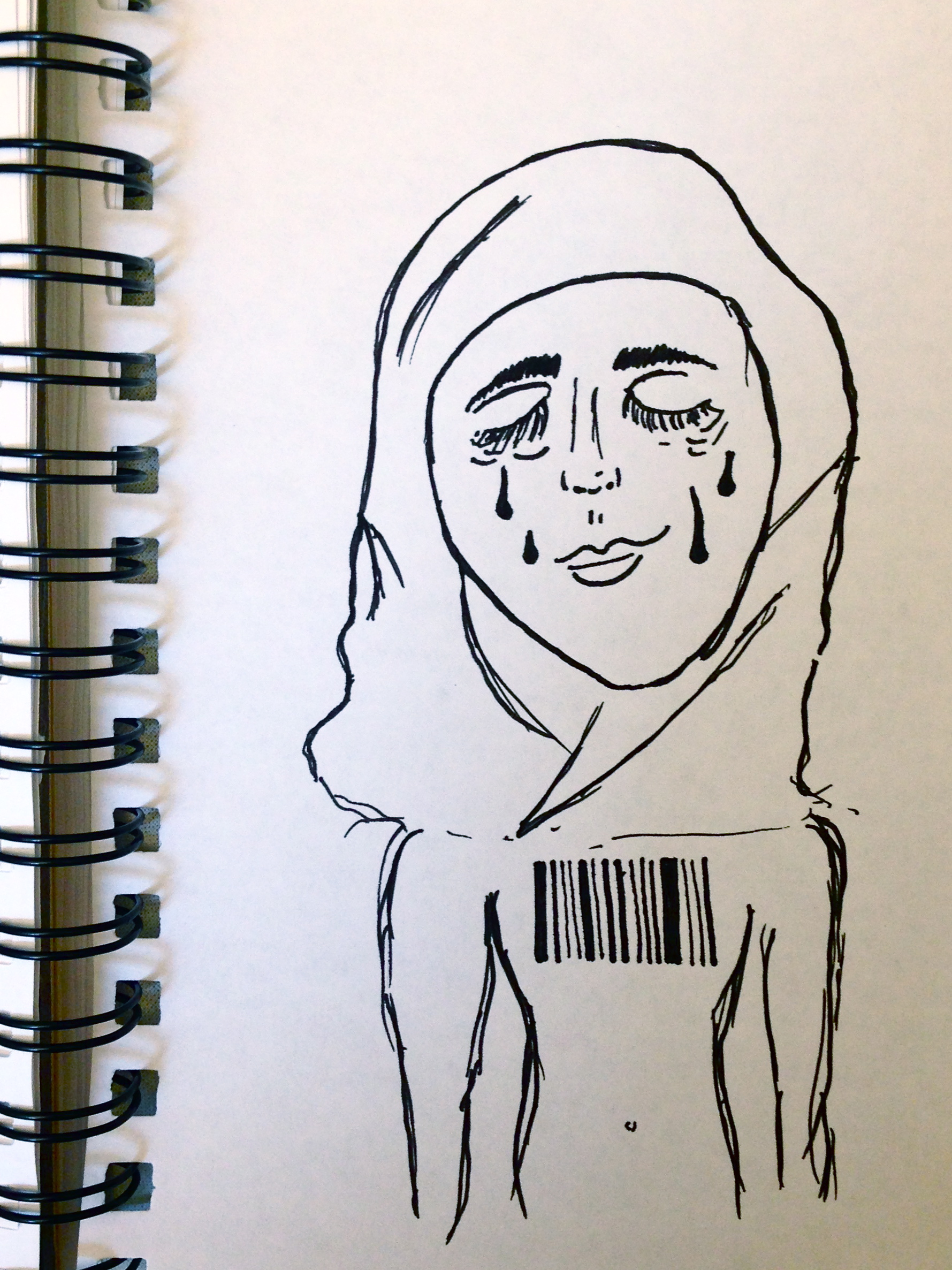
I decided to make these drawings to show how disheartening it is when women are viewed simply as objects. When their worth is stripped away from them, it’s a painful thing to see. Within the bigger picture of female discrimination I included a representation of other major prejudices as well: religion, age, race and gender discrimination are all included.
Something that I have thought about a lot more since taking this class is the judgments we make based solely on appearances. Take this Muslim woman, for example. The scarf wrapped around her head is representative of her religion and seeing this, people automatically make assumptions. That she is weak, that she has no power… all based on generalizations of a patriarchal society. I thought that it was so interesting when we talked in class about the head scarves, and how many women wear them as an expression of liberation, and how many women wear them by choice instead of force. In this way, this expression of faith is beautiful and should not be discriminated upon.
The third picture depicts discrimination against race. An age old fight against the difference in skin tone. This is one that we’ve made great leaps with, but is still present.
The second picture depicts a young girl, innocent and yet still distraught, because she is quickly being exposed to the cruelties and injustices of the world. She is young; her thoughts opinions aren’t seen as valuable to the world yet. She has little influence on those around her. I think that this picture and the fourth one go hand in hand. The fourth picture represents the effects that societies expectations have on young girls when they grow into young women. Society expects women to follow the so-called social norms. They must follow certain guidelines to be perceived as beautiful. Be thin, be athletic, be polite, be feminine and graceful. All are things that young girls hear as they grow up. This girl in the fourth picture is struggling to keep up with what society is telling her to do in order to be beautiful, and that’s not beautiful.
Through these dark images, I hope to invoke a sense of awakening, the need for change and ultimately, the need for equality between ever race, sex, gender and religion.