Archive for April, 2018

Conference of the Birds: Self-Transformation

Wednesday, April 25th, 2018

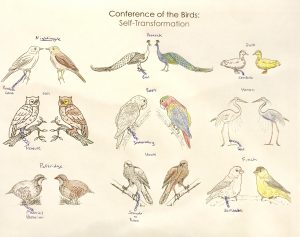
A major question that has been consistently asked in this class is “Who’s Islam?”. One perspective of Islam that we learned about was that of Sufism. Our reading, analysis, and viewing of the epic poem Conference of the Birds was a great tool to understanding the beliefs associated with sufism. The epic poem uses different birds to illustrate the vices and mechanism by which humans stray away from the path to God, enlightenment, and growth. One concept of Sufism that is incredibly important is the idea of self-transformation and annihilation of the ego. The Conference of the Birds does an amazing job of illustrating this concept by showing the transformation that each bird goes through as they make their way to the find/meet their mystical ruler, the Simorgh. At the end of the book, the birds reach the palace of the Simorgh only to find a reflecting pool in which they see themselves, which is a demonstration that God/Enlightenment is not external but intrinsic to all life as we are our own Simorgh. I was very fascinated by this book and the concept of self-transformation so I created this piece with sketches of the different birds that are represented in the poem to show their spiritual transformation. The piece shows the transformation of the birds in three ways. Firstly, each bird has a duplicate that is looking back at the original. This duplication shows the self-reflection that the enlightened birds must do while also, on a more positive note, showing the potential that each bird has in annihilation of the ego. Another way I illustrate the transformation is by giving the enlightened/transformed version of each bird color while keeping the original in black and white. The color is meant to show he fulfilled potential and beauty that comes from the spiritual journey that the birds struggle through. Lastly, I show the transformation that each bird goes through in regards to detachment by getting rid of the vices that weigh down the original version of the birds.
Ghazal inspired by Persepolis

Wednesday, April 25th, 2018

Journey Home

by Abdurezak Shemsu

Forget the world is on Fire and seek
Take in every desire and seek

For the journey home has always been long
Investigate your soul, enquire, and seek

Take the journey to where the heart and soul meet
Be honest, reflect, ceasefire and seek

Fortify your soul with empathy
Uplift, bring your people higher, and seek

And if you fail to find your way
Forget the struggles prior and seek


For this creative piece I decided to take a stab at writing my own Ghazal. Throughout this course we have seen the political, spiritual, and personal impact that poetry has had on so many nations and individuals and I wanted to experience the process of creating one. For inspiration I looked to the graphic novel Persepolis by Marjane Satrapi. In reviewing the graphic novel, I observed the repeated theme of “identity” and “finding a home”. The book in short is an autobiography of Marjane Satrapi and her search for self and home in the intersection of both an Iranian and Western identity amidst Iran’s troubled political and social past. It is clear that the chief conflict in Satrapi’s story is the tension that comes with Iranian and Western Identity. Satrapi never really feels at home whether she is in Europe of Iran because when she is in Europe she encounters a lot of racism and prejudice and when she is Iran she does not feel free to do what she wants and be who she wants to be (In addition to being accepted). At the end of the graphic novel, Satrapi’s sentiment is that home is neither in Austria nor in Iran and she is forced to ask if Iran will ever be home once again. As a Muslim immigrant, I resonated with Marjane’s struggle. A lot of my life has been filled with the struggle of trying to find the intersection of my American Identity with my Muslim and Ethiopian Identity. In this Ghazal I try to express that struggle.

Cultural Studies Approach to Understanding Islam

Wednesday, April 25th, 2018

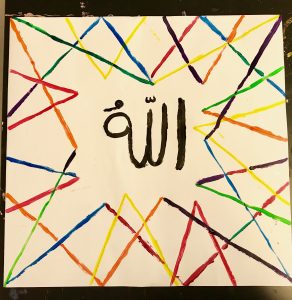
One of the major/most important themes of this class has been the importance of asking “Who’s Islam?” and taking a cultural studies approach to understanding the way that Islam is interpreted, practiced, and expressed in different communities of Muslims. Because the Quran is a text that is open to interpretation, there are a lot of different ways that interpretation and practice manifest themselves among these different communities of Muslims. However, although this is the case, many people have a very singular view of what Islam is and what it means to be Muslim. To illustrate the diversity of Islam, not just in the people who practice it but also how they practice, I decided to paint a symbolic geometric painting with the word “Allah” in the middle. The interconnected lines found in the geometric shapes illustrate all of the different ways that people worship, interpret, and practice Islam. The center piece of the painting, the “Allah” in arabic, illustrates the idea that at the end of the day even though Islam manifests itself in many different forms, the core principal/mission is to worship God and build a relationship with him. The different colors of the lines are symbolic of the diversity that is found in all aspects of Islam. The overlapping/inconsistencies in color are also meant to symbolize the overlaps and tensions that come forth from the differing view points and beliefs of Muslims across the world.