You are viewing a read-only archive of the Blogs.Harvard network. Learn more.

Mystical Meditations and Other Miscellaneous Musings

Month: March 2018

Week 5: Expressing Theology Through Drama

Today is Palm Sunday for Catholics all around the world. On this day, the gospel reading at Mass is different from any other day of the year. While most Sunday readings of the gospel change yearly, this feast day alone is commemorated with the recounting of Jesus’ passion. This narrative has been interpreted throughout the years in dramatic forms that have come to be known as passion plays. It is fitting then, that on this day I make this blog post about a passion play in the Muslim tradition.

The Ta’ziyeh is one of the most powerful examples of this dramatic genre known as “passion plays.” In this theatrical production, Shiite Muslims in Iran perform a reenactment of the tragedy of Hussein, the grandson of the Prophet Muhammad. The tragedy recounts the death of Hussein, along with his male children and companions in a brutal massacre at Karbala in the year 680 AD. Hussein’s murder, the consequence of a prolonged power struggle for control of the newly emerged Islamic community following the death of the prophet, resulted in the formation of two major factions of Muslims that had developed opposing views regarding leadership. This slaughter at Karbala came to be seen as the ultimate example of sacrifice for Shiite Muslims.

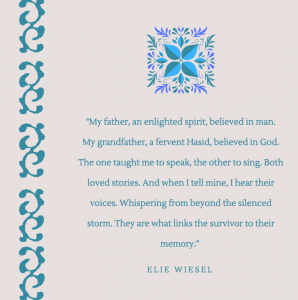
This Iranian tradition which began in the mid-nineteenth century “literally means expressions of sympathy, mourning and consolation…Despite criticism by the majority of the religious authorities who considered it sacrilegious for mortal men to portray any holy personage, Ta’ziyeh became more and more beloved by the people.” (Chelkowski, page 2, 8) This creation and consequent evolution of tradition is exactly what inspired me to make this graphic of the Elie Wiesel quote pictured above. I think the quote highlights the extreme importance of story-telling for the sake of the preservation of history and culture. This sustained tradition that relives the death of Hussein, which underscores the entire Shiite creed, is in a sense linking the survivors to the memory of their beloved martyrs.

I chose for this design to be somewhat simplistic because I wanted the attention to be directed towards the actual quote. But the line of designs on the left-hand side reminded me of similar visuals we have seen in Islamic arabesque. Similarly, the design pictured above the quotation resembled many of the architectural designs I had seen on my visit to La Alhambra in Granada, Spain. Although Wiesel was referencing his own Jewish ancestry, I think this is a lovely example of how humanity is united. Despite differences in cultures, races, opinions, times, and spaces, the human experience is, in fact, universally related. The importance of oral tradition in molding a culture or a people’s history is the same across these differences, and I think that this is an especially fitting representation of this phenomenon.

Week 6: The Significance of Mosque Decor

In Week 6, we looked at the various intricacies of mosque décor and discussed their significance within Islam. As we heard in both of our guest lectures and in the film Islamic Art: Mirror of an Invisible World, there are no laws of Islam that necessarily mandate a standard form or shape from which sacred spaces of ritual and prayer are to be constructed. In other words, the design of a mosque is not dictated or informed by religious doctrine. Furthermore, mosque architecture is not specific to any particular denomination or sect of Islam.

Whereas in Christianity, Protestant, Catholic or Orthodox churches can be visually distinguished, every mosque may be unique in its design but still serves as a place of worship for Muslims of all kinds. Over time, the architectural staples of mosques have evolved and transformed, each reflecting new symbolic values and embodying different facets of Islam throughout the centuries and across the Muslim world. These singular expressions of Muslim identity serve to highlight the diversity that exists within the different communities of Islam.

Though mosques or “masjids” literally signify “places of worship,” these architectural masterpieces have been seen throughout history to take on secular functions. Since Islam’s very foundation in the 7th century, mosques have taken on various roles within Muslim societies. Though their primary purpose is to provide a place for prayer and worship, mosques are common settings for educational, social, and civic celebrations.

Spatial and aesthetic conventions only began to emerge as a response to both political and social conditions. For example, as shown in this media compilation, the spreading influence of Islamic art and architecture to southern Spain created an entirely new genre of mosque architecture, reflective of this morphing of Arab and Spanish culture. This particular geographic region is one that is especially interesting to me because I have actually visited the south of Spain and seen some of these magnum opuses of Islamic grandeur first-hand. The musical mashup that accompanies the video includes some of my favorite artists from this area of Spain, singing about “Andalucia,” the almost ethereal region of Spain that is a visible blend of the three still present and lasting cultures of Christianity, Judaism and Islam. I chose to create both a visual and audible representation of the powerful influence that diversity plays in molding a culture and people. The architecture and music that is a tangible consequence of history is felt by anyone who witnesses their beauty.

Week 2: Constructions of Islam

In Professor Asani’s second chapter of Infidel of Love, he notes that “Diversities of language, religion, or race, according to the Muslim scripture, are to be respected as signs of divine genius and opportunities for mutual understanding, tolerance, and compassion between nations and communities.” Of the many themes discussed in the first couple weeks of lecture, this was perhaps my favorite. The notion of the term ‘muslim’ as one that refers to any member of the universal community of believers, regardless of the particular faith that they ascribe to, is one that I find incredibly accepting as a devoted Catholic still eager to learn about Islam and open to any Truths it may hold therein. Discussing the difference between “Muslim” with a capital ‘M’ and “muslim” with its aforementioned, all-encompassing definition, made me realize that believers ascribing to Islam, although confident that Islam is the religion of Truth, are very pluralistic in their conviction that all religions are striving towards the same personal encounter with the Divine.

This quasi-collage of “muslims” pictured above was inspired by this pluralistic outlook. Despite diversities of language, religion or race as Professor Asani mentions, all of these communities of believers are united in their yearning for the transcendent essence that lies at the root of all creation. These differences are not meant to be seen as divisions, but rather as “signs of divine genius” and as chances to grow in understanding of and foster relationships with our fellow man. It is for this reason that I believe so many world religions, traditions and spiritualities hold the celebrated “golden rule” so intimately to their creeds. At their very core, the religiously inclined want nothing more than to spread compassion and to uphold justice.

Professor Asani also notes that “Anyone who is polluted by violence cannot, by definition, be a Muslim. Instead, the faithful need to cultivate within themselves so that they can extend compassion to all of God’s creation.” To be Muslim does not simply require biological happenstance and knowledge of the Qur’an. To be a true Muslim means to recognize that all believers are part of the same family and that they all share a common mission to be the love in whose image they believe to have been created, and to make an effort, however grand or slight, to leave this world a bit more uprightly than they found it.