

Reading: Infidel of Love: Exploring Muslim Understandings of Islam Introduction
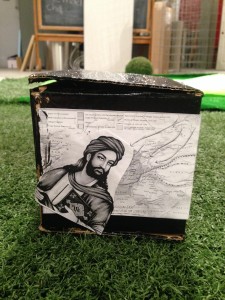
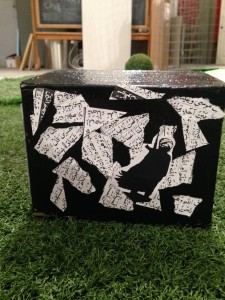
This box represents cultural and religious illiteracy and misunderstanding of religion. Professor Asani stated in his introduction that people usually categorize and paint “with a single color and a single brush stroke” difference and in that sense failing to acknowledge or perceive the diversity, beauty and complexity of other cultures. For that reason, all the human figures or images representing different aspects of Islam are in black and white on the box.
Professor Asani emphasized the problem of religious and cultural illiteracy, how misunderstandings and ignorance can lead to misconceptions and tensions between and within cultures. I thus decided to represent Islam as a black box, reflecting various erroneous or narrow-minded views people can hold of the religion. It is important to understand that I make no reference to planes’ black boxes in any way. I decided to take a box after remembering the saying “Think outside the box”. For me, it involves thinking for yourself and not taking for granted what you are told. I then chose the color black to show that narrow-minded people have a vision of Islam that is not enlightened, they are behind a sort of “veil of ignorance” and have no access to “light” as in truth or wisdom.
The 4 sides of the box represent lens through which religion can be approached: through devotional or textual approaches (as mentioned in the introduction) or by looking for instance at the history of the religion or its artistic traditions. But looking at each separately does not give a correct and well-rounded idea of Islam. Looking at Islam only through a devotional approach (doctrines and rituals for instance), leads to “rarely acknowledging the diversity of interpretations and practices” . The textual approach can lead to misinterpretations if one ignores the context in which the scriptures were written and be ground to “exclusivist interpretations” and “extremisms within religions” such as the emergence of a deadly interpretation of “djihadism”. Only looking at Islam’s history or at its artistic expressions (calligraphy, architecture etc.) are two other ways of interpreting religion. Although these two lens of studying religion are not as dangerous as the previous ones, they do not give a full understanding of Islam and only allow the viewer to access a limited and fragmented insight into this religion.
Instead, knowledge and understanding of religion reside in the opening of the box, in being curious enough and rigorous enough to explore religion in its entirety and integrating all its different aspects at once when studying it.
Recent Comments