Before taking this class, I did not know much about Islam. Coming from a French catholic background, I had mainly heard of it through media and newspaper articles. Most of the content I had been exposed to concerned immigration from Arabic countries, its political and social implications such as the rise of extreme-right wing party in response to the fear of an “islamization” of France. And I had heard a lot about the conflations made about the Muslim communities, especially after the Charlie Hebdo attacks, and was aware that many people hold misconceptions about Islam but I did not actually know what its practices were, its culture and was completely oblivious to its complexity and diversity. I knew who Muhammad was but nothing about his story, I knew about the Qur’an but had never read a verse, I knew about some rituals but nothing about their multiplicity, I knew about the rivalry between Shia and Sunni but nothing about the diversity of communities of interpretation. I discovered during the course of this semester that I was religiously illiterate and that most of the people from my community and background were too. And this religious illiteracy can lead to many misconceptions and generalization. “For the Love of God and His Prophet: Religion, Literature, and the Arts in Muslim Cultures” has not only been an eye-opening experience about Islam and Muslim communities but also a life-lesson on how to approach religion and unknown situations in general so as to get educated and well-rounded pictures. The course looked at Islam through different lens: we have explored its artistic expressions, its rituals, its political past, its history and its Scriptures. Most importantly, the course underlined the multitude of branches and diversity of Muslim communities of interpretations. In my art projects, I have tried to reflect on three themes we have explored in class: religious illiteracy and ways of approaching religion, the differences and similitudes among communities of interpretations of Islam, and finally art expressions and artistic rituals in Muslim traditions. In order to do so, I have 6 art projects using visual arts such as chalk, collage, water color pencils, pen and 3D objects:
- “Streams of Interpretation” in response to “Communities of Interpretation” by F.Daftary
- “Spring Stroll” in response to “Persian Sufi Poetry” by De Bruijn
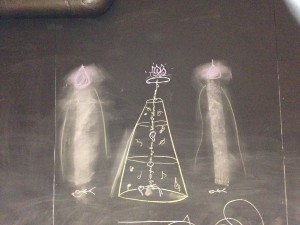
- “Samā’, Love and Ascendance” in response to “The Sacred Music of Islam: Samā’ in the Persian Sufi Tradition” by Leonard Lewisohn
- “Four Prominent Ideals” in response to Infidel of Love: Exploring Muslim Understandings of Islam by Professor A. Asani
- “The Beloved Light: Prophet Muhammad” in response to Infidel of Love: Exploring Muslim Understandings of Islam by Professor A. Asani
- “Box of Ignorance” in response to Infidel of Love: Exploring Muslim Understandings of Islam by Professor A. Asani
***
The first theme we have approached in class and that I have tried to reflect on in my first post is religious and cultural illiteracy. We have seen in class that these two forms of illiteracy often lead to “clashes of ignorance”. That is, a number of conflicts, tensions and misconceptions about others stems from ignorance about others’ culture, traditions and beliefs. Man is scared of the unknown. And unfortunately, fear is often followed by suspicion and can even lead to hatred. The Western world is often illiterate about Islam, its traditions and its people. For instance, one of the most common misconception we discussed in class is the belief that the majority of Muslims live in the Middle East. In reality, 62% of Muslims live in South and Southeast Asia. The reason why there are so many misconceptions about Islamic communities stems from the way people learn about Islam: through the media. The media have in the past decade mostly talked about this religion when reporting news about wars and conflicts in the Middle East or when reporting violent barbaric acts committed by extremist organizations such as Al-Quaeda or ISIS which pursue what they interpret jihad to be. Ignorance about Islamic culture combined with biased and narrow-minded information leads to misconceptions and “ill-informed characterizations” about Muslims and Islam. People usually only look through one lens at a time, for instance looking only at the Qur’anic Scriptures, or at the political ideals motivating certain Muslim groups etc. This way of looking at things and in particular at Islam have lead to problems such as the Ahmed Mohamed clock incident we talked about in class or many stereotypes. People fail to acknowledge the diversity of Muslims communities and do not have a well-rounded and well informed view of Islam. I tried to illustrate this idea with my project “Box of Ignorance”, to reflect how misguided people are and what they are missing when they are looking at religion, in particular at Islam, through only one lens.
In class, we have looked at different facets of this religion to get a well-rounded picture, we thought “outside the box”. We have learnt about the history of the Islamic movement; we studied the rise of Muhammad, the political rivalry existing between him and poets, the influence of colonialism on the redefinition of Muslims’ values in the XXth century etc. We also explored different artistic Islamic expressions such as Rumi’s ghazals, calligraphy, or Ta’ziyehs. We not only looked at different types of arts (music, dance etc.) but also at arts from different time periods and places, listening for instance to the modern hip hop song “Muhammad Walks” by Lupe Fiasco and to classic recitations of the Shahada (call to prayer) in the Middle East. We also studied mosques, their architecture, their function, the importance and debates of ornaments and art, and we even had to design our own. Finally, we looked at both Scriptures and sacred texts (the Qur’an but also hadiths for instance) as well as studied certain rituals and how they differed from one place to another ad from one time to another (Qur’anic recitations for instance). And every time we looked at one aspect of Islam, we always looked at its “historical, political, economic and cultural” background. This multi-contextual and cultural approach allowed us to get a better understanding of Islam, a more rounded and less narrow-minded picture. We were able to explain the why of the what, the reasons behind some characteristics, values and rituals for instance. This thought-process is not only useful when studying Islam, but can be more generally applied to the study of religion or of anything new. It avoids making false and hasty assumptions. Here, it also allowed us to perceive more accurately not only what was common to all Muslims but also the differences and nuances existing among the multiple communities.
Indeed, another theme we have explored in class is the similitudes and differences among the various Islamic branches.
To learn about these similitudes, we have read about the history of Islam, its emergence and about the values and ideals commonly found across Muslim groups. The rise of Islam is the common root to all Muslim communities. The religion can best be understood as having been brought by the Prophet Muhammad. He is the symbol of union of all his followers, of the entire umma. The best example of this general agreement is the Shahada, the profession of faith which is commonly seen as an essential criteria defining a Muslim: “There is no god but God. Muhammad is the messenger of God”. The way the Prophet is perceived is usually a consensus among all communities of interpretations. Muhammad has been subject to a real cult of personality across time and space. I have tried and explored in “The Beloved Light: Prophet Muhammad” the different roles he plays; as a Prophet and messenger from God, as a role model, as an intercessor and finally as God’s beloved.
In the reading of Chapter II of Infidel of Love: Exploring Muslim Understandings of Islam, we learnt about common Islamic values and beliefs that transcend groups’ differences such as “peace and compassion, social justice, love of God and jihad”. I explored these fundamental pillars in my sketch “Four Prominent Ideals”. Although I have only reflected on these two important parts of Muslims’ identity (values and veneration for Muhammad), it is important to note that the similitudes among the different communities of interpretations are not limited to certain beliefs and attitude towards the Prophet. We have seen for instance that some rituals, traditions and arts are commonly found across the different groups. In class, we have for instance compared calligraphy from different parts of the globe and from different times (watching for instance videos of Chinese Calligraphy and observing calligraphy from the Middle East at the MET). We also watched the movie “Koran By Heart” which illustrated the importance of Qur’anic recitations all over the world, even for groups that cannot speak Arabic! Some characteristic of Islam can be found in all communities, they are markers of Muslims’ identity, but they are
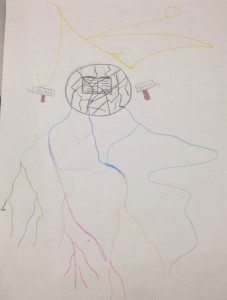
Of course, we also had the opportunity to then learn about the origin of the different branches of Islam, their beliefs and rituals. Islam is not all black and white, different groups interpret the religion differently, disagree on the definition of a Muslim, on the rules of recitation, on the legitimacy of political and religious leaders, their role etc. The cultural studies approach asserts that each religious faith has multiple communities of interpretation shaped by different circumstances such as the political, economic or social background. Each of these communities believe that it is on the “right path” and consider all other communities as “heretics” and holding the wrong values. My art project “Streams of Interpretation” tries to capture and reflect this diversity in Islam and illustrates origins. The reading “Communities of Interpretation” by F.Daftary allowed us to gain a better understanding of the multitude of branches that exist and how they came to existence. Often, these differences have political implications in that communities try and gain the authority to assert their interpretation over others.
The cultural study approach that we applied in this class gave us a great insight into the diversity of communities of interpretations in Islam. They differ in terms of beliefs, political stands but also art and traditions.
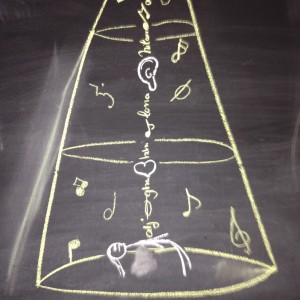
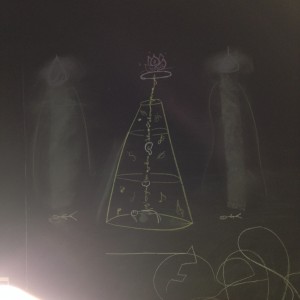
We explored further in class the theme of art expression and rituals within certain Muslim groups. Art has always been a way for Man to praise beauty, to celebrate what he values and in the same time to express his inner feelings. We studied different types of art like calligraphy, music, poetry as well as different rituals such as Qur’anic recitations, or Sufi traditions like the Samā. The rules that these art forms and rituals had to follow differed from one group to another, and were even a source of disagreement within communities of interpretations. For instance, Sufis are mystic Muslims that believe in the enlighten of the inner self trough inspiration, revelation and witnessing. They are opposed to more rationalist and logical approaches to know God. Yet, Sufis can be found in many communities of interpretations, Sunni or Shi for instance. I was particularly interested in understanding how art could be used as a vehicle to get closer to God, to attain the wajd (ectasy). We talked in class about the feeling of “intoxication” with God’s love once one has attained the “ma’rifah” (interior knowledge or gnosis) and “mahabbah” (love). To reach this ecstatic state, Sufis perform the Samā’ (ritual involving dancing ad listening to music and poetry). They believe that it allows them to reach a spiritual status during which they are ego-less and god-centered. I tried to reflect the process and conditions necessary according to Sufi scholars to attain this wajd in my blog post “Samā’, Love and Ascendance”.
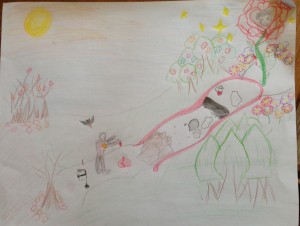
Samā’ is seen as a way to experience God’s love. Muslims in general have also been really interested in expressing and depicting their feelings and love relationship with their Beloved (Allah). The most important and respected medium to do so is poetry. We studied in class more specifically the prominence of the “ghazal” in Middle Eastern and Indian literature. Ghazals are lyric poems about the love relationship between a poet lover and the Beloved and the hardships as well as the joys associated with this relationship. They usual contain many symbols that I have tried to incorporate in my 6th blog post “Spring Stroll”. Ghazals were completely new to me and are really interesting as they use what may seem as controversial symbols to express religious feelings. For instance, wine imagery is really frequent in such poems and is used to mirror the feeling of intoxication Muslims feel when they are full of God’s love. Yet, wine is a forbidden element in Islam. Along the same line, some poems depict relationships between men when homosexuality is once again forbidden. Ghazal captures an important aspect of Muslims’ identity. It illustrates their intense love-focused relationship with God and can help one understand better Islam in general.
Both the Samā’ and the Ghazal are part of the artistic and religious tradition of Islam. They are specific exampled of a more general theme we have been exploring during the semester, which is how art can be used as a medium to get closer to Allah (and for Sufism to get to a higher hal) as well as to praise His Beauty and to express Muslims inner feelings. They are characteristic features and component of Islam. One cannot hope to get a good picture of Islam without understanding the role and importance of art in its religious traditions and culture.
***
I tried to crystalize in my blog post what I thought were important and interesting aspects of Islam. And my hope is that a religiously illiterate reader discovering them would get a glimpse of what cultural studies are, their importance, and will get out of my art project a better and more complete understanding of Islam.
I am really grateful and happy that I took this class! I not only learnt a lot about the Muslim world, got rid of some misconceptions I had of Islam and feel more educated but also have gained an invaluable way of looking at religions and events/movements in general. To avoid ill-conceived beliefs and to be able to grasp and appreciate the complexity of a situation, it is important to be able to look at this situation through different lens so as to define not only the “what” but also its “why” and “how”.
Recent Comments