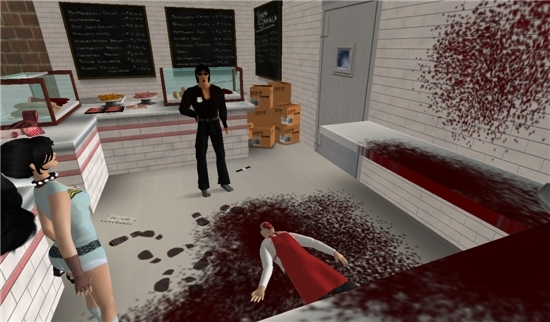
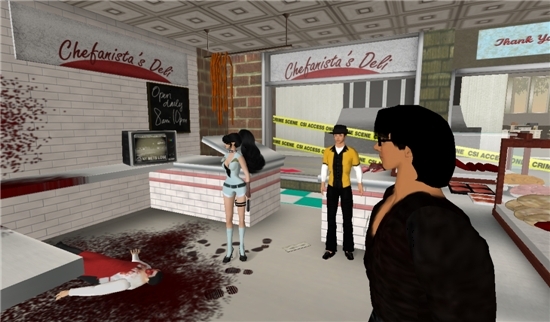
*Note: This was written about my final group project for CyberOne, which was about voice implementation in Second Life. Second Life did not have voice features at the time
1. What were the topic and goals of your group project for CyberOne?
The topic of our group project was to discuss voice introduction into Second Life and address what Linden Labs or Second Life users should do to prevent discrimination of certain user groups.
Our goals were in several phases, because we started out without having a concrete problem, but with the fact that a new technology or service was going to be introduced, and thinking of the problems that could arise from that service.
We began with trying to organize the pros and cons of voice implementation and then went from there to looking at potential problems that could stem from the demerits. We had a very unique project in the sense that we were not trying to solve one specific problem, but rather exploring various scenarios on hypothetical situations based on somewhat similar precedents in cyberspace and real life in how implementation of new technology creates benefits as well as disadvantages.
2. Explain the empathic argument behind your project idea. Who were you trying to persuade? What were the interests of the people you were trying to persuade? How did you find out what their interests were?
Our group project was extremely interesting in that we had a very strong empathic argument going from our very first meeting, because some members advocated voice services and others didn’t.
In an immediate sense, we were trying to persuade Linden Labs, but in a broader sense, we were addressing all users of Second Life. This was a difficult task because we had chosen a service that has not been implemented yet and therefore we could not compile any raw data based people’s current sentiments.
Our main empathic argument was to acknowledge the point that voice brought a number of benefits to Second Life and that implementation of voice does not necessarily mean abandoning text functions, but that introduction of voice itself would inevitably discriminate certain groups or people in certain situations. We especially wanted to point out that voice could actually be threatening or pose emotional distress to people with voice-related disabilities, such as lisps, stutters, or non-native English speakers. We also wanted to address the fact that people may not be in situations to use voice because of work or because they do not wish to reveal their identity, and make sure that these people are not discriminated if the majority becomes to use voice.
We discovered the interests of the parties involved by talking with people who were directly inflicted with voice-related handicaps.
3.How did your project attempt (or plan to attempt) to persuade people? That is, once you had the idea what did you do with it?
One of the biggest problems with our project, as briefly mentioned above, was that it was difficult to persuade people about a problem that has not even taken place. In the case of Second Life users, we had several vague plans on raising awareness so that people would respect (text) chatters. We even went to the extent as to say that we should make Linden promise not to make voice a default like chat is now, so that people are not pressured to think that they have to use voice. However, we did not get to this stage of our project.
4. What aspects of your group project did you contribute significantly to? Please list and describe them in detail.
I believe my experience in actually “living” a digital life contributed greatly in foreseeing possible problems. Towards the end of the semester, I took on the role of group leader, because I had the highest attendance level of group meetings and therefore had the best sense of the developments in our projects. This leadership role, however, taken up at too late a point, was only used to assign specific tasks for the final project. I was also in charge of making a final machinima after each of the other members uploaded their podcasts.
5. If your group had more time to devote to the project–for instance, if the course still had a month left–what would you do next on your project? Are there things about your project that you would do differently if you could start again?
Although the topic of our project was interesting, if I had a month left, I would change the topic altogether and focus not on a hypothetical problem, but on one of more imminent interest, such as urban zoning issues, which could evoke more immediate response.
I believe bad choice of our topic came from our lack of knowledge about Second Life and over-enthusiasm for new services. Problems in Second Life, however, cannot be found without spending more time in Second Life. This would require all the members to devote more hours to the virtual world, which is a very demanding and a difficult thing to request since all members are busy in real life.
If topic-changing is not possible, an important thing that our group lacked was finding a very specific thesis statement that involves actual action. It would have been nice to spend more time on honing that section.
6. Tell us about your experience in Second Life this semester. We’re interested in how it affected your experience of the class, your relationships with us and fellow students, etc. What did you like about it? What didn’t you like about it?
Second Life proved to be a very intimate and friendly place, perfect for building interpersonal relationships. Although we were speaking through avatars, the fact that the meetings were taking place real-time and in person made SL meetings very “real.”
I especially appreciated how close I, as a distance education student, could feel with my instructors and felt that such classes in 3D virtual worlds are optimal for giving lectures the ‘personal touch.’ That intimacy also applies to classmates- in other distance classes, it was difficult to form a relationship with other classmates or engage in a real-time conversation. Second Life gives the student a chance of experiencing a very realistic, participative class that increases the quality of course itself.
The main negative aspect about Second Life is that people still consider it as a game instead of a virtual platform. There is little sense of classroom ethics or decorum or other basic rules that people would naturally keep in real life, but dismiss lightly because Second Life is a cyber platform.
I do not think that offline education should be Spartan, but a certain level of online etiquette and stricter classroom rules should be introduced so that SL courses can be more effective.
As for personal observations regarding Second Life, I believe there are so many elements within Second Life that can be explored and studied, but that getting involved in any of the socio-economic issues within Second Life can result in a lot of time consumption. Since Second Life is just as complicated as real life in how it is structured, telling a student to “go learn about Second Life” is like sending one on a needle search in a haystack. Because of the great amount of time that Second Life requires for one to do anything of any significance, Second Life as a mere place of congregation and Second Life as a subject of study should be two entirely different things.
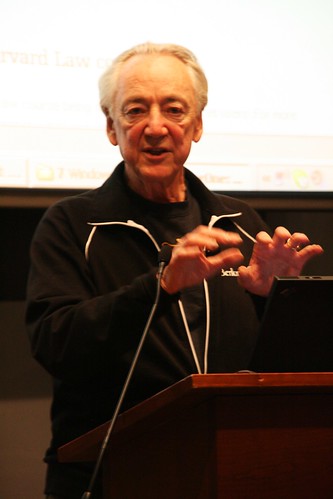 Charlie Nesson spoke to the alumni association today about Second Life and some of the problems we must address if we are to use it as an educational platform.