Archive for the ‘Journalism & Media’ Category

Harry Potter shows the future of newspapers

Monday, January 28th, 2008

Many think of Harry Potter as a being a fictional character and his magical world one that doesn’t exist. The world depicted in Harry Potter, however, shows many aspects of what the ideal (or at least my ideal) is for our future newspapers, one that will be laced with technology instead of magic yet preserve analog aspects of our lives.

For technology, as it evolves, is performing magic in ways that we have never before imagined. The newspaper featured in the Harry Potter books (the Daily Prophet), for instance, is in paper form, but the photos in the pictures are moving images. The Daily Prophet is a preliminary form of what newspapers of the future will look like. Once the “electronic paper” being developed at institutes such as MIT becomes a mass product, our newspapers will look like that. The “paper” will have the traits of the conventional newspaper in that the editors can organize the layout in relevance to news importance, but it will support articles that are magically (digitally) downloaded and the photographs will be stills that become video clips when touched.

Hopefully, future technology will also enable reporters to have the “magic feather pen” that reporter Rita Skeeter has. It will be able to transcribe voice conversations accurately so that reporters will not have to listen to long interviews that they have conducted. Currently, this process has been made much easier due to the digital recorder, which enables audio to be made into MP3s, but a digital transcriber has yet to be developed.

One thing that will hopefully not follow the Potter world is that there will be multiple media in competition with each other. As can be seen in the Potter series, the fact that the Daily Prophet is the only news source helps it manipulate public opinion and shows all the kinds of negative things that can happen when a media is under the control of one party of specific interest (which in the case of the Potter is the Ministry of Magic).

Blogs Won’t Take Over Newspapers

Thursday, November 23rd, 2006

(Week 6 Journal for Cyberone)

Blogs are certainly a form of citizen journalism, but although they prove to be a complementary addition to the existing forms of journalism, they will never be able to take over existing media.

The most critical disadvantage that blog-generated contents contain is the question about how credible that information is. Currently, news agencies and other news-related service providers act as a gatekeeper, which not only protects reporters, but also protects the public in that the entity takes responsibility for what it publishes. Writers of blogs, however, are not yet required to follow guidelines or certain fact re-checking procedures that are undertaken in major news servicers.

It is also interesting to note that much of the controversial blog-generated contents were created by people already involved to some extent, in journalism. The reason these contents became so widely known was because the writer already had an established credibility from his or her job, although that job necessarily may not have a direct link with the particular contents contained in the blog. This is why perhaps, certain Internet portals, in desperate search of UCC, are thinking of beginning a separate blog newsfeed service- not with citizen reporters, but with real reporters, to ensure a certain level of quality or credibility in the news.

However, as citizen-participated news Web sites such as OhMyNews have shown, sometimes the regular citizen notices things that reporters have not. Even with their extensive network of reporters, even wire news agencies such as Reuters or AP could not cover all aspects of society.

News agencies should therefore encourage citizens to participate in generating news contents, but should also establish a separate department with people who monitor such material. In Scandinavia, some newspapers are already doing such services; the contents that they receive from citizens include not only text but photos as well. The only difference is that based on these citizens’ reports, the newspapers conduct indepth reporting to confirm facts provided by the citizen. If this filtering process does not take place, it would be difficult to determine which citizen reports were created out of the feeling of making the society a better place, and which were merely promotional reports with no sound facts to support the claim.

Blogs, as the word web-log implies, are extremely personal areas being used increasingly as a marketing tool, not only for companies, but for individuals as well. But because of the subjectivity (and one-sided views) that blogs allow, readers should keep in mind that the information contained in blogs has an element of high risk.

[Feedback from Rebecca Nesson]

What I want to push you on is the issue raised by Nick Sylvester’s situation. That is, are credible facts actually what makes journalism reliable or unreliable? In some cases the print media uses facts in a way that causes them to be misleading even if they are true. In other cases, such as Nick’s writing, interesting and worthwhile ideas are communicated without reliance on the reader trusting the facts. I agree with you that there are advantages to having a medium where facts are checked, but it seems to me that we often fail to see the advantages of media like blogs because we are so hung up on the facts not being checked. A medium where facts aren’t checked gives a writer a whole lot more freedom in the communication that is lost when you go to a fact-checked medium like print news. We tend to see the advantages of the fact checking without considering all of the modes of communication that we are prevented from getting because of the fact-checking requirement.

Meeting Adam Reuters

Saturday, October 21st, 2006

reu.jpg

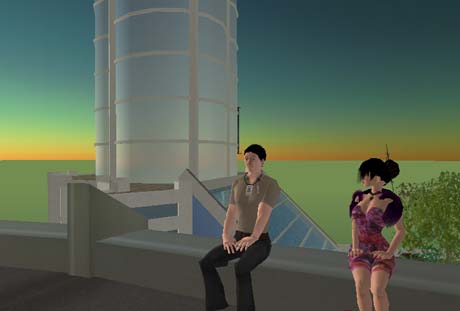
After reading about Reuters, I teleported to the island and was taking some aerial shots when Adam Reuters IMed me.

-I like your dress. I was on the roof and thought I saw a parachute, he said.
-Ah, waiting for Superman now, are we? I said.
-I’m no Clark Kent, he said.
I didn’t tell him that it was Lois Lane, not Clark Kent, that had been waiting on the roof for superman. Besides, Clark Kent was the shame of all journalists. I don’t remember if he ever actually did any reporting. I did appreciate Adam’s great taste in fashion, though. (I was wearing an outfit of my own design, called Paradise)

We sat on the edge of the roof and had a short conversation, sipping Pina Coladas, but only because it wasn’t his official working hours yet. In RL, Adam was on the phone for most of the time, but in SL, at least he was sitting there smiling and sipping his drink while I blabbed on and on about nothing in particular.

The island and the architecture were beautiful, and quite a number of people were there. In the lobby, some people were interviewing a man from Electric Sheep. Outside, there were people lined up to meet Adam. One of them pointed out that his online presence may turn out to be annoying to him, especially since it makes it easier for anyone to meet him. Interesting, on the banners inside for “top news” there was a huge picture of Kim Jong Il. I bet Mr. Kim doesn’t even know his face is hanging in virtual Reuters headquarters.


Adam gave me a newsfeed banner (sort of like Google Toolbar) that you can put in the corner of your screen and click on for updated news, which will take you to the news link. I was impressed that Reuters was so net-savvy as to implement these functions in Second Life. But then again, I don’t really want to have Reuters news hanging in my window all the time. Even in RL I have disabled all the IM-type RSS newsfeed services that most newspapers and broadcasting companies offer.