Archive for March, 2016

Mosques of the World – Debunking Misconceptions of Islamic Art

Tuesday, March 22nd, 2016

Masjids of the World

For this piece, I created a data visualization, to illustrate a central point of Islamic Architecture being defined by local cultural contexts to enrich the subjects of debate between various scholars and critics of Islamic art. In the visualization, I map the geographic locations of various Masjids, by no means comprehensive, but my goal was to take a rather diverse sampling from them (in terms of style and geography).


By displaying the geographic spread of mosques around the world, I put into conversation the viewpoints of scholars such as Nasr, Faruqi, and Necipoglu. Here I will focus on Faruqi’s rebuttal to architecture scholar K.A.C. Creswell in Misconceptions of the Nature of Islamic Art and how it actually supplements Nasr’s consideration of geopolitical context for considering Islam. Contrary to Creswell’s belief that there is only a “Muslim architecture”, Faruqi rebuts that Islamic architecture as a category does exist (Faruqi 33). Through this aggregation of mosque locations, I show Faruqi’s point that Islamic architecture is defined by its unity across believers despite the wide geographic spread of Islam. The architecture, while stylistically regional and diverse, is nonetheless a feature of spreading Islamic influence reinforced by its architecture. Even though Islamic architecture rose out of regional diffusion and mixing with local architecture styles, it should not be ruled out as its own class of architecture simply because of its borrowing from local cultural contexts.


Furthermore, below the map, I created a panel that displays mosque details when their location dots are clicked. By displaying the mosque visuals as well, I invite the viewer to judge and find the patterns between the various mosques themselves. Here are a few to start. Can you see historical patterns emerge in the architecture? Which mosques have minarets? What about the particularly shaped domes distinctive of Persian influence?

My mosque image sources for this project are from Frishmann and Khan’s The Mosque.

The Cloak at Karbala: Inside-out

Sunday, March 20th, 2016

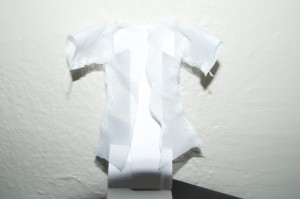
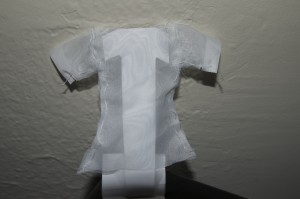
A contemporary artistic take on Husain's cloak.

A contemporary artistic take on Husain's cloak.

A contemporary artistic take on Husain’s cloak.

As an artistic reaction to Husain’s martyrdom at Karbala, I created a miniature hand-sewn shirt-cloak inspired by Husain’s story of sacrifice. The base material is white voile fabric. The total size of the piece is 4’’ x 4’’.


Persian Taziyeh dramas honor the act of Husain’s martyrdom. Considerable emphasis is placed on the fact that even when faced with eminent defeat and death, Husain chose to don ragged robes over his garments. In reacting with my handcrafted piece I mirror the connection between the literary and theological in Husain’s clothing choice by focusing on the message of purposeful worldly transcendence.


First off, the cloak plays the role as a transformative symbol. Only after donning it, is Husain able to make his ultimate worldly sacrifice, giving his own life for his followers. Thus, his cloak intrinsically carries a power that is transcendent of exterior worldly appearance. This is reflected in The Miracle Play translated by Colonel Pelly, when Husain makes a request of his sister Zainab to fetch him his ragged dress:


“I am covered with shame before thee. I cannot lift up my head. Though the request is trifle, yet I know it is grievous to thee to grant. It is this; bring me an old, dirty, ragged garment to put on. But do not ask me, I pray thee, the reason why, until I think myself it proper to tell thee.” (Pelly 90)


On the exterior, the dress is unassuming, humble and perhaps even in the eyes of Husain’s enemy, an outwardly undesirable way to die. It’s a curious fashion choice. Other passages in Pelly’s translation label it as “tattered shirt”, “loathsome thing”, “ragged robe” and “mysterious cloak” (Pelly 91). However, despite the outward appearance of his cloak, Husain’s choice of clothing emphasizes the transcendent nature of his sacrifice.


My piece uses the lightweight and semi-transparent qualities of voile fabric to portray Husain’s cloak in an inside-out alternate rendering of his sacrifice. I choose a light cloth (in both color and weight) not just to honor the Taziyeh practice of casting protagonists in white or green, but also to make the theme of fleeting worldliness clear and visually surface the importance of intrinsic purity (Chelkowski 9).

As Husain utters that the “old robe close to my skin, though neither old nor new of this world can be depended on”, he actually preempts his own worldly transcendence as he departs and focuses importance on himself (Pelly 92). His divestment from the worldly signals his followers to invest more faith in the intrinsic than extrinsic; thus Shia recognize their Imam figure as a religious leader who draws authority by nature of direct inward relation to Mohammed through bloodline. The white of the cloak, with the running of white thread on the seams is a nod to the descendants surviving the last prophet’s prophetic light, raising suggested relation to Mohammed’s own cloak The Burda via the embedded color association. Ultimately, by putting the interior of Husain’s martyrdom on the exterior of a cloak, this piece challenges the viewer to think beyond the surface of Husain’s ragged robes and think about the implications of his clothing choice on the meaning of his sacrifice.


-Week 5

Contemporary Soundtrack to Miraj

Sunday, March 20th, 2016

Medium: Mixtape/Playlist


In response to the Swahili Miracles of Mohammed, I engaged with imagining the various aspects of the levels of heaven during the Miraj and how the process of the journey could be conveyed with curating contemporary sound only. In particular I limited myself to choosing from tracks I could find on Spotify. I chose to break the night journey down into various stages, and match each with a contemporary song that embodied each stage aurally. The end result was a sequenced playlist which interprets the arc of the Miraj divided into five stages of the journey: Flight, Consequence, Ascension, Curtains, Return.


Flight

Buraq carries the Prophet from Earth towards Heaven. I chose “Nights Off” by Siriusmo for this stage. The first thing we hear is an arpeggiator synth (0:00 – 0:14) making a continuous pattern – oscillating between four different chords. This repetition continues throughout the entire song even behind the melodies, conveying a sense of constant and consistent kinesis of the flight. The listener’s heightened sensation of movement is further enhanced with the driving feel of later instruments such as the higher pitched marimba sound (2:15-2:30). These audio factors combine to generate a sense of traveling, mid-air flight, which conveys the Prophet’s journey with Buraq.


Consequence

The Prophet gets a glimpse of the Seven Hells. I chose “Redemption” by Zack Hemsey. Overall Miracles of Mohammed characterizes the scenes of this stage as “hard to describe”, making this a tough song to place overall – I chose to focus on the idea of judgment having a heavy auditory feel (77). The song’s first minute is eerie with the foreshadow of a heavy attack in the backdrop. Starting from (1:00 onwards) this attack of the timpani drums come in and act as the musical motif for judgment, and punishment as the heavy consequence of sin. The attack of the horns in new musical phrases accompanies each changing glance the Prophet makes at viewing another part of Hell – switching view from the evil men forced to drink from boiling cauldrons, to the woman being cooked over a fire alive, and so forth.


Ascension

The Prophet continues up the Seven levels of Heaven. I chose “Still Waters” by Breakbot. The important theme I wanted to convey here was the climb and a consistent but more nuanced sense of rising via ladders and stairs, rather than smoother ride on a flying steed as in the first stage. Even though the drums fall rather straight on the beat, the syncopation of the bass line (0:31 onwards) gives the song an organic stepping sensation while maintaining a positive vibe to accompany the Prophet connecting with the previous Prophets before him across the levels of Heaven each made of a different precious metal or stone.


Curtains

With God’s face-to-face revelation to the Prophet, I picked “Best Moments” by Kondor and Blazo to convey the beauty and holiness of the Prophet’s experience. Miracles of Mohammed reveals upon first meeting God, the Prophet even “fainted, but there was His own hand to support me” (82). This unsure moment of light-headedness is reflected in the beginning before the beat kicks in to regulate the ear. Later the musical motif of the angelic chorus creates musical halos in the listener’s ear, a reminder that divine light and prophetic light have met for the Prophet to receive the commandments, and the beauty of the Garden paradise is finally revealed.


Return

Finally I center on the transcendence of time and space as a theme for the Prophet’s return. With “True” by Spandau Ballet, I finally use a song that has lyrics (albeit rather limited). I did choose it for its calm feel, almost like a lullaby for the Prophet returning back to his bed to go back to sleep. However, more importantly it lyrically touches upon dreams and truth. “But now I’ve come back again”, and “I know this much is true” is repeated in the chorus, to remind the listener that the Prophet’s journey may have happened in a dream-like state, but that nonetheless it is true!


With this mixtape series of five songs and twenty-one minutes, I have created a musical arc representing and recapping the Prophet’s night journey, all expressed with contemporary music which I invite you to enjoy.


-Week 4

Hello world!

Thursday, March 17th, 2016

Welcome to Weblogs at Harvard. This is your first post. Edit or delete it, then start blogging!