Archive for March, 2016

Week 6: The Art, Architecture, Symbolism and Décor of Mosques

Tuesday, March 22nd, 2016

Week 4 Response

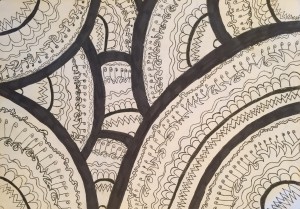
During week six of class, we had discussed three types of mosque designs, including the arabesque, calligraphic, and geometric designs, and how these styles can be combined in various shapes and forms in mosque architecture (Necipoglu 62, 222). I had been particularly fascinated by the photos we had see in class of the Mihrab, specifically of one that we had seen that was black and white (Lecture 3.1.16; Frishmann & Khan 33). As the Mihrab is such a key component of prayer within the mosque, I decided to create my own artistic piece of a portion of a black and white Mihrab. I created this piece using sketchpad paper and a black pen and sharpie. In the image, I tried to utilize both the arabesque and geometric designs (Necipoglu 62). As Muslims view God as “the light of the heavens and the earth,” the white portions of this design represent where God manifests his light in the Mihrab (Renard 7).

In her piece, Necipoglu argues that in order to understand Islamic art, individuals need to employ a semiotic framework and thereby take context into account (Necipoglu 83). The repetition of the various arabesque and geometric designs and its many layers represent the different communities of interpretation that are present within the religious tradition (Daftery 163). In the Frishmann and Khan piece, Graber mentions that the local community affects the design of mosques (Frishmann & Khan 245). Subsequently, depending on the local context, the black and white could represent the interaction between yin and yang. In other words, I would imagine such a white and black colored Mihrab in a mosque in China, where the mosque architecture adapts to the local belief in yin and yang.

To conclude, this artistic response represents the unifying principle that is involved in all Islamic art despite all of the variations you find within different communities of interpretations or within different local contexts (Nasr 3). Perhaps Nasr states what I am trying to express with my artistic response with greater clarity, “Islamic art is the result of the manifestation of Unity upon the plane of multiplicity” (Nasr 7).
Week 4: Prophet Muhammad as Paradigm, the Mi’rāj, and Poetry in Praise of the Prophet

Tuesday, March 22nd, 2016

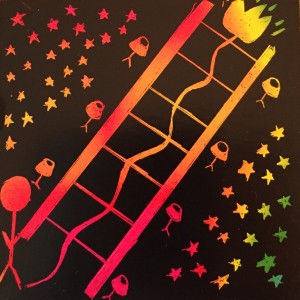
According to Asani, one of the four ways in which Muslims portray the Prophet Muhammad in devotional life is as God’s beloved and mystic. Artists often portray this role of Muhammad through miniature paintings, such as those of Muhammad’s “ascension to the highest heaven and his subsequent meeting with God” or the Mi’rāj (Asani 128). In response to the illustrations of this celestial journey that we have seen during week four of class, I have created my version of such a miniature painting (Lecture 3.1.16). In the Mi’rāj, or his celestial journey, Muhammad meets prophets on different steps of the ladder until he comes face to face with God (Asani 129). Subsequently, in my miniature painting, I have represented the prophet in his ascension by showing a figure beside a ladder. Along the sides of the ladder, there are other prophets, which I have represented through lamps because lamps are associated with prophetic light (Asani 132). At the very top of the ladder, there is a light, or the light of God, to represent God. In the black background, you will find stars that represent the celestial journey. I have thus drawn the prophet as the only individual with a figure in order to distinguish him from the rest of those involved in his celestial journey.

Instead of using canvas and paint, I have made my artwork on a “Scratch Magic Note” because the various colors, or colors of the rainbow, allow me to represent the different communities of interpretations and the various racial, historical, and local contexts of those who practice Islam and may interpret the Mi’rāj in different ways (Daftery 163; Necipoglu 83). Therefore, by including these communities of interpretation in my Mi’rāj, I hope to represent the unity that Islam, and Muhammad, provides for the diversity within the religious tradition.

Week 6 Response

Week 3: God’s Word as Sacred Sound and the Concept of Prophethood

Tuesday, March 22nd, 2016

During week three of class, we focused on the Quran as sacred sound: the Quran is the word of God as God transmitted the Quran to the Prophet Muhammad (Nelson 257). Listening to the Quran then becomes an act of communion with the savior, or, as Nelson puts it, “a testimony to the miracle of human and divine interaction” (Sells 184; Nelson 257). Consequently, when the Quran becomes a part of the soundscape, whether it is on the radio or at a mosque, sound becomes something powerful (Nelson 260-261).

While it has been a long time since I have taken classes in music theory, I have chosen to compose a music piece in response to week three. As I do not understand the chord progression of the Ayat in the Quran, I have attempted to compose music phrases, or verses, that reflect what I think the Ayat we have heard in class sound like. I have specifically used the lower voices of the instruments – the two pianos, guitar, and base – to reflect the voices of the typical human being in Islam: one who is suffering due to his or her forgetfulness of God (Lecture 1.28.16). I have also chosen three instruments to reflect the different communities of interpretation involved in the religious tradition. Consequently, each instrument that I use repeats the same verse but sounds different due to the different communities of interpretations’ interpretations of the verses (Daftery 163). I have also used two pianos in order to represent male and female voices within communities of interpretation because in countries like Indonesia, individuals can even hear women reciting the Quran publicly (Rasmussen 30).

Ultimately, my goal is that through this artistic piece, both the listeners and myself will experience something somewhat sacred and powerful: if these voices are able to work together in producing a coherent music piece, then the different communities of interpretation and men and women can work together in harmony in society as well.