Archive for the ‘Digital Talk’ Category

Death by social media: thoughts on the emerging social challenge.

Wednesday, November 21st, 2018

Rumors have always spread since the beginning of time, sometimes with disastrous consequences for society. They are harmful because there is no way good way to fight them. Yet they can be everywhere. The more vicious they are, the more they are repeated and believed, and targets can suffer irreparable harm from them. Yet modern day social media platforms have multiplied the risk. Whereas in the past, a rumor limped its way around a community, today, it spreads far and wide in a matter of seconds. Platforms like Facebook and WhatsApp are not inherently bad, but they have accentuated the toxic rumors risk. In India, this phenomenon has evolved sometimes with tragic consequences which warrant government intervention in the interest of public safety.

Recurring tragedies
The following cases provide examples of this challenge:

  • In 2017, a message falsely alleging child abductors, speaking  Hindi, Bangla and Malyali were on the prawl, was circulated on Whatsapp, leading to the lynching of innocent people in Jharkhand.
  • In May 2018, a 55-year-old woman was killed by a mob in southern Indian state of Tamil Nadu, amid false Whats App messages and rumors over kidnapping of children.
  • In June 2018, two men that had stopped to ask for directions were beaten to death by a large mob in north-eastern Assam state. They were mistaken for being child abductors following a message spread on Whatsapp leading unsuspecting villagers into believing that their children may be targeted by abduction gangs.

A significant adaptive challenge

It may very well be that mischief-makers bent on causing community alarm and despondency spread these messages, with tragic consequences including disturbing the peace. We cannot however, just pin the blame on the technology, because that assumes people were good prior to the advent  of social platforms.

What is clear is that there is no technical fix to this challenge of vigilante justice. There is neither a silver bullet to it, nor a known answer to the challenge. This situation is a typical adaptive challenge, which has no easy answers. Nonetheless, the remedies to this situation can be found by analysing the key stakeholders to the challenge. These stakeholders can be mapped as follows:
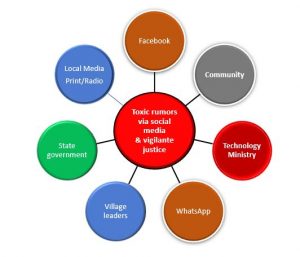
The stakeholders to these adaptive challenges can can be managed as follows:

  • Facebook and Whats App
    With over half a billion internet users in India, according to the Washington Post, both platforms have a significant customer base. Facebook has over 200 million users while WhatsApp has over 270 million users. Since Whats App is owned by Facebook, we can argue that the same company has nearly the entire population on the Internet in India on their platforms. Because India contributes almost a quarter of Facebook 2.27 billion users, it is important that Facebook understands its responsibilities to public safety in a market it has a significant stake in. To that extend, engaging both Facebook and Whats App ought to focus on:
    – Engaging both platforms, which derive significant value from India, to send messages to their users warning of the spread of such toxic rumours on their platforms, especially once alerted by either the public or authorities.
    – Request users to flag or alert them within those platforms where a suspiciously toxic and dangerous message or video if being circulated. This helps to crowd-source risk management or flagging of such messages as it may not be possible for the platforms to check all messages/content users circulate. This is especially important for Whats App which does not currently have such a feature.
    – Engage Facebook to prioritise posts by professional media which usually flag such rumors when they start circulating. This is especially important because Facebook in March 2018 presented a separate newsfeed on their platform that prioritises content from family and friends while hiding away posts by professional news organisations. This has the effect of promoting and amplifying such rumors among friends and family making professional news debunking of such rumors less prominent.
    – Nudge Facebook and Whatsapp to engage local language moderators who understand local nuances to sift through content and moderate it. This would be complicated for Whatsapp that encrypts its messages, but this is where they need to crowdsource this risk by implementing a reporting function.
    – Push both platforms to set up a local corporate entity as well as appoint a grievance officer to manage and help curb the spread of rumors that have claimed several lives.
  • Local Community/Village Leaders
    For local communities, the fundamental issue is educate them to promote community cohesion and peace. For example, once the rumors start spreading among the community, the leaders in those communities can flag the issues with authorities to ensure that law enforcement kicks in. This issue goes beyond the social media platforms, it is about promoting tranquility among people in local communities.Dealing with the community entails engaging community leaders. For this to be successful, the ministry can arrange training, for example via seminars, for both law enforcement officers and community leaders in order to curb vigilante justice.In addition, there is no point in wasting a crisis. The ministry should coordinate with the justice ministry to ensure that the law is not just enforced, but perfect examples are set for perpetrators of vigilante justice.
  • Technology Ministry/State Government
    The ministry and state government both play a role in ensuring that the above stakeholders play their part, and that education programs are implemented. Evolving adaptive challenges like these require leadership, and its important for the ministry to lead these efforts, including engaging all stakeholders. In addition, the ministry can also try the following:
    -Holding social media groups administrators responsible. This is particularly important for WhatsApp where toxic messages can be circulated/broadcast rapidly within groups. Holding administrators within groups can help push for responsible actions within groups to make sure that someone is accountable.
    – In times of emergency situations where there is a severe breach of the peace or loss of lives due to nasty fall-outs arising from these rumours, the ministry can try, as a last resort to temporarily switch of the Internet access to the two social media platforms via local internet service providers. While turning off the Internet can be a plan B in times of crisis, it is not a solution to the spread of hate rumors. It simply slows down the pace. What is important is to work towards building social cohesion. Neither Facebook nor Whatsapp created the problems of distrust in the communities.
  • Local Media/Radio Stations
    Professional media can be mobilised too to help correct and counter toxic rumors that have had tragic consequences. Radio would be most effective where it has coverage as the message can be broadcast to a broad audience. 

A double edged-sword.
Technology has brought with it massive advantages to information dissemination. Platforms like Facebook have democratized communication tools by enabling anyone with a smartphone the ability to broadcast. However, these are just tools, and they can be used to spread constructive messages, or hate. Just like in the past, traditional mass media has been used to mobilize mass violence. The genocide in Rwanda in the 90s provides an informative case study. We cannot wait for tragedies and genocides to occur before we move in to manage these new e-platforms. They must be responsible, and must be held responsible as they can supercharge content that ratchets up tribal and religious hate which can upset fragile social balances in communities. 

Lean starting up and how to be agile: A lesson from the past.

Monday, September 24th, 2018

Success is great. But failure can be greater, if you take the lessons! This is not to say failure is not annoying! It is annoying. Yet when you fail, you learn. You learn how to fail, and how not to fail. Better still, failure gives us lessons on how things should have been done, had we known better. Being in business school making armchair analysis gives you an air of invincibility, but getting into the actual act of managing projects, running a business or setting up one is a different ball game, which provides hard lessons. I call it a university of hard knocks. Here is a typical story of failure, from which I learnt lessons on what to avoid in my subsequent ventures. This account emphasizes two approaches relevant to executing projects, namely the agile approach, as contrasted with the waterfall method.

My first e-commerce project was in fact motivated by my business school research on retailing business models. At the time, Amazon was rising. So was Rakuten, the largest e-commerce business in Japan. The question on my mind was, why not explore that in Africa? I knew there were some known knowns, known unknowns and unknown unknowns in such a venture. For example, I knew the existence of retail businesses in Zimbabwe meant there were retail customers. I also knew there were no online payment options, and it was necessary to set-up one. I also knew there would be delivery hassles, among many others hiccups. In short, there was no e-commerce ecosystem. I was also clear about the business model to explore. I also knew I had to bootstrap the start-up, given lack of venture capital. But there were other things that were unknown to me at the time, the agile approach to executing such a venture. Had I known better, I would have executed it differently.

With my friend Mansour Ali, we mapped the project plan in his apartment in Fukuoka. After years of doing projects in banks, making sure there was a project plan prior to starting a new project had become second nature to me. Where is the project plan? Who is the project owner? Who is the project manager? What are the steps to the project? Which group of activities go first? What is the critical path?  These were key questions I sought to address first. It was all a silo and compartmentalized mindset acquired from previous experience running banking projects.

I was the project sponsor, Mansour was the project manager working on the platform development. I was to fund everything necessary, implement the project in Zimbabwe and lead the deployment, stakeholder management and business development. With hindsight, our approach was a typical waterfall approach: build the online marketplace, add as many features we deemed necessary as possible till it looks great, perform an internal test of the platform, then sell the platform to existing retailers so that they can sell their products to a broader audience online, find a payments solution and figure out how to execute delivery, then launch, and succeed!

The entire process took several months. It was complicated by the fact that we both had to work full-time on our other jobs. Mansour ran his other business while I worked separately elsewhere. It was worsened by the reality that he sometimes traveled halfway around the world to Oman, where he was developing a car exports business. Each time he traveled there, he would stop working on the project on account of internet controls in the host country. As the key developer and project manager, this caused serious delays. This complicated the waterfall approach we took as it took very long to launch the end product, an multiple merchant e-commerce marketplace.

Pazimba.com homepage

After over 9 months of working on the project, and an investment worth several thousands of dollars in time and money, we launched the online marketplace in the last quarter of 2014. We got fairly good media coverage in key technology websites and daily newspapers. At that point we had a handful of very good merchants in the country who signed up to run virtual stores on our platform, including a well established book publisher with a very rich catalog going back several decades. Getting merchants to sign up turned to be a complex task. It was a long pipeline that involved travelling across the country to make presentations to each of them. In each case, we had to explain the features and benefits of running a web-store. What became clear was that most of them vaguely knew about e-commerce, but had never thought about using the internet to sell their products. In general, they were not convinced they needed to have resources set aside to run a web delivery channel. This started creating several unknown unknowns we had never factored in our waterfall development approach. Though we got some merchants to sign up alright, the biggest unknown unknown was that we had to do much of the work ourselves because merchants neither had the time no human resources to either update their own catalogs or processes deliveries. This left us running from pillar to post to cover all the gaps. The work was tedious. Finding a delivery solution was also not easy. Fortunately, unlike other African countries, like Nigeria, Zimbabwe has an effective postal address system. We therefore partnered Zimpost (the national postal service), which delivered packages reliably at a low price. The price was low at the beginning, but was changed upwards a few weeks later. We did not have enough critical mass to negotiate the price downwards. All these dynamics were unknown unknowns.

After a few months working on the venture, it became obvious that we were bleeding money. Mansour was getting disillusioned. It became clear that we has to scale down the project. And we did. It was not necessary to continue bleeding more resources.

Pazimba.com marketplace

The question is what should we have done differently. It became clear several months later that Zimbabwe was just not ready for e-commerce. What were my assumptions, that made me proceed anyway with the project in spite of all its blind spots? I had proceeded because I believed that Henry Ford’s quip, “If I had asked people what they wanted, they would have said faster horses,” would be turn out true in our case. So we did not engage the market as we as necessary as we proceeded to implement our solution, at a huge cost.

Yet we could have done things differently. How? Had we been more agile in our deployment, we could have seen sooner, at far much less cost, that there was not much light at the end of the tunnel. How? Had we followed the agile lean start-up approach, we could have tested our idea before proceeding all pistons firing to implement it. We could have tested our assumptions and hypothesis first by engaging merchants/retailers to assess their appetite for online delivery channels. In addition, we should have sampled potential buyers first, to validate our assumption that they would somehow use the solution. We knew that buying anything online had not grown on our potential customers, but we assumed our efforts would change their behavior. We should have validated those assumptions through an agile approach. What else could we have done? Had we established some level of appetite from customers and some merchants, instead of spending months building a fully fledged multi-merchant e-commerce platform, we should have built a thin minimum viable product off commercial templates to prototype and validate our assumptions. We could have done this by setting the prototype platform one one merchant to gauge the potential interest from consumers.

As it turned out, we did not, at great cost in terms of money and time. Lesson: always implement any venture or project in agile fashion. Validate your assumptions, figure out how to prototype and deploy a minimum viable product, and be sure its worth proceeding before investing huge amounts of money that are irrecoverable way later.