You are viewing a read-only archive of the Blogs.Harvard network. Learn more.
Stop Torture » Torture

Stop Torture

The Harvard Anti-Torture Coalition

Archive for the 'Torture' Category

53 Apologists and 7 Bystanders: It’s a Dog Eat Detainee World Out There

Posted by stoptorture on 9th November 2007

The Senate vote for torture (Mukasey) is in.

TORTURE APOLOGISTS (boycott them here!):

  • All 46 Republicans present voted for torture. Three were absent [see “WEASELS”].
  • Six Democrats [Bayh (D-IN), Carper (D-DE), Feinstein (D-CA), Landrieu (D-LA), Nelson (D-NE), and Schumer (D-NY)], plus Lieberman (I-CT) also voted for torture.


BYSTANDERS
:

  • Seven senators did not bother to vote, most notable among these, Senator McCain (R-AZ), torture survivor, and all of the Democratic senators who are candidates for president. Sure, candidates Biden, Clinton, Dodd, and Obama all talked the talk of opposing Mukasey, but why should they ruin their “electability” on something like torture when they can say the words of opposition to torture (like Bush does) and take no meaningful action? Way to learn a lesson from your opponents, Dems!

One last thought that occurred to me while watching “Rendition” tonight: maybe the Democrats haven’t gotten serious about torture because the Clinton administration is guilty of it also. Perhaps everybody fears felony prosecutions. After all, the rendition program did start under Clinton. Exposing the “progressive” party’s own dirty hands would be remarkably inconvenient politically, no?

I know what you’re thinking: let’s distinguish the supposed “rendition to justice” program under Clinton from the “rendition from justice (to torture)” program under Bush. But do you believe the lines were ever drawn so neatly? Besides, my friends, no matter what, Clinton did create a “rendition to justice” program, one that sowed the seeds of lawlessness. It created a precedent that lay around like a loaded gun for Bush.

Having witnessed so many squandered opportunities to stop the torture program, there can no longer be any doubt that the Democrats are a pro-torture party. Sound exaggerated? Just try convincing me that they are an anti-torture party. The nail in the coffin: there were fewer than 60 “Yeas” in the Senate today. That means that even the 40 “Nays” were cowards for not filibustering.

Shame on all of Congress and all of us. We are officially an atrocity society. And with Sarkozy getting a cozy reception in D.C., I’ll take the opportunity to finally just come out and say it: J’accuse!

Jennifer Harbury is a Harvard Law School J.D. graduate from 1978. In 1992, her husband Everardo (Efrain Bamaca Velasquez) was disappeared and tortured by the CIA and the Guatemalan military. She still seeks justice. But the story of CIA torture and secret prisons is older still than hers and her husband’s. We have been an atrocity society for a long time. The difference is that now, at last, we embrace it.

On our first day of law school in 2005, Dean Elena Kagan told us that in the olden days, they used to say something horrible during the admissions info sessions for Harvard Law School: “Look to your left, and look to your right. One of you will be gone by next fall.” This was meant put us on notice that it was a dog eat dog world out there.

But today, we look to the left, and sure enough: there is nobody there. The left has disappeared. To our right, though, sits war criminal Alberto Gonzales, Harvard Law School alum. And torture apologist (ok, let’s face it — advocate) Alan Dershowitz, Harvard Law School professor. The list goes on.

These days, it’s a dog eat detainee world out there.

YEAs: 53

NAYs: 40

Not Voting: 7

Posted in Human Rights, Torture, U.S. Law | Comments Off on 53 Apologists and 7 Bystanders: It’s a Dog Eat Detainee World Out There

They Came, They Saw, They Voted for Torture

Posted by stoptorture on 8th November 2007

No surprise: the Democrats failed to deliver on a fundamental principle. For those who want to stop the U.S. torture program, not all is lost, however. Let the whole episode be a warning to would-be torturers that the whole world knows of their deeds, and that the discussions of criminal liability are no longer happening only in the corners of coffee houses among lefty campus groups.

That talk is now on the front page of the NY Times. Former military and CIA officials have come out against the torturers.

For those who insist on disappearing people into secret prisons to be tortured: know that one day the law will catch up with you. It ‘s already getting close.

Posted in Human Rights, International Law, Torture, U.S. Law | Comments Off on They Came, They Saw, They Voted for Torture

How Schumer & Feinstein May Blow the Best Chance in Years to Stop Torture

Posted by stoptorture on 6th November 2007

Senators Schumer and Feinstein both think we can do no better than Mukasey under Bush. A resigned Feinstein declared, “Judge Mukasey is the best nominee we are going to get from this administration.” There is no justification for the Senate setting its expectations so low. A senator should evaluate a nominee on his or her merits, not on who the president might or might not send next. Besides, and most importantly, Schumer and Feinstein missed the big picture.

Here is why Mukasey’s nomination presents the biggest chance in years to stop the U.S. torture program:

The risk of criminal liability is the only thing that has put the brakes on the U.S. torture program to any serious degree. After the Supreme Court applied Geneva Common Article 3 protections to the “war on terrorism” detainees in Hamdan (June 2006), the resulting risk of war crimes liability for violators of Geneva (see War Crimes Act) single-handedly did what nothing previously had been able to do: it shut down the CIA secret prisons. Nervous CIA interrogators, fearing prosecution, refused to go on with the program. Unfortunately, the shutdown lasted less than a month, however, because Congress unforgivably caved during election season in September 2006, and rewarded President Bush with the Military Commissions Act of 2006, a rather remarkable response to Bush’s then recent public acknowledgement that the U.S. had been disappearing detainees into secret prisons and torturing them. (Acknowledged with somewhat less accurate vocabulary). The Military Commissions Act of 2006, with its decriminalization of non-grave breaches of the Geneva Conventions (quite possibly the functional equivalent of an illegal amnesty, but that’s for another post) and its allotment of interpretive authority of Geneva to the president, made the Bush administration and the CIA personnel feel secure enough to reopen their secret prisons.

Throughout the episode, fear of criminal prosecution, or lack thereof, was the key. Jack Goldsmith, former head of the OLC, discusses in The Terror Presidency how Addington, Gonzales, and others have always been obsessed with the possibility of facing criminal prosecutions for torture. So much so, that Rumsfeld would talk about the need to combat “lawfare,” a term he took from the writings on universal jurisdiction of Air Force Brigadier General Charles Dunlap. If there’s been one reliable anti-torture motivator in the Bush administration, it’s been the criminal law. Proverbial flows of potential criminal liability have been accompanied by ebbs of the U.S. torture program.

Fastfoward to Mukasey. The frontpage New York Times story from November 1, 2007, marked the start of the first major public discussion of the Bush administration’s potential criminal liability for torture since Hamdan. This because the post-Hamdan discussion was flawed, the mainstream media buying into the administration’s spin, in which it raised the specter of Democratic witch-hunts of “well-meaning” CIA interrogators, who had but laid a gentle finger upon detainees. The Bush administration used this specter to railroad the Military Commissions Act through Congress, and then to interpret it how they saw fit.

But Congress shouldn’t have fallen for the act. Politically, no U.S. prosecutor would go after the CIA unless real cases were involved. If those cases arise, then they deserve to be investigated. Either way, as commentators like Prof. Jack Balkin have noted, the CIA agents then as now may have a defense under U.S. law to prosecution since they seem to have ostensibly relied on official readings of the law (OLC opinions) for their actions. A note of caution to would-be CIA torturers, however: as Jack Goldsmith points out in his book, that reliance must be reasonable, and reliance on clearly flawed opinions would not count, and some of the torture memos might meet this standard. Also, under international law, such a defense would almost definitely not be admitted anyway, so universal jurisdiction cases would still threaten.

Regardless, this story has always really been about the criminals in the White House rather than those in the CIA Salt Pits of Afghanistan or elsewhere. Both are guilty of torture, but it is the former that are now scrambling to cover their behinds in the Mukasey debate. Why? Because the Mukasey debate is different than the Hamdan one. This time, the story has spun out of the Bush administration’s control. Waterboarding is the issue, and it is so clearly torture, and torture is criminal, and conspiracy to commit torture is criminal (as Senator Cardin told Mukasey), and everybody knows these days that Bush and Co. ordered it nonetheless.

If there were ten votes (Democratic or otherwise) against Mukasey in Committee, not only would that block the nomination, it would demonstrate that Congress is serious about calling the CIA’s methods criminal. Faced with a “no” vote, Bush would have to either recess appoint Mukasey or subject another person to a confirmation proceeding, in which they would certainly be asked the same questions on waterboarding, war crimes, and the like (i.e. the Bush nightmare: the creation of an anti-torture litmus test). Any new nominee would either have to accept that the Bush administration is seemingly liable for conspiracy to commit torture, or face the Senate’s big “no.” Democracy at work! Checks and balances! Fancy that.

The message sent to federal prosecutors, the administration, and the public would be loud and clear: there will be no more torture without accountability. This would an immediate chilling effect on U.S. torturers everywhere, even if investigations and prosecutions never panned out.

The waterboarding question has temporarily put the Democrats in a position to checkmate the administration on torture. Without an attorney general to rubber stamp their torture program—or with only a de-legitimated recess-appointed one—the Bush administration would have had to move to Plan C: mass presidential torture pardons when shamefully bowing out of office. (Don’t rule that out, by the way. In fact, expect no less).

Had Schumer and Feinstein stood strong, perhaps the CIA would have gotten the jitters again à la Hamdan, and the secret prisons might have closed once more. But alas, Schumer and Feinstein not only lack principle, apparently they lack tactical thinking. Never throw away a checkmate that stares you in the face.

The loss entailed by Schumer’s and Feinstein’s decisions is much greater than that of a mere augmentation of torture apology in the echo chamber of the national security discourse. The Mukasey confirmation was the best chance that has come up in years stop the U.S. torture policy. Perhaps today, as the torture survivors who are planning to attend the confirmations look on, Schumer and Feinstein will have the courage, and the brains, to change their minds and vote to stop torture.

One thing is for certain: they may think Mukasey is the best they will get, but Schumer and Feinstein are not the best we will get. We will demand more, and we will work to boycott their fundraising efforts and remember to vote them out of office at the next opportunity. In the meantime, they should be ashamed, and they should be shamed. The demonstration outside Congress today and the protest gathered outside Schumer’s New York City office in silent vigil to deliver written testimonies of waterboarding survivors to his staffers show that we will not let them forget their complicity.

***

CURRENT TALLY

  • In Favor of Moral & Legal Ambiguity on Torture
    • Schumer (NY)
    • Feinstein (CA)
  • Opposed to Mukasey and Torture
    • Whitehouse (RI)
    • Biden (DE)
    • Durbin (IL)
    • Kennedy (MA)
    • Leahy (VT)
    • Feingold (WI)
    • Cardin (MD)
    • Kohl (WI)

Note: Since the Senate Judiciary Republicans are all expected to vote for Mukasey, even the ones who theoretically are against torture (e.g. Specter and Graham), we count here only Senate Judiciary Democrats, the members of that oh so disappointing party.
Posted in Human Rights, International Law, Torture, U.S. Law | Comments Off on How Schumer & Feinstein May Blow the Best Chance in Years to Stop Torture

Is Foreign Waterboarding of Americans Illegal? Top State Dept Lawyer Won’t Say

Posted by stoptorture on 5th November 2007

Today, the Guardian, a British newspaper reports: “The top legal adviser within the US state department, who counsels the secretary of state, Condoleezza Rice, on international law, has declined to rule out the use of the interrogation technique known as waterboarding even if it were applied by foreign intelligence services on US citizens. John Bellinger refused to denounce the technique, which has been condemned by human rights groups as a form of torture, during a debate on the Bush administration’s stance on international law held by Guardian America, the Guardian’s US website. He said he would not include or exclude any technique without first considering whether it violated the convention on torture.” (emphasis added).

If this is not a wake up call for U.S. citizens, nothing is.  Talk about national security.  Do you feel safer?

There is still time.  Demand that the Senate vote down Mukasey.

Posted in Human Rights, International Law, Torture, U.S. Law | 1 Comment »

Waterboarding in History (Part II): Slavery in America–A lesson dedicated to Schumer and Feinstein

Posted by stoptorture on 4th November 2007

Narrative of Charles Ball, American slave, on waterboarding torture by a slave owner in Georgia:

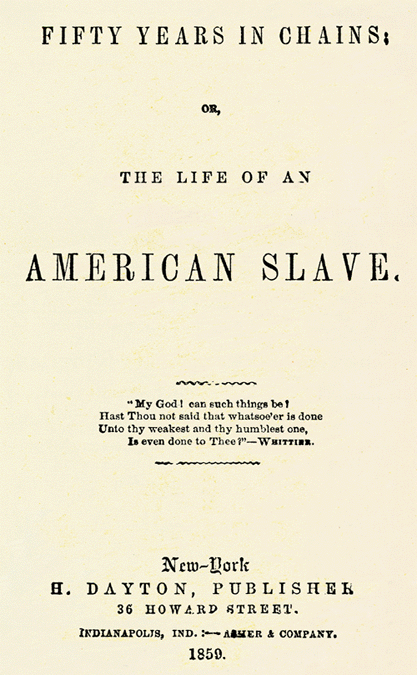
SOURCE: Ball, Charles.  Fifty Years in Chains; or, The Life of an American Slave. New York: H. Dayton, 1859. (Read the full account here).

When I had been here about a week, my master came into the field one day, and, in passing near me, stopped and told me, that I had now fallen into good hands, as it was his practice not to whip his people much. That he, in truth, never whipped them, nor suffered his overseer to whip them, except in flagrant cases. That he had discovered a mode of punishment much more mild, and, at the same time, much more effectual, than flogging; and that he governed his negroes exclusively under this mode of discipline. He then told me, that when I came home in the evening, I must come to the house; and that he would then make me acquainted with the principles upon which he chastised his slaves.

Cover of Charles Ball's account of slavery in AmericaGoing to the house in the evening, according to orders, my master showed me a pump, set in a well in which the water rose within ten feet of the surface of the ground. The spout of this pump, was elevated at least thirteen feet above the earth, and when the water was to be drawn from it, the person who worked the handle ascended by a ladder to the proper station. The water in this well, although so near the surface, was very cold; and the pump discharged it in a large stream. One of the women employed in the house, had committed some offence for which she was to be punished; and the opportunity was embraced of exhibiting to me, the effect of this novel mode of torture upon the human frame. The woman was stripped quite naked, and tied to a post that stood just under the stream of water, as it fell from the spout of the pump. A lad was then ordered to ascend the ladder, and pump water upon the head and shoulders of the victim; who had not been under the waterfall more than a minute, before she began to cry and scream in a most lamentable manner. In a short time, she exerted her strength, in the most convulsive throes, in trying to escape from the post; but as the cords were strong, this was impossible. After another minute or a little more, her cries became weaker, and soon afterwards her head fell forward upon her breast; and then the boy was ordered to cease pumping the water. The woman was removed in a state of insensibility; but recovered her faculties in about an hour. The next morning she complained of lightness of head; but was able to go to work.

This punishment of the pump, as it is called, was never inflicted on me; and I am only able to describe it, as it has been described to me, by those who have endured it. When the water first strikes the head and arm, it is not at all painful; but in a very short time, it produces the sensation that is felt when heavy blows are inflicted with large rods, of the size of a man’s finger. This perception becomes more and more painful, until the skull bone and shoulder blades appear to be broken in pieces. Finally, all the faculties become oppressed; breathing becomes more and more difficult; until the eye-sight becomes dim, and animation ceases. This punishment is in fact a temporary murder; as all the pains are endured, that can be felt by a person who is deprived of life by being beaten with bludgeons;–but after the punishment of the pump, the sufferer is restored to existence by being laid in a bed, and covered with warm clothes. A giddiness of the head, and oppression of the breast, follows this operation, for a day or two, and sometimes longer. The object of calling me to be a witness of this new mode of torture, doubtlessly, was was to intimidate me from running away; but like medicines administered by empirics, the spectacle had precisely the opposite effect, from that which it was expected to produce.

After my arrival on this estate, my intention had been to defer my elopement until the next year, before I had seen the torture inflicted on this unfortunate woman; but from that moment my resolution was unalterably fixed, to escape as quickly as possible. Such was my desperation of feeling, at this time, that I deliberated seriously upon the project of endeavouring to make my way southward, for the purpose of joining the Indians in Florida. Fortune reserved a more agreeable fate for me.

***

[UPDATE: See more on waterboarding in history at: http://balkin.blogspot.com/2007/11/waterboarding-through-ages.html]

Posted in Human Rights, Torture | 1 Comment »

Waterboarding in History (Part I): Brazil’s Dictators–A lesson dedicated to Schumer and Feinstein

Posted by stoptorture on 4th November 2007

BRAZIL: NEVER AGAIN[1]

Brasil: Nunca Mais is a study of state repression during the Brazilian military dictatorship from 1964-1985. Undertaken clandestinely by a team of lawyers, clergymen, and others, the study is based entirely on the Brazilian government’s own records of interrogations, disappearances, and other operations taken on in the name of national security. The documents were photocopied secretly until the archives of the Supreme Military Tribunal were reproduced. To date, the identity of many of the project’s participants is unknown. The book was first published in 1985, the final year of the Brazilian dictatorship. It is an abridged version of the complete work, which is over 5,000 pages long.

The Brazilian dictatorship opened Pandora’s Box on officially-sanctioned torture in 1964. Torture remains widespread and systematic in Brazil to this day.[2]

*****

Preface by Cardinal Arns, Archbishop of São Paulo (May 3, 1985)

4. What has most impressed me throughout the years of my vigilance against torture is, however, the following: how the very torturers degrade themselves.

Chapter 2: The methods and instruments of torture

So states article 5 of the Universal Declaration of Human Rights signed by Brazil: No one shall be subjected to torture or to cruel, inhuman or degrading treatment or punishment.

In twenty years of Military Government, this principle was ignored by Brazilian authorities. Our study revealed nearly one hundred different torture techniques–using physical aggression and psychological pressure–and with the most varied of instruments applied on Brazilian political prisoners. Court documents reveal in rich detail this criminal activity done under the auspices of the State. The depositions, here partially transcribed, demonstrate the principal methods and instruments of torture adopted by the repression in Brazil.

The parrot’s perch

“… The parrot’s perch consists of an iron bar that is introduced between the bound wrists and the bends of the knees; that ‘arrangment’ is placed between two tables and the body of the tortured remains hanging 20 or 30 centimeters above the floor. This method is almost never used in isolation; its usual ‘complements’ are electroshocks, the wooden bat or club, and the drowning [waterboarding]…”[3] (emphasis added).

The drowning [waterboarding] (emphasis added)

“…The drowning is one of the ‘complements’ of the parrot’s perch. A small rubber tube is introduced into the mouth of the tortured and water then follows…”[4]

“…, and had introduced into his nostrils, into his mouth, a hose of running water, which he was forced to breathe in each time he received a charge of electric shocks;…”[5]

“drowning by means of a wet towel in the mouth: when one has almost stopped breathing, one receives a jet of water in the nostrils;…”[6]

Chapter 3: The torture of children, women, and pregnant women


[1] Brasil: Nunca Mais [Brazil: Never Again]. 34th Ed., Petropolis: Editora Vozes, 2005. (Originally published by the Archdiocese of São Paulo in 1985. [Translation by Stop Torture.]

[2] See U.N. Economic and Social Council, Commission on Human Rights, 57th sess., agenda item 11(a), Report of the Special Rapporteur, Sir Nigel Rodley, Submitted Pursuant to Commission on Human Rights Resolution 2000/43, Addendum: Visit to Brazil, U.N. Doc. E/CN.4/2001/Add.2 (2001).

[3] Augusto César Salles Galvão, student, 21 years old, Belo Horizonte; handwritten letter, 1970: BNM no. 150, V. 2, p. 448-450.

[4] Supra note 2.

[5] José Milton Ferreira de Almeida, engineer, 31 years old, Rio de Janeiro; identification and interrogation deposition, 1976: BNM no. 43, V. 2, p. 421-430.

[6] Leonardo Valentini, steelworker, 22 years old, Rio de Janeiro; identification and interrogation deposition, 1973: BNM 75, V. 5o, p. 1277.

Posted in Human Rights, Torture | Comments Off on Waterboarding in History (Part I): Brazil’s Dictators–A lesson dedicated to Schumer and Feinstein

Senators Schumer and Feinstein Sell Out on Torture

Posted by stoptorture on 2nd November 2007

Senators Schumer (NY) and Feinstein (CA) have decided to sell out to torture and back Mukasey for attorney general, the AP has reported. This ensures Mukasey has the votes to pass the Senate Judiciary Committee and go to the full Senate floor, where he is widely expected to be confirmed.

One wonders what benefits the Democrats ever gain from standing by their party. Schumer and Feinstein deserve to be boycotted at the next elections. That might teach them what “voting with your conscience” means.

Of course, a lone senator could still pull through and serve as the national conscience. Leahy could hold the nomination in committee indefinitely, for example. Or a senator could put a “hold” on Mukasey’s nomination. For instance, Durbin has a hold on the nomination of Steven Bradbury, author of the new torture memos. Senate majority leader Harry Reid could also refuse to schedule Mukasey’s vote. Perhaps, a senator could even filibuster.

There are ways for a single senator with a shocked conscience to stop this train, but we do not have much hope in that. As a nation, we have sold out to torture yet again. When will we ever stop?

Let us realize the arc of the moral universe is long, but it bends toward justice.” – Martin Luther King Jr.

Posted in Human Rights, International Law, Torture, U.S. Law | Comments Off on Senators Schumer and Feinstein Sell Out on Torture